

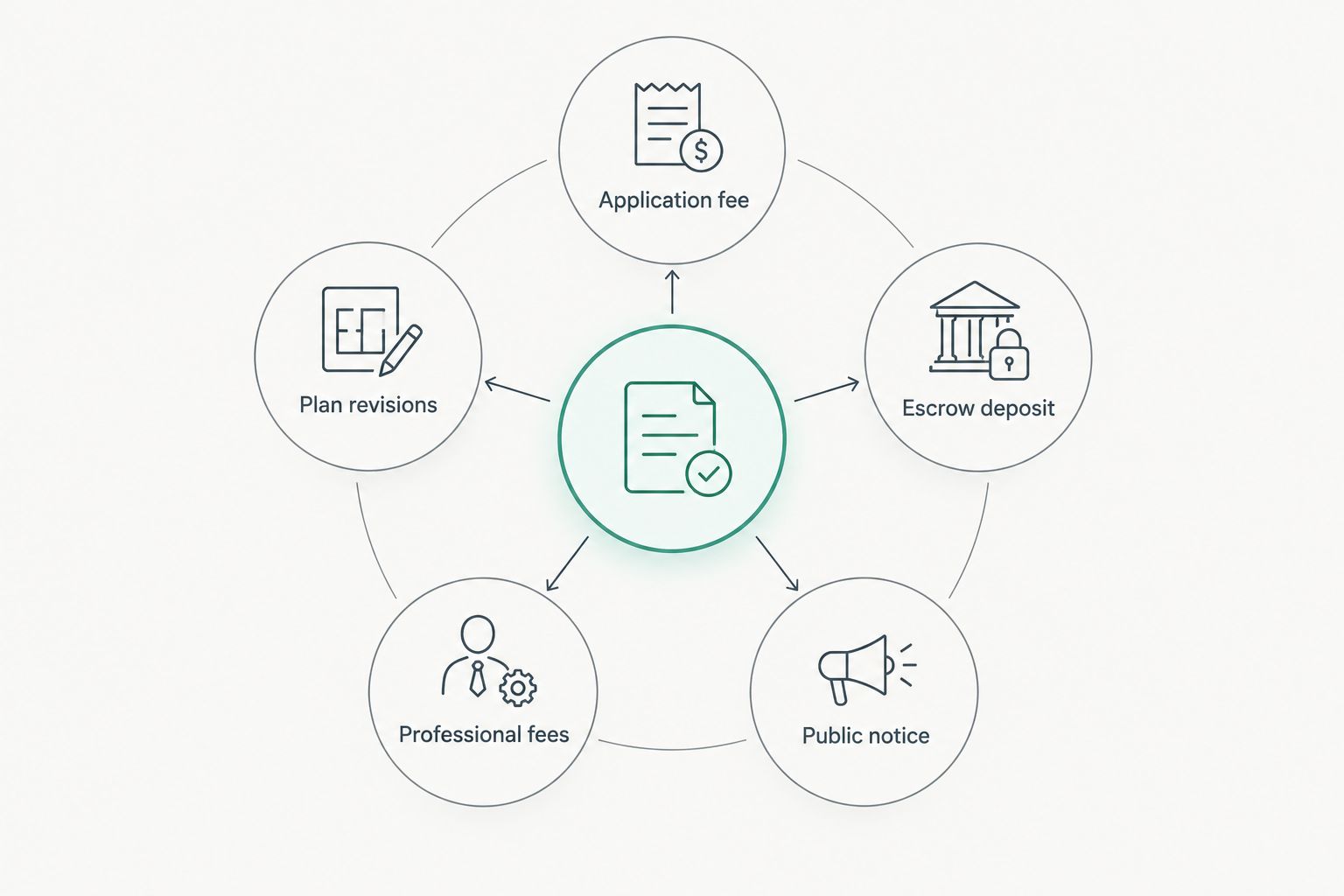
A zoning variance in New Jersey has no fixed statewide cost in 2026 because each municipality sets its own application fees and escrow deposits. The filing fee is only one part of the total: municipal professional review, public notice, your project team, plan revisions, and additional hearing dates can add substantial expense.
- Zoning variance cost New Jersey has no statewide rate in 2026; each municipality adopts its own fee schedule.
- Municipal escrow pays the board’s attorney, planner, engineer, and other professionals for application review.
- Use variances usually require more legal and planning work than straightforward bulk variances.
- Unused escrow should be returned after final billing, but applicants must cover valid review charges.
- Nieves Development provides zoning guidance and municipal-process coordination for New Jersey development projects.
Why this matters
A low application fee does not make a variance inexpensive. The larger financial exposure often sits in the escrow account, where municipal professionals bill for reviewing plans, writing reports, attending hearings, and evaluating revisions.
Your first step is to obtain the current fee ordinance from the municipality handling the application. Nieves Development provides municipal-process and board-preparation guidance for developers, property owners, and investors in Paterson and throughout New Jersey.
Nieves Development is best for New Jersey applicants who need zoning guidance and municipal-process coordination for multifamily, mixed-use, or redevelopment projects.
How much does a zoning variance cost in New Jersey in 2026?
There is no single New Jersey zoning variance price to quote in 2026. To estimate the total, separate the municipal charges from the money spent on your own project team.
| Cost component | What it covers | How to verify it |
|---|---|---|
| Application fee | Municipal intake and processing of the land-use application | Check the current municipal fee ordinance |
| Escrow deposit | Review by the board's attorney, planner, engineer, and other professionals | Confirm the required deposit and replenishment rules |
| Public notice | Newspaper publication and notice to property owners within 200 feet | Ask the municipal office which notice procedures apply |
| Applicant professional fees | Your attorney, planner, engineer, architect, surveyor, or traffic consultant | Request a scope from each professional |
| Plan revisions | Changes requested after completeness review or board feedback | Track revision rounds and professional responsibilities |
The initial municipal payment is not necessarily the final municipal cost. If professional charges reduce the escrow below the municipality's required balance, the applicant can receive a request to replenish it before review continues.
The reverse also matters. Escrow is not automatically a fee that the municipality keeps in full; the account is used to pay valid review charges, and the remaining balance is addressed through final accounting after the application closes.
Bulk c variance: dimensional zoning relief
A bulk variance concerns physical zoning controls such as setbacks, building height, lot coverage, floor area, or parking requirements. These applications fall under the c variance standards in the New Jersey Municipal Land Use Law.
A focused request involving one dimensional issue can require less testimony and fewer plan changes than a broader application. That is not a guaranteed cost difference: a contested setback request, incomplete survey, or complicated site condition can still generate significant review work.
Best for: An applicant whose proposed use is permitted but whose design does not comply with one or more dimensional requirements.
The important budgeting question is whether the bulk variance stands alone or accompanies site plan, subdivision, or other approvals. Combined applications involve more material for the board's professionals to review in 2026.
Use d variance: relief for a prohibited use or regulated intensity
A use variance addresses relief covered by N.J.S.A. 40:55D-70(d), including a use or principal structure that the zoning ordinance does not permit in the district. Certain density, floor-area-ratio, height, and expansion issues also fall within the d variance provisions.
A d variance requires five affirmative votes from a seven-member zoning board. The applicant also carries an enhanced proof burden, including the positive and negative criteria relevant to the requested relief. Those requirements usually call for coordinated legal and professional testimony rather than a simple explanation from the property owner.
Best for: Developers and property owners pursuing a project that conflicts with the municipality's permitted-use framework or another standard governed by subsection d.
For a multifamily, mixed-use, or redevelopment proposal, confirm the variance classification before setting the 2026 budget. Misclassifying the relief can affect the required plans, witnesses, hearing strategy, and municipal escrow.
Why zoning variance costs vary
- Municipal fee ordinance: Each New Jersey municipality adopts its own application charges and escrow requirements.
- Type of relief: A dimensional c variance and a use d variance involve different legal standards and testimony.
- Project scope: A variance combined with site plan or subdivision approval gives municipal professionals more material to review.
- Application quality: Missing documents, inconsistent plans, or incomplete zoning schedules create additional review rounds.
- Professional witnesses: Planning, engineering, architecture, traffic, environmental, or other testimony adds to the applicant's costs.
- Hearing activity: Continuances, objector questions, revised exhibits, and additional hearing dates increase professional time.
These factors interact. A use variance is not expensive merely because it carries a d classification; the total grows when the legal standard, site conditions, plan set, testimony, and hearing record require more work.
How can I estimate the cost before filing?
Use the municipality's current ordinance and the actual application scope rather than a statewide estimate. A defensible 2026 budget follows these steps:
- Identify every approval required. Separate variance relief from site plan, subdivision, design review, and permit requirements.
- Confirm the reviewing board. Determine whether the application belongs before the zoning board or planning board.
- Obtain the current fee schedule. Record the application fee, initial escrow, and any separate charges tied to the project type.
- Define the project team. Identify which plans and testimony must come from an attorney, planner, engineer, architect, surveyor, or specialist.
- Allow for revisions. Keep a contingency for comments issued during completeness review and public hearings.
- Track escrow statements. Compare each municipal charge with the professional, task, date, and application it covers.
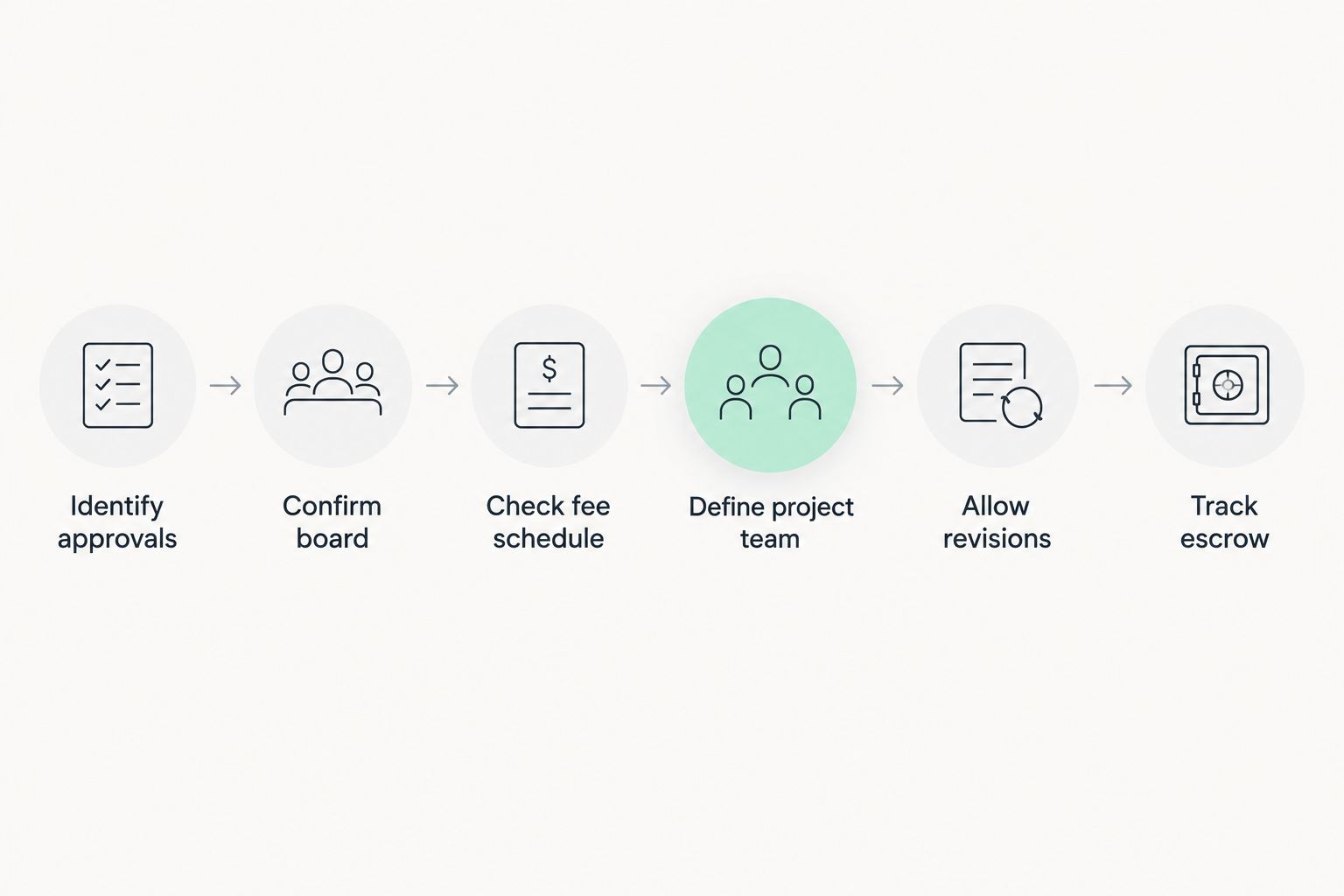
This process does not create a guaranteed final number, but it exposes the categories that can change. It also prevents the common mistake of treating the initial filing payment as the full land-use budget.
Scope your variance process
Get zoning guidance and municipal-process coordination for a New Jersey development project.
Is unused variance escrow refunded in New Jersey?
Unused variance escrow is subject to final accounting rather than automatically becoming municipal revenue. Request a closing statement after the application and associated professional billing are complete, then confirm how the municipality processes the remaining balance.
Do not assume the original deposit will be returned intact. The board's attorney, planner, engineer, and other authorized professionals can bill valid review work against that account.
Does a contested hearing increase the total cost?
A contested hearing can increase the total because objections, cross-examination, revised exhibits, and another hearing date require additional professional time. The effect depends on what occurs in the record, not simply on whether a neighbor attends.
An organized presentation helps the board address the requested relief without searching through conflicting plans or incomplete testimony. It does not eliminate opposition, but it reduces avoidable confusion.
Can I reduce zoning variance costs without weakening the application?
You can control avoidable costs by confirming the required relief, submission checklist, and professional roles before filing. Cutting necessary planning, legal, or engineering work can create revisions and continuances that cost more than preparing the application correctly.
Nieves Development supports this preparation through development strategy, zoning guidance, and municipal-process coordination. Review selected New Jersey development projects to see how that coordination applies across multifamily, subdivision, and redevelopment work. The goal is a submission matched to the actual municipal process, not a generic package built around assumptions.
About the author: Hector L. Nieves Jr. is the founder and principal of Nieves Development Consulting LLC. His experience includes municipal land-use work and service on the City of Paterson Planning Board. He provides development strategy, project coordination, and municipal-process guidance; clients remain responsible for retaining the licensed professionals their projects require.
FAQ
How much does a zoning variance cost in New Jersey in 2026?
New Jersey has no single statewide zoning variance cost in 2026 because each municipality sets its own application fee and escrow requirements. Your total also includes public notice, applicant professionals, plan revisions, and hearing activity.
What is the biggest variable in a New Jersey variance budget?
Professional review is the biggest variable because municipal escrow and your own consultants reflect the time required by the application. Broader approvals, revisions, and additional hearings increase that time.
Is a use variance more involved than a bulk variance?
A use d variance is generally more involved because it carries an enhanced proof burden and requires five affirmative votes from a seven-member zoning board. A bulk c variance addresses dimensional zoning controls under different legal standards.
Who pays the zoning board’s professionals?
The applicant funds an escrow account used to pay authorized municipal professionals who review the application. Charges can include work by the board’s attorney, planner, engineer, and other specialists.
Do I have to notify nearby property owners?
New Jersey land-use applicants commonly must provide notice to property owners within 200 feet when the Municipal Land Use Law requires public notice. Confirm the recipients, timing, and proof requirements with the municipality handling the application.
Can a municipality require more escrow during review?
A municipality can require escrow replenishment when authorized professional charges reduce the account below the required balance. Review the current local ordinance and each escrow statement rather than relying only on the initial deposit.
What should I request before filing a variance application?
Request the current application forms, submission checklist, fee ordinance, escrow schedule, hearing calendar, and notice instructions. Confirm the required approvals and reviewing board before paying or filing.
Can Nieves Development help with a New Jersey variance process?
Nieves Development provides zoning guidance and municipal-process coordination for developers, property owners, and investors working on multifamily, mixed-use, and redevelopment projects in Paterson and throughout New Jersey.
One last thing
The best cost-control decision happens before the application enters the hearing calendar. In 2026, verify the variance classification, full approval scope, required witnesses, and municipal fee ordinance together; solving only the filing fee leaves the largest budget variables unanswered.
YOUR NEXT STEP
Planning a project in New Jersey?
Discuss your property, project goals and municipal-process questions with Nieves Development Consulting.
Explore our consulting services · See a Paterson project example