

There is no single New Jersey timeline for closing a PILOT tax abatement deal in 2026; the schedule depends on municipal review, approval of the financial agreement, document execution, and any conditions tied to your financing or redevelopment closing. A municipal approval date is not necessarily the date you can close. Build your schedule around verified milestones rather than an assumed number of months.
- How long does it take to close a PILOT tax abatement deal? New Jersey timing depends on municipal and transaction milestones.
- Municipal approval, financial agreement execution, and lender readiness are separate milestones; confirm which one your closing requires.
- Nievesdevelopment provides development consulting and municipal-process coordination, not licensed legal or tax advice.
How long does it take to close a PILOT tax abatement deal?
A defensible closing date comes from the project's remaining requirements, not a statewide average. For a New Jersey payment in lieu of taxes, or PILOT, identify the applicable tax-exemption framework, the municipal approval procedure, and the documents your transaction requires before setting a date.
Your PILOT tax abatement and redevelopment closing roadmap should distinguish municipal action from transaction readiness. Those workstreams connect, but they do not end at the same milestone.
Use this milestone table to establish what remains open:
| Milestone | Evidence to request | Scheduling significance |
|---|---|---|
| Application readiness | Required submission materials and identified applicant | Establishes whether municipal review can proceed |
| Municipal review | Current comments, unresolved terms, and responsible reviewers | Identifies substantive work before approval |
| Governing-body action | Applicable approval documents and procedural requirements | Establishes the municipal authorization milestone |
| Agreement execution | Final financial agreement and required signatures | Distinguishes authorization from an executed agreement |
| Transaction readiness | Counsel's and lender's applicable closing conditions | Establishes whether the financing or acquisition can close |
Treat an unknown status as an unresolved dependency. Do not turn it into an assumed completion date.
Why this matters
A PILOT schedule affects more than the tax assumptions in your development model. If your acquisition or financing depends on an approved and executed financial agreement, an unresolved municipal requirement becomes a transaction dependency.
For a 2026 project, ask the team to distinguish a target date from a confirmed procedural milestone. A target expresses intent; a confirmed milestone has an identified requirement, responsible party, and supporting document.
That distinction matters for first-time property owners and experienced developers alike. A favorable discussion with municipal representatives does not establish that the required governing-body action, agreement execution, or lender review is complete.
Build the timeline from these milestones
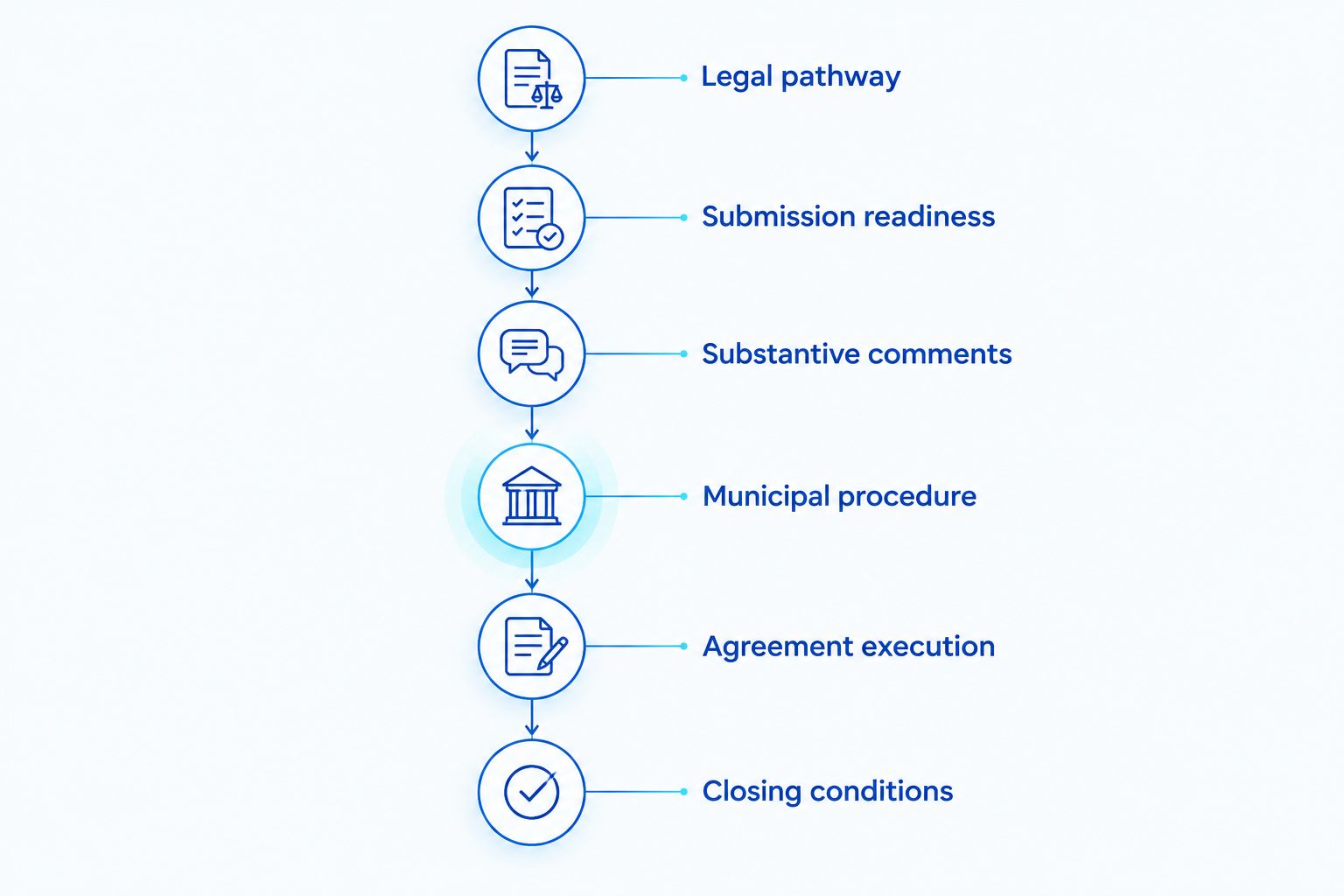
Confirm the legal pathway
Have New Jersey counsel identify the applicable statutory framework and required municipal actions. Long-term tax exemptions under New Jersey's Long Term Tax Exemption Law involve a financial agreement and municipal authorization; other exemption or abatement programs follow different requirements.
Do not assume that redevelopment designation, a redevelopment agreement, and a PILOT financial agreement are interchangeable. They address different matters, even when they concern the same property.
Readiness test: Your team can identify the applicable framework, required applicant entity, approving body, and approval documents.
Establish submission readiness
Request the municipality's current application requirements and confirm who receives the submission. Assemble a consistent project description, ownership information, proposed development program, and financial materials required for that application.
Keep the project description consistent across municipal submissions and financing materials. If the proposed use, development scope, or ownership structure changes, identify which documents need revision before advancing the next milestone.
Readiness test: Each required submission item has an owner, a current version, and a confirmed delivery status.
Resolve substantive comments
Separate open business terms from missing documents and legal drafting issues. A discussion about the financial agreement's terms needs a different response from a request for an organizational document.
Maintain a comment log that states the issue, responsible party, required response, and dependency. Ask whether a response closes the issue or simply advances it to another reviewer.
Readiness test: The team can identify every unresolved issue that prevents municipal action or final agreement preparation.
Confirm the municipal procedure
Ask municipal counsel or the designated municipal contact to confirm the required governing-body procedure. Where ordinance adoption is required, account for the applicable introduction, notice, hearing, adoption, and effectiveness requirements.
An agenda opportunity is not an approval commitment. Confirm submission cutoffs and procedural requirements before treating a meeting date as part of the closing schedule.
Readiness test: Counsel has identified the required actions and distinguished tentative dates from scheduled proceedings.
Complete agreement execution
Confirm that the final financial agreement matches the authorized terms and identifies the correct parties. Resolve required signatures, supporting documents, and any applicable conditions before treating execution as complete.
Use a controlled final version. Circulating different drafts among the municipality, developer, and lender creates uncertainty about which terms each party has reviewed.
Readiness test: Counsel confirms the execution status and identifies any remaining effectiveness or delivery requirements.
Satisfy closing conditions
Compare the executed agreement and municipal approval documents against the actual acquisition or financing checklist. A lender's required evidence is a separate question from whether the municipality has approved the agreement.
Assign a party to confirm each condition. Where a document remains outstanding, record whether it prevents closing or is subject to a separately agreed delivery arrangement.
Readiness test: Transaction counsel and the lender identify the remaining conditions instead of relying on a general statement that the PILOT is approved.
Why PILOT closing timelines vary
For a 2026 schedule, track the factors that change the remaining work rather than assigning every project the same duration:
- Applicable legal framework: The governing statute and municipal procedure determine which actions and documents are required.
- Submission readiness: Missing or inconsistent materials leave application work unresolved.
- Unsettled agreement terms: Open financial or legal terms must reach the required level of agreement before final documents can advance.
- Municipal procedure: Applicable notice requirements, hearings, agenda cutoffs, and governing-body action shape the approval sequence.
- Related project approvals: Land-use approvals or redevelopment obligations affect the closing schedule when the transaction makes them conditions.
- Financing requirements: Lender review and required closing evidence remain separate from the municipality's approval process.
The practical response is a dependency schedule. Show which tasks can proceed together and which require another milestone to finish first.
Do not describe every open task as equally urgent. Distinguish an item that prevents the next municipal action from an item needed only before financing closes.
What does “closed” mean for your project?
Define the endpoint before asking for a duration. “The municipality approved the PILOT” and “the construction loan closed” describe different events.
Your project team should specify whether the requested date means municipal authorization, execution of the financial agreement, satisfaction of its applicable conditions, acquisition closing, or financing closing. Put that definition at the top of the schedule.
For example, if the lender requires an executed financial agreement, a scheduled municipal vote does not satisfy that requirement. If an acquisition contract contains its own approval condition, counsel must evaluate that contract's wording rather than substitute a general understanding of PILOT readiness.
Use the transaction's required endpoint as the scheduling target. Otherwise, different team members can report progress accurately while referring to different finish lines.
Connect municipal terms to lender underwriting
A PILOT financial agreement and a lender's underwriting model serve different purposes. The agreement establishes applicable obligations; underwriting evaluates the financing against the lender's requirements and assumptions.
A commercial property appraisal addresses property valuation, while municipal approval establishes the authorized agreement; neither substitutes for the lender's review of the transaction documents. Keep valuation assumptions, payment obligations, and closing requirements aligned without treating them as the same deliverable.
For your 2026 closing file, ask counsel and the lender to identify the tax-treatment assumptions used in underwriting and the documents needed to support them. If negotiated terms change, flag the change for the professionals responsible for the model and closing review.
The feasibility-to-lender-underwriting workflow addresses this broader coordination issue: project assumptions need to remain consistent as the transaction advances.
The benefit of parallel coordination is earlier visibility into unresolved requirements. The limitation is equally important: parallel work does not remove a required municipal action or a lender condition.
Can you close before the PILOT agreement is signed?
An unsigned PILOT agreement is not an executed financial agreement. Whether your acquisition or financing can close at that stage depends on the transaction documents, lender requirements, and counsel's review.
Do not treat a favorable municipal discussion or scheduled vote as a substitute for required execution. Ask transaction counsel to identify exactly which documents must exist at closing and which obligations remain afterward.
Does site-plan approval mean the PILOT is approved?
Site-plan approval does not itself establish PILOT approval. Site-plan review addresses land-development requirements; a PILOT requires the applicable tax-exemption and financial-agreement process.
Track the workstreams separately, then identify their connections. Your closing documents or municipal agreements determine whether a particular land-use milestone must precede another transaction step.
Can coordination shorten the process?
Coordination reduces avoidable uncertainty by assigning document ownership, recording open issues, and identifying dependencies. It does not guarantee a shorter municipal process or a favorable decision.
Nievesdevelopment is best for developers, property owners, and investors seeking development consulting and municipal-process coordination for New Jersey projects. Its stated services address strategy, zoning guidance, and coordination for multifamily, mixed-use, and redevelopment work in Paterson and throughout the state.
Nievesdevelopment's development consulting role is distinct from licensed legal, engineering, architectural, planning, and surveying services. Use the appropriate professionals for legal interpretation, financial-agreement drafting, technical submissions, and other work within their licensed scope.
Set a closing target your team can use
Before committing to a 2026 date, hold a milestone review with the parties responsible for municipal coordination, legal documents, and financing. The objective is a shared list of unresolved requirements, not a general expression of confidence.
Record these items in the closing roadmap:
- Required endpoint: State exactly what must be complete for the relevant closing.
- Outstanding action: Describe the document, decision, or submission still needed.
- Responsible party: Name who must produce it and who must accept it.
- Dependency: Identify what must happen before that action can finish.
- Date status: Distinguish an internal target from a confirmed meeting or contractual deadline.
- Change trigger: Identify which project or agreement changes require another review.
Nievesdevelopment provides development consulting and municipal-process coordination within that roadmap. Municipal decisions, licensed professional judgments, and lender acceptance remain with the responsible parties.
Disclaimer: This article provides general process information, not legal, tax, appraisal, engineering, architectural, planning, or surveying advice. Confirm project-specific requirements with New Jersey counsel, the municipality, the lender, and appropriately licensed professionals. No municipal approval or closing outcome is guaranteed.
FAQ
How long does it take to close a PILOT tax abatement deal in New Jersey?
There is no single New Jersey closing timeline. Establish the remaining municipal actions, financial-agreement requirements, and financing conditions before assigning a project-specific date.
When should I start tracking the PILOT closing schedule?
Start tracking the schedule when you identify the applicable legal pathway and transaction endpoint. Record application requirements, municipal actions, execution requirements, and lender conditions as separate milestones.
Is municipal PILOT approval the same as financial closing?
Municipal PILOT approval is not the same as financial closing. Your lender and transaction documents determine what additional execution, delivery, and closing conditions apply.
Can a redevelopment agreement replace a PILOT financial agreement?
A redevelopment agreement and a PILOT financial agreement serve different purposes and are not interchangeable. Have counsel identify the documents and approvals required for your project.
Can I negotiate financing while the municipality reviews the PILOT?
Financing discussions can proceed alongside municipal review, but that does not establish permission to close. Confirm which final municipal documents the lender requires and keep underwriting assumptions consistent with negotiated terms.
Does hiring a consultant guarantee PILOT approval?
Hiring a consultant does not guarantee PILOT approval. Development consulting supports strategy and process coordination; the municipality retains its decision-making authority, and licensed professionals remain responsible for their respective work.
One last thing
Ask each party what document proves that its milestone is complete. That question exposes the difference between a discussion, an authorization, an executed agreement, and a satisfied closing condition.
A closing roadmap becomes actionable when every claimed completion has evidence. Until then, a date remains a target.
Related guides
- How long does redevelopment agreement negotiation take?
- How long does site-plan approval take in New Jersey?
- How much can a PILOT tax abatement save a developer?
YOUR NEXT STEP
Planning a project in New Jersey?
Discuss your property, project goals and municipal-process questions with Nieves Development Consulting.
Explore our consulting services · See a Paterson project example