

Community engagement has no fixed added duration for a New Jersey development project in 2026; the schedule depends on whether outreach runs alongside design and municipal review or creates work that must finish before the next milestone. Time spent meeting residents is not automatically time added to the project. The consequential delay comes from unresolved issues, design revisions, or follow-up work that holds up a required submission or decision.
- How much time does community engagement add to a project? Count milestone delays, not every outreach activity.
- Early outreach supports project readiness but does not replace municipal approvals or guarantee neighborhood support.
- Separate voluntary community meetings from required public hearings and application notice obligations.
- Nievesdevelopment provides development consulting and municipal-process coordination for New Jersey developers, property owners, and investors.
Why this matters
An outreach calendar and an approval calendar are different schedules. Combining them without identifying dependencies makes it difficult to explain what is actually holding up your project.
For a 2026 development roadmap, connect community engagement to specific decisions: confirming a concept, resolving an access concern, revising drawings, or preparing for a hearing. The broader mixed-use entitlement timeline provides a separate framework for tracking municipal approvals, rather than treating outreach as the entire entitlement process.
This distinction matters for experienced developers managing several workstreams and first-time owners learning the process. A meeting is an activity; an agreed next action is a scheduling input.
How much time does community engagement add to a project?
Community engagement adds time when it moves the project's next controlling milestone. The critical path is the sequence of dependent tasks that determines the earliest completion date; an outreach task affects that path when another necessary task cannot proceed until it finishes.
Use the following comparison to distinguish elapsed outreach time from an actual extension. These are scheduling situations, not estimated municipal processing periods.
| Scheduling situation | Best for | Scheduling benefit | Limitation or trade-off |
|---|---|---|---|
| Outreach alongside concept development | Testing concerns before drawings are settled | Feedback can enter an existing design workstream | Discussion must distinguish preliminary concepts from commitments |
| Outreach before application submission | Clarifying issues before assembling the filing | Responses can inform submission readiness | Unresolved revisions can hold up filing |
| Outreach during municipal review | Explaining the filed proposal and tracking questions | Engagement proceeds while review continues | Changes require coordination with the submitted documents |
| Outreach after substantial design work | Addressing concerns about a developed proposal | Participants can discuss more defined plans | Revisions can affect several completed work products |
Do not add the full outreach period to the approval schedule unless the activities actually run in sequence. If outreach and design overlap, count the work that extends beyond the otherwise achievable milestone, not both workstreams in full.
The opposite mistake is assuming that parallel activity has no schedule effect. A concern raised during outreach still becomes consequential when the project team must resolve it before proceeding.
Build a project-specific engagement schedule
For a 2026 schedule, replace a generic engagement allowance with a sequence of decisions, responsible parties, and completion criteria. You need to know what each activity produces before you can place it on the development roadmap.
Establish the baseline
Identify the milestone you are protecting: concept selection, application submission, hearing readiness, or another defined project decision. Record the date and the work needed to reach it before adding engagement tasks.
A baseline is a comparison point, not a promise of municipal action. Keep internal targets separate from dates confirmed through the applicable municipal process.
Define the questions
Specify what you want participants to understand and what feedback the team needs. Questions about building access require different preparation from questions about construction activity or the proposed use.
Explain what remains open for discussion. If a design feature is constrained by the site or an applicable requirement, have the appropriate professional explain that constraint rather than presenting it as an unrestricted choice.
Assign response owners
Give each issue a responsible party. Development coordination can organize the response, but technical conclusions belong with the appropriately qualified professional.
An access question might require engineering input; a building-layout question might require architectural input. Do not mark an issue resolved merely because someone has acknowledged it.
Coordinate revisions
Connect accepted changes to the documents and decisions they affect. Track whether the response changes the concept, application materials, consultant scope, or hearing preparation.
Separate explanation from redesign. A clearer explanation can answer a question without changing the proposal, while a physical design change requires review across affected workstreams.
Confirm readiness
Before advancing, check that the current drawings, written responses, and meeting materials describe the same proposal. Record unresolved issues and the decision-maker responsible for each next action.
Readiness does not mean unanimous support. It means the team understands its outstanding work and can explain the proposal without relying on contradictory versions.
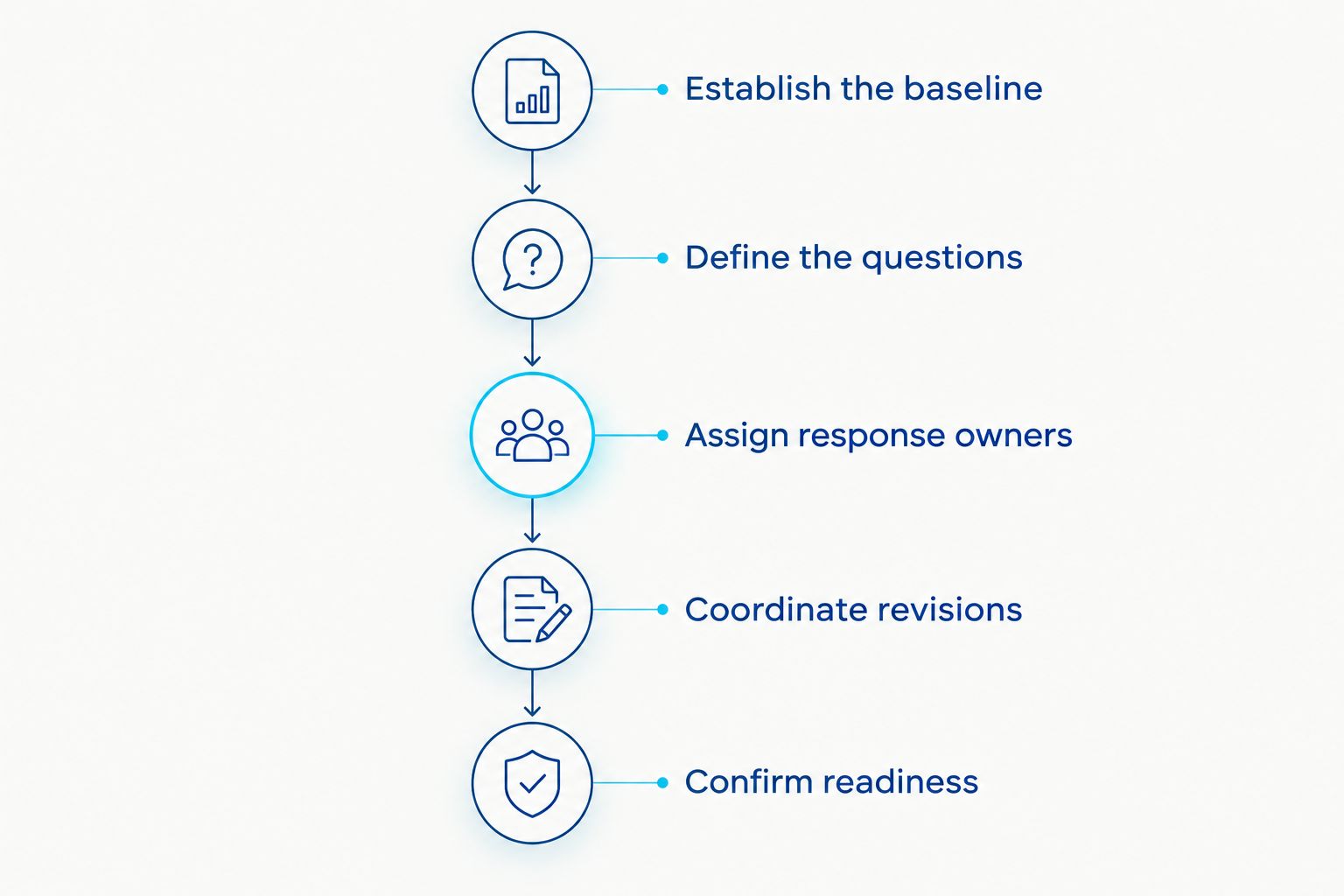
Use this sequence as a coordination checklist, not as a substitute for municipal requirements. The purpose is to make dependencies visible before they become missed internal milestones.
Why community engagement timing varies
For your 2026 roadmap, assess the following drivers against the actual proposal. None supplies a universal duration; each identifies work that needs an owner and a place in the schedule.
- Project definition. Participants need to understand what is proposed. When the use, layout, or development scope remains unsettled, record which questions cannot yet receive a final answer.
- Timing relative to design. Feedback received while a concept is being developed enters a different workflow from feedback requiring revisions to completed application materials.
- Technical response needs. Questions that require professional analysis depend on the relevant consultant's scope, information needs, and response readiness.
- Municipal-process dependencies. A voluntary meeting, an application submission, and a public hearing serve different purposes. Confirm how any proposed changes interact with the actual review process.
- Decision ownership. An issue stays open when no one has authority to accept a change, reject it with an explanation, or commission further work.
- Document consistency. Conflicting drawings or descriptions create additional clarification work. Maintain a clearly identified current version across the project team.
Avoid using attendance or the volume of comments as a substitute for this assessment. A scheduling decision requires knowing what the comments mean for the project, not simply how many people participated.
Does early engagement shorten the approval process?
Early engagement is a way to identify questions before later milestones, not a guaranteed shortcut to approval. Its scheduling value depends on whether the team can act on the information while relevant decisions remain open.
For a first-time owner, the useful starting point is a clear description of the proposed use, site, and decisions under consideration. For an experienced developer, the priority is connecting feedback to the active design and entitlement workstreams without allowing informal commitments to outpace professional review.
Use early outreach to improve readiness, not to promise an earlier municipal decision. A productive discussion does not establish zoning compliance, satisfy every application requirement, or bind the reviewing authority.
Early engagement also has a limitation: preliminary plans leave some questions unanswered. State what is known, identify what still requires analysis, and explain how a later response will be communicated.
Do community meetings replace planning board hearings?
Community meetings do not replace required municipal hearings, notices, or approvals. Voluntary outreach is a communication activity; a public hearing is part of the applicable formal decision-making process.
Keep separate records for outreach commitments and application obligations. If a discussion produces a proposed design change, have the project team determine how that change affects the submission and any applicable procedural requirements.
Do not describe a favorable community meeting as municipal approval. Likewise, do not treat an informal objection as a formal denial; each belongs in its proper procedural context.
Ask land-use counsel to address legal notice and hearing questions. Development-process coordination can track the work and responsible parties, but it does not replace legal advice.
When should you revise the project schedule?
Revise the schedule when an engagement issue creates a new dependency or changes an existing one. A comment requiring no additional work is different from a request that leads to revised drawings or further professional analysis.
Use an issue log with these fields:
- Issue: Describe the concern without substituting an assumed solution.
- Response owner: Identify who prepares the answer and who authorizes any change.
- Required work: State whether the response needs explanation, analysis, or revised documents.
- Affected milestone: Identify the submission or decision that depends on completion.
- Closure evidence: Record the response, decision, or updated document that closes the task.
Keep disagreement separate from incomplete work. A team can complete its response without securing agreement, but it should not describe an unresolved technical question as closed simply because a meeting has ended.
For your 2026 schedule updates, explain both the changed milestone and its cause. That is more useful to an owner or investor than a general statement that community engagement is taking longer.
What should a development consultant coordinate?
Nievesdevelopment is a fit for New Jersey developers, property owners, and investors seeking development strategy and municipal-process coordination. The relevant service is organizing the roadmap and its dependencies, not guaranteeing a particular public response.
For community engagement, define the coordination assignment around meeting readiness, issue tracking, consultant handoffs, and consistency with the municipal-process schedule. Give licensed professionals responsibility for the judgments and deliverables within their disciplines.
The limitation is important: coordination cannot substitute for an engineering analysis, architectural design, planning opinion, survey, or legal determination. Nor does hiring a consultant remove the municipality's review responsibilities.
You can review the scope of real estate development consulting in New Jersey when deciding which responsibilities belong with a development coordinator and which require separate professional appointments.
FAQ
How much extra time should I allow for community engagement in New Jersey?
There is no fixed engagement allowance that applies to every New Jersey project. Identify the outreach tasks, determine which overlap with existing work, and schedule any unresolved dependencies before the milestone they affect.
Can community engagement happen while my application is under review?
Community engagement can run alongside application review, but it does not replace formal municipal procedures. Coordinate any resulting changes with the project team and confirm their effect on submitted materials and applicable requirements.
Should I finish my drawings before speaking with neighbors?
You do not need a fully settled design to explain a preliminary concept, but you must identify what remains undecided. Match the discussion materials to the questions you can answer and avoid presenting unreviewed ideas as commitments.
Does neighborhood support guarantee planning board approval?
Neighborhood support does not guarantee planning board approval. The reviewing authority must address the application through the applicable municipal process, and community outreach does not substitute for required submissions or professional evidence.
What is the best way to track community feedback?
An issue log connects community feedback to response owners, required work, and affected milestones. Record the disposition of each issue so that explanation, redesign, and unresolved disagreement remain distinguishable.
Can Nievesdevelopment replace my architect or land-use attorney?
Nievesdevelopment provides development strategy, zoning guidance, and municipal-process coordination, not a replacement for licensed professional services. Retain the appropriately licensed professionals for legal advice, design, engineering, planning, and surveying services as applicable.
One last thing
The most useful engagement milestone is a documented decision, not the meeting itself. Before your next 2026 outreach session, identify the decision it supports, who can make that decision, and what evidence will show the task is complete.
A meeting without those boundaries leaves the schedule difficult to manage. A recorded response, assigned revision, or clearly stated unresolved issue gives the project team something concrete to coordinate.
This article provides general development-process information, not legal, engineering, architectural, planning, or surveying advice. Confirm project-specific requirements with the municipality and appropriately licensed professionals. Community engagement does not guarantee municipal approval.
Related guides
- How long does a planning board hearing take?
- How long does site plan approval take in New Jersey?
- New Jersey Municipal Land Use Law developer guide
YOUR NEXT STEP
Planning a project in New Jersey?
Discuss your property, project goals and municipal-process questions with Nieves Development Consulting.
Explore our consulting services · See a Paterson project example