
Paterson is a market to evaluate parcel by parcel in 2026, not a blanket yes for multifamily development. A project merits further commitment when documented rental demand, permitted development capacity, physical site conditions, and financing assumptions support the same plan. Municipal approvals and redevelopment status do not, by themselves, establish investment feasibility.
- Is Paterson a good market for multifamily development in 2026? Judge the parcel, approval pathway, and underwriting together.
- Paterson multifamily development requires separate checks for rental demand, zoning capacity, site constraints, and financing.
- Nieves Development Consulting LLC fits developers seeking development strategy and municipal-process coordination, not an investment-performance guarantee.
- Advance acquisition commitments only when unresolved issues have assigned owners and decision milestones.
Is Paterson a good market for multifamily development in 2026?
Treat Paterson as a site-specific investment decision, not a citywide investment verdict. Your target parcel must support a buildable concept, an identifiable municipal approval pathway, and an operating model grounded in relevant rental evidence. Strength in one area does not resolve weakness in another.
Start with Paterson zoning due diligence before property acquisition. Establish what the property permits before treating a proposed apartment count as an investment assumption.
Use these decision gates in order:
- Demand evidence. Identify the intended renter, relevant competing properties, achieved rents where available, concessions, and leasing conditions. Separate documented observations from broker expectations.
- Development capacity. Compare the proposed use, density, building dimensions, parking, and access against the rules governing the parcel. Record every unresolved interpretation or required deviation.
- Financial readiness. Test acquisition, construction, operating, financing, and approval assumptions together. A concept is not ready for commitment while its financial case depends on unverified development capacity.
For a first-time owner, these gates prevent an attractive building concept from becoming a premature acquisition decision. For an experienced developer, they establish a consistent basis for comparing competing opportunities.
Why this matters
A city-level market narrative cannot tell you whether a particular property supports your proposed multifamily project. Nearby parcels can have different zoning, access, physical constraints, existing approvals, or redevelopment requirements. Those differences affect what your team must investigate and document.
For a 2026 acquisition, distinguish market attractiveness from project readiness. Market attractiveness concerns demand and competition; project readiness concerns whether your specific development concept has a supported path through acquisition, approvals, construction, and operation.
Do not let a favorable demand assumption substitute for a feasible site plan. Equally, a concept that fits zoning still needs a credible operating case. Both sides must work before you treat the opportunity as ready to advance.
Compare the development pathways before choosing a concept
Multifamily development is not a single approval or construction pathway. Compare the alternatives against the property's actual conditions rather than choosing a concept solely because its preliminary apartment count appears attractive.
The following labels describe investigative fit, not a recommendation to purchase a property.
| Development pathway | Best for | Potential advantage | Constraint to investigate |
|---|---|---|---|
| Ground-up multifamily | Sites where a new residential building matches the development objective | The team can develop a new layout around the proposed program | Permitted capacity, access, utilities, site conditions, and construction feasibility still require confirmation |
| Adaptive reuse | Existing buildings being evaluated for residential conversion | An existing structure provides a physical starting point for the concept | Building configuration, code compliance, structural conditions, and any applicable historic review can limit conversion |
| Mixed-use development | Projects intentionally combining residential and nonresidential uses | The concept accommodates distinct uses within one development | Each use adds operating assumptions and requires coordinated review of access, servicing, and applicable regulations |
A ground-up concept offers layout flexibility but does not remove land-use constraints. Adaptive reuse starts with a building, but that building is not proof of residential suitability. Mixed-use development introduces a separate question: whether the nonresidential component has a supported purpose and operating case.
Select the pathway after the initial property review. Asking an architect to refine an unsupported concept does not resolve the underlying acquisition risk.
Ground-up multifamily: establish permitted capacity
For ground-up multifamily development, begin with the governing zoning district and any applicable redevelopment plan. Confirm the source and effective status of the requirements used in the analysis. Do not rely solely on a listing description or an informal statement about neighboring buildings.
Distinguish a permitted use, which the governing regulations allow subject to applicable requirements, from a proposed use requiring discretionary relief. Also distinguish use restrictions from dimensional requirements such as setbacks, height, and lot coverage.
Your initial capacity review should identify:
- The proposed residential use and dwelling-unit assumptions.
- Applicable density and dimensional controls.
- Parking, circulation, loading, and access requirements.
- Utility, grading, drainage, and other physical feasibility questions.
- Required approvals and the professionals responsible for evaluating them.
Treat the apartment count as provisional until the concept and governing requirements have been reconciled. A density calculation alone does not establish a workable building layout or an approvable application.
Adaptive reuse: test the building before counting apartments
For adaptive reuse, the existing structure is an input to feasibility, not a shortcut around it. Residential conversion requires an assessment of how the proposed use fits the building and applicable requirements.
Have appropriately licensed professionals evaluate the matters within their disciplines, including structural conditions, building systems, life safety, accessibility, and layout feasibility. Identify environmental and historic-review questions where applicable rather than assuming every existing building has the same review pathway.
The practical milestone is a documented conversion concept with its material constraints identified. A preliminary floor plan should distinguish confirmed conditions from assumptions that still require investigation.
For your 2026 underwriting, keep building-condition uncertainty visible. Do not treat an uninvestigated repair scope as a resolved construction assumption simply because an existing shell is already standing.
Mixed-use development: support both operating cases
A mixed-use concept combines uses, but it does not combine their financial evidence automatically. Residential demand does not establish demand for the proposed commercial space. Evaluate the nonresidential component on its own terms.
Confirm that the proposed combination of uses fits the governing rules. Then coordinate questions involving entrances, deliveries, waste handling, parking, utilities, and management responsibilities with the design team.
Choose mixed-use because the property and operating plan support it, not because the label sounds more valuable. If the commercial component remains undefined, keep its leasing and operating assumptions separate from the residential case. That separation makes the unresolved risk visible to the acquisition team and lender.
Why multifamily feasibility varies across Paterson sites
The relevant question is not whether every Paterson property shares the same opportunity. It is which conditions change your project's approval pathway, design, operating case, or readiness to proceed.
- Governing land-use rules. Zoning and any applicable redevelopment plan determine the regulatory starting point. Verify the rules for the parcel rather than borrowing assumptions from another project.
- Physical site conditions. Access, utilities, drainage, environmental conditions, and existing improvements require property-specific review. Assign technical questions to qualified professionals.
- Building and project type. New construction, conversion, and mixed-use concepts require different investigations. Select the review scope to match the actual proposal.
- Rental evidence. Comparable properties must be relevant to the intended unit mix, condition, location, and renter profile. Asking rents are not the same evidence as executed leases.
- Approval and financing dependencies. Identify which decisions require municipal action, professional findings, lender acceptance, or additional documentation. Record these dependencies before fixing transaction milestones.
These factors belong in the same decision record. Reviewing them in isolation leaves the acquisition team without a clear explanation of how one unresolved issue affects the rest of the project.
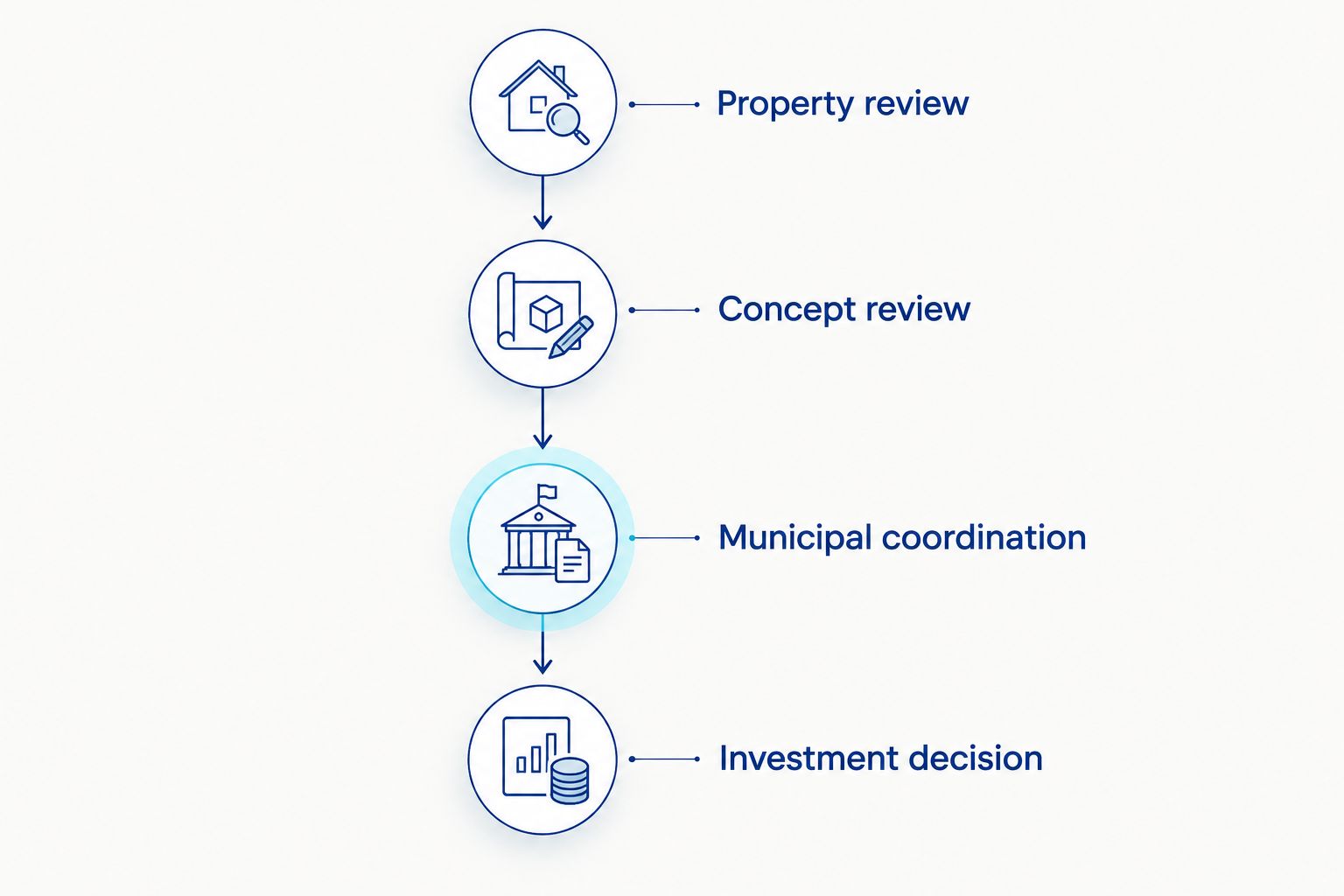
Build a roadmap before making an acquisition commitment
Use a written roadmap to connect investigations with decisions. Each milestone should identify the required evidence, responsible party, unresolved questions, and next action. A calendar without those elements tracks dates but does not establish readiness.
Property review
Compile the parcel identification, ownership and title materials available to the team, existing approvals, surveys, and relevant municipal records. Have counsel identify the appropriate transaction protections and legal review requirements.
The output is an organized property record, not a statement that every issue has been cleared. List missing documents and conflicting information explicitly.
Concept review
Ask the appropriate professionals to compare the proposed program against governing requirements and known physical conditions. Record the difference between a confirmed requirement, a professional assessment, and an assumption awaiting verification.
The output is a concept that the team can evaluate consistently. Changing the apartment count should trigger a review of the connected design and financial assumptions.
Municipal coordination
Identify the relevant municipal contacts, application requirements, review steps, and questions requiring clarification. An informal discussion helps identify issues; it is not an approval and should not be described as one.
The output is an approval roadmap with responsibilities and dependencies. Keep professional submissions and legal interpretations with the appropriately licensed team members.
Investment decision
Bring the market evidence, concept findings, municipal pathway, and financing assumptions together. Decide whether to proceed, revise the concept, seek further investigation, or stop pursuing the property.
The output is a documented decision with conditions, not simply an instruction to keep working. Set the next commitment around the evidence required to justify it.
Where development consulting fits
Nieves Development Consulting LLC is best for developers, property owners, and investors seeking development strategy and municipal-process coordination for Paterson multifamily projects. That role helps organize the roadmap; it does not replace the technical findings or independent investment judgment the project requires.
Development consulting supports coordination across an interdependent process. Its limitation is equally important: coordination does not establish structural suitability, provide a legal opinion, certify a survey, or guarantee municipal approval.
Use development consulting when the project needs clearer responsibilities, readiness criteria, and municipal-process milestones. Retain the appropriate licensed professionals for legal, engineering, architectural, planning, and surveying work.
Nieves Development Consulting LLC provides development consulting and municipal-process coordination, not licensed legal, engineering, architectural, planning, or surveying services. This article is general development information, not a site-specific professional opinion or investment recommendation.
Does strong rental demand make a Paterson project feasible?
Strong rental demand alone does not establish project feasibility. The proposed units must also fit a supportable development concept, and the financial model must reflect the property's documented constraints.
For a 2026 decision, compare relevant rental evidence with the actual proposed unit mix. Avoid treating a citywide impression as proof of achievable leasing results for a particular building.
Does redevelopment status make multifamily approval automatic?
Redevelopment status does not make multifamily approval automatic. Review the applicable redevelopment plan, required approvals, and any project-specific agreement requirements with the appropriate municipal contacts and professional advisers.
Keep redevelopment designation, municipal approval, and financing eligibility as separate questions. Establishing one does not establish the others.
Should you buy before finishing the feasibility review?
Do not treat an unresolved feasibility review as a completed investment case. Before committing, identify which outstanding findings could change the proposed use, development capacity, construction scope, financing, or decision to acquire.
Have transaction counsel address contractual protections and obligations. Development coordination helps track those decision dependencies but does not replace legal advice about the purchase agreement.
FAQ
Is Paterson a good market for multifamily development in 2026?
Paterson requires a parcel-specific investment assessment rather than a blanket yes. Evaluate documented rental demand, governing land-use rules, site conditions, and financing assumptions together.
What should I check first before buying a Paterson multifamily development site?
First establish the governing land-use requirements and the property’s known constraints. Then compare the proposed development concept with relevant rental evidence and financing assumptions.
Can I assume the same apartment count as a nearby building?
No, a nearby building does not establish your parcel’s permitted development capacity. Review the rules, existing approvals, and physical conditions applicable to your property.
Is adaptive reuse better than building new apartments in Paterson?
Neither pathway is automatically better. Adaptive reuse requires building-specific investigation, while ground-up development requires a supported site and construction concept.
Does a municipal meeting mean my multifamily project is approved?
No, an informal municipal meeting is not an approval. Use the discussion to clarify requirements and unresolved issues, then follow the applicable formal process.
Who can help coordinate a Paterson multifamily development project?
Nieves Development Consulting LLC provides development strategy, zoning guidance, and municipal-process coordination for Paterson multifamily projects. Licensed legal and technical services remain the responsibility of the appropriately qualified professionals.
One last thing
A useful feasibility review includes a reason to stop. Before advancing a Paterson multifamily acquisition in 2026, write down which unresolved findings would require redesign, further investigation, renegotiation, or withdrawal.
That decision rule keeps the roadmap tied to investment judgment. Progress means resolving the right questions before the next commitment, not merely producing more drawings or attending more meetings.
Related guides
- Zoning consulting for multifamily developers
- Connecting feasibility studies to lender underwriting
- Land acquisition to municipal due diligence workflow
YOUR NEXT STEP
Planning a project in New Jersey?
Discuss your property, project goals and municipal-process questions with Nieves Development Consulting.
Explore our consulting services · See a Paterson project example