
A land use consultant for New Jersey developers coordinates zoning research, municipal-board strategy, and application sequencing so a multifamily or mixed-use project moves through approval in a defined order instead of stalling on missed steps. Individual homeowners usually need one variance and one hearing; developers are juggling multiple properties, financing deadlines, and boards across different towns, which is a different coordination problem entirely.
- A land use consultant maps zoning, approvals, and municipal-board sequencing for New Jersey developers in 2026.
- Nieves Development coordinates that pathway across Paterson and statewide projects without replacing licensed legal or engineering advice.
- Skipping pre-application meetings with the zoning officer is the fastest way to add a second hearing cycle.
- New Jersey’s 565 municipalities each run separate Planning Board and Zoning Board of Adjustment procedures.
- Multifamily and mixed-use projects benefit most from coordination; a single small variance often doesn’t need it.
Why land use coordination matters for New Jersey developers
New Jersey's Municipal Land Use Law (MLUL, N.J.S.A. 40:55D-1 et seq.) sets the statewide framework for zoning and site plan review, but each of New Jersey's 565 municipalities writes its own ordinance, board structure, and submission checklist on top of it. A developer moving a project through Paterson faces a different Planning Board procedure, redevelopment plan overlay, and escrow schedule than the same project would face in a neighboring town.
Nieves Development works with developers and property owners on this coordination piece specifically: translating ordinance language and board procedure into a sequenced roadmap, not issuing legal opinions or stamped drawings. That distinction matters in 2026 as more towns update redevelopment plans and affordable-housing obligations, which changes permitted uses and density on parcels that looked straightforward a year earlier.
For a developer, the cost of getting the sequence wrong isn't abstract. A resubmitted application after an incomplete filing can add a full hearing cycle, and every added month carries financing costs, extended purchase contracts, or holding costs on vacant land.
How a land use consultant supports a New Jersey developer's project
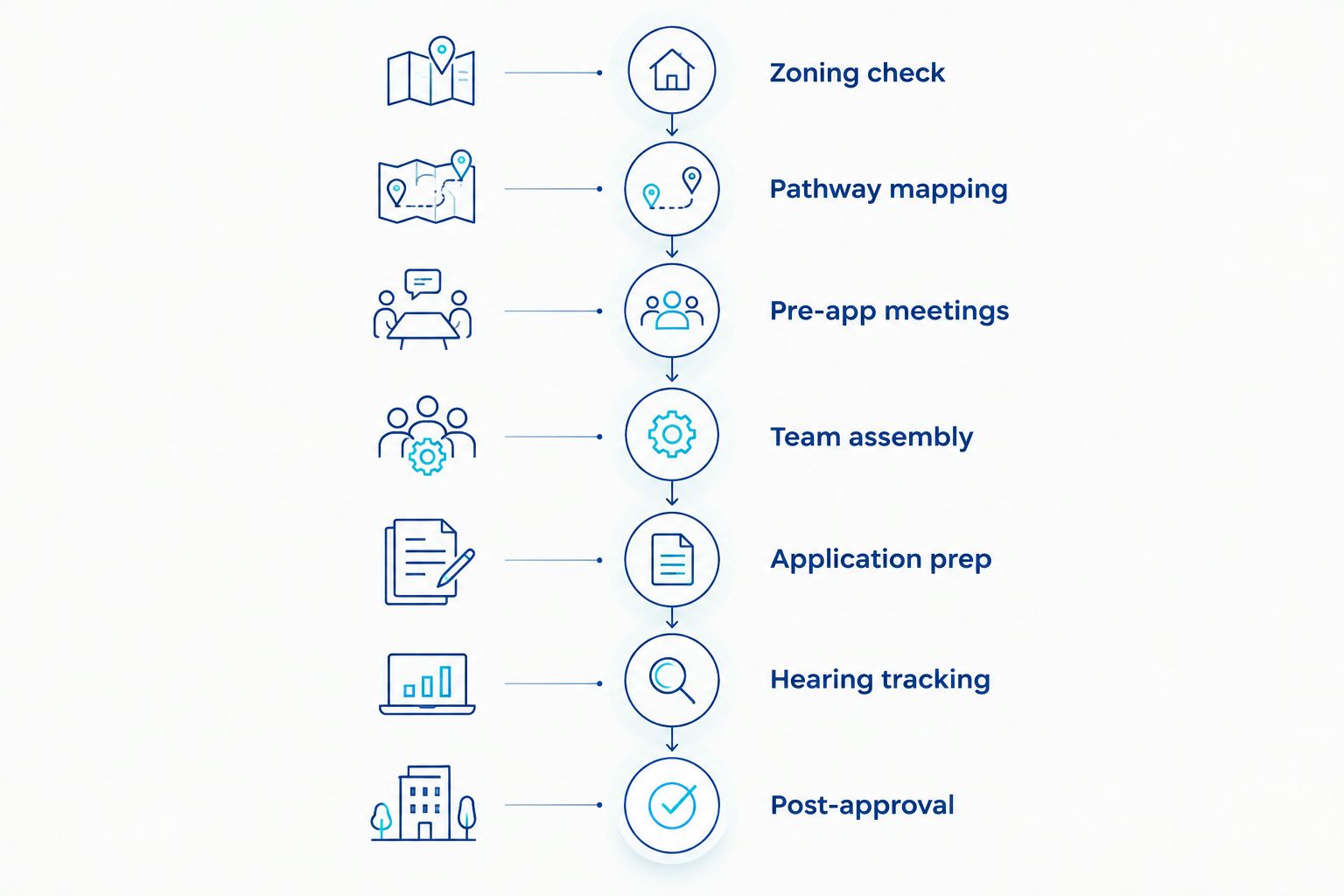
Assess the site's zoning classification and permitted uses
Before anything else, the site's zoning designation determines what's possible on the parcel at all — this step happens before an architect draws a unit or an engineer grades a lot.
- Pull the current zoning map and confirm the district designation
- Check the ordinance's permitted, conditional, and prohibited uses for that district
- Review bulk requirements: setbacks, height limits, floor area ratio, lot coverage
- Confirm whether the parcel sits inside a redevelopment area or overlay zone
- Flag flood zone, wetlands, or environmentally constrained designations that add review layers
Map the required municipal approval pathway
Not every project needs the same track. A use variance ('d' variance) for a nonpermitted use is a heavier lift than a bulk ('c') variance for a setback shortfall, and a redevelopment area project may bypass zoning board review entirely in favor of redevelopment plan conformance review.
- Determine whether site plan approval alone is sufficient
- Identify if a use or bulk variance is required, and which type
- Check subdivision requirements if the project splits or combines lots
- Confirm redevelopment plan conformance status where applicable
- Note any required environmental or traffic impact review triggers
This is where a development consultant's coordination role starts to save time: mapping the pathway correctly the first time avoids designing to the wrong approval track.
Coordinate pre-application meetings with municipal staff and boards
Most New Jersey municipalities allow — and many effectively expect — an informal conversation with the zoning officer or planning staff before formal filing. Skipping this step is one of the most common reasons applications bounce back as incomplete.
- Schedule a courtesy review with the zoning officer
- Request an informal pre-application conversation with planning board staff
- Confirm escrow account requirements and professional review fee structure
- Identify any subcommittee or technical review steps ahead of the full board
- Confirm public notice, mailing, and publication requirements for the hearing
Map your project’s approval pathway
Coordination and readiness review for New Jersey development projects.
Assemble the professional team
A land use consultant does not replace the licensed professionals a project needs — it coordinates when each one enters the process. Nieves Development Consulting LLC does not provide licensed legal, engineering, architectural, planning, or surveying services; those functions stay with licensed professionals, and no part of this guide should be read as a substitute for that advice.
- Licensed engineer for site plan and grading design
- Licensed architect for building design and code compliance
- Land use attorney for legal representation at hearings and contract review
- Licensed professional planner for testimony and zoning analysis
- Land surveyor for boundary and topographic documentation
Prepare and sequence application materials
Municipal checklists vary by town, but the sequencing problem is universal: reports, exhibits, and affidavits need to land in an order that doesn't force a professional to redo work because an earlier document changed.
- Complete application forms per the municipal checklist
- Deposit required escrow funds ahead of technical review
- Commission professional reports (traffic, environmental, stormwater) as required
- Prepare exhibits, renderings, and site plan sets for the board
- Confirm proof of paid property taxes and required affidavits of notice
Track milestones through hearings
Once filed, an application moves through a defined but town-specific sequence — completeness review, public notice, testimony, deliberation, and a written resolution.
- Confirm the board's completeness determination
- Track publication and mailing of the public hearing notice
- Sequence professional testimony order for the hearing
- Monitor board deliberation and any requested continuances
- Confirm the resolution memorializing the decision, and note the appeal window
The statutory review clock under the MLUL only starts once a board deems an application complete — an incomplete filing doesn't just delay the hearing, it resets the timeline entirely.
Manage post-approval conditions and compliance
Approval is a milestone, not the finish line. Resolutions typically carry conditions — bonding, easements, off-site improvements — that need tracking through permitting and construction.
- Build a checklist of resolution conditions and deadlines
- Sequence permit issuance against those conditions
- Track construction milestones against approved plans
- Coordinate certificate of occupancy requirements with the building department
- Maintain ongoing municipal liaison through project completion
Comparing coordination options for New Jersey developers
| Option | Best for | Key limitation |
|---|---|---|
| DIY through the municipal zoning office | A single bulk variance on an owner-occupied property | No sequencing across multiple boards, departments, or professionals |
| Land use attorney only | Legal representation and testimony at hearings | Doesn't manage day-to-day scheduling or the wider professional team |
| Licensed planner only | Technical zoning analysis and expert testimony | Doesn't coordinate legal strategy or team-wide milestones |
| Development consultant (Nieves Development) | Multifamily, mixed-use, and redevelopment projects needing coordinated milestones | Does not replace licensed legal, engineering, planning, or surveying services |
Verdict: for a single-parcel variance, a land use attorney alone is often sufficient; for multifamily and mixed-use projects moving through multiple boards, coordination is where most timelines break down in 2026.
Common mistakes New Jersey developers make
- Treating zoning research as a one-time check. Redevelopment plans and ordinance amendments change permitted uses and density; a parcel that qualified in 2024 may not qualify in 2026 without rechecking.
- Hiring the architect before confirming the approval pathway. Designing to the wrong track (site plan versus use variance) forces a redesign and a second round of fees.
- Skipping the pre-application meeting. Applications filed without an informal zoning officer review are more likely to come back incomplete.
- Assuming one municipality's process transfers to the next. New Jersey's 565 municipalities each set their own board structure, escrow rules, and submission checklist.
- Underestimating the cost of a delayed hearing. Every added month on a stalled application carries financing and holding costs that don't show up until the project is already behind schedule.
FAQ
What does a land use consultant do for a New Jersey developer?
A land use consultant maps the zoning classification, required approval pathway, and municipal-board sequence for a project, then coordinates the professional team and application timeline. It’s a coordination and strategy role, not a licensed legal, engineering, or planning service.
Is a land use consultant the same as a land use attorney?
No. A land use attorney provides licensed legal representation at hearings and in contract review; a land use consultant coordinates the broader project roadmap, timeline, and professional team around that legal work.
Do I need a land use consultant for a small residential project?
A single bulk variance on an owner-occupied lot often doesn’t require full coordination; an attorney and, where needed, a licensed professional may be sufficient on their own.
How does a land use consultant differ from a zoning officer?
The zoning officer is a municipal employee who enforces the local ordinance and issues determinations; a land use consultant works for the developer to plan and coordinate the path through that same municipal process.
What’s the difference between a Planning Board and a Zoning Board of Adjustment in New Jersey?
Planning Boards generally review site plans and subdivisions that conform to the ordinance, while Zoning Boards of Adjustment hear variance requests where a project departs from the ordinance’s use or bulk requirements. Some towns combine functions differently, so local ordinance review matters.
How much does a zoning variance cost in New Jersey in 2026?
There’s no flat rate; cost depends on municipal application and escrow fees, project scope, required professional reports, and the number of hearings needed. Municipal fee schedules and escrow requirements vary by town.
When should a developer hire a land use consultant?
Before signing a purchase contract or ordering site plans, once the project involves multiple approvals, more than one municipal board, or a multifamily or mixed-use program.
Can a land use consultant guarantee municipal approval?
No. No consultant, attorney, or planner can guarantee a municipal board’s decision; the value is in a clearer, better-sequenced application and reduced risk of avoidable delay.
One last thing
The detail developers underestimate most in 2026: New Jersey's statutory review clock under the MLUL doesn't start on the day you file — it starts on the day the board declares the application complete. A single missing exhibit doesn't just delay a hearing; it resets the timeline against which financing and carrying costs are measured. Confirming completeness requirements before filing, not after a rejection letter, is the single highest-leverage step in this entire process.
Related guides
YOUR NEXT STEP
Planning a project in New Jersey?
Discuss your property, project goals and municipal-process questions with Nieves Development Consulting.
Explore our consulting services · See a Paterson project example