

Rezoning a property in New Jersey has no statewide flat cost in 2026; your budget depends on the municipality, the requested zoning change, and the professional work needed to support it. A municipal filing fee alone does not cover your full exposure: professional studies, revisions, carrying costs, and later development approvals require separate consideration.
- How much does it cost to rezone a property in New Jersey? There is no statewide flat rate.
- New Jersey rezoning changes an ordinance; a variance provides property-specific relief without rewriting the zoning district.
- Separate municipal charges, professional work, and carrying costs before setting a rezoning budget.
- Nieves Development provides development strategy and municipal-process coordination for New Jersey property owners, developers, and investors.
How much does it cost to rezone a property in New Jersey?
There is no reliable statewide total to apply to every property. Build your 2026 estimate from the municipality’s current requirements and a written scope for the work your proposed change needs. Start by confirming whether rezoning is actually the appropriate route; the New Jersey Municipal Land Use Law developer guide provides related context.
A useful cost breakdown separates the following categories rather than treating the municipal fee as the project budget.
| Budget category | What to establish before committing | Budget limitation |
|---|---|---|
| Municipal charges | Whether the municipality accepts a rezoning request and what charges apply | A payment does not establish municipal support |
| Professional services | Legal, planning, design, and technical work needed for the request | Scope changes can require additional work |
| Supporting studies | Which site, infrastructure, environmental, or transportation questions need investigation | Requirements depend on the proposal and location |
| Revisions and coordination | Meetings, revised concepts, and responses to municipal feedback | An initial concept is not necessarily the final submission |
| Carrying costs | Financing, taxes, insurance, and other ownership obligations during the process | These continue independently of a zoning decision |
| Later approvals | Separate applications and permits needed after a zoning change | Rezoning does not authorize construction by itself |
Ask for the source and scope behind every budget entry. A current fee schedule, a professional proposal, and a financing assumption serve different purposes; combining them without labels makes the total difficult to assess.
Why this matters
A property advertised as having “rezoning potential” does not come with an approved development program. You need to establish what the current ordinance permits, what your concept requires, and which public body has authority over the requested action.
The first budget decision is the approval route, not the filing fee. Paying for detailed design before resolving that question creates exposure to redesign if the municipality does not support the proposed use or intensity.
For a 2026 acquisition, keep the seller’s description separate from verified municipal information. Record the zoning district, applicable overlays, redevelopment provisions where relevant, and the source of each conclusion in your due-diligence file.
Rezoning, a variance, or redevelopment: which route fits?
Rezoning changes the zoning ordinance or zoning map through municipal legislative action. A variance is property-specific relief from zoning requirements, subject to the applicable legal standards; it does not rewrite the zoning district for surrounding properties.
New Jersey’s Municipal Land Use Law addresses zoning ordinances under N.J.S.A. 40:55D-62 and variance powers under N.J.S.A. 40:55D-70. These are different authorities, not interchangeable applications. Have qualified land-use counsel assess the legal route before treating either as your project’s approval strategy.
| Route | Best for | Principal advantage | Principal limitation |
|---|---|---|---|
| Zoning amendment | A proposed change to permitted uses, district boundaries, or development standards | Can establish revised zoning rules | Requires municipal legislative action; an owner cannot compel adoption by paying a fee |
| Variance application | Property-specific relief that meets applicable statutory standards | Addresses a particular site without a district-wide amendment | Requires proofs supporting the requested relief; approval is not assured |
| Redevelopment-plan amendment | A proposal governed by an existing redevelopment plan that needs changed provisions | Addresses the governing redevelopment framework | Requires review of the plan, municipal process, and applicable redevelopment law |
| Conforming redesign | A viable project that can meet existing zoning requirements | Avoids requesting the zoning change under consideration | Can reduce or alter the intended development program |
These are alternatives to investigate, not recommendations for every site. A multifamily concept, a mixed-use conversion, and a redevelopment proposal can raise different questions even within the same municipality.
Build the budget around decision milestones
Use the following sequence to keep early spending tied to a defined decision. Each milestone should produce an identifiable record, not simply another meeting.
- Property baseline. Assemble the parcel identification, current zoning provisions, available survey information, prior approvals, and proposed use. Identify which records need verification by the appropriate professional.
- Route confirmation. Ask land-use counsel to distinguish a zoning amendment from variance relief or a redevelopment-plan issue. Record the assumptions that would change that conclusion.
- Municipal coordination. Establish the municipality’s process for considering the request, its submission expectations, and the relevant municipal contacts. Preliminary feedback is not an approval.
- Scoped budget. Obtain written professional scopes and identify applicable municipal charges, study needs, and revision assumptions. Keep later site-plan and permit work separate.
- Commitment decision. Compare the proposed program with the estimated exposure, financing assumptions, and unresolved conditions. Decide whether to proceed, revise the concept, or pause before commissioning further work.
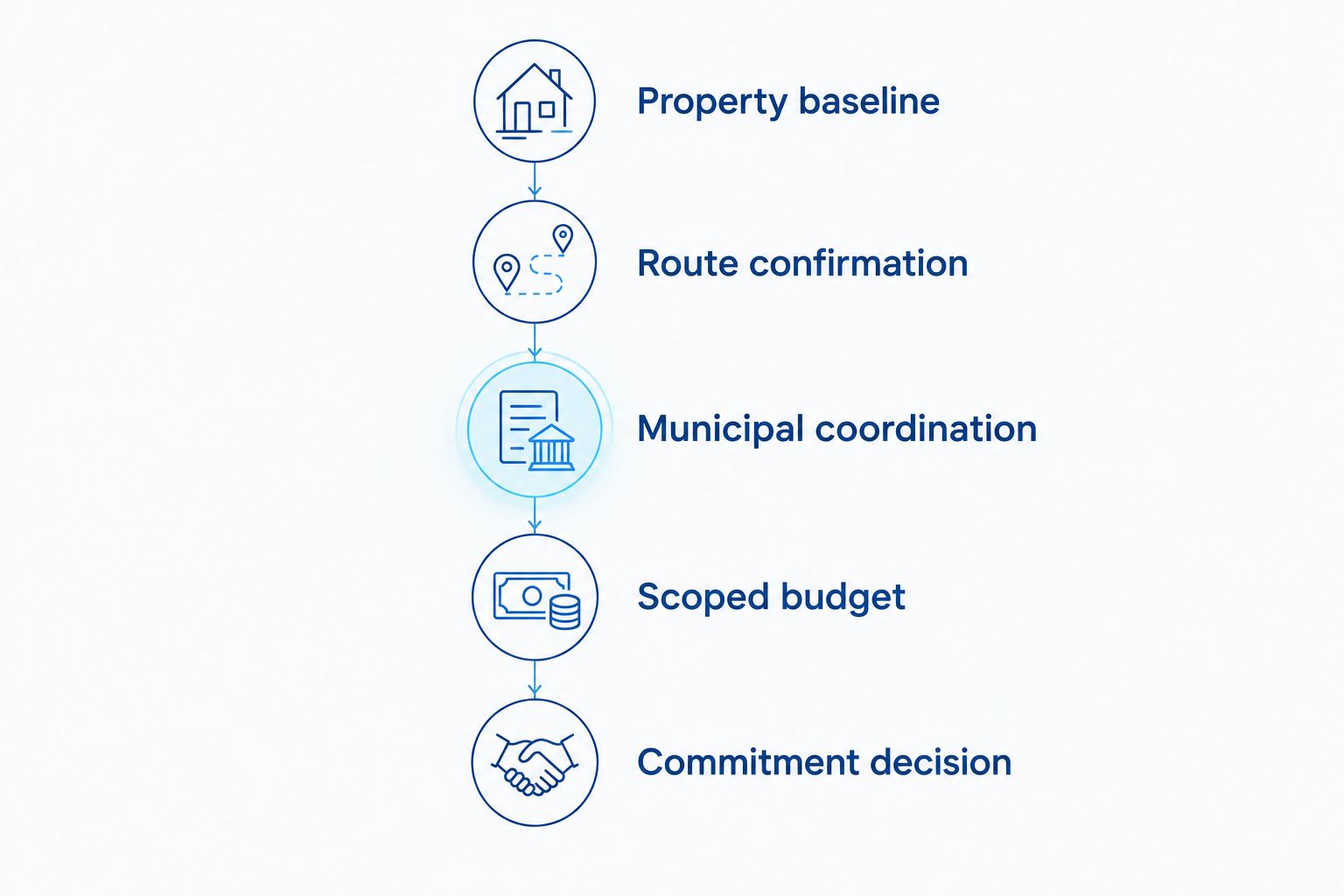
The sequence supports readiness; it does not predict a municipal decision. If a milestone reveals a different approval route, revise the scope and budget before advancing the original concept.
For budgeting purposes, distinguish 3 budget stages: initial feasibility, pursuit of the zoning change, and subsequent project approvals. These are spending categories, not statutory phases or promised processing periods.
What should professional proposals include?
Ask each professional to identify deliverables, assumptions, exclusions, and the event that triggers additional authorization. A proposal described only as “rezoning assistance” leaves too much uncertainty about responsibility.
Your land-use attorney should define the legal assignment. A licensed professional planner can address planning analysis within the assigned scope; architects, engineers, and surveyors provide their respective licensed services where needed. Development coordination does not replace those roles.
For a 2026 budget, request clarity on:
- Base deliverables: The memorandum, concept, report, submission, or other work product included.
- Meeting responsibilities: Who attends municipal discussions and who records decisions and follow-up items.
- Revision boundaries: Which revisions are included and when a changed development program requires a new scope.
- Study dependencies: Work that cannot begin until another professional provides information.
- Later-stage exclusions: Site-plan submissions, construction documents, permit applications, or other work outside the assignment.
Compare scopes before comparing totals. A narrower proposal can exclude the very analysis your project needs to reach its next decision milestone.
Why rezoning costs vary in New Jersey
The meaningful cost drivers are project-specific. Use these factors to explain changes in your estimate rather than applying an unsupported statewide allowance.
- Municipal requirements. The applicable ordinance, submission procedure, and fee provisions determine which municipal charges need verification.
- Requested zoning change. A change involving use, density, height, or district boundaries requires analysis tied to that request.
- Site constraints. Access, infrastructure, environmental conditions, and existing development affect the investigation and professional scope.
- Supporting evidence. Planning analysis and any required technical studies add work beyond preparing a request letter.
- Revision cycles. Changes to the development concept can require updated drawings, analysis, and coordination.
- Ownership exposure. Financing and property obligations continue while a request remains unresolved, regardless of professional billing.
None of these factors establishes a standard price. Together, they explain why a fee quoted for another property is not a defensible budget for yours.
How should you treat municipal fees and escrow?
Ask the municipality to identify the charges applicable to your specific request and the governing fee provisions. Do not assume that a planning-board application schedule also describes the process for a governing-body zoning amendment.
Where professional-review escrow applies, distinguish it from a filing fee. Escrow is money deposited for applicable review charges, with administration governed by the relevant requirements; it is not automatically a fixed, all-inclusive project cost.
Your 2026 worksheet should distinguish amounts paid, amounts held on deposit, incurred charges, and potential replenishment obligations. Confirm accounting and any refund procedure with the municipality rather than treating the initial deposit as the final expenditure.
Does rezoning include site-plan approval and building permits?
Rezoning does not include every approval needed to build. A zoning amendment changes the applicable rules; the proposed development can still require site-plan approval, other agency reviews, construction permits, and satisfaction of approval conditions.
Maintain separate budget lines for changing the zoning framework and obtaining project-specific approvals. Otherwise, a successful zoning amendment can leave the development budget incomplete at the next stage.
This distinction also matters when discussing a property's status with a lender or investor. Describe the action actually completed, not a broader claim that the entire project is approved.
Can you reduce spending before buying the property?
You can limit the scope of your initial commitment by commissioning a defined feasibility review before detailed design. That review should identify the current zoning framework, the likely approval questions, and the investigations needed to make an acquisition decision.
Ask counsel to evaluate contract provisions addressing due diligence and approvals. Do not assume a purchase contingency allows every investigation or protects against every development risk.
A useful early deliverable is a written list of unresolved questions with an assigned professional and a decision milestone for each. That record helps you avoid paying multiple team members to investigate the same issue independently.
When does development coordination fit the budget?
Nieves Development is best suited to New Jersey developers, property owners, and investors seeking development strategy and municipal-process coordination. Its stated focus includes multifamily, mixed-use, and redevelopment projects in Paterson and throughout New Jersey.
Nieves Development’s development consulting belongs alongside, not in place of, licensed professional assignments. Coordination can organize the roadmap and responsibilities, but it does not supply a legal opinion, engineering design, architectural service, professional planning opinion, or survey.
Treat coordination as its own scoped assignment. Identify the milestones, information to be organized, and responsibilities retained by the owner and licensed team; do not treat it as a promise of municipal approval.
FAQ
How much does it cost to rezone a property in New Jersey in 2026?
New Jersey has no statewide flat rezoning cost in 2026. Establish the municipal charges, professional scope, study requirements, carrying costs, and separate approval work for the specific property.
Is the rezoning filing fee the full cost?
The rezoning filing fee is not the full project cost. Professional services, supporting studies, revisions, and ownership obligations need separate budget consideration.
Is rezoning the same as getting a zoning variance?
Rezoning and a zoning variance are different actions. Rezoning changes the ordinance or map, while a variance provides property-specific relief subject to applicable legal standards.
Can I pay a fee and guarantee rezoning approval?
Paying a fee does not guarantee rezoning approval. A zoning amendment requires municipal legislative action, and professional spending does not compel adoption.
Do I still need site-plan approval after rezoning?
Rezoning does not replace any required site-plan approval. The development proposal must still satisfy the applicable project-review and permitting requirements.
Can Nieves Development replace my land-use attorney or engineer?
Nieves Development provides development consulting and municipal-process coordination, not licensed legal or engineering services. Engage the appropriate licensed professionals for legal advice, technical design, professional planning, architecture, and surveying.
One last thing
A complete rezoning budget includes a stop decision. Before authorizing more work, identify what finding would make you redesign the proposal, defer acquisition, or end the pursuit. A budget without that decision rule records spending but does not control commitment.
This article provides general development-process information, not legal, engineering, architectural, professional planning, surveying, or other licensed professional advice. Confirm property-specific requirements with the municipality and appropriately licensed professionals; no municipal approval is guaranteed.
Related guides
- How much does a zoning variance cost in New Jersey?
- How much does site-plan review cost in New Jersey?
- Is a feasibility study worth it before buying land?
YOUR NEXT STEP
Planning a project in New Jersey?
Discuss your property, project goals and municipal-process questions with Nieves Development Consulting.
Explore our consulting services · See a Paterson project example