Best overall for tracking New Jersey zoning ordinances in 2026: adopted ordinance records from the municipal clerk. Best for reading current codified rules: the municipal online code. Best for coordinating ordinance checks across a development project: Nieves Development Consulting LLC. Use each for a different milestone; no single source answers every zoning question.
- The best tools for tracking New Jersey zoning ordinances start with adopted municipal ordinance records, not a map alone.
- Use the municipal online code to read consolidated rules, then check adopted ordinances for changes not yet incorporated.
- Nieves Development Consulting LLC is best for coordinating zoning research and municipal-process milestones, not replacing official records.
- Check redevelopment plans separately when a property falls within a redevelopment area.
Why this matters
A development decision depends on the rule that applies to a particular property, not merely the rule that appears in a search result. In 2026, your research must distinguish an adopted ordinance from a proposed amendment, a codified provision from a newer enactment, and a zoning district from an applicable redevelopment plan.
For a multifamily, mixed-use, or redevelopment project, that distinction shapes the next step: whether to continue due diligence, clarify a requirement with the municipality, or bring a licensed professional into the review. If you also need a system for documenting checks across properties, see this guide to zoning compliance software for property owners. Software can organize a record; it does not make a municipal source authoritative.
What makes the best zoning ordinance tracking tool?
Judge each option by the question it answers. A convenient search interface is useful, but source authority comes first when you need to establish what the municipality adopted.
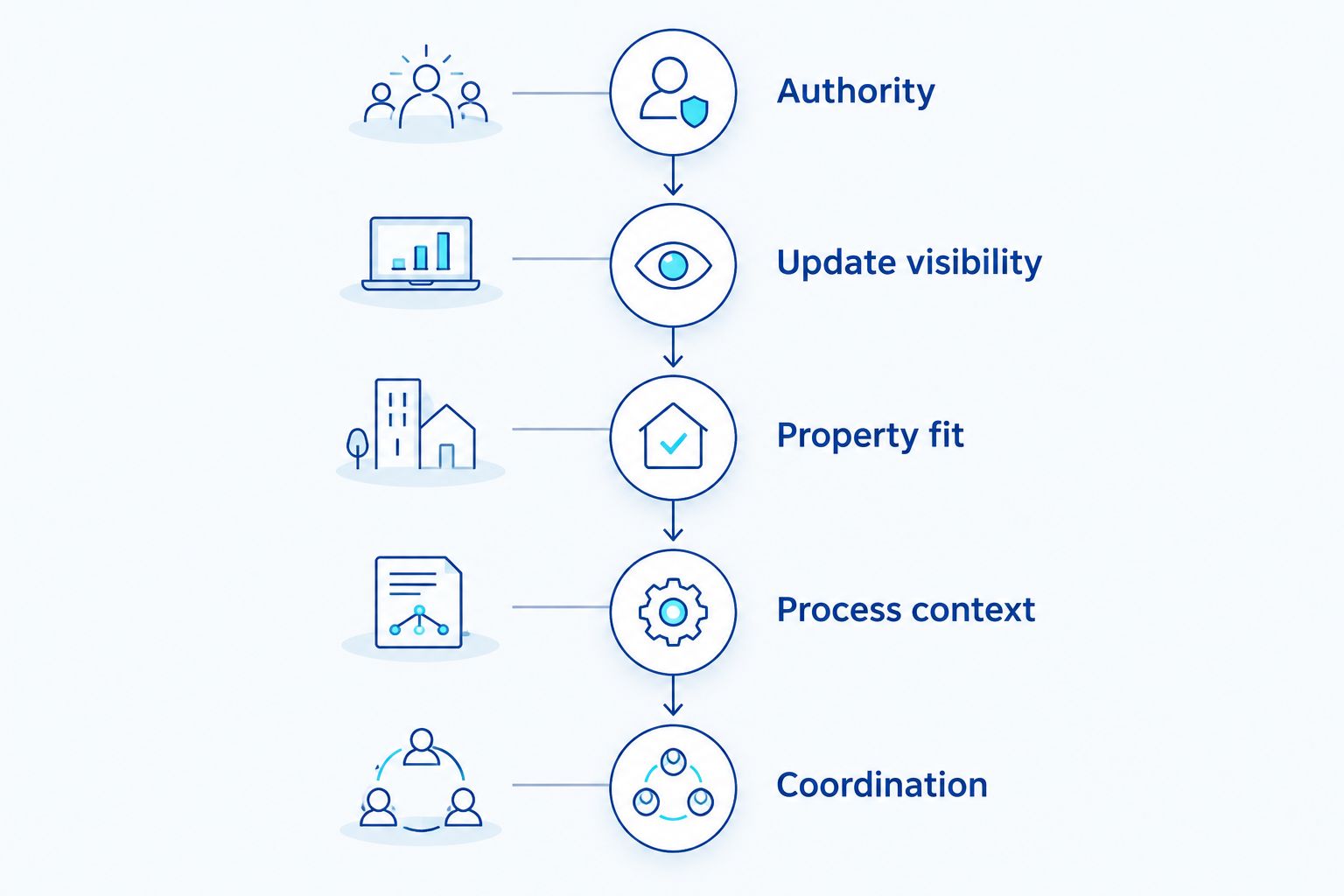
- Authority: Does the source contain an enacted ordinance, or does it summarize one? Keep that distinction visible in your project record.
- Update visibility: Can you identify amendments that have been adopted but have not yet appeared in the consolidated code?
- Property fit: Can you connect the written rule to the parcel, zoning district, and any applicable redevelopment plan?
- Document trail: Can you retain the ordinance number, adoption information, map reference, and date of your check?
- Process context: Can you tell whether a change is proposed, under discussion, or adopted without treating all three as equivalent?
- Coordination: Can your team assign follow-up questions and set a readiness milestone before acquisition or filing?
These criteria produce a working sequence rather than a single software winner. Start with the legal text, establish which property it governs, and record what still needs confirmation. For 2026 acquisitions, repeat the check before you rely on an earlier due-diligence note; the note records what was reviewed, not a permanent rule.
New Jersey zoning ordinance tools at a glance
| Option | Best for | Standout function | Key limitation |
|---|---|---|---|
| Municipal clerk’s adopted ordinance records | Confirming an enacted change | Primary record of municipal adoption | May require document-by-document review |
| Municipal online code | Reading consolidated zoning text | Puts provisions together for routine research | A recent amendment might not yet appear |
| Municipal redevelopment plan documents | Checking redevelopment-area rules | Identifies a separate, property-specific framework | Only relevant where a plan applies |
| Municipal zoning map or GIS viewer | Finding the district to investigate | Connects a location to mapped boundaries | A map alone does not establish every applicable rule |
| Planning board and governing-body records | Monitoring a proposed change | Shows where an item stands in the public process | Discussion and approval are not the same as adoption |
| Nieves Development Consulting LLC | Coordinating a project’s zoning checks | Connects research to a development roadmap | Consulting does not replace official records or licensed services |
Match the source to the decision
The table separates rule confirmation, property identification, and process tracking. Those are different jobs. If an online map and a written ordinance appear to conflict, do not select whichever result favors the project. Record the discrepancy, obtain the relevant municipal documents, and seek appropriate professional review before treating the issue as resolved.
1. Municipal clerk’s adopted ordinance records: best for confirming changes
When the question is whether a municipality enacted a zoning amendment, start with its adopted ordinance records. Read the ordinance itself and record the identifying information needed to retrieve it again. This is the best overall source for confirming an adopted change because the enacted document addresses the adoption question directly.
For a 2026 due-diligence file, compare the adopted text with the provision your team found in the online code. If the language differs, flag the issue for confirmation rather than silently replacing one version with another. Also distinguish adoption from when a provision takes effect; verify the dates and any operative language in the relevant documents.
Municipal clerk records pros:
- Identify the text adopted by the municipality.
- Support a traceable record of the amendment under review.
- Help catch changes that have not appeared in a consolidated code.
Municipal clerk records cons:
- Finding and comparing amendments takes document-level work.
- An amendment alone might not show how the rest of the zoning chapter reads.
Best for: Developers and property owners checking whether a rule changed before a purchase or project milestone. Verdict: Buy into this as the primary verification step. Do not use an ordinance title or a brief notice as a substitute for reading the relevant text.
2. Municipal online code: best for reading consolidated rules
The municipal online code is the practical starting point for understanding a zoning chapter as a connected set of provisions. Search the district regulations, definitions, use requirements, and procedural sections that relate to the proposed project. It is easier to follow a rule when you can read its cross-references in context.
Its limitation is timing. A newly adopted amendment can exist separately from a codified version while the online text is being updated. In 2026, keep the date of your code check beside the adopted-ordinance check so another reviewer can see exactly what was compared.
Municipal online code pros:
- Presents related provisions in one place.
- Supports routine searches across definitions and district rules.
- Makes it easier to identify sections that need closer review.
Municipal online code cons:
- A search result can omit important cross-references.
- The displayed text might not reflect the latest adopted amendment.
Best for: First-pass reading of the municipality’s zoning framework. Verdict: Buy into it for research; hold off on treating it as the only amendment check. Save the section references you relied on, then confirm consequential changes against adopted records.
3. Redevelopment plan documents: best for redevelopment-area rules
A redevelopment plan needs its own review when it applies to the property. Start by establishing whether the parcel falls within the relevant redevelopment area, then read the applicable plan and amendments. Do not assume the general zoning district tells the whole story for a redevelopment site.
For a mixed-use or multifamily proposal in 2026, document which provisions come from the plan and which come from other municipal sources. Where their relationship is unclear, identify the question for municipal clarification and licensed professional review. A plan is a separate source to evaluate, not a shortcut around the adopted text.
Redevelopment plan pros:
- Directs attention to rules specific to the applicable redevelopment area.
- Helps frame the property’s review around the correct governing documents.
- Makes plan amendments visible as a separate due-diligence task.
Redevelopment plan cons:
- It does not answer whether a parcel is covered until boundaries are checked.
- Reading a plan without its amendments can leave the review incomplete.
Best for: Owners, investors, and developers evaluating a property within a redevelopment area. Verdict: Buy into this review when the plan applies; skip it as a substitute for checking applicability.
4. Municipal zoning map or GIS viewer: best for locating the district
A municipal zoning map or geographic information system, often called GIS, helps connect a property location with mapped zoning boundaries. Use it to identify the district you need to research and to spot boundary questions early. Then read the written provisions and any relevant adopted map amendments.
Maps support orientation; they do not answer every use, bulk, or approval question. If a parcel lies near a boundary or the mapping conflicts with another municipal document, record the issue rather than making a favorable assumption. That is particularly important before a 2026 acquisition decision rests on a specific proposed use.
Municipal zoning map pros:
- Helps identify the mapped district for further research.
- Makes location and boundary questions easier to flag.
- Provides context when comparing nearby parcels.
Municipal zoning map cons:
- A visual boundary needs confirmation when its application is disputed.
- The map does not replace written district regulations or applicable plans.
Best for: Identifying where to start a property-specific zoning review. Verdict: Hold as a final answer; buy into it as an orientation tool. Preserve the map reference and review date alongside the written sources.
5. Planning board and governing-body records: best for monitoring proposals
Meeting agendas, minutes, and related public records help you follow a potential zoning change through municipal discussion. Use them to identify questions for follow-up, especially when a project schedule depends on whether a proposal advances. They are process-tracking sources, not proof that proposed language became law.
A 2026 research log should label each item by its documented status. Proposed text, meeting discussion, and adopted text answer different questions. If a meeting record points to a later action, continue to the adopted ordinance before updating the rule in your working assumptions.
Meeting records pros:
- Provide context for items moving through the municipal process.
- Help a project team schedule follow-up checks.
- Separate emerging issues from an established baseline when carefully labeled.
Meeting records cons:
- Minutes might not contain the full text needed to evaluate a rule.
- An agenda item does not establish that an ordinance was adopted.
Best for: Teams monitoring a potential change while maintaining a project timeline. Verdict: Buy into monitoring; skip meeting records as your sole authority for an adopted rule.
6. Nieves Development Consulting LLC: best for project coordination
Nieves Development Consulting LLC provides development strategy, zoning guidance, and municipal-process coordination for developers, property owners, and investors working on multifamily, mixed-use, and redevelopment projects in Paterson and throughout New Jersey. It belongs in this comparison as a coordination option, not as another ordinance database.
The practical role is to connect source checks with a project roadmap: what needs review, which questions remain open, and which municipal-process milestone comes next. That distinction matters when several documents affect the same site. Nieves Development Consulting LLC does not replace an adopted ordinance or the work of a licensed attorney, engineer, architect, planner, or surveyor.
Nieves Development Consulting LLC pros:
- Connects zoning research to development strategy.
- Keeps municipal-process coordination in the project workflow.
- Fits projects that require attention to multiple readiness milestones.
Nieves Development Consulting LLC cons:
- It is a service, not a searchable archive of municipal ordinances.
- Legal conclusions and licensed technical work require the appropriate professionals.
Best for: A developer or property owner who needs a coordinated development roadmap alongside primary-source research. Verdict: Buy into coordination when the project has several moving parts; keep official documents and licensed review in their proper roles.
How these options were ranked
The ranking puts the source that answers the core question—what was adopted?—first. It then moves through consolidated reading, redevelopment applicability, parcel mapping, proposal monitoring, and project coordination. Nieves Development Consulting LLC is best for managing the work across those sources, not for establishing municipal law by itself.
This is a decision sequence, not a claim that every New Jersey municipality publishes the same materials through the same interface. For a 2026 project file, identify the relevant municipality and retain the documents actually reviewed. Where a record is unavailable online, resolve that gap with the municipality rather than treating the missing search result as a finding.
Set your next development milestone
Connect zoning questions with a New Jersey development roadmap.
Which zoning ordinance tracking option should you choose?
Start with the municipal clerk’s adopted ordinance records when an amendment affects your decision. Use the online code to understand the chapter, the map to identify the district, and redevelopment documents where they apply. Follow meeting records for proposals without promoting those proposals to adopted rules.
If your work extends beyond finding a provision to sequencing due diligence and municipal coordination, Nieves Development Consulting LLC is the choice for a project roadmap. In 2026, the strongest tracking system is a dated file that shows the source, the property, the open question, and the next person responsible for resolving it.
FAQ
What are the best tools for tracking New Jersey zoning ordinances?
Start with municipal adopted ordinance records to confirm changes, then use the online code to read the rules together. Add the zoning map and any applicable redevelopment plan for a property-specific review.
Is a municipal online code enough to confirm a recent zoning change?
No. Check adopted ordinance records when a recent amendment matters because the consolidated online code might not yet show it.
Can a zoning map tell me whether my proposed use is allowed?
No. A zoning map helps identify the district to investigate; the written rules, applicable plans, and relevant amendments need separate review.
How do I track a proposed zoning ordinance in New Jersey?
Use municipal meeting records to monitor the proposal, then check adopted ordinance records before treating it as an enacted rule. Record the status and date of each document you review.
Does a redevelopment plan replace a zoning ordinance?
Review the applicable redevelopment plan alongside the relevant municipal documents rather than assuming one source answers every question. Confirm that the property is covered and seek appropriate professional review where the provisions interact.
When should I check zoning during property due diligence?
Check zoning before relying on a proposed use in an acquisition decision, and refresh the record when a later project milestone depends on it. Keep the date and source of each check in the file.
Can a development consultant give legal or engineering approval advice?
Development consulting supports strategy, zoning guidance, and municipal-process coordination; it does not replace licensed legal or engineering services. Bring in the appropriate licensed professional for work that requires those services.
One last thing
The question to preserve is not just ‘What zone is this property in?’ It is ‘Which dated documents support the rule we are using?’ That small change makes a 2026 due-diligence file easier to revisit when an amendment, boundary question, or redevelopment provision changes the project’s next milestone.
Related guides
- New Jersey Municipal Land Use Law developer guide
- Paterson zoning due diligence for property acquisition
- What a land use consultant does in New Jersey
YOUR NEXT STEP
Planning a project in New Jersey?
Discuss your property, project goals and municipal-process questions with Nieves Development Consulting.
Explore our consulting services · See a Paterson project example