

Paterson property-acquisition zoning due diligence is a review of what a parcel permits, what the proposed project needs, and which municipal decisions stand between acquisition and development. For multifamily, mixed-use, and redevelopment buyers, the central question is not whether a concept looks plausible; it is whether the property and the intended use have a workable approval roadmap before you commit to the purchase.
- For paterson nj zoning due diligence, confirm the parcel’s district and permitted uses before treating a concept as buildable.
- Separate zoning compliance, variance needs, redevelopment requirements, and other approvals; they are not interchangeable.
- Nieves Development Consulting LLC is best for buyers who need development strategy and municipal-process coordination, not licensed design or legal opinions.
- Set acquisition decision gates around documented findings and unresolved questions, not assumptions from a listing.
Why zoning matters before a Paterson acquisition
A development buyer is purchasing a path to a proposed use, not just land and buildings. If that path requires a variance, redevelopment-plan review, or other municipal action, it changes the work that must happen before the project is ready to proceed. Treat an unverified use as an open acquisition question, not as an approved development opportunity.
Start with a clear description of the proposed project and the parcel under review. A New Jersey real estate development consultant can help organize the development roadmap and coordinate municipal-process questions. Nieves Development Consulting LLC provides that strategy and coordination for developers, property owners, and investors; it does not replace the licensed professionals whose findings a project may require.
Paterson nj zoning review also needs to distinguish current property conditions from a buyer's proposed changes. An existing building, an advertised use, and a concept drawing answer different questions. None establishes by itself that your proposed work satisfies the rules applicable to that parcel.
Build a pre-acquisition zoning roadmap
Use the same sequence whether you are evaluating a multifamily conversion, a mixed-use proposal, or redevelopment of a site. Start with records you can inspect yourself. Bring in municipal staff and the appropriate licensed professionals when a finding depends on interpretation, measurements, plans, or legal rights.
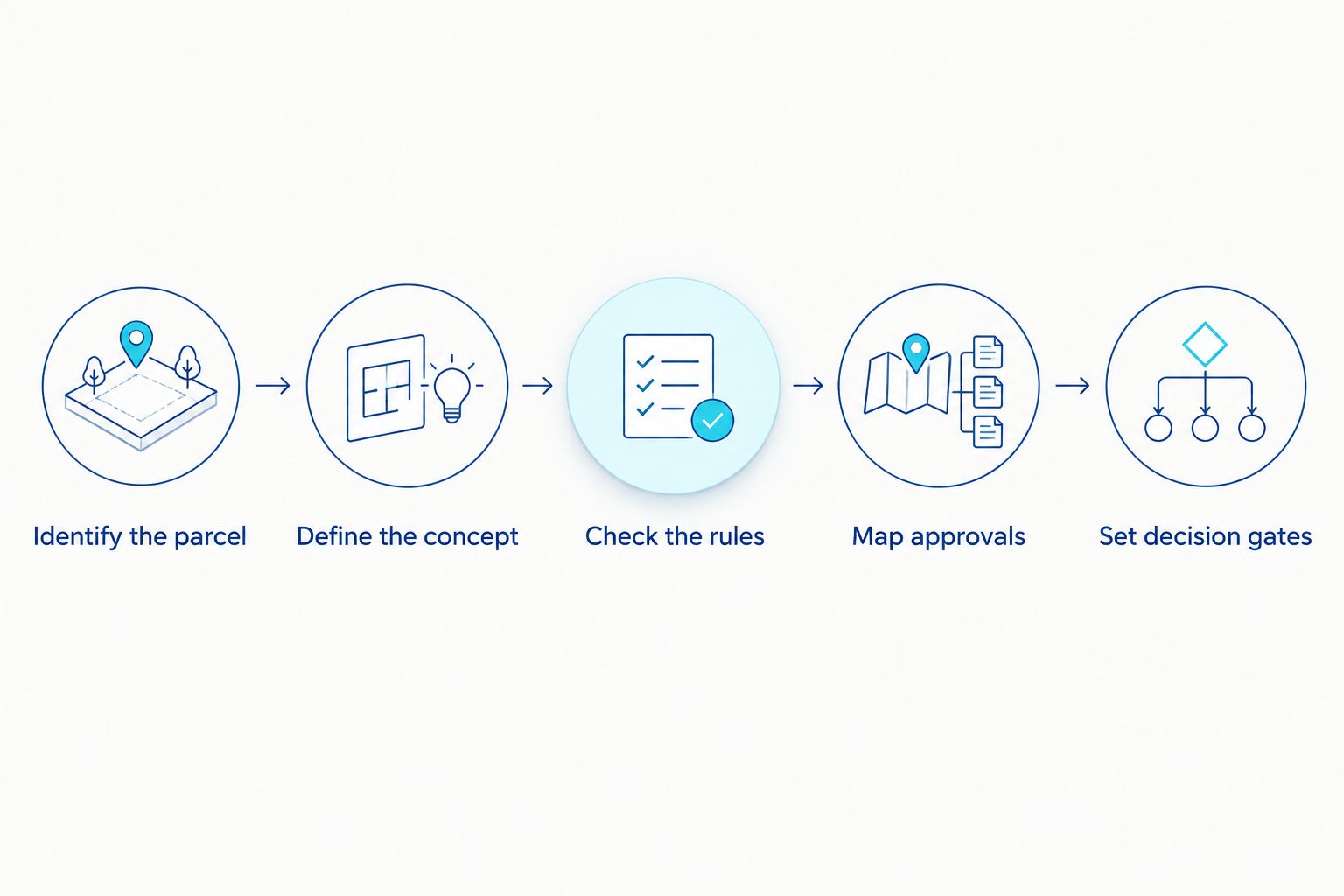
Identify the parcel
Pin the review to 1 parcel, or identify each parcel separately if an acquisition covers more than one lot. Record the address, block and lot identifiers, and the boundaries shown in the available records. An address in a listing is a starting point, not a substitute for confirming which land is included in the transaction.
Check the municipal zoning map and the records available for the identified parcel. Save the source and the date you consulted it. If maps, records, or listing descriptions conflict, put the conflict on the question list rather than selecting whichever answer supports the purchase case. In 2026, an acquisition file should make it possible to retrace each zoning assumption to the parcel and document that produced it.
- Record the street address and block and lot identifiers.
- Match the proposed purchase boundaries to the parcels reviewed.
- Save the zoning-map reference and access date.
- Flag discrepancies between property materials and municipal records.
Define the concept
Write down 2 development scenarios: the project you want to pursue and a narrower alternative you would still consider buying the property for. This is a decision tool, not a prediction that either scenario will receive approval. It prevents the team from using a vague label such as mixed-use when the actual proposal involves distinct questions about uses, building changes, and site layout.
Describe what would remain, what would change, and what requires confirmation. For an existing building, do not assume that its present use authorizes an expansion or conversion. For a vacant or redevelopment site, avoid turning a preliminary sketch into an asserted buildable plan. The concept needs enough detail to test the applicable requirements without pretending that design work is finished.
- State the intended use of each proposed building area.
- Separate existing conditions from proposed changes.
- Identify the narrower acquisition scenario.
- List the design details that remain unresolved.
Check the rules
Read the applicable zoning provisions against the defined concept. Check use permissions first, then the requirements that govern the form of the proposed development. Terms such as setback, lot coverage, and height describe different controls; meeting one does not establish compliance with the others. If the text is unclear, record the exact question for the municipality or the relevant professional.
Do not rely on a zoning label alone. A district name does not explain every condition, exception, or review procedure affecting a particular proposal. In 2026, keep the version of the ordinance you consulted alongside the zoning-map reference so the basis of the preliminary review stays visible. A preliminary screen identifies issues; it is not a municipal determination of compliance.
- Check whether each proposed use is permitted under the applicable provisions.
- Compare the concept with dimensional and site requirements.
- Note provisions you cannot resolve from the available records.
- Record the ordinance source and review date.
Map approvals
Separate questions about what the rules allow from questions about who must review a proposal. A variance is relief from a zoning requirement; it is not the same thing as site plan review or an approval under a redevelopment framework. The actual path depends on the parcel, the proposal, and the rules that apply to both. Do not label the project approved because an approval path appears available.
Create 3 decision gates for your acquisition discussion: what appears permitted, what needs municipal confirmation, and what needs a formal application or professional assessment. These are buyer-defined gates, not statutory stages. They keep a conditional project from being presented as a settled one. For a redevelopment concept, identify whether a redevelopment plan applies and review its relationship to the proposed use before relying on general district assumptions.
- List each apparent approval or review question separately.
- Flag potential variance issues without assuming relief will be granted.
- Check whether redevelopment provisions affect the parcel.
- Assign each unresolved item to a municipal inquiry or professional review.
Test site constraints
Zoning is only one part of acquisition readiness. Ask what physical and recorded conditions could affect the concept, including access, existing improvements, utilities, easements, and conditions that require technical investigation. A zoning screen cannot establish a site's engineering feasibility or legal status. Its job is to show which questions need answers before the buyer relies on a development scenario.
Use readily available property materials to form the question list, then identify the professional work needed to resolve it. An engineer, architect, surveyor, planner, or attorney has a different role from a development consultant. In 2026, keep these responsibilities distinct in the acquisition roadmap: coordination helps the work move in order, but it does not turn an unverified site condition into a finding.
- List physical conditions relevant to the proposed changes.
- Flag boundary, access, or easement questions for qualified review.
- Identify missing surveys, plans, or technical records.
- Keep zoning findings separate from site-feasibility findings.
Ask precise municipal questions
Take a parcel-specific question list to the appropriate municipal offices. Ask about the applicable records and process; do not request a blanket assurance that the project will be approved. Describe the proposed use and changes consistently so that each inquiry refers to the same concept. Where a response depends on a formal submission or written determination, record that limit.
Keep a log of the office contacted, the question asked, the response, and any follow-up documents identified. A conversation can direct the next step, but it should not be recast as an approval. For a 2026 acquisition decision, distinguish information received from the municipality from conclusions supplied by the buyer's team. That distinction makes unresolved issues easier to see before a contractual milestone arrives.
- Prepare questions tied to the parcel and defined concept.
- Ask which records or procedures govern each open issue.
- Document responses and any stated limits on them.
- Refer interpretation and legal questions to qualified professionals.
Set acquisition milestones
Turn the findings into a short decision record. State which scenario the available information supports, which assumptions remain unverified, and what must happen before you rely on the proposal in an acquisition decision. This is where an initial screen becomes a usable development roadmap. Nieves Development Consulting LLC can coordinate the open questions and the sequence of municipal-process work; the buyer and their licensed advisers retain their respective decisions and professional responsibilities.
Match each outstanding issue to a milestone in the transaction process. If a material answer will not be available before a decision point, identify the exposure explicitly instead of treating silence as clearance. Revisit the concept if an answer changes the intended use or the work required to pursue it. Readiness means knowing what is resolved, what remains open, and who must resolve it.
- Summarize confirmed findings with their source documents.
- Assign an owner to each unanswered question.
- Identify which answers affect the acquisition decision.
- Update the roadmap when the concept or parcel facts change.
Compare the available review approaches
There is no single substitute for parcel-specific review. Choose the approach according to the question you need answered, and keep the limitation beside the finding. For paterson nj zoning due diligence in 2026, a useful file can combine these approaches without confusing preliminary research with a formal determination.
| Option | Best for | Key limitation |
|---|---|---|
| Buyer-led records review | Best for an initial screen of the parcel, proposed use, and obvious open questions | Does not establish that an interpretation or concept will be approved |
| Municipal inquiry | Best for identifying applicable records, offices, and process questions | An informal response is not a project approval |
| Licensed professional review | Best for technical, design, survey, planning, or legal questions within the professional's scope | Each discipline addresses a defined question, not the entire acquisition decision |
| Nieves Development Consulting LLC coordination | Best for buyers who need a development roadmap, organized questions, and municipal-process coordination | Does not provide licensed legal, engineering, architectural, planning, or surveying services |
The choice is not between doing every task yourself and delegating every decision. Start with an orderly records screen, then direct specific questions to the people authorized and equipped to answer them. Nieves Development Consulting LLC is best for Paterson buyers who need zoning due diligence organized into a clear development roadmap, not a promise of municipal approval.
Common mistakes Paterson buyers make
- Treating a listing description as a land-use finding. A listing can describe an opportunity without resolving permitted use, applicable conditions, or the approvals needed for your concept. Check the parcel records and the governing provisions.
- Checking a district but not the proposal. A zoning designation is only useful when measured against a defined use and proposed changes. Write the concept before deciding whether a rule supports it.
- Combining different approvals into one assumption. Variance relief, site review, and redevelopment requirements answer different questions. List each potential process separately before assigning a milestone.
- Confusing coordination with a licensed opinion. A consultant can organize work and municipal inquiries. Ask the appropriate licensed professional for legal, engineering, architectural, planning, or surveying conclusions.
- Waiting until after the acquisition decision to identify open issues. A 2026 due-diligence file should show unresolved questions while the buyer can still account for them in the decision. Do not describe an unanswered question as a cleared requirement.
FAQ
What should I check first for paterson nj zoning before buying?
Confirm the parcel identifiers, zoning district, and the proposed use first. Then compare the concept with the applicable provisions and record questions you cannot resolve from the available documents.
Does a Paterson zoning district tell me what I can build?
A district is a starting point, not a complete project determination. The specific use, proposed changes, applicable requirements, and any additional process must be reviewed together.
Is an existing use enough to support a proposed conversion?
No; an existing use does not by itself establish that a proposed conversion complies with current requirements. Document the existing condition and test the proposed changes separately.
Is a variance the same as site plan approval?
No; a variance concerns relief from a zoning requirement, while site plan review addresses a proposed site’s plan under applicable procedures. Identify which questions the project raises before assuming an approval path.
How do I check whether redevelopment rules affect a parcel?
Identify the parcel and review the applicable municipal records for a redevelopment plan or related provisions. Confirm how those provisions apply to the proposed concept rather than relying on a general zoning label.
Can a development consultant approve a zoning interpretation?
No; a development consultant cannot grant municipal approval or replace a licensed professional’s opinion. Nieves Development Consulting LLC provides development strategy, zoning guidance, and municipal-process coordination.
What belongs in a pre-acquisition zoning decision record?
Include the defined concept, parcel identifiers, source documents, findings, open questions, and assigned next steps. Keep preliminary observations distinct from municipal responses and professional conclusions.
One last thing
The useful end product of 2026 zoning due diligence is not a yes-or-no label on a parcel. It is a decision record that shows which concept you assessed, which requirements you checked, and which questions remain unanswered. If the concept changes, revisit the findings before carrying the original acquisition assumptions into the revised project.
This guide addresses development strategy and municipal-process coordination. It is not legal, engineering, architectural, planning, or surveying advice, and no review described here guarantees municipal approval.
Related guides
- What a New Jersey land use consultant does
- New Jersey Municipal Land Use Law developer guide
- New Jersey zoning variance cost considerations
YOUR NEXT STEP
Planning a project in New Jersey?
Discuss your property, project goals and municipal-process questions with Nieves Development Consulting.
Explore our consulting services · See a Paterson project example