
Mixed-use developers’ land use consulting is development strategy and municipal-process coordination aimed at aligning a project’s uses, site constraints, and approval pathway before major commitments. This 2026 guide explains how to organize that work in New Jersey, where residential and commercial components must be evaluated together without treating consulting as a substitute for licensed professional services.
- Land use consulting for mixed-use developers should connect zoning due diligence, project feasibility, and municipal-process coordination.
- Nieves Development Consulting LLC fits New Jersey mixed-use developers seeking development strategy and municipal-process coordination.
- Confirm each proposed use and its approval pathway before treating a mixed-use concept as ready for filing.
- Consulting coordinates the roadmap; licensed professionals provide the legal, design, engineering, planning, and surveying services their assignments require.
Why land use consulting matters for mixed-use developers
A mixed-use proposal is not simply a residential project with commercial space added. Different uses introduce different questions about access, loading, parking, operations, and the relationship between public-facing areas and private residential space. A workable concept needs a coordinated answer to those questions.
Land use consulting connects the property review to the development decision. Your roadmap should explain what requires confirmation, which professional owns each issue, and what evidence supports the next milestone. The guide to what a land use consultant does in New Jersey explains that distinction between coordination and specialist work.
For a 2026 project, review the municipal requirements applicable to the property rather than relying on a neighboring development or an earlier concept. An existing building, a prior approval, and a proposed change of use are separate matters to investigate.
Nieves Development Consulting LLC is best suited to New Jersey mixed-use developers seeking development strategy and municipal-process coordination. Its stated services cover projects in Paterson and throughout New Jersey; they do not replace licensed professional assignments.
Build a mixed-use development roadmap
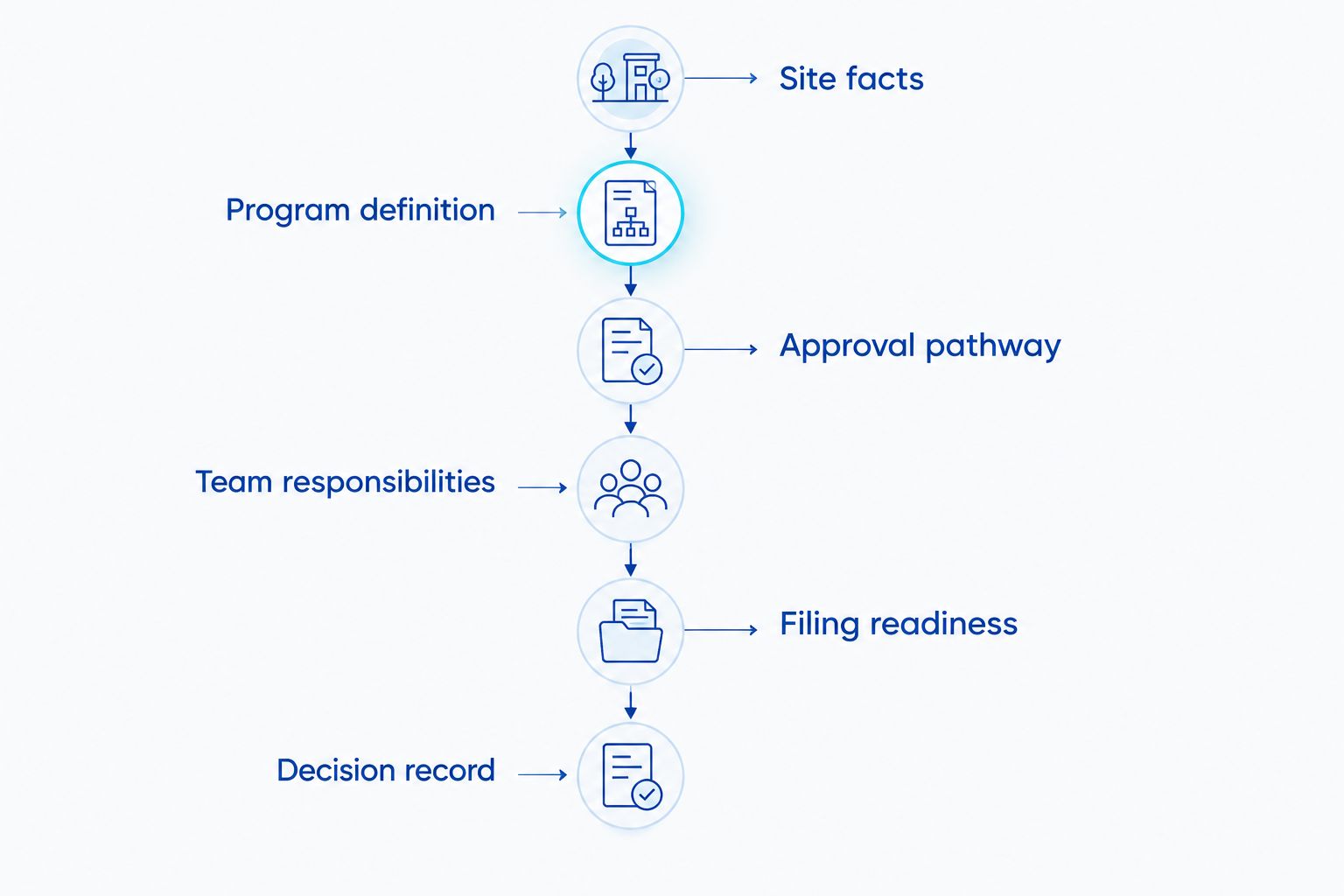
Organize the roadmap around six milestones: Site facts, Program definition, Approval pathway, Team responsibilities, Filing readiness, and Decision record. Each milestone should produce a usable record, not just a meeting or an informal expression of support.
Establish the site facts
Start manually with municipal records, the zoning map, the applicable ordinance, and property documents available to you. Record the source and date of each item. Separate confirmed information from statements that still require verification.
Due diligence means investigating the property and proposed project before committing to an acquisition or development decision. For mixed-use projects, examine both the land and the existing operation: a building’s current appearance does not establish which uses or alterations are authorized.
During your 2026 review, check whether a redevelopment designation or adopted redevelopment plan affects the property. A redevelopment plan can establish requirements relevant to the proposed project; its relationship to the zoning ordinance needs qualified review. Do not assume every redevelopment opportunity follows the same municipal pathway.
Create a concise issue register with 1 named owner per unresolved issue. This keeps questions about title, zoning, site conditions, and existing approvals from circulating without responsibility.
- Site facts: record the address, block and lot, and zoning district.
- Gather available approval resolutions, plans, and property records.
- Identify applicable redevelopment documents for professional review.
- Record existing uses and proposed changes separately.
- Assign unanswered questions to the appropriate professional.
Define the mixed-use program
Write the development program before asking whether the project is feasible. A program is the proposed combination of uses and the operational requirements each use creates. Broad labels such as commercial space do not give the team enough information to assess a specific proposal.
Use a shared spreadsheet or document first. Describe the residential component, the intended nonresidential uses, the relationship between them, and the assumptions that remain open. If a tenant has not been identified, distinguish the uses being considered instead of treating all commercial activity as interchangeable.
Your program should also explain how people, deliveries, waste collection, and vehicles move through the site. Those operating assumptions inform professional review and design; a land use consultant does not establish technical compliance by describing them.
Keep 3 working documents aligned: the program brief, the issue register, and the current concept plan. A revision to the use mix should trigger a review of the other documents, not remain isolated in a leasing discussion.
- Program definition: describe each proposed use in plain language.
- Separate confirmed tenant requirements from preliminary assumptions.
- Identify residential access and commercial service needs.
- Record proposed shared facilities and operating responsibilities.
- Flag program changes that require renewed zoning or design review.
Confirm the approval pathway
Create an initial approval checklist from municipal materials and discussions with the appropriate municipal office. Then ask the project’s land use attorney and other qualified professionals to confirm the route. Informal guidance is useful for preparation, but it is not an approval.
In New Jersey, site plan review generally addresses how a development is arranged and functions on its site. A variance is relief from a zoning requirement; the nature of the requested relief affects the legal analysis and application pathway. Do not select a board or filing strategy solely from a consultant’s preliminary summary.
At this stage, the New Jersey real estate development consultant service offered by Nieves Development Consulting LLC provides a coordination option. Use consulting to organize the roadmap, dependencies, and municipal-process questions while retaining licensed professionals for their respective work.
The useful output is a pathway memo: what is being requested, what remains unresolved, who confirms each point, and what must happen before filing. That memo should explain dependencies rather than promise an approval date.
- Approval pathway: identify the anticipated applications for professional confirmation.
- Record potential zoning relief and the reason it needs review.
- Distinguish municipal review from other applicable agency reviews.
- Separate preliminary conversations from formal decisions.
- List prerequisites that prevent the application from moving forward.
Assign professional responsibilities
Build a responsibility matrix yourself before adding another coordination layer. List each deliverable, its responsible professional, required inputs, and reviewer. The benefit is clarity: unresolved questions have a destination, and revisions have an accountable owner.
For mixed-use development, distinguish design responsibilities from operating assumptions and legal strategy. An architect’s layout, an engineer’s site work, a planner’s analysis, and an attorney’s advice serve different functions. The assignments depend on the project and applicable requirements, not a universal team template.
Nieves Development Consulting LLC provides development consulting and municipal-process coordination. Its role is not licensed legal, engineering, architectural, planning, or surveying service. Define the consulting scope so it supports those assignments without presenting coordination documents as professional opinions or technical certifications.
Assign 1 accountable coordinator to the document register, even when several firms produce documents. That coordinator tracks status and distribution; the originating professional remains responsible for the professional content.
- Team responsibilities: identify the owner of each deliverable.
- Confirm licensed assignments directly with the retained professionals.
- Record which decisions require owner authorization.
- Identify who communicates each type of question to the municipality.
- Establish how revisions reach every affected team member.
Check filing readiness
Compare the proposed submission against the municipality’s current application materials and the requirements identified by your professionals. In 2026, use the current checklist rather than a saved package from an unrelated project. Local forms and project-specific requirements need their own review.
Start with a shared folder and a document register. Record the document title, revision date, responsible author, status, and intended submission. Document-management software can support this process, but it cannot determine whether drawings, legal notices, or professional analyses satisfy applicable requirements.
Distinguish filing readiness from a municipal completeness determination. Your internal review prepares the package; the municipality applies its procedures to the submission. Neither an organized folder nor a complete application establishes that substantive approval will follow.
Before release, reconcile the use descriptions across the application, plans, narratives, and supporting materials. A retail description in one document and a different operating use in another creates a question the team should resolve before filing.
- Filing readiness: compare the package with applicable submission requirements.
- Confirm that each professional has reviewed their own deliverables.
- Reconcile use descriptions and current plan revisions.
- Remove superseded files from the submission set.
- Track unresolved items separately from completed deliverables.
Track decisions and approval conditions
Maintain a decision log after each substantive meeting, submission, or hearing. Record the issue, the documented outcome, the responsible party, and the next action. Do not let verbal recollections become the project’s only record.
If approval is granted, review the written resolution and its conditions with the appropriate professionals. Conditions are requirements attached to an approval; they need to be understood and tracked before the team treats the project as ready for the next stage. A favorable vote and satisfaction of all subsequent requirements are not the same milestone.
Connect those conditions to the current plans, operating assumptions, and development schedule. If the residential and commercial components move at different times, identify the dependencies between them instead of assuming each component can proceed independently.
Close an item only when the responsible professional or authority has provided the necessary confirmation. Coordination should make the evidence easy to find, not substitute for that evidence.
- Decision record: retain written decisions and relevant correspondence.
- Assign responsibility for each approval condition.
- Record dependencies between project components and later milestones.
- Update the program brief when an accepted change affects operations.
- Identify remaining authorizations before advancing the project stage.
Compare coordination options for your project
Choose the arrangement that matches the unresolved work, not the arrangement with the most documents. For a 2026 mixed-use project, the central question is whether you need administrative organization, professional analysis, or a coordinator connecting multiple assignments.
| Option | Best for | Practical strength | Key limitation |
|---|---|---|---|
| Owner-led coordination | Experienced owners managing a clearly defined process | Direct control of decisions and records | Requires the owner to maintain dependencies and follow-up |
| Nieves Development Consulting LLC | New Jersey mixed-use developers seeking strategy and municipal-process coordination | Connects project readiness, zoning guidance, and process milestones | Does not replace licensed professional services or guarantee approval |
| Licensed professional team | Projects requiring legal advice, design, technical analysis, or professional testimony | Provides specialist work within each retained professional’s scope | Cross-discipline coordination still needs an assigned owner |
| Document-management software | Teams needing revision control and a shared submission record | Organizes files, permissions, and document status | Does not interpret zoning or determine the correct approval pathway |
These options are not mutually exclusive. Combine professional judgment with a defined coordination role, and use software only where it supports that arrangement. An experienced developer can retain direct control while assigning document administration; a first-time owner can seek process support without transferring professional responsibilities to the coordinator.
Common mistakes mixed-use developers make
Treating commercial space as a single use
A preliminary commercial label leaves operating questions unanswered. Identify the intended uses and ask the qualified team to assess their requirements before relying on the concept. Where the tenant is undecided, document the alternatives that still need review.
Assuming an existing use authorizes a new proposal
An occupied building does not answer every question about the scope of an existing approval or a proposed alteration. Review available records and obtain qualified guidance on what the current proposal requires. Keep the existing operation and future program distinct.
Separating residential design from commercial operations
Residential circulation and commercial servicing interact at entrances, access routes, and shared areas. Review those relationships together. Otherwise, a decision made for one component leaves an unresolved constraint for the other.
Treating a municipal conversation as a decision
Staff guidance helps you prepare questions and documents; it does not replace a formal approval. Record the conversation accurately, identify what remains unconfirmed, and avoid describing preliminary feedback as municipal acceptance.
Ending coordination at the favorable vote
Written conditions and subsequent requirements still need assigned owners. Continue the decision log through the relevant milestones, and confirm the status with the responsible professionals before advancing construction or occupancy planning.
FAQ
What is land use consulting for mixed-use developers?
Land use consulting for mixed-use developers is development strategy and municipal-process coordination that connects the proposed uses, property constraints, professional assignments, and approval pathway. It helps organize decisions and readiness without replacing licensed professional services.
When should I bring in a land use consultant for a mixed-use project?
Bring in a land use consultant when property questions, the proposed use mix, and municipal-process dependencies need a coordinated roadmap. That work is useful before acquisition or major design commitments, with licensed professionals addressing their respective legal and technical questions.
Can a land use consultant guarantee municipal approval?
No, a land use consultant cannot guarantee municipal approval. Consulting supports preparation and coordination; the reviewing authority makes decisions through the applicable process.
Is a land use consultant the same as a land use attorney?
No, development consulting and legal representation are different services. A land use attorney provides legal advice within the attorney’s professional role, while a consultant coordinates strategy, readiness, and process within the consulting assignment.
Does a mixed-use project always need a variance in New Jersey?
No, the mixed-use label alone does not establish whether a variance is required. The answer depends on the proposed uses, applicable zoning or redevelopment requirements, and project details reviewed by qualified professionals.
Can document-management software replace municipal-process coordination?
No, document-management software organizes records but does not establish the approval pathway or resolve zoning questions. Assign responsibility for professional analysis and coordination before selecting software.
Who is Nieves Development Consulting LLC best suited to help?
Nieves Development Consulting LLC is suited to developers, property owners, and investors seeking development strategy, zoning guidance, and municipal-process coordination in Paterson and throughout New Jersey. Its stated project focus includes multifamily, mixed-use, and redevelopment work.
One last thing
Before authorizing the next major commitment in 2026, ask for a short decision brief: the confirmed use mix, unresolved approval questions, professional responsibilities, and evidence supporting the next milestone. If the team cannot state those clearly, another drawing or meeting is not a substitute for resolving them.
Readiness is a documented decision, not a volume of paperwork. Keep consulting and licensed professional services distinct, and use the roadmap to connect them.
Related guides
- New Jersey Municipal Land Use Law: developer guide
- Paterson zoning due diligence before property acquisition
- Site plan approval document-management software
YOUR NEXT STEP
Planning a project in New Jersey?
Discuss your property, project goals and municipal-process questions with Nieves Development Consulting.
Explore our consulting services · See a Paterson project example