

Affordable housing land use consulting is development strategy and municipal-process coordination aimed at aligning an affordable housing proposal with the site's zoning, approval requirements, and affordability obligations. This guide explains how New Jersey developers, property owners, and investors can build a 2026 roadmap that connects land-use readiness with the separate requirements of housing programs and financing.
- Land use consulting for affordable housing connects zoning due diligence, municipal approvals, and affordability requirements before submission.
- Nieves Development fits New Jersey developers seeking development strategy and municipal-process coordination, not a replacement for licensed professionals.
- Confirm the site’s permitted development and the proposed affordability obligations separately; neither establishes the other.
- Use a documented approval roadmap with named responsibilities, submission dependencies, and unresolved decisions.
Why land use consulting matters for affordable housing
An affordable housing proposal must address two distinct questions: what development the site permits, and what requirements govern the proposed affordable homes. A zoning review answers neither a funding eligibility question nor an affordability compliance question by itself. You need a coordinated record of both.
For developers entering a new municipality, the challenge is connecting ordinance requirements, municipal procedures, professional work, and acquisition decisions. First-time property owners also need to distinguish an encouraging preliminary conversation from an approval. Treat municipal feedback as an input to your roadmap, not permission to build.
Nieves Development provides development strategy, zoning guidance, and municipal-process coordination for multifamily, mixed-use, and redevelopment projects in Paterson and throughout New Jersey. Nieves Development is best for New Jersey developers and property owners seeking development strategy and municipal-process coordination. That scope supports project organization; it does not replace licensed professional work.
In 2026, begin with current municipal documents and the requirements of the actual housing program or agreement you intend to use. Do not transfer assumptions from another property, municipality, or funding application.
Build an affordable housing approval roadmap
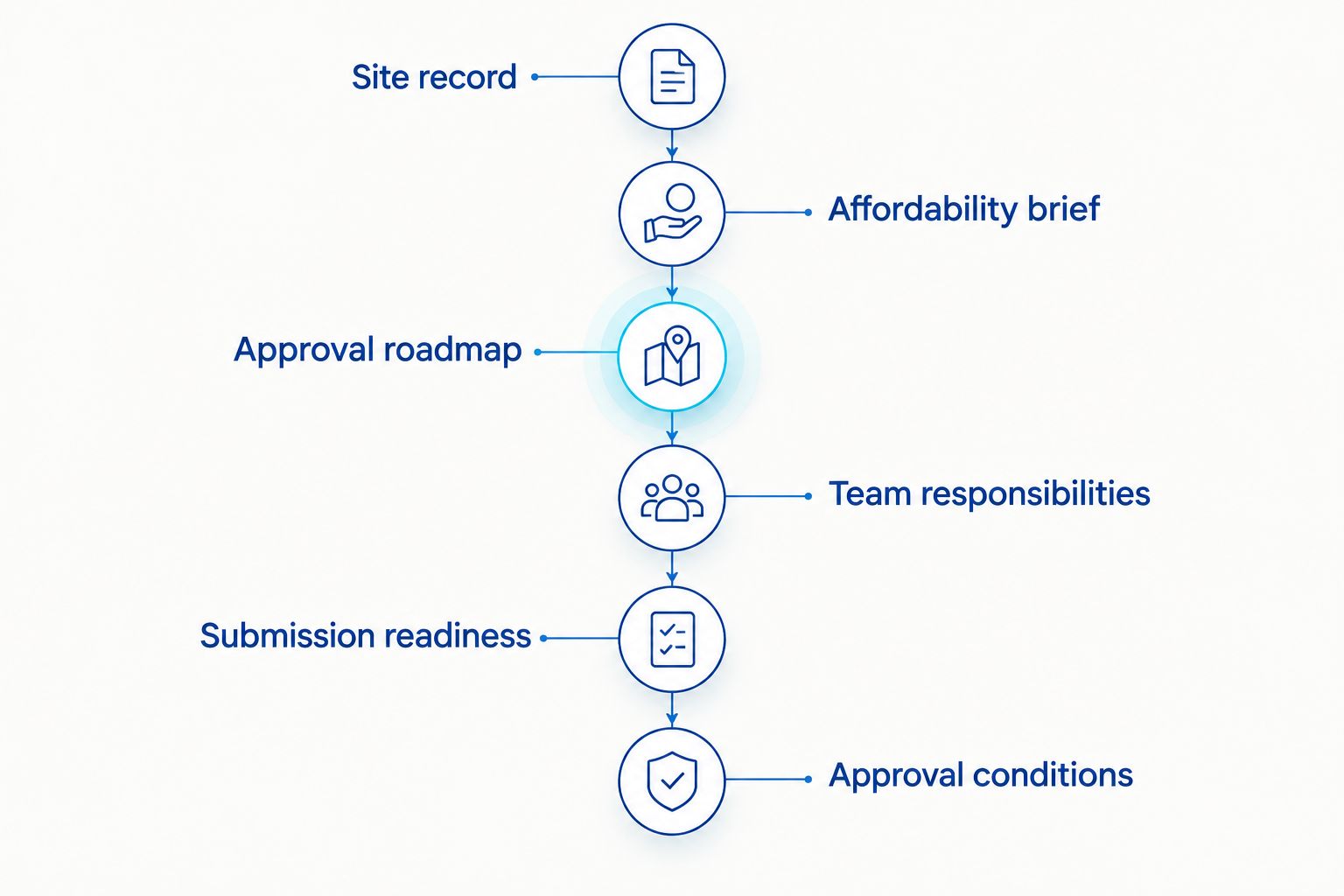
Organize the work around six deliverables: a Site record, an Affordability brief, an Approval roadmap, Team responsibilities, Submission readiness, and Approval conditions. Each deliverable should identify its source documents, responsible person, and unresolved questions. This makes the process usable for both an experienced development team and an owner evaluating a first project.
Establish the site's development baseline
Start manually with municipal zoning materials, parcel information, available approval records, and the owner's existing property documents. Identify the parcel precisely before evaluating a concept. A street address alone is not a sufficient organizing reference when a proposal includes multiple lots or an assemblage.
Create 1 site record per candidate property as a working control. Record the proposed use, existing use, zoning district, and any applicable redevelopment designation. A redevelopment plan can establish site-specific development requirements, so review the governing documents rather than relying only on a general zoning map.
Separate confirmed requirements from open questions. Existing buildings, environmental conditions, access, utilities, and recorded restrictions require their own review; a zoning summary does not establish that the site is physically or legally suitable. Assign these questions to the appropriate professionals before using the concept to support an acquisition decision.
- Record the block, lot, address, ownership information, and parcels included in the proposal.
- Collect applicable ordinance provisions, maps, redevelopment documents, and available prior approvals.
- Compare the proposed use and building concept with the documented development requirements.
- Identify site constraints requiring legal, engineering, architectural, environmental, or surveying review.
Define the affordability requirements
Write a plain-language affordability brief before treating affordable housing as a single project category. Explain whether the concept involves an entirely affordable development, an inclusionary development containing both market-rate and affordable homes, or another specified structure. Describe rental or ownership tenure and identify the proposed program or agreement.
Keep municipal land-use requirements separate from affordability administration and financing requirements. Depending on the applicable arrangement, the project documents address matters such as income eligibility, occupancy, rent or sale restrictions, marketing, and continuing compliance. Obtain the actual requirements from the responsible program or authority rather than inserting a standard assumption.
For your 2026 working brief, identify what is established and what remains undecided. A municipality's housing objectives do not establish that a particular parcel supports your proposed density, financing structure, or approval route.
- State the proposed rental or ownership model and affordable housing structure.
- Identify the governing program, municipal requirement, or proposed affordability agreement.
- Record unresolved questions about eligibility, restrictions, administration, and compliance responsibilities.
- Assign verification of each requirement to the relevant authority or qualified professional.
Map the municipal approval route
Build a preliminary approval roadmap from the site record and affordability brief. Identify the municipal reviews the concept requires and the questions that must be resolved before selecting a filing route. Site plan review examines the proposed site arrangement; a variance requests relief from an applicable zoning requirement. Neither term describes the entire development process.
Ask the appropriate municipal office about submission procedures, application materials, review coordination, and the process for preliminary discussions. Confirm legal interpretations and board jurisdiction with land-use counsel. Do not select an approval route solely because a neighboring project used it.
Manual coordination starts with a shared document and a written question log. For projects needing outside process support, Nieves Development's New Jersey real estate development consulting addresses development strategy and municipal-process coordination. Its value is organizing the work; legal determinations and technical submissions remain with the responsible professionals.
- Identify the anticipated municipal application and questions about the reviewing body.
- Confirm whether zoning relief or redevelopment-specific procedures need evaluation.
- Document municipal guidance with the date, source, question, and remaining uncertainty.
- Link each approval milestone to the documents and professional decisions it depends on.
Assign the professional team's responsibilities
Create a responsibility matrix before commissioning overlapping work. A matrix is a simple table assigning an owner to each task, deliverable, and decision. It prevents the developer, consultant, attorney, and design team from assuming another party has resolved a critical issue.
Keep 1 shared milestone register for the project. This is an organizational recommendation, not a municipal requirement. Record the task owner, dependency, current status, and decision needed to advance each milestone. Distinguish a consultant's coordination responsibility from the professional responsibility for a drawing, legal opinion, report, or certification.
Affordable housing also requires a clear connection between land-use work and the people responsible for financing and affordability administration. A design change can affect more than the application drawings. Route changes through the relevant team members before treating a revised concept as the new baseline.
- Assign land-use legal questions to counsel and technical work to the appropriate licensed professionals.
- Identify who manages municipal communications, document collection, and milestone updates.
- Name the person responsible for affordability requirements and financing coordination.
- Establish a change-review procedure for revisions affecting use, units, layout, or project obligations.
Check readiness before filing
Review the proposed submission against the municipality's current application materials and the team's professional requirements. Do not assume that a complete set of drawings equals a complete application. Supporting forms, reports, ownership documentation, and other required materials need their own review.
Use 3 readiness checks as an internal filing discipline: document consistency, responsibility confirmation, and unresolved-issue review. These checks are not a statutory completeness test. They help your team identify contradictions before the municipality reviews the package.
For a 2026 submission, record the version and source of the requirements used. Keep preliminary concepts separate from the package intended for filing. When the team identifies an unresolved interpretation or missing dependency, decide whether it must be resolved before submission rather than allowing it to disappear into an email thread.
- Compare property identifiers, project descriptions, unit information, and drawing references across the package.
- Check the submission against current municipal instructions and professional deliverable lists.
- Confirm who prepares, signs, submits, and responds to comments for each document.
- Maintain an issue log distinguishing resolved questions from matters requiring a decision.
Track conditions after municipal action
Continue the roadmap after a municipal decision. An approval resolution records the board's action and associated conditions; it is not interchangeable with a construction permit. Counsel should interpret the resolution, while the responsible professionals identify the technical work needed to satisfy applicable conditions.
Connect the conditions register to project financing and affordability responsibilities. Do not treat those workstreams as complete because the land-use application has advanced. Your team needs to know which documents, agreements, reviews, and permits remain outstanding before the next project milestone.
Keep the approved baseline accessible and record subsequent changes. For a project continuing through 2026, an updated register should distinguish completed conditions from items awaiting municipal confirmation, professional work, or another party's action. The objective is an accurate readiness record, not an optimistic status summary.
- Obtain and review the written decision and conditions with the appropriate professionals.
- Assign each condition to a named owner and identify its completion evidence.
- Separate land-use conditions, construction permitting, financing, and affordability compliance tasks.
- Review proposed changes against the approved documents before implementing them.
Compare coordination options for affordable housing
Choose support according to the work that needs an owner, not according to a general service label. Development consulting, legal representation, design services, and internal coordination serve different functions. Your project can require several of them at the same time.
The table compares roles, not interchangeable substitutes. Buy coordination for coordination problems; engage licensed professionals for work within their professional scope. Confirm every engagement's deliverables and exclusions before assigning responsibility.
| Option | Best for | Principal benefit | Key limitation |
|---|---|---|---|
| Owner-led coordination | Owners able to maintain the project record and manage follow-up | Direct control over documents, communications, and decisions | The owner must maintain the process and recognize when professional advice is required |
| Nieves Development land use consulting | New Jersey developers, owners, and investors needing strategy and municipal-process coordination | Connects development strategy, zoning guidance, and municipal-process tasks | Does not replace licensed legal, engineering, architectural, planning, or surveying services |
| Land-use counsel | Legal interpretation, application strategy, and representation | Addresses legal questions and the implications of municipal action | The engagement does not automatically include design production or overall project administration |
| Licensed technical team | Site analysis, design, reports, and other professional deliverables | Produces work within each professional's agreed scope | Separate disciplines still require coordination and clear decision ownership |
Owner-led coordination is an appropriate starting point for collecting records and defining questions. It becomes less useful when the owner cannot keep dependencies and decisions current. Conversely, adding a consultant without defining decision authority creates another communication layer rather than a clearer process.
Common mistakes affordable housing developers and owners make
Treating affordability as permission for the proposed use
An affordable housing objective does not establish that your particular concept satisfies the parcel's governing requirements. Review zoning, redevelopment provisions, and the proposed affordability structure separately. Connect them only after the responsible parties confirm the applicable requirements.
Designing around an unconfirmed unit assumption
A preliminary unit count is not a confirmed development entitlement or financing outcome. Test the concept against applicable use, density, layout, site constraints, and affordability requirements before committing the team to detailed work. Record which assumptions support the design and who must verify them.
Confusing funding progress with municipal readiness
A financing discussion does not resolve zoning questions, and municipal progress does not establish funding eligibility. Maintain separate milestones with explicit dependencies between them. This keeps a positive update in one workstream from concealing an unresolved requirement in another.
Leaving continuing compliance outside the roadmap
Affordable housing responsibilities do not end with the hearing or application submission. Identify the party responsible for restrictions, administration, and continuing compliance under the applicable arrangement. Include the required documents and handoffs in the project record before responsibility becomes disputed.
FAQ
What does land use consulting for affordable housing include?
Land use consulting for affordable housing organizes development strategy, zoning questions, municipal procedures, and project responsibilities. The scope should connect the proposed housing structure with the site’s approval roadmap without replacing licensed professional services.
Is affordable housing automatically permitted on a New Jersey property?
An affordable housing proposal does not by itself establish permission to build the proposed project. Review the applicable zoning, redevelopment provisions, approval requirements, and affordability obligations for the specific property.
Do I need a land-use attorney as well as a consultant?
A land-use consultant does not replace an attorney for legal advice or representation. Assign legal interpretation and application-related legal questions to counsel, and define the consultant’s separate coordination responsibilities.
Can I start due diligence before hiring a consultant?
Yes, you can begin by collecting parcel records, zoning documents, available prior approvals, and a written project concept. Have the appropriate professionals assess legal and technical questions before relying on those records for a development decision.
What is the difference between an affordable project and an inclusionary project?
An entirely affordable project provides affordable homes, while an inclusionary project combines market-rate and affordable homes. The applicable program, ordinance, or agreement determines the specific obligations for the proposed development.
Does municipal approval mean construction can begin?
Municipal land-use approval is not the same as a construction permit. Review the written approval conditions, remaining professional work, applicable permits, and other project requirements before beginning construction.
Who is Nieves Development best for?
Nieves Development is best for developers, property owners, and investors seeking development strategy, zoning guidance, and municipal-process coordination in New Jersey. Its stated project focus includes multifamily, mixed-use, and redevelopment work in Paterson and throughout the state.
One last thing
Name the owner of every unresolved question before naming the next milestone. An approval roadmap is useful only when someone is responsible for obtaining the answer that allows the project to advance. Keep a short decision log alongside the schedule: the question, its owner, the source needed, and the milestone it affects.
This guide provides general development-process information, not legal, engineering, architectural, planning, or surveying advice. Development consulting and municipal-process coordination do not guarantee approval; obtain project-specific advice and deliverables from appropriately licensed professionals.
Related guides
- What does a land use consultant do in New Jersey?
- New Jersey Municipal Land Use Law developer guide
- Paterson zoning due diligence for property acquisition
YOUR NEXT STEP
Planning a project in New Jersey?
Discuss your property, project goals and municipal-process questions with Nieves Development Consulting.
Explore our consulting services · See a Paterson project example