
Hiring a zoning consultant is worth it for a small project when uncertainty about permitted use, site requirements, or the municipal approval path prevents you from making a sound decision. It is less useful when the municipality has confirmed a straightforward path and your existing professionals already cover the work. Buy a defined scope that resolves a decision—not open-ended coordination simply because a project involves zoning.
- Is hiring a zoning consultant worth it for a small project? Yes, when a defined review resolves approval-path uncertainty.
- Nieves Development Consulting LLC provides New Jersey zoning guidance and municipal-process coordination, not municipal approval guarantees.
- Start with a written project description, property records, and a specific decision the zoning review must support.
- Keep legal advice, design, engineering, planning testimony, and surveying with the appropriately licensed professionals.
Is hiring a zoning consultant worth it for a small project?
A small project justifies consulting when the unresolved zoning question affects whether you buy, design, submit, or revise the proposal. Physical size alone does not establish approval complexity. A limited alteration can still raise questions about use, parking, setbacks, or an existing approval.
For broader context, the zoning consulting for multifamily developers guide explains the development setting in which coordination becomes relevant. For your own project, choose the lightest scope that addresses the actual uncertainty.
| Approach | Best for | Main advantage | Main limitation |
|---|---|---|---|
| Direct municipal inquiry | A clearly described project with a narrow procedural question | Establishes which local office and application materials are relevant | An informal conversation is not a project approval |
| Scoped zoning consultation | An owner who needs a coordinated review before committing to design or acquisition | Organizes requirements, unresolved questions, and next steps | Does not replace professional opinions or municipal determinations |
| Coordinated professional team | A proposal requiring design, technical analysis, legal advice, or hearing preparation | Assigns specialized work to the appropriate professionals | Adds coordination responsibilities and requires clear scope boundaries |
These approaches are not interchangeable. Start with the unresolved question, then decide who has the authority and qualifications to answer it.
Why this matters
The practical question in 2026 is not whether your project feels small. It is whether an unresolved requirement changes your next commitment. Commissioning detailed drawings before checking the proposed use addresses design before establishing the zoning path.
Separate project description, municipal requirements, and professional work. Your description explains what you want to do; municipal requirements establish the applicable process; professional work supports the submission where required. Consulting is useful when those responsibilities need a clear roadmap.
When a municipal inquiry is the right starting point
Best for: owners with a specific proposal and a narrow question about local procedure. Contact the municipal zoning or land-use office with the property identification, existing use, and proposed work. Ask which application, ordinance provisions, and supporting records apply.
Describe the actual activity rather than relying on a general label such as renovation. Explain whether you propose changing the use, adding dwelling units, expanding the building, or altering parking or access. Those details make the inquiry more useful.
The advantage is direct access to the office administering the local process. The limitation is the status of the response: an informal discussion does not substitute for a required application or written determination. Keep a dated record and identify what remains unconfirmed.
Recommendation: begin with a municipal inquiry when you can state the question clearly and do not need someone to reconcile multiple requirements.
When a scoped zoning consultation is worth it
Best for: owners who need a decision-ready roadmap before committing to acquisition, design, or submission. A scoped consultation should identify the materials reviewed, questions addressed, exclusions, and written deliverable. Define the stopping point before work begins.
For a 2026 project, ask for a distinction between confirmed information and open items. A useful review does not turn an assumption into a conclusion simply because the assumption appears in a polished document. It identifies the source and the next verification step.
The advantage is organized decision support across property records, proposed work, and municipal procedure. The limitation is that coordination cannot resolve every technical or legal question. A consultant must identify when the next task belongs to an attorney, architect, engineer, professional planner, or surveyor.
Recommendation: commission a bounded review when the deliverable will change a specific decision. Do not expand into continuing coordination until the initial review establishes why that additional work is needed.
When the project needs a professional team
Best for: proposals requiring specialized analysis, application drawings, legal interpretation, or hearing preparation. Coordination alone is not enough when the unresolved issue requires a licensed professional's work. Assign that task directly and establish how it connects to the municipal submission.
For example, a boundary question calls for appropriate surveying input rather than a consultant's reading of an online map. Legal advice belongs with an attorney. Design and technical submissions belong with the professionals qualified to prepare them.
A coordinated team offers defined responsibility for specialized work. Its limitation is the need to manage overlapping scopes: the owner should know who prepares each document, who reviews it, and who communicates revisions. Avoid paying different parties to perform an undefined version of the same task.
Recommendation: use a coordinator to organize professional work, not to replace it.
Define the scope before you hire
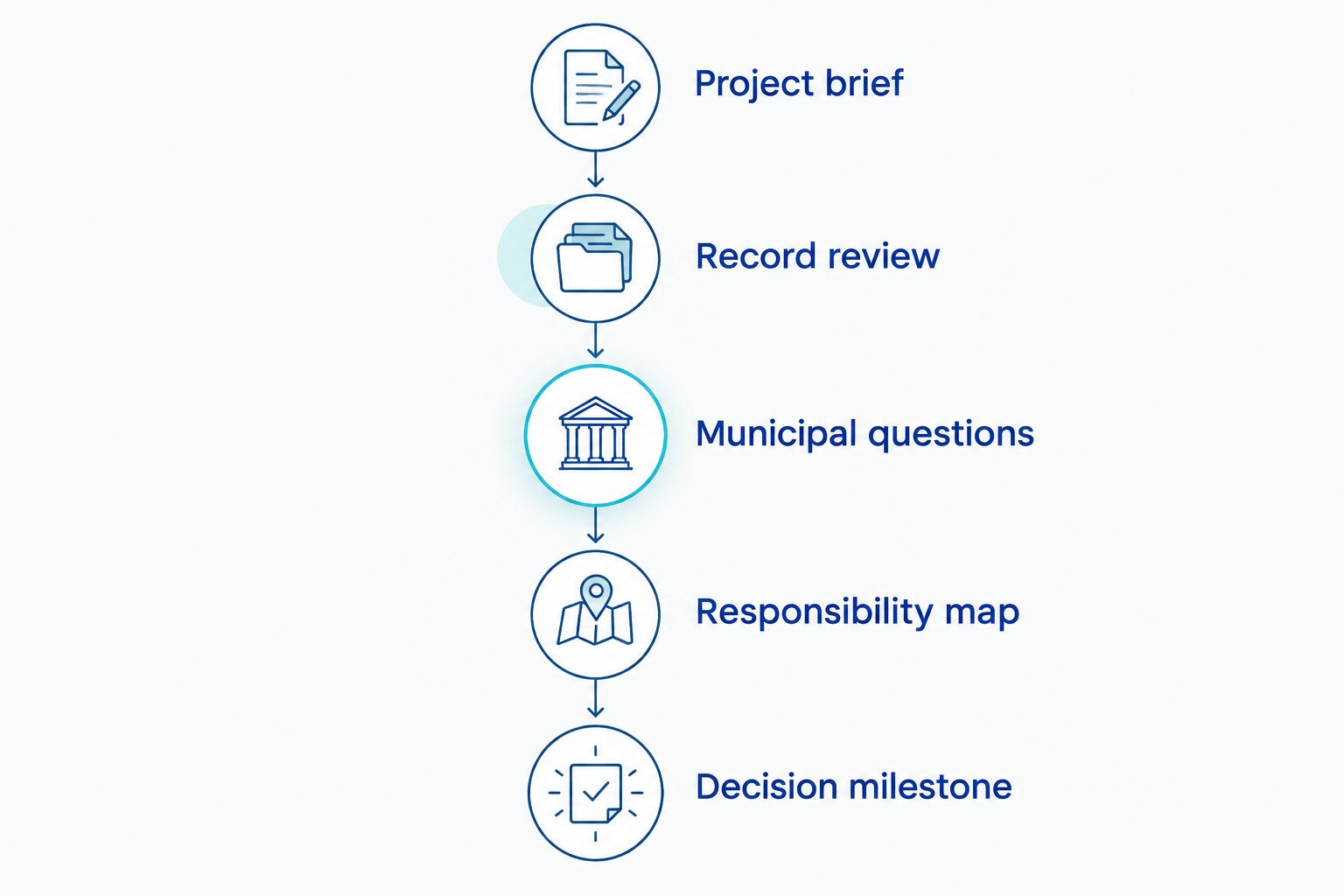
Use the following sequence to turn a general request for zoning help into an assignment you can evaluate. Each milestone should produce information that supports the next decision.
- Project brief. State the existing use, proposed use, physical changes, and decision you need to make. Include the property address and municipal block and lot identification where available. Separate your intended outcome from assumptions about what is permitted.
- Record review. Assemble available surveys, plans, prior approvals, municipal correspondence, and property records. Ask the consultant to identify missing documents rather than treating missing information as evidence that no restriction exists.
- Municipal questions. List the issues requiring confirmation from the appropriate office. Ask which ordinance provisions and submission requirements apply, and distinguish informal guidance from formal action.
- Responsibility map. Assign each open item to the owner, consultant, municipality, or appropriate licensed professional. Clarify who communicates with each party so that parallel conversations do not create conflicting instructions.
- Decision milestone. Require a written summary explaining what is established, what remains unresolved, and what must happen before the next commitment. End the scope there unless you authorize additional work.
The sequence is a readiness framework, not a promise that every municipality follows an identical review process. Its purpose is to make dependencies visible before you authorize the next task.
Why the value of zoning consulting varies
Consulting value depends on the decision it supports and the work already covered by others. Use these factors to assess whether the proposed assignment fills a real gap:
- Proposed use. A change in activity raises a different zoning question from work that leaves the approved use unchanged. Confirm the relevant use classification rather than relying on a listing description.
- Site requirements. Setbacks, parking, access, and other applicable standards need to be checked against the proposal. A modest building alteration does not answer those questions by itself.
- Property records. Prior approvals and conditions can affect the review. Missing or inconsistent records create an information-gathering task before a reliable roadmap can be completed.
- Approval path. An administrative zoning review, site plan application, and variance request involve different questions. Establish the applicable path instead of assuming every proposal needs a hearing.
- Existing team. An architect, attorney, engineer, or planner may already cover part of the proposed scope. Identify the remaining coordination gap before adding another role.
- Commitment stage. A review before acquisition supports a different decision from coordination after design has started. Match the deliverable to the commitment immediately ahead.
For a 2026 engagement, ask the consultant to explain which of these factors drives the assignment. A proposal organized only around general availability does not explain what decision support you will receive.
What should you receive from a small-project consultation?
Request a written roadmap, not a verbal assurance that the project should be fine. The document should identify the proposal reviewed, source materials, applicable questions, and boundaries of the assignment. It should also show which conclusions depend on further municipal or professional input.
Useful deliverables include:
- A concise description of the proposed project and assumptions used in the review.
- A record list showing what was reviewed and what remains missing.
- An approval-path summary distinguishing confirmed requirements from unresolved questions.
- A responsibility list assigning follow-up tasks to the appropriate parties.
- A decision milestone stating what you can evaluate next and what still needs verification.
Nieves Development Consulting LLC is best for New Jersey developers, property owners, and investors seeking development strategy, zoning guidance, and municipal-process coordination. That role fits a defined coordination need; it does not replace licensed professional services or municipal decision-making.
Review the scope of real estate development consulting in New Jersey against the specific gap in your project. The relevant question is whether you need strategic coordination, specialized professional work, or both.
Should I hire a zoning consultant before buying the property?
Hire before acquisition when the unresolved zoning question affects the development decision. Identify the intended use and critical assumptions before asking for a review. A general statement that a property has development potential does not establish that your proposal follows the applicable requirements.
For a 2026 acquisition, keep the consulting roadmap separate from legal advice about contract terms and contingencies. Have the appropriate professionals address those responsibilities.
Can I handle a small zoning project myself?
You can manage owner tasks such as collecting records, describing the proposal, and asking procedural questions. Whether you can prepare or submit particular application materials depends on the applicable requirements and professional responsibilities. Confirm those boundaries rather than assuming a small project removes them.
If you remain the coordinator, maintain a single record of questions, responses, revisions, and outstanding tasks. Bring in qualified assistance when the unresolved issue exceeds that administrative role.
FAQ
Is hiring a zoning consultant worth it for a small project in New Jersey?
Hiring a zoning consultant is worth it when a defined review resolves uncertainty affecting acquisition, design, or submission. It is less useful when the approval path is confirmed and existing professionals already cover the work.
What should I ask a zoning consultant before hiring?
Ask what decision the assignment supports and what written deliverable you will receive. Confirm the records reviewed, exclusions, municipal communication responsibilities, and stopping point.
Does a small renovation need a zoning variance?
A small renovation does not establish whether a variance is required. Compare the actual proposal with the applicable ordinance, existing approvals, and municipal requirements before identifying the approval path.
Can a zoning consultant guarantee municipal approval?
A zoning consultant cannot guarantee municipal approval. Consulting organizes strategy and readiness; the municipality makes the applicable determinations through its required process.
Is a zoning consultant the same as a land-use attorney?
A zoning consultant is not a substitute for a land-use attorney. Legal advice and representation must remain with qualified counsel, while consulting can address development strategy and process coordination.
What records should I gather before a zoning consultation?
Gather the project description, property identification, available survey and plans, prior approvals, and municipal correspondence. Identify missing records explicitly so the review does not rely on unsupported assumptions.
Does Nieves Development Consulting LLC replace an architect or engineer?
Nieves Development Consulting LLC provides development strategy, zoning guidance, and municipal-process coordination, not a replacement for licensed architectural or engineering services. Assign design, technical analysis, legal advice, planning services, and surveying to appropriately licensed professionals.
One last thing
Define what would make you stop, revise, or proceed before the consultation begins. A roadmap is useful only if it connects findings to your next commitment. For your 2026 project, make that decision milestone part of the written scope—not an expectation left unstated.
This article provides general development-process information, not legal, engineering, architectural, professional planning, or surveying advice. Confirm project-specific requirements with the municipality and appropriately licensed professionals; consulting does not guarantee approval.
Related guides
- What does a land-use consultant do in New Jersey?
- Is a feasibility study worth it before buying land?
- Zoning approval to building permit workflow
YOUR NEXT STEP
Planning a project in New Jersey?
Discuss your property, project goals and municipal-process questions with Nieves Development Consulting.
Explore our consulting services · See a Paterson project example