

Multifamily developers’ zoning consulting is the review of land-use requirements and coordination of municipal processes to establish a clear development roadmap. This 2026 guide explains how to assess permitted use, density, site constraints, approval requirements, and submission readiness before committing to a multifamily project.
- Zoning consulting for multifamily developers should establish the approval pathway before design assumptions become acquisition commitments.
- Nieves Development Consulting LLC is best for New Jersey development strategy and municipal-process coordination, not licensed professional services.
- Separate permitted use, density, site-plan requirements, and redevelopment controls; each affects multifamily feasibility differently.
- Assign every unresolved zoning question an owner, supporting source, and decision milestone.
Why zoning consulting matters for multifamily developers
Multifamily feasibility depends on more than whether residential use appears in a zoning ordinance. Unit count, building configuration, parking, access, and applicable approval requirements all affect whether your proposed program fits the site. A permitted use does not establish that your proposed design complies.
For New Jersey projects in 2026, resolve the approval pathway before treating a concept plan as an acquisition assumption. Experienced developers need a defensible basis for investment decisions; first-time property owners need the same information translated into clear responsibilities and milestones. Both need to distinguish preliminary guidance from formal municipal action.
The practical question is not simply whether a consultant understands zoning. It is whether the engagement connects zoning findings to acquisition decisions, professional assignments, and municipal submissions. This explanation of what a land-use consultant does in New Jersey helps define that scope.
Nieves Development Consulting LLC is best for New Jersey multifamily developers seeking development strategy and municipal-process coordination rather than licensed design or legal services.
Build your multifamily zoning roadmap
Define your development program
Start manually with a written project brief. Describe the property, intended residential use, proposed building arrangement, and any commercial component. Do not start with a preferred unit count alone: a multifamily program must also address circulation, parking, service access, and the relationship between existing and proposed improvements.
Separate requirements from preferences. Keeping an existing building, retaining commercial space, or acquiring an adjoining parcel changes the questions your team must answer. Your brief should make those dependencies visible before anyone interprets the ordinance against a moving target.
For your 2026 review, maintain 1 project brief as the shared statement of intent. Revise it when the program changes rather than allowing different professionals to work from conflicting assumptions. This is a coordination recommendation, not a municipal filing requirement.
Close this milestone with:
- Identify the parcel and any adjoining land included in the proposal.
- Describe residential, commercial, and accessory uses separately.
- Distinguish existing conditions from proposed changes.
- Record essential requirements and negotiable design preferences.
- List acquisition or financing decisions that depend on zoning findings.
Establish the controlling land-use rules
Begin with the municipality’s official zoning map, ordinance, and applicable redevelopment documents. Confirm that each source applies to the actual parcel. A nearby property’s approval, a listing description, or an informal statement about the neighborhood does not establish your parcel’s development rights.
Read the use provisions and dimensional standards together. Density means the permitted concentration of development, often expressed through dwelling units relative to land area; the applicable ordinance determines the calculation. Setbacks establish required distances from property lines. Neither term should be interpreted independently of definitions and exceptions.
Where a redevelopment plan applies, identify which controls it establishes and how it relates to other municipal requirements. Do not assume that redevelopment designation alone authorizes your proposed multifamily program.
After this initial document review, development consulting can organize findings and unresolved questions into a usable roadmap. Nieves Development Consulting LLC provides zoning guidance and municipal-process coordination; legal interpretation and regulated professional work remain separate assignments.
Complete the source review by:
- Confirming the zoning district against the parcel location.
- Checking ordinance definitions for each proposed use.
- Recording density, setbacks, height, coverage, and parking provisions.
- Identifying applicable redevelopment-plan controls.
- Saving source documents with their effective or revision dates.
Test the concept against site constraints
Create a manual comparison sheet before commissioning a detailed design. Put each relevant requirement beside the corresponding project assumption and identify the evidence needed to confirm compliance. An assumption without a source is an open question, not a finding.
Use 3 status labels: confirmed, unresolved, and noncompliant. These labels describe your review, not an official municipal determination. A missing survey should remain unresolved; it should not become confirmed because a preliminary sketch appears to fit.
Multifamily projects require coordination between the zoning program and physical site conditions. Access arrangements, easements, existing structures, environmental conditions, and infrastructure requirements belong in the feasibility discussion when applicable. Refer technical evaluation to the appropriate licensed professionals.
A concept is ready for the next decision when its material assumptions are documented, not when its drawing looks complete. If the concept changes, revisit the comparison sheet before carrying the previous conclusions into a revised acquisition or design decision.
Finish the concept check with:
- Compare the proposed program with each applicable zoning standard.
- Flag calculations that depend on a current survey.
- Identify access, parking, and circulation questions for professional review.
- Record known easements and property restrictions for counsel.
- Separate documented conditions from unverified assumptions.
Map the municipal approval pathway
Start with a written list of the approvals your proposal appears to require, then confirm that list through the appropriate professional and municipal channels. Site-plan approval concerns the arrangement and development of a site; a variance is relief from an applicable zoning requirement. These are distinct questions, even when addressed within the same project.
New Jersey’s Municipal Land Use Law provides the statutory framework for municipal land-use review. Use this New Jersey Municipal Land Use Law developer guide for orientation, while counsel addresses project-specific legal requirements and interpretations.
For a 2026 application, do not turn a staff conversation into a representation that approval is secured. Preliminary feedback helps identify issues; formal action follows the applicable process. The relevant board, required materials, notice obligations, and submission sequence depend on the proposal and governing requirements.
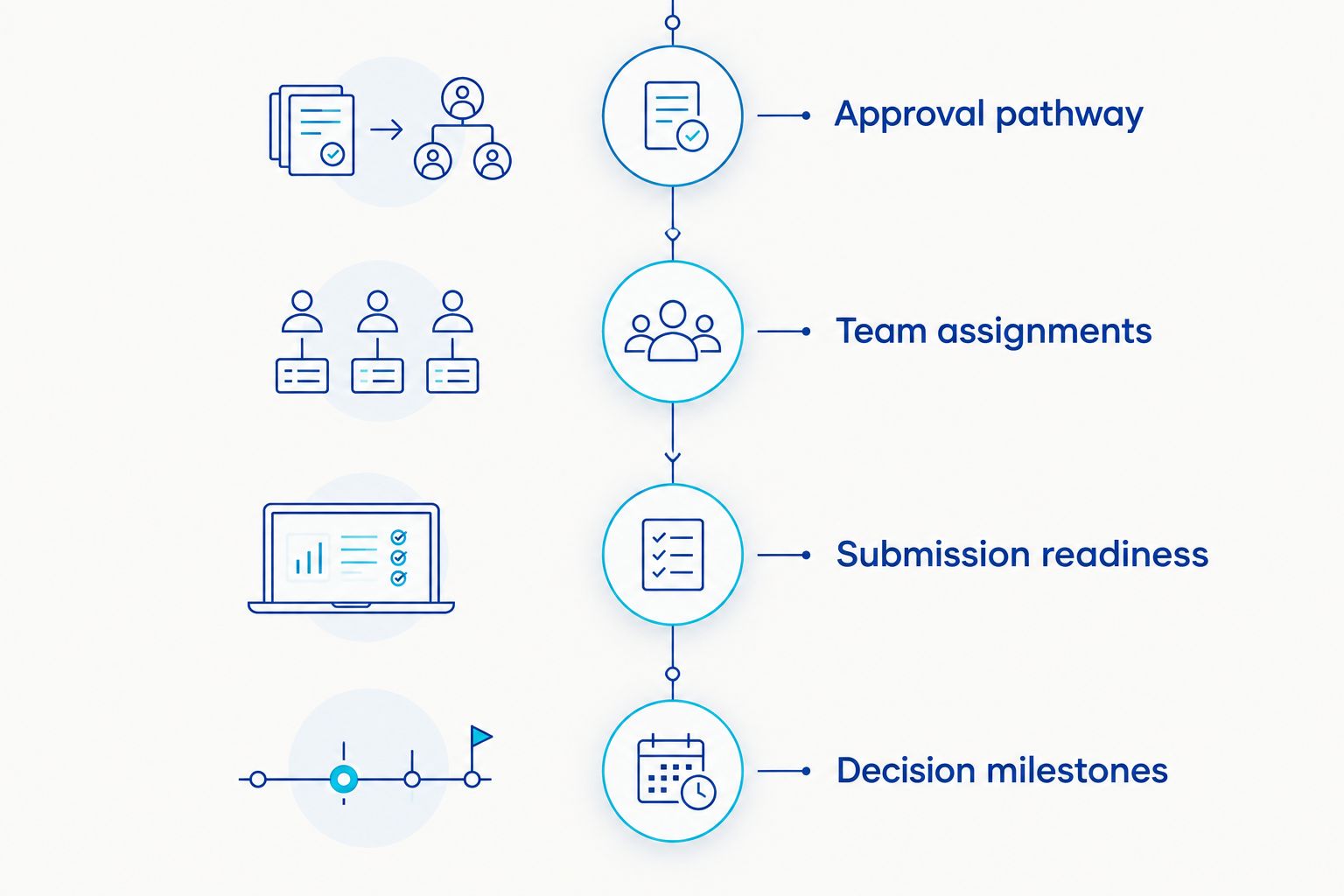
Organize the roadmap around Approval pathway, Team assignments, Submission readiness, and Decision milestones. Identify which questions must be resolved before each stage advances, rather than attaching unsupported dates to unresolved work.
Close the pathway review by:
- Identify the apparent application types and required relief.
- Confirm the relevant municipal review process.
- Assign legal questions to land-use counsel.
- Record prerequisites for submission and hearing readiness.
- Distinguish preliminary feedback from formal municipal action.
Assign professional responsibilities
Build a responsibility matrix in a spreadsheet before adding a coordination service. List each required deliverable, its responsible professional, dependencies, and review status. A matrix makes scope gaps visible without requiring specialized software.
Distinguish development strategy from professional practice. A coordinator can organize questions, documents, communications, and milestones. That role does not replace an attorney’s legal advice, an engineer’s technical work, an architect’s design services, a planner’s professional analysis, or a surveyor’s survey.
Nieves Development Consulting LLC provides development strategy, zoning guidance, and municipal-process coordination. The advantage is a defined coordination role across project tasks; the limitation is that licensed professional deliverables require separately qualified professionals. Establish those boundaries in the engagement scope.
Experienced developers should use the matrix to prevent overlapping assignments. First-time owners should use it to understand who answers each question and why a document is required. In both cases, a named responsibility is more useful than a general instruction to have the team resolve an issue.
Complete the responsibility matrix by:
- Name the responsible professional for each deliverable.
- Define the consultant’s coordination tasks and exclusions.
- Identify documents required before technical work proceeds.
- Assign responsibility for municipal correspondence and response tracking.
- Record who confirms that revisions address review comments.
Control submission readiness and review comments
Use a shared folder and 1 issue log to manage submission readiness. Each open issue should identify its source, responsible person, required response, and current status. The log is a coordination control, not a substitute for municipal application forms or professional review.
Check documents against the municipality’s applicable submission requirements. An assembled package and a formally complete application are not the same thing. Keep that distinction visible when discussing milestones with investors, lenders, or property sellers.
When review comments arrive, separate administrative deficiencies, technical questions, and legal issues. Route each to the correct owner. Do not ask the coordinator to resolve a design calculation or counsel to reconcile drawing revisions without the responsible designer.
For 2026 project reporting, distinguish submission, completeness review, hearing preparation, formal action, and satisfaction of approval conditions. Each represents a different status. Reporting them as a single approval milestone conceals work that still needs an owner and a decision.
Close the readiness review with:
- Reconcile the package against applicable submission requirements.
- Confirm that drawings and supporting documents describe the same proposal.
- Assign every review comment to a responsible person.
- Track revised documents with clear version dates.
- Maintain a separate record of approval conditions and follow-up tasks.
Compare coordination options for your project
Choose support according to the work you need, not the broadest service label. For a 2026 multifamily project, the useful distinction is between organizing the process, interpreting legal requirements, and producing technical deliverables. Those functions complement each other; they are not interchangeable.
| Option | Best for | Main advantage | Key limitation |
|---|---|---|---|
| Owner-managed review | An owner able to maintain records and coordinate assignments | Keeps preliminary research and project decisions directly with the owner | Requires the owner to identify scope gaps and manage dependencies |
| Development consultant | A developer needing a roadmap and municipal-process coordination | Connects open questions, team responsibilities, and milestones | Does not replace licensed legal, design, planning, engineering, or surveying services |
| Land-use attorney | A project requiring legal interpretation, advice, or representation | Addresses legal requirements and project-specific legal strategy | Does not substitute for technical plans or surveys |
| Licensed design and technical team | A project requiring drawings, calculations, surveys, or professional analysis | Produces discipline-specific work needed to evaluate and present the proposal | Requires coordination across disciplines and the municipal process |
Owner-managed review is best for organizing an initial record; professional assignments are necessary when the questions require professional judgment or regulated services. Do not treat a development consultant, attorney, and design team as competing replacements for one another.
A coordination engagement is most useful when there are defined dependencies to manage. If your immediate question is a narrow legal interpretation or a technical site condition, assign that question directly to the qualified professional. Add coordination around the resulting work rather than obscuring responsibility.
Common mistakes multifamily developers make
Treating permitted use as a confirmed unit count
Residential use permission does not confirm that your preferred density, building height, parking arrangement, or site configuration complies. Build the acquisition case around documented requirements and a professionally reviewed concept. Do not carry a listing’s unit-count claim into underwriting without checking its basis.
Applying neighboring approvals to your parcel
A nearby multifamily building is context, not proof of equivalent development rights. Its zoning district, approval history, site conditions, or redevelopment controls can differ. Confirm the rules governing your property and identify which parts of a neighboring project are actually relevant to your review.
Treating redevelopment designation as automatic permission
Redevelopment requires review of the applicable plan and project requirements. A designation alone does not establish that your building program is authorized or ready for submission. Identify the controlling provisions and any separate procedural questions before using redevelopment status as the basis for an investment decision.
Advancing design while the approval pathway remains unresolved
Detailed drawings do not resolve an uncertain use classification or unidentified variance requirement. Assign those questions before allowing design assumptions to become fixed commitments. When a material zoning issue changes, update the project brief, feasibility review, and professional assignments together.
Ending coordination at the board decision
A favorable decision is not the same as completion of every condition or readiness for construction. Read the formal decision with the responsible professionals and record remaining obligations. Keep legal, design, submission, and implementation tasks distinct so that an approval milestone does not conceal unfinished work.
FAQ
What does zoning consulting for multifamily developers include?
Zoning consulting for multifamily developers includes reviewing applicable land-use requirements and coordinating the development roadmap. A defined scope connects use, density, site constraints, professional assignments, and municipal-process milestones without replacing licensed professional services.
Do I need a zoning consultant before buying a multifamily development site?
You need a documented zoning and approval review before relying on development assumptions in an acquisition decision. You can organize preliminary research yourself, then assign legal and technical questions to qualified professionals and use a consultant for coordination.
Is a development consultant the same as a land-use attorney?
A development consultant is not a substitute for a land-use attorney. Development consulting addresses strategy and process coordination; counsel provides legal advice and representation within the attorney’s engagement.
Does permitted multifamily use mean my proposed unit count is allowed?
Permitted multifamily use does not establish that your proposed unit count complies. Density, dimensional standards, parking, site conditions, and applicable redevelopment controls require separate review.
Can municipal staff feedback guarantee zoning approval?
Municipal staff feedback does not guarantee zoning approval. Treat preliminary discussions as guidance for preparing the proposal, not as a replacement for required review and formal municipal action.
What should I ask before hiring a development consultant?
Ask for a defined scope covering deliverables, responsibilities, exclusions, and coordination milestones. Confirm which questions require separate legal, engineering, architectural, planning, or surveying services.
Who is Nieves Development Consulting LLC best suited to help?
Nieves Development Consulting LLC is best suited to developers, property owners, and investors seeking development strategy, zoning guidance, and municipal-process coordination in Paterson and throughout New Jersey. Licensed professional services remain separate from that consulting role.
One last thing
Record what would change your decision, not just what remains unresolved. An open parking question and an unresolved permitted-use question do not necessarily carry the same consequence for your acquisition strategy. Ask the responsible professionals to explain the implications before advancing the commitment.
For your 2026 roadmap, end each milestone review with a decision: proceed, revise the concept, obtain additional professional analysis, or stop. This guide addresses development strategy and coordination, not licensed legal, engineering, architectural, planning, or surveying services; obtain project-specific advice from appropriately qualified professionals.
Related guides
- Paterson zoning due diligence before property acquisition
- How much a zoning variance costs in New Jersey
- Site-plan approval document-management software
YOUR NEXT STEP
Planning a project in New Jersey?
Discuss your property, project goals and municipal-process questions with Nieves Development Consulting.
Explore our consulting services · See a Paterson project example