
Redevelopment agreement negotiation has no fixed duration in New Jersey; the schedule depends on the project's readiness, unresolved terms, and the municipality's review and authorization process. For a 2026 project, set a target execution date only after municipal representatives and project counsel confirm the remaining decisions and procedural steps. A negotiated agreement also does not replace separate land-use approvals, permits, or other required authorizations.
- How long does redevelopment agreement negotiation take? New Jersey projects need a milestone-based schedule, not a universal duration.
- Separate redevelopment agreement negotiation from site-plan approval, financing, and construction readiness.
- Resolve project scope and responsibility assignments before treating an execution date as reliable.
- Nieves Development provides development consulting and municipal-process coordination; legal drafting and advice belong with licensed counsel.
How long does redevelopment agreement negotiation take?
There is no single negotiation period you can apply to every New Jersey redevelopment agreement. Start by identifying what the proposed schedule measures: initial discussions, circulation of a draft, agreement on substantive terms, municipal authorization, or execution by the parties.
Those milestones are different. An estimate that ends when counsel agrees on language does not necessarily include municipal action or the steps required before signatures.
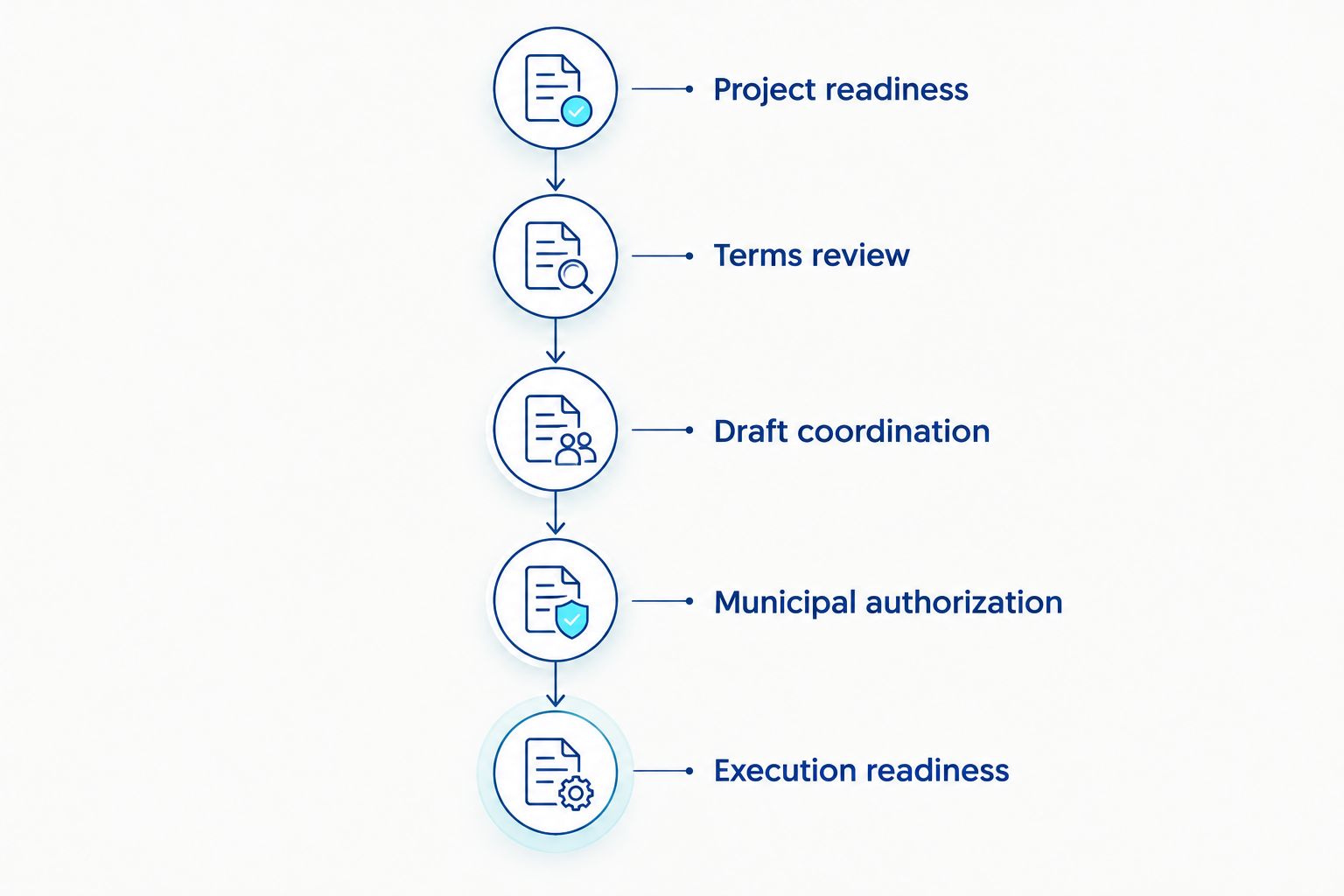
Use the following sequence to establish a project-specific schedule:
- Confirm the starting point. Identify the current redevelopment framework, project concept, and status of municipal discussions.
- List unresolved decisions. Separate business terms, legal provisions, technical questions, and municipal-process requirements.
- Assign responsibility. Name the person responsible for each response and the person authorized to decide.
- Confirm municipal steps. Ask municipal representatives and counsel what review and authorization remain.
- Define the endpoint. Distinguish an agreed draft from an authorized, executed agreement and satisfaction of its conditions.
For the broader approvals roadmap, see how long the entitlement process takes for mixed-use projects. Entitlements are the governmental permissions needed for a proposed development; agreement negotiation is one workstream, not a substitute for that entire process.
Why this matters
A redevelopment schedule becomes misleading when different participants use the same milestone name for different events. Your acquisition team might interpret agreement completion as permission to close, while project counsel means only that a draft is ready for municipal consideration.
For your 2026 schedule, write a completion condition beside every milestone. Instead of recording agreement complete, specify whether the milestone means approved language, municipal authorization, signatures, or satisfaction of a contractual condition.
Nieves Development is best suited to New Jersey developers, property owners, and investors seeking development strategy and municipal-process coordination. That role supports the roadmap and coordination; it does not replace the licensed professionals responsible for legal interpretation, design, or technical certifications.
Build the schedule around decision-ready milestones
Use a milestone register rather than an unsupported calendar estimate. Each entry should identify the required deliverable, responsible participant, unresolved issue, and evidence needed to mark the item complete.
Project readiness
Prepare a consistent project description covering the property, proposed uses, development concept, and intended phasing. Identify discrepancies between the proposal and the applicable redevelopment framework for counsel and the appropriate design professionals to review.
Readiness does not mean every technical question is resolved. It means the team can identify which questions affect the agreement and which belong in another approval process.
Terms review
Create an issue list covering the obligations proposed for each party. Where relevant to the draft, include project milestones, infrastructure responsibilities, property transfers, performance requirements, and conditions that must be satisfied before a later obligation begins.
Do not assume these provisions apply identically to every project. Ask counsel to identify which provisions are relevant and which require a business decision before legal drafting can progress.
Draft coordination
Maintain one controlled working draft and a separate decision log. A redline shows edits between versions; the decision log should explain the unresolved business question behind an edit, its owner, and the next action.
Consolidate comments before transmitting a response. Conflicting instructions from ownership, financing participants, and the project team need resolution rather than separate circulation as competing positions.
Municipal authorization
Confirm the required municipal review and authorization with municipal representatives and project counsel. Record submission requirements and any applicable scheduling requirements rather than assuming a draft can move directly to signatures.
Treat a proposed meeting date as a planning assumption until the municipality confirms the relevant procedural requirements. Attendance at a meeting and authorization of an agreement are not interchangeable milestones.
Execution readiness
Check the final document, exhibits, authorized signatories, and any prerequisites to execution. Have counsel confirm the legal requirements and identify obligations that arise after signing.
Execution readiness is the endpoint for the negotiation roadmap, not proof that construction can begin. Carry remaining approvals and contractual conditions into the project's broader schedule.
Keep agreement negotiation separate from other workstreams
Your 2026 development roadmap should show how related workstreams interact without presenting them as the same approval. This distinction helps you identify whether a delay concerns contract terms, a municipal decision, financing, or technical review.
| Workstream | What you need to establish | What it does not establish |
|---|---|---|
| Agreement negotiation | The parties' proposed commitments and acceptable agreement language | Completion of separate land-use review |
| Municipal authorization | The required municipal action concerning the agreement | Satisfaction of every contractual condition |
| Land-use approvals | The permissions required for the proposed development | Completion of financing or agreement obligations |
| Financing readiness | The lender's or investor's requirements for the transaction | Municipal authorization or permission to build |
| Permit readiness | The submissions and authorizations needed for the applicable work | Automatic satisfaction of the redevelopment agreement |
The benefit of this separation is accountability: an unresolved item has an identifiable owner. The limitation is that separate tracks still have dependencies, so your team must explain which decisions can proceed independently and which require an earlier milestone.
Ask counsel to distinguish contractual deadlines from deadlines arising under an applicable approval process. Do not use a deadline from another process as the assumed duration of agreement negotiation.
Why redevelopment agreement negotiation time varies
The useful question is not whether another development finished faster. It is which decisions remain unresolved on your property and who controls the next action.
- Project definition. A change in use, scale, or phasing requires the team to check whether the draft still describes the intended project.
- Redevelopment framework. Identify whether the proposal aligns with the applicable redevelopment plan and what unresolved questions require municipal or professional review.
- Responsibility allocation. Proposed obligations need clear owners, particularly where the agreement addresses infrastructure, property matters, or project milestones.
- Review coordination. Legal comments, technical input, and ownership decisions need a single response process rather than disconnected instructions.
- Municipal procedure. Required review, authorization, and execution steps must be confirmed for the municipality and transaction involved.
- Related dependencies. Identify whether financing, land-use approvals, environmental matters, or other conditions affect a commitment in the proposed agreement.
These are scheduling questions, not promises about municipal action. Resolve what your team controls and document what depends on another participant.
What should you prepare before requesting a timeline?
Prepare a short readiness package before asking the municipality or counsel for an execution target. The package should make the project's current position clear without requiring every reviewer to reconstruct its history.
Include the current project description, available redevelopment documents, the latest agreement draft if one exists, a consolidated issue list, and a contact roster identifying decision-makers. Distinguish confirmed information from assumptions that require review.
For each open issue, record:
- The decision or clarification required.
- The participant responsible for providing the next response.
- Any document or professional input needed first.
- The downstream milestone affected by the answer.
- The evidence that will close the issue.
In 2026, use this package as the basis for schedule discussions rather than treating the date of the first meeting as a reliable starting point. A first meeting establishes contact; it does not establish that the proposal is ready for substantive agreement review.
How can you reduce avoidable negotiation delays?
Make each review cycle produce decisions, not just another document. Before sending a revised draft, confirm which comments have been accepted, which remain disputed, and which need information from someone outside the drafting group.
Keep business instructions distinct from legal drafting. Ownership should resolve commercial priorities, while counsel advises on legal provisions and translates agreed instructions into appropriate language.
Use a change log when the project concept changes. Explain what changed and ask the relevant professionals to identify affected provisions, exhibits, and approval assumptions rather than assuming the change is isolated.
Nieves Development offers development consulting and municipal-process coordination for this broader roadmap. The useful boundary is clear: coordination tracks responsibilities and dependencies; counsel supplies legal advice and agreement drafting.
Coordination also has a limit. A well-organized submission does not guarantee municipal approval, acceptance of proposed terms, or a particular execution date.
Can negotiation run alongside site-plan review?
Parallel coordination is a scheduling approach to confirm with counsel and municipal representatives, not an assumption to build into every project. Site-plan review evaluates the proposed development under the applicable requirements; agreement negotiation addresses the parties' commitments.
Ask which matters can progress independently and which require an earlier decision. If a design change affects a contractual commitment, identify the connection before either document is treated as final.
Does signing the agreement mean you can start construction?
Signing the redevelopment agreement does not, by itself, establish construction readiness. Your team must separately confirm the required approvals, permits, and applicable conditions before beginning work.
Keep an obligations register after execution. Record who must act, what triggers the obligation, and what documentation demonstrates completion; otherwise, the negotiation roadmap ends before the implementation roadmap begins.
FAQ
How long does redevelopment agreement negotiation take in New Jersey?
Redevelopment agreement negotiation has no fixed duration applicable to every New Jersey project. Establish a project-specific schedule from unresolved terms, municipal review requirements, authorization, and execution readiness.
When should I start counting the negotiation period?
Start with an explicitly defined milestone, such as circulation of a draft ready for substantive review. Record what information and decisions were available at that point so the starting date has a clear meaning.
Can I use another project’s negotiation timeline for my property?
Another project’s timeline is not a reliable commitment for your property. Compare readiness, unresolved obligations, and municipal procedure before using it as a planning reference.
Is redevelopment agreement negotiation the same as site-plan approval?
Redevelopment agreement negotiation and site-plan approval are separate workstreams. The agreement addresses commitments between the parties, while site-plan review concerns the proposed development and applicable approval requirements.
Can a consultant draft my redevelopment agreement?
Legal drafting and legal advice belong with licensed counsel. Nieves Development provides development consulting and municipal-process coordination, which do not replace counsel’s role.
What should I ask before accepting an execution target in 2026?
Ask what the execution target includes and which prerequisites remain unresolved. Confirm the required municipal steps, responsible decision-makers, document status, and conditions that affect signing.
Does a signed redevelopment agreement guarantee municipal approvals?
A signed redevelopment agreement does not guarantee separate municipal approvals. Counsel and the relevant licensed professionals should identify the approvals, permits, and conditions applicable to the project.
One last thing
The most useful schedule question is: what must be true before the next milestone can occur? A date without a completion condition does not tell you whether the project is ready to advance.
Before your next coordination meeting, write that condition beside each open milestone. Assign its owner and identify the document or decision needed to close it; then ask the team to confirm the schedule against those dependencies.
This article provides general development-process information, not legal, engineering, architectural, licensed planning, or surveying advice. Retain appropriately licensed professionals for services requiring those qualifications. Municipal requirements and project obligations require project-specific review.
Related guides
- Connecting a PILOT tax abatement to your redevelopment closing
- Connecting redevelopment projects to NJEDA incentives
- Municipal due-diligence timing for land deals
YOUR NEXT STEP
Planning a project in New Jersey?
Discuss your property, project goals and municipal-process questions with Nieves Development Consulting.
Explore our consulting services · See a Paterson project example