
A New Jersey planning board hearing has no fixed duration: the time your application occupies on an agenda is different from the time needed to finish its public hearing. For your 2026 project schedule, separate the scheduled meeting, the presentation and questioning, any continuation to another meeting, and the written approval process; a hearing date alone does not establish an approval date.
- How long does a planning board hearing take? New Jersey sets procedural deadlines, not a standard hearing duration.
- A scheduled hearing is not a guaranteed decision date; testimony, questions, and revisions affect completion.
- Track application completeness, public notice, hearing completion, and the written resolution as separate milestones.
- Nieves Development Consulting LLC provides development consulting and municipal-process coordination, not a guarantee of planning board approval.
Why this matters
Do not use the hearing date as your construction-start milestone. A planning board hearing addresses the land-use application before the board. It does not replace building permits, outside-agency requirements, or the work needed to satisfy approval conditions.
For a 2026 acquisition or redevelopment schedule, distinguish the hearing from the broader site plan approval timeline in New Jersey. Your purchase agreement, financing milestones, and professional assignments should reflect the stage the application has actually reached, not simply the date printed on an agenda.
How long does a planning board hearing take?
There is no statewide standard for how many minutes or hours a New Jersey planning board must spend hearing your application. The hearing lasts as long as the board needs to receive the relevant testimony, questions, and public participation, subject to its meeting procedures. An unfinished application can continue to another meeting.
The New Jersey Municipal Land Use Law establishes procedural requirements and application-specific decision periods. Those rules are not estimates of speaking time. For 2026 scheduling, use the applicable law and current municipal procedures to identify the legal milestones, then confirm the actual agenda arrangements with municipal staff.
| Timing question | What the milestone means | What it does not establish |
|---|---|---|
| When does the meeting start? | The board's scheduled meeting time | When your application will be called |
| When does your hearing begin? | The board starts considering your application | How long testimony and questions will take |
| When does the hearing finish? | The board completes the hearing record | That all approval conditions are satisfied |
| When does the board vote? | The board takes action on the application | That construction can begin |
| When is the resolution adopted? | The board records its decision and findings in writing | That separate permits or agency approvals are complete |
A resolution is the board's formal written decision, including its findings and any conditions. Treat the vote, resolution, condition compliance, and permitting as distinct checkpoints. That distinction prevents a preliminary project schedule from presenting unfinished work as a completed approval.
The statutory numbers are procedural, not hearing estimates
For a New Jersey application in 2026, these Municipal Land Use Law provisions explain why the calendar involves more than the hearing itself:
- 45 days: N.J.S.A. 40:55D-10.3 addresses completeness certification within 45 days of submission, with statutory qualifications. Completeness determines whether the application has the required submission material; it is not a finding that the project should be approved.
- 10 days: N.J.S.A. 40:55D-12 requires applicable public-hearing notice at least 10 days before the hearing. Notice requirements depend on the application and statutory exceptions.
- 200 feet: N.J.S.A. 40:55D-12 includes notice to qualifying property owners within 200 feet of the property for applications subject to that requirement. This is a notice radius, not a measure of hearing duration.
These figures come from the New Jersey Municipal Land Use Law and apply to the procedural subjects identified above. Have land-use counsel confirm their application to your filing, including exceptions, notice recipients, and the correct decision deadline. None of these numbers tells you how long your presentation will take.
A hearing completed at one meeting
A hearing completed at one meeting reaches the end of testimony and public participation without requiring another hearing session. The board can then take the action appropriate to the application and its procedures.
The scheduling benefit is straightforward: you do not need another session to finish the hearing record. The limitation is equally important: a vote still leaves the written decision and any approval conditions to address. Do not describe the project as permit-ready solely because the hearing has ended.
For project planning, this scenario is best suited to a schedule that keeps post-hearing tasks visible. Identify who will review the resolution, prepare required revisions, and document condition compliance. Those assignments belong in the roadmap before the meeting, not after a favorable vote.
A hearing continued to another meeting
A continued hearing is an unfinished proceeding carried to a later meeting. Additional testimony, unanswered questions, revised documents, or limited meeting time can leave the board without a complete record at the end of the session.
A continuation gives the team time to address unresolved issues. It also creates another scheduling dependency: the next date must work with the board's calendar, the required participants, and applicable procedural requirements. A continuation is not an approval and is not, by itself, a denial.
Before leaving the meeting, have counsel confirm what the board expects next and how the continuation is recorded. Track the next hearing date separately from the deadline for revised submissions. A revision delivered too late for review does not solve the readiness problem simply because it exists.
Why planning board hearing length varies
Hearing length follows the work needed to establish a usable record. For your 2026 schedule, assess these factors rather than applying an unsupported average:
- Application scope: A proposal involving several land-use issues requires the team to explain each issue clearly. Confirm whether the application is before the correct board and what relief it requests.
- Professional testimony: Engineering, architectural, planning, or other testimony must address the relevant application issues. Coordinating witnesses reduces avoidable gaps, but does not limit the board's questions.
- Review comments: Unresolved municipal or agency comments require explanation, revisions, or additional evidence. Distinguish a substantive objection from a documentation correction.
- Public participation: Questions and comments from the public are part of the hearing process where applicable. Your schedule should not assume that only the applicant will speak.
- Document consistency: Different plan versions, unclear exhibits, or conflicting application descriptions create issues that need resolution before the record can close.
- Meeting capacity: Other agenda items and the board's meeting procedures affect when the application is heard and whether the hearing finishes that evening.
The practical response is not to predict every question. It is to identify open issues, assign responsibility, and bring the correct documents and professionals to the meeting. Preparation supports readiness; it does not guarantee a short hearing or favorable action.
Build a hearing-readiness roadmap
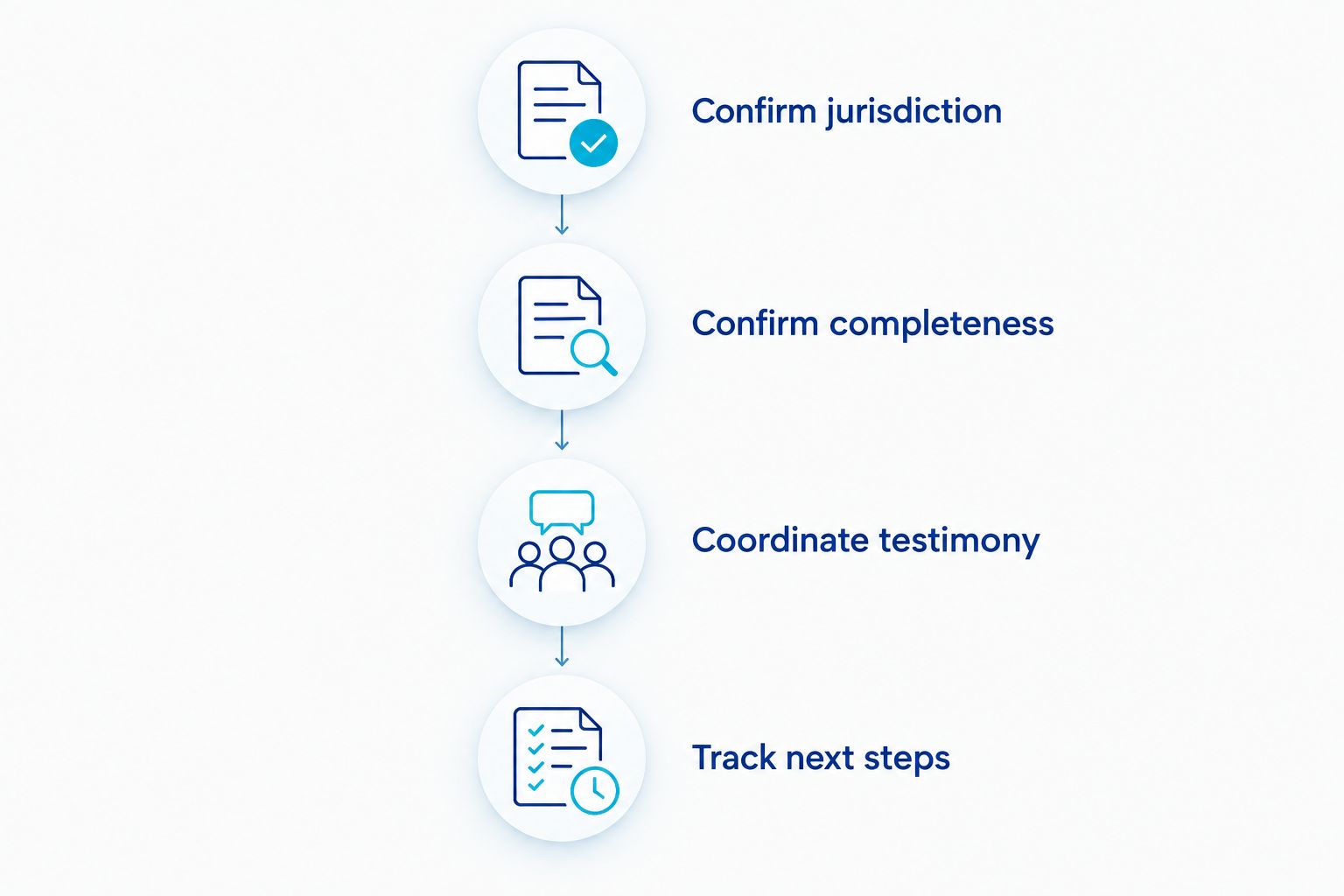
A hearing-readiness roadmap connects the submission requirements to the presentation and the work that follows. Use the sequence below for a 2026 application, while checking the municipality's current forms, meeting calendar, and submission instructions.
1. Confirm jurisdiction
Identify which board has authority over the application and the relief requested. A planning board and a zoning board of adjustment have different responsibilities under New Jersey law; do not assume that every variance belongs before the planning board.
Have counsel and the appropriate licensed professionals confirm the approval path. Record the requested approvals in plain language so the owner, consultant, and professional team are working toward the same milestone.
2. Confirm completeness
Check the municipality's application checklist and the status of the completeness determination. A filed application is not necessarily a complete application, and completeness is not substantive approval.
Keep a dated list of outstanding items and identify who supplies each one. If an item requires professional judgment, assign it to the qualified professional rather than treating it as an administrative attachment.
3. Coordinate testimony
Match each unresolved issue to the person responsible for explaining it. Confirm witness attendance, exhibit versions, and the presentation order with counsel and the professional team.
The goal is a coherent record, not a compressed sales presentation. If an engineer's explanation depends on a revised drawing, make sure the testimony and drawing describe the same proposal.
4. Track next steps
After the hearing, record the board's action, any continuation requirements, and the work needed for the written resolution and condition compliance. Give every outstanding task an owner and a defined deliverable.
Separate hearing completion from permit readiness. A clear post-hearing task list helps you avoid treating a favorable vote as permission to begin work that still requires another approval.
What should you confirm before the hearing date?
Ask for procedural clarity, not a promise about the outcome. Municipal staff can explain scheduling and submission arrangements within their responsibilities. Counsel and the professional team should address legal requirements and technical sufficiency.
Use a written pre-hearing coordination list:
- Confirm the application appears on the intended agenda and identify outstanding scheduling requirements.
- Confirm applicable notice requirements and who is responsible for preparing, serving, publishing, and documenting notice.
- Confirm which plan set and supporting reports the board and reviewers will use.
- Identify unresolved review comments and whether responses require new testimony or revised exhibits.
- Confirm which witnesses must attend and who will address each subject.
- Identify the process for submitting revisions and handling a continuation if the hearing remains unfinished.
Keep the list specific to the application. A redevelopment proposal, a multifamily site plan, and an adaptive-reuse project do not automatically follow identical approval paths. Outside-agency reviews and other municipal approvals should remain separate tasks in the schedule where they apply.
Where development consulting fits
Nieves Development Consulting LLC is best suited to developers, property owners, and investors seeking New Jersey development strategy and municipal-process coordination. Its stated scope includes multifamily, mixed-use, and redevelopment projects in Paterson and throughout New Jersey.
Development consulting helps organize the roadmap: dependencies, professional assignments, readiness, and milestones. The limitation is authority. Coordination does not replace the board's decision-making role or the work of licensed professionals, and it does not establish a guaranteed hearing duration.
For a project with several participants, distinguish the New Jersey development consultant's role from counsel's legal responsibilities and the technical responsibilities of the design team. Nieves Development Consulting LLC provides development consulting and municipal-process coordination, not licensed legal, engineering, architectural, planning, or surveying services.
Can a planning board approve my application that night?
A planning board can take action at the meeting when the application is ready for a decision and the applicable procedure permits it. That possibility does not turn the scheduled hearing into a promised decision date.
Ask counsel to distinguish the board's vote from the written resolution and any conditions. Your project schedule should identify each separately, including work required before permits can proceed.
Does a continued hearing mean my project was rejected?
A continued hearing does not, by itself, mean the project was rejected. It means the hearing remains unfinished and further proceedings are needed.
Record the specific reason for the continuation and the required next submission or testimony. That information determines the next coordination task; the label alone does not explain what the team must do.
Is a planning board hearing the same as zoning variance approval?
A planning board hearing is not automatically a zoning variance proceeding. The correct board and process depend on the application and requested relief under New Jersey law.
Have land-use counsel confirm jurisdiction before building the schedule. Presenting a project to the wrong approval path is a procedural problem, not something a longer presentation resolves.
FAQ
How long does a planning board hearing take in New Jersey?
A New Jersey planning board hearing has no fixed statewide duration. Your application can finish at one meeting or continue to another, depending on testimony, questions, unresolved issues, and meeting procedures.
Will my application start at the meeting’s scheduled time?
The meeting’s scheduled start time does not establish when your application will be called. Confirm agenda arrangements with municipal staff and keep required participants available for the application.
Does the 45-day completeness period mean I get approval in 45 days?
The 45-day completeness provision in N.J.S.A. 40:55D-10.3 concerns application completeness, not approval. The applicable decision period depends on the application and legal requirements.
How far ahead do I need to notify neighbors about a hearing?
Applicable public-hearing notice under N.J.S.A. 40:55D-12 is required at least 10 days before the hearing. Have counsel confirm whether notice is required, the correct recipients, and the applicable service and publication requirements.
Can I start construction after a favorable planning board vote?
A favorable planning board vote does not by itself authorize construction. Confirm the written resolution, approval conditions, required permits, and any separate agency approvals before starting work.
Can a development consultant replace my attorney or engineer?
Development consulting does not replace licensed legal or engineering services. Nieves Development Consulting LLC provides development strategy and municipal-process coordination; licensed professionals remain responsible for work within their respective disciplines.
What should I do if my hearing is continued?
Confirm the next hearing date and the board’s required follow-up work with counsel and the project team. Track revised submissions, witness attendance, and applicable procedural requirements as separate tasks.
One last thing
The most useful scheduling question is not how long you will speak; it is what must be resolved before the hearing can close. Ask your team to identify each open issue, the evidence needed to address it, and the person responsible. That turns an uncertain meeting duration into a specific readiness checklist.
This article provides general New Jersey development-process information, not legal advice or licensed engineering, architectural, planning, or surveying services. Confirm application-specific requirements with the municipality, land-use counsel, and the appropriate licensed professionals.
Related guides
- New Jersey Municipal Land Use Law developer guide
- Site plan approval for property owners
- Zoning approval to building permit workflow
YOUR NEXT STEP
Planning a project in New Jersey?
Discuss your property, project goals and municipal-process questions with Nieves Development Consulting.
Explore our consulting services · See a Paterson project example