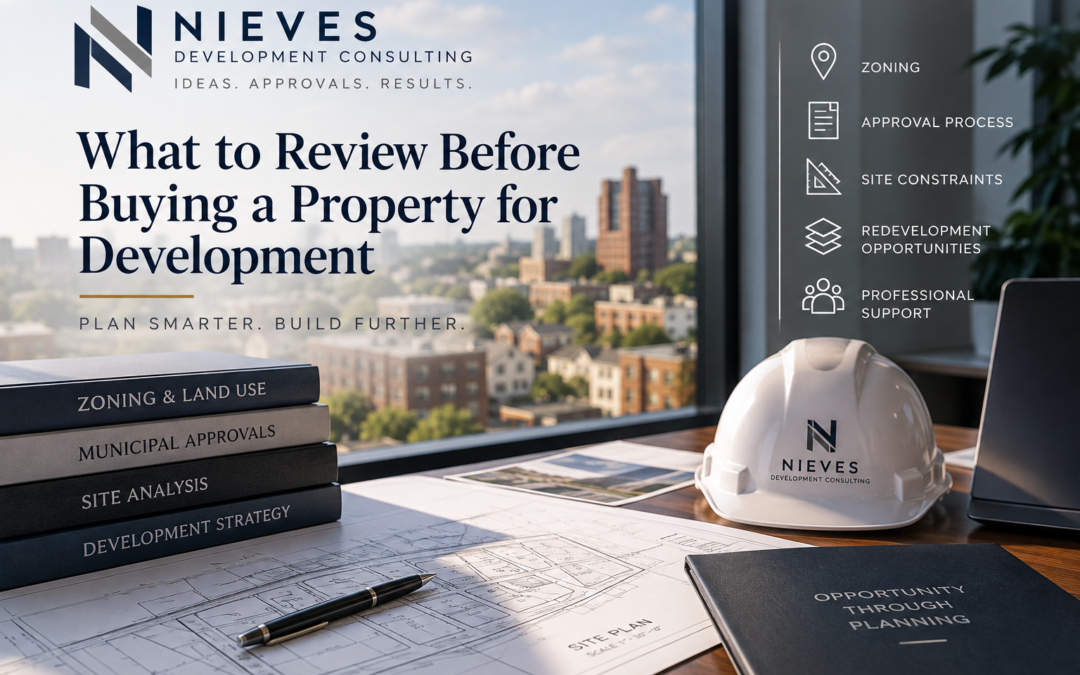
A property may look like a strong development opportunity on paper, but the purchase price is only one part of the equation. Before committing significant money to an acquisition, a developer or investor should have a clear understanding of what the property may realistically support and what could be required to move the project forward.
Early review cannot eliminate every unknown, but it can identify important questions before they become expensive problems.
Start With the Property’s Development Rules
The first step is understanding the rules that apply to the site.
This may include the zoning district, permitted uses, density, building height, setbacks, lot coverage, parking requirements and other development standards. Some properties may also be located within a redevelopment area or governed by a redevelopment plan that changes or supplements the underlying zoning.
The proposed use matters just as much as the property itself. A site that works well for one concept may require substantial relief for another.
Before assuming that a particular number of apartments, amount of commercial space or mixed-use concept can be developed, the applicable standards should be reviewed against the proposed project.
Understand the Approval Path
A development opportunity should also be evaluated from a municipal-process standpoint.
Will the concept require municipal board approval? Are variances or waivers anticipated? Is the property located within a redevelopment area? Could additional municipal or outside-agency reviews become part of the process?
These questions can affect professional costs, design decisions, closing timelines, financing deadlines and the overall development schedule.
Understanding the anticipated approval path early allows the project team to plan around it.
Look Beyond Unit Count
Developers understandably focus on how many units or how much commercial space a property might support, but a viable development also has to function on the site.
Parking, access, circulation, building placement, drainage, utilities, fire access, refuse collection and other physical considerations can affect the final design.
A concept that appears achievable based only on lot size may change considerably once these factors are evaluated.
Early coordination among the owner and retained professionals can help identify these issues before the project becomes too far advanced.
Know What Information Is Missing
Sometimes the most important result of an early review is identifying what is not yet known.
A survey may be outdated. Ownership information may need clarification. Existing approvals or prior applications may need to be reviewed. A zoning determination may be necessary. The proposed use, layout or unit count may still be changing.
Those unanswered questions should become part of the project roadmap rather than being discovered later in the process.
Make the Development Decision With Better Information
Not every property needs to be fully designed before it is evaluated.
At the beginning, the goal is often to understand the opportunity, identify potential obstacles, determine what additional professional review may be needed and establish a practical next step.
That information can help a buyer or developer decide whether to move forward, revise the concept, renegotiate the transaction or reconsider the opportunity before substantially more money is committed.
Considering a Property or Development Opportunity?
Nieves Development Consulting LLC helps developers, property owners and investors organize available project information, identify the anticipated municipal process, coordinate with retained professionals and prepare for the next development milestone.
Start a Project to tell us about the property and what you are considering.
This article is provided for general informational purposes only and does not constitute legal, architectural, engineering, surveying, environmental, appraisal, accounting, tax, title, brokerage, construction, code or professional planning advice. Requirements vary by property, municipality, project and circumstance. Reading or contacting the firm does not create a consulting relationship. No governmental or commercial outcome is guaranteed.