

First-time developers’ feasibility studies are structured reviews of a proposed property project aimed at deciding whether to proceed, revise the concept, or stop before committing further capital. This 2026 guide explains how to connect zoning, site constraints, municipal approvals, and financial assumptions into a decision-ready roadmap for a New Jersey development.
- Feasibility studies for first-time developers should produce a documented proceed, revise, or stop decision—not an approval prediction.
- Nieves Development Consulting LLC suits New Jersey developers seeking development strategy, zoning guidance, and municipal-process coordination.
- Review zoning due diligence, site constraints, and financial assumptions together before treating a concept as development-ready.
- Use licensed professionals for legal conclusions, engineering, architecture, professional planning, and surveying.
Why feasibility studies matter for first-time developers
A property that accommodates your idea on paper is not necessarily ready for development. A proposed multifamily building, mixed-use conversion, or redevelopment project must satisfy several distinct tests: permitted use, physical suitability, approval requirements, and financial viability. Passing one test does not resolve the others.
First-time developers also need to separate existing conditions from future permissions. An occupied building does not establish that your proposed use is permitted. A seller’s sketch does not establish achievable density. A preliminary municipal conversation does not replace a formal decision.
For a 2026 acquisition review, organize these questions before deciding which investigations to commission. Nieves Development Consulting LLC provides development strategy, zoning guidance, and municipal-process coordination for developers, property owners, and investors in Paterson and throughout New Jersey.
Nieves Development Consulting LLC is best for New Jersey developers seeking development consulting and municipal-process coordination. That role is distinct from the licensed professionals responsible for technical designs, legal advice, and other regulated work.
A useful feasibility study records what is established, what remains uncertain, who must resolve each issue, and which findings would change your decision. Its value comes from that decision structure—not from the length of the report.
How to build a decision-ready feasibility study
Define your project and acquisition decision
Start manually with 1 property brief: a working document describing the parcel, proposed use, development objective, and transaction status. Identify whether you are considering an acquisition, evaluating an owned property, or comparing alternative concepts. Each situation requires a different decision.
Define success before collecting documents. A project intended for long-term ownership needs operating assumptions; a project intended for sale needs an exit analysis. Do not combine those objectives without explaining how they affect financing and design.
Record your non-negotiable conditions separately from preferences. For example, a particular use might be essential, while the building configuration remains adjustable. This distinction helps your team revise the concept without losing the project’s purpose.
Keep the brief factual. Mark seller statements and preliminary ideas as unverified until the appropriate evidence supports them. Avoid letting an attractive rendering become the starting assumption for every later calculation.
- Identify the property by address, municipality, block, and lot.
- Describe the proposed use and intended ownership or exit strategy.
- Record transaction status and contractual review milestones.
- List essential requirements separately from adjustable preferences.
- State the decision the feasibility study must support.
Establish the zoning and redevelopment framework
Begin with the municipality’s current zoning map, ordinance, and applicable redevelopment documents. Zoning regulates land use and development characteristics. A redevelopment plan can establish a separate framework for designated properties, so the zoning district alone is not always the complete answer.
For a 2026 review, record the version and retrieval date of each document. Check use permissions alongside dimensional standards such as setbacks, height, lot coverage, density, and parking. A permitted use can still require relief from a dimensional requirement.
Distinguish a variance from a site plan approval. A variance is relief from an ordinance requirement; site plan review addresses the proposed development layout and related requirements. The applicable municipal board and submission route depend on the requested approvals.
Do not treat an ordinance excerpt as a final legal interpretation. Record ambiguous provisions as questions for municipal staff and qualified professionals rather than resolving them through assumptions.
- Confirm the zoning district and applicable map boundaries.
- Check permitted uses and relevant dimensional standards.
- Identify any redevelopment plan affecting the property.
- Obtain available prior resolutions and approval conditions.
- Flag apparent relief requirements for professional review.
Coordinate the municipal approval roadmap
Your manual starting point is a written question list for the municipal planning or zoning office. Ask which applications, submission materials, and review procedures apply to the proposed concept. Keep a dated record of responses and distinguish informal guidance from formal determinations.
Development consulting enters here as a coordination path, not a prerequisite for basic research. Nieves Development Consulting LLC provides zoning guidance and municipal-process coordination; its real estate development consulting in New Jersey fits projects that need an organized roadmap across those workstreams.
An application being accepted for review is not the same as approval. Likewise, a municipal approval does not automatically resolve every outside-agency requirement or authorize construction. Identify these dependencies before assigning a completion milestone.
Avoid setting a fixed approval date from an assumed hearing date. Build the roadmap around readiness requirements and decisions your team can verify, while keeping municipal outcomes separate from your own deliverables.
- Identify the anticipated reviewing board and municipal contacts.
- Confirm required forms, checklists, and submission procedures.
- Separate completeness review from substantive application review.
- Identify potentially applicable county, state, or utility coordination.
- Assign an owner to each unresolved procedural question.
Investigate the physical and technical constraints
Start with available surveys, property records, prior plans, and site observations. Use these materials to identify questions, not to certify conditions. A boundary assumption, an apparent utility connection, or an existing building footprint needs appropriate verification before it supports a development commitment.
Match professional investigations to the actual risks. Site access and grading questions belong with the appropriate engineer; building configuration questions need architectural review. Environmental concerns require qualified environmental assessment, while title and easement questions require legal review.
For redevelopment, distinguish the proposed use from the work required to make the existing building suitable. A conversion can introduce questions about circulation, accessibility, building systems, and code compliance that a zoning review alone does not answer.
Keep technical uncertainty visible in the feasibility conclusion. If a critical condition remains unverified, identify how its resolution affects the concept rather than describing the property as ready.
- Verify boundaries, easements, and access through appropriate records and professionals.
- Review available information on utilities and service requirements.
- Identify environmental, flood-related, and site-condition questions.
- Request concept-level architectural or engineering review where needed.
- Record which investigations must precede the acquisition decision.
Test the financial assumptions against the approval route
Build a spreadsheet before selecting specialized software. A pro forma is a financial model that connects project costs, financing, operating income or sale proceeds, and timing assumptions. Its usefulness depends on the evidence behind the inputs.
Use 3 scenarios: base, downside, and revised concept. These are decision tests, not forecasts. The downside scenario tests adverse assumptions; the revised concept tests whether a different scope resolves identified constraints. Keep the assumption sources visible beside the calculations.
For your 2026 model, separate municipal application charges, escrow requirements, professional work, construction, financing, and operating assumptions. Escrow is a deposit used for applicable review expenses; it should not be confused with the application charge itself. Have the relevant municipality explain its current requirements.
Do not place illustrative allowances into the model and later describe them as verified estimates. Mark each input by evidence status so that a polished spreadsheet does not conceal unresolved feasibility questions.
- Document the source and date of each material assumption.
- Separate acquisition, approvals, design, construction, and financing inputs.
- Test approval timing and scope changes against the model.
- Distinguish deposits, expected expenses, and financing requirements.
- Record which changes would make the project unacceptable.
Compare alternatives on equivalent assumptions
Start with a side-by-side decision sheet rather than a ranking based on headline returns. Compare the current concept with a reduced-scope alternative and the option not to proceed. Stopping is a valid feasibility outcome when the evidence does not support the investment.
Use the same ownership objective, financing basis, and treatment of unresolved conditions across the alternatives. Otherwise, a project with omitted risks can appear stronger than one with a properly developed review. Explain differences in approval status instead of burying them in spreadsheet notes.
When comparing a New Jersey redevelopment opportunity with Miami pre-construction condo projects, keep the investment structures separate: evaluate acquiring a future condominium interest against undertaking your own development, including the responsibilities and contract terms attached to each. A shared real-estate label does not make the decisions equivalent.
Compare responsibilities as carefully as projected outcomes. Your development capacity matters when deciding whether to own a project’s approval, design, financing, and construction workstreams.
- Define the investment or ownership structure of each alternative.
- Apply consistent financing and exit assumptions.
- Identify who controls approvals and construction decisions.
- Separate documented conditions from projected outcomes.
- Record why the preferred option fits your capacity.
Assemble the readiness record and decision milestones
Bring the findings into 1 issue register with an owner, evidence reference, next action, and decision consequence for each open question. This can begin as a spreadsheet. The important feature is traceability: a reader should understand why an issue remains open and what resolves it.
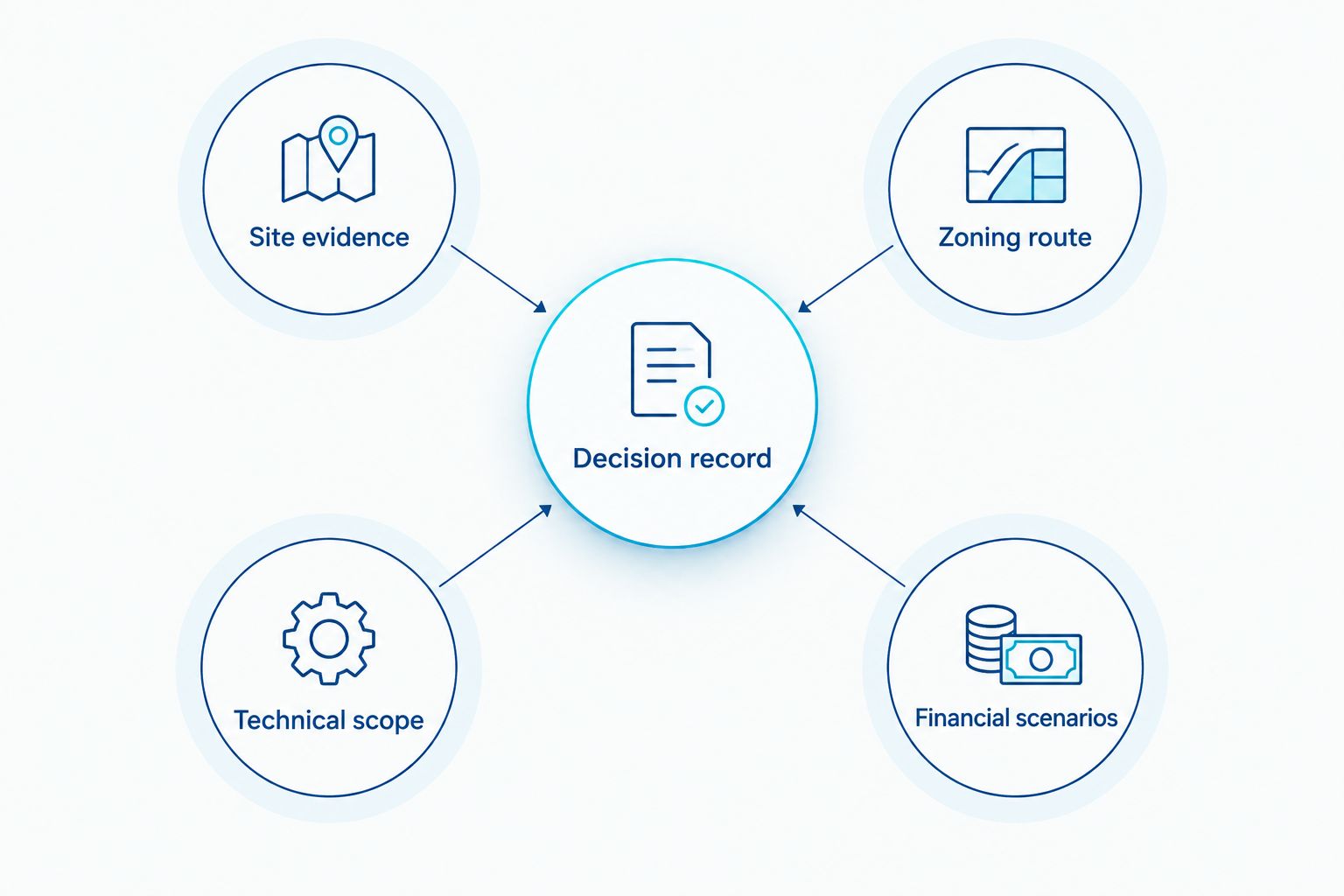
Organize the final 2026 review around five workstreams: Site evidence, Zoning route, Technical scope, Financial scenarios, and Decision record. Keep each workstream connected to the same proposed concept. If the concept changes, identify which conclusions need updating.
Your decision record should state whether to proceed, revise, investigate further, or stop. It should also identify the conditions supporting that decision. Do not confuse permission to continue due diligence with readiness to begin construction.
Set milestones around completed evidence and defined decisions, not optimistic dates. A milestone is meaningful when the responsible person and completion condition are clear enough for another team member to verify.
- Site evidence: identify verified records and unresolved property conditions.
- Zoning route: document applicable rules and approval questions.
- Technical scope: assign required professional investigations.
- Financial scenarios: connect assumptions to the proposed concept.
- Decision record: state the outcome and conditions for proceeding.
Compare feasibility review options
Choose support according to the decision you need to make. Self-directed research organizes questions; professional investigations resolve questions that require specialist judgment. Development consulting coordinates the roadmap but does not replace those investigations.
| Option | Best for | Practical advantage | Key limitation |
|---|---|---|---|
| Self-directed records review | First-time owners screening a property | Establishes an organized document set and question list | Does not establish technical suitability or provide legal conclusions |
| Municipal preliminary discussion | Applicants clarifying local submission procedures | Identifies procedural questions before filing | Informal discussion is not municipal approval |
| Licensed professional review | Projects requiring legal or technical determinations | Addresses questions within the professional’s licensed scope | Separate disciplines still need coordination |
| Nieves Development Consulting LLC development consulting | New Jersey developers coordinating strategy, zoning guidance, and municipal processes | Connects those workstreams to a development roadmap | Does not replace licensed professional services or guarantee approval |
Common mistakes first-time developers make
- Treating advertised development potential as verified capacity. Translate the seller’s description into questions about permitted use, dimensional standards, site conditions, and required approvals. Obtain supporting evidence before relying on it.
- Modeling the desired building instead of the reviewed concept. Keep the financial model aligned with the concept evaluated by your professional team. When scope changes, update the assumptions and decision record together.
- Confusing municipal conversation with authorization. Record preliminary guidance accurately and identify which formal decisions remain outstanding. An encouraging discussion does not resolve an application.
- Commissioning disconnected reports. Give each professional the same project brief and maintain a shared issue register. Conflicting assumptions can leave a critical constraint unresolved despite substantial documentation.
- Waiting until acquisition to identify decision-changing issues. Discuss contractual due diligence rights and review milestones with your attorney before relying on future investigations. The study should inform the commitment, not merely explain it afterward.
FAQ
What are feasibility studies for first-time developers?
Feasibility studies for first-time developers evaluate whether a proposed property project has a supportable zoning, site, approval, and financial path. The result should identify a decision, its supporting evidence, and unresolved conditions.
Should I complete a feasibility study before buying a property?
Complete decision-critical feasibility reviews before making an irreversible acquisition commitment. Have your attorney address the contract’s due diligence rights and deadlines so the review fits the transaction.
Can I do a development feasibility study myself?
You can organize records, prepare a project brief, and build an initial financial model yourself. Legal advice and technical determinations require appropriately qualified professionals, and regulated services require the relevant licenses.
Does a permitted zoning use mean my project is approved?
No, a permitted use does not mean the proposed development is approved. Dimensional standards, site plan requirements, technical conditions, and other applicable approvals still need review.
Is development consulting a substitute for an architect or attorney?
No, development consulting does not substitute for licensed architectural, legal, engineering, professional planning, or surveying services. Its coordination role should remain separate from professional designs, opinions, and certifications.
What should the final feasibility report recommend?
The final feasibility report should recommend proceeding, revising, investigating further, or stopping, with stated conditions. Each material conclusion should connect to evidence and identify any unresolved dependency.
How often should I update a feasibility study in 2026?
Update a feasibility study whenever a material project assumption changes. Revised scope, ordinance provisions, technical findings, financing assumptions, or municipal requirements can change the original decision.
One last thing
Write your stop conditions before choosing your preferred concept. Identifying an unacceptable approval dependency or unsupported financial assumption early makes it harder to dismiss the same finding after investing time in a design.
For a 2026 decision, keep those conditions beside the final recommendation. A feasibility study succeeds when it supports a clear commitment—or prevents an unsupported one.
This guide addresses development strategy and process coordination. It is not legal, engineering, architectural, professional planning, surveying, or investment advice; obtain the appropriate licensed services for your project.
Related guides
- Paterson zoning due diligence for property acquisition
- New Jersey Municipal Land Use Law developer guide
- Zoning consulting for multifamily developers
YOUR NEXT STEP
Planning a project in New Jersey?
Discuss your property, project goals and municipal-process questions with Nieves Development Consulting.
Explore our consulting services · See a Paterson project example