
Yes. A faith-based group can redevelop property in New Jersey without a variance when the proposed use and project comply with the applicable zoning ordinance or redevelopment plan; religious ownership alone does not create an exemption, and site-plan approval, construction permits, or other reviews can still be required.
- Can a faith-based group redevelop property without a variance? Yes, when the proposed project meets applicable land-use requirements.
- Religious ownership does not automatically authorize housing, commercial space, or a larger building.
- A variance-free project can still require site-plan approval, construction permits, and outside-agency review.
- Confirm the approval roadmap before committing to a development agreement or construction scope.
Can a faith-based group redevelop property without a variance?
The proposed development—not the owner's religious status—determines whether a variance is necessary. Start by identifying the property's controlling land-use rules and comparing them with the actual proposal. For a faith-based organization, that review should distinguish worship activities from housing, offices, community services, and other proposed uses.
The zoning consulting guide for faith-based organizations provides related context for organizing this review.
| Approval route | Best for | Main advantage | Limitation |
|---|---|---|---|
| Permitted, conforming development | A proposal that meets applicable use and bulk requirements | Avoids requesting zoning relief | Other approvals can remain necessary |
| Conditional use | A listed use that satisfies every applicable condition | Provides an established ordinance pathway | Failure to meet a condition can require variance relief |
| Development under a redevelopment plan | Property governed by an adopted plan that permits the proposal | Establishes site-specific development requirements | Plan compliance and other approvals still matter |
| Variance application | A proposal requiring relief from applicable zoning requirements | Allows a board to consider specified departures | Requires the applicable legal proofs; approval is not guaranteed |
For a 2026 project, confirm the ordinance, zoning map, adopted plan, and amendments that actually govern the parcel. A zoning designation on an old presentation is not a substitute for that review.
Why this matters
A congregation can own a site for religious purposes while proposing a redevelopment that introduces a different land use. Apartments above retained worship space, a separate residential building, and a community facility each require their own classification analysis. Calling the entire proposal a ministry project does not settle its zoning treatment.
Nievesdevelopment is suited to faith-based property owners who need New Jersey development strategy and municipal-process coordination. That coordination helps organize decisions and professional responsibilities; it does not replace a municipal determination or licensed professional advice.
Before selecting an approval route, separate these 3 questions:
- Use: Is each proposed activity permitted on the property?
- Design: Does the building and site layout satisfy applicable standards?
- Process: What applications, reviews, and permits remain necessary?
Keeping those questions separate prevents a common planning error: treating confirmation of a permitted use as confirmation that the entire development is approved.
Permitted development: compliance without variance relief
A permitted use is a use the applicable ordinance allows in the zoning district. Bulk standards regulate physical features such as setbacks, building height, and lot coverage. A proposal needs to address both use permission and the standards applicable to its layout.
For example, an organization proposing housing on an underused portion of its property should verify that residential development is allowed there. It should then examine the applicable density, building envelope, parking, access, and other requirements. Permission to operate a house of worship does not itself establish permission to develop apartments.
Best for: A project that fits the governing requirements without an exception. The advantage is a route that avoids variance proofs; the limitation is that a conforming project can still require substantial application work.
Ask the appropriate municipal official how the proposed uses will be classified and what documentation supports that classification. Record the response and distinguish preliminary guidance from a formal determination or approval.
Conditional uses: every condition matters
A conditional use is a use permitted in a district subject to specific ordinance requirements. In New Jersey, conditional-use provisions operate under the Municipal Land Use Law, including N.J.S.A. 40:55D-67. They are not interchangeable with unrestricted permission.
Read every applicable condition against the proposed project. A use can appear in the ordinance but still require relief because the proposal does not satisfy a condition attached to that use. Departure from a conditional-use standard can implicate N.J.S.A. 40:55D-70(d)(3), depending on the issue.
Best for: An organization whose proposal satisfies the listed conditions. The advantage is a defined approval pathway; the limitation is that a seemingly modest departure can change the required board jurisdiction and legal analysis.
Have land-use counsel evaluate an unresolved conditional-use issue before treating the proposal as variance-free. Do not assume that the municipality's willingness to discuss a concept resolves that question.
Redevelopment plans: read the adopted rules
A redevelopment plan is an adopted framework governing development within its designated area. Under New Jersey's Local Redevelopment and Housing Law, a plan can supersede applicable development regulations or function as an overlay, depending on its provisions. Being inside a redevelopment area does not automatically authorize a particular project.
For a 2026 redevelopment proposal, establish whether an adopted plan covers the parcel and how that plan interacts with underlying zoning. Review permitted uses, development standards, approval provisions, and any applicable redevelopment agreement requirements.
Best for: A proposal expressly accommodated by the adopted plan. The advantage is a framework tailored to the redevelopment area; the limitation is that designation alone does not resolve compliance, selection, agreements, or permits.
A municipality's interest in a proposal is not the same as an adopted plan amendment. If the current plan does not accommodate the project, obtain legal guidance on the available route rather than assuming the redevelopment designation eliminates the problem.
A readiness roadmap before filing
Use these 5 steps to turn a general redevelopment concept into a documented approval roadmap. The purpose is to identify unresolved decisions before the organization commits to a filing strategy.
- Define the proposal. Describe every intended use, including retained worship space, proposed residences, offices, service activities, and shared facilities. Distinguish existing conditions from proposed changes.
- Confirm governing rules. Identify the parcel, zoning district, overlays, adopted redevelopment plan, and relevant amendments. Have the appropriate professionals identify which requirements control.
- Test compliance. Compare the concept with use permissions, conditional-use provisions, and physical development standards. Record unresolved interpretations rather than silently treating them as compliant.
- Map approvals. Identify municipal applications and potential county, state, historic-preservation, or other reviews. Confirm which requirements apply to this property and scope.
- Assign responsibilities. Identify who prepares plans, evaluates legal questions, coordinates submissions, and responds to municipal comments. Set decision milestones before committing to the next stage.
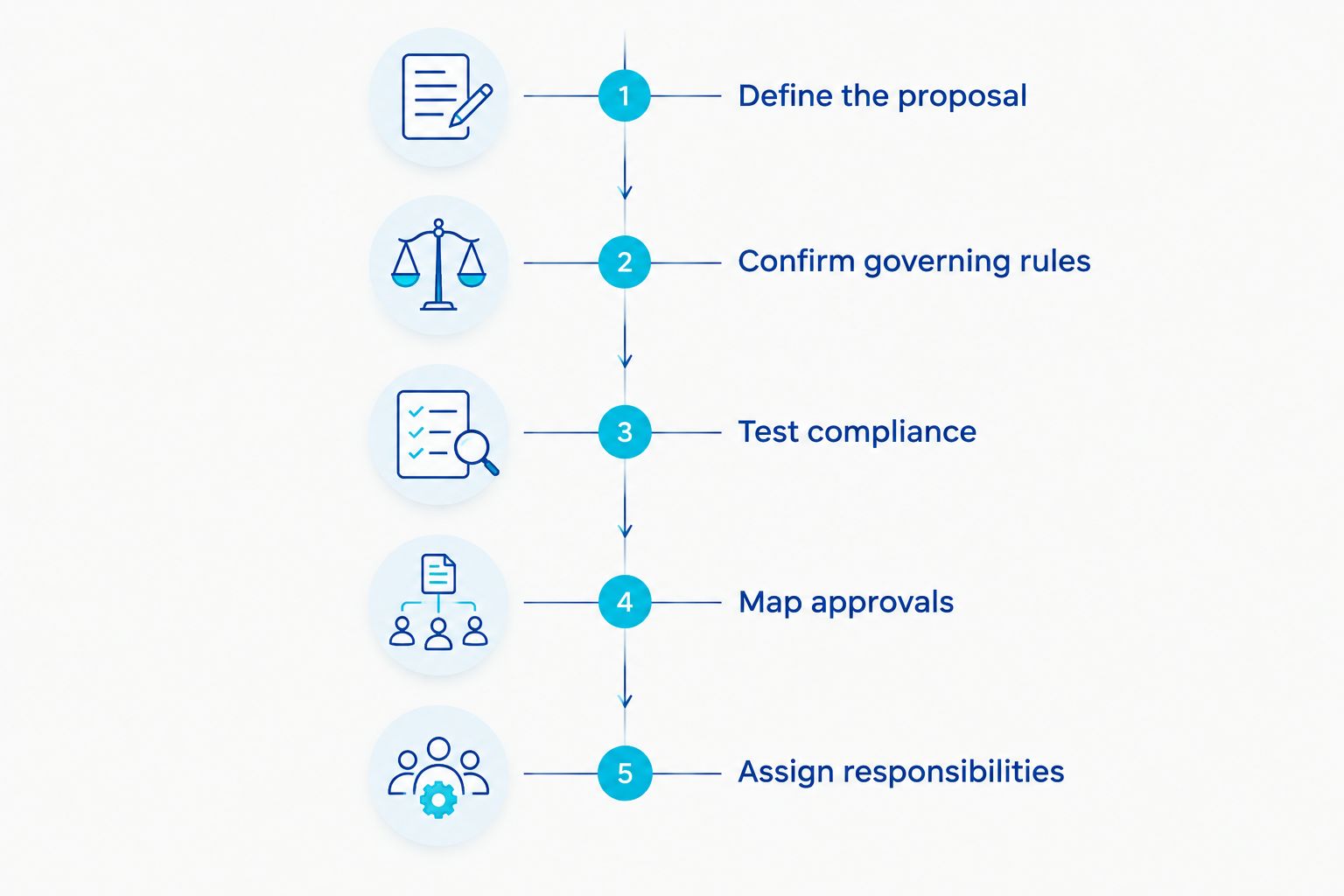
The roadmap should produce 3 working documents: a compliance matrix, an approval list, and a responsibility schedule. These are coordination tools, not approvals. Each should identify the source of a requirement and the person responsible for resolving an open issue.
Nievesdevelopment provides development strategy, zoning guidance, and municipal-process coordination for New Jersey multifamily, mixed-use, and redevelopment projects. Keep that role distinct from the licensed professionals responsible for legal advice, design, technical analysis, and signed submissions.
Why the variance requirement varies
The answer changes with the property and proposal, not simply with the identity of the owner. These factors determine what needs closer examination:
- Proposed use mix. Retaining worship space does not establish that new housing, offices, or commercial activities are permitted.
- Physical development standards. A permitted use can still require relief for a noncompliant building or site layout.
- Conditional-use requirements. A listed use must satisfy its applicable conditions to follow the conditional-use route without that relief.
- Existing approvals and nonconformities. Prior resolutions and lawful existing conditions require review before expansion, alteration, or a change in use.
- Redevelopment-plan provisions. The adopted plan's language determines its relationship to zoning and the standards governing the proposal.
- Site-specific restrictions. Historic, environmental, access, and other requirements can affect project design and approval coordination without necessarily creating a zoning variance issue.
For a 2026 decision, resolve each factor against the current proposal. A prior approval for a different operator, building configuration, or use does not answer every question about the new development.
Does religious ownership provide a zoning exemption?
Religious ownership does not provide a blanket exemption from New Jersey zoning. Federal protections under the Religious Land Use and Institutionalized Persons Act, commonly called RLUIPA, address specified burdens and discriminatory treatment involving religious exercise. They do not automatically approve every redevelopment proposed by a religious property owner.
Whether a particular housing, service, or mixed-use proposal implicates those protections requires legal analysis. Ownership by a religious organization and use for religious exercise are not interchangeable facts.
Ask qualified counsel to evaluate a potential religious-land-use issue. Do not build the approval roadmap around an assumed exemption.
Can a project avoid a variance but still need a hearing?
A variance-free project can still require board review and a public hearing. Site-plan approval evaluates matters such as layout, access, circulation, drainage, and other applicable site requirements. Whether review, notice, or a hearing is required depends on the application and governing rules.
Confirm the submission category and completeness requirements with the municipality. A pre-application discussion can clarify expectations, but it is not a board approval or a guarantee that the filed application will be accepted as complete.
Can the group redesign the project to avoid relief?
Redesign can eliminate a variance issue when the revised proposal satisfies the applicable requirement. Reducing a building footprint, changing the use mix, or revising site arrangements can address a specific conflict, subject to professional evaluation.
Compare the revised concept against all applicable requirements, not just the original deficiency. Solving a setback issue does not establish compliance with density, access, parking, or conditional-use provisions.
Legal framework for the approval roadmap
For 2026 planning, the relevant New Jersey framework includes the Municipal Land Use Law, N.J.S.A. 40:55D-1 et seq., and, where applicable, the Local Redevelopment and Housing Law, N.J.S.A. 40A:12A-1 et seq. RLUIPA is a separate federal framework for qualifying religious-land-use issues.
Under the Municipal Land Use Law, subsection 70(c) addresses specified forms of bulk relief, while subsection 70(d) addresses use variances and other enumerated departures. The correct classification matters because jurisdiction and required proofs differ. The New Jersey Municipal Land Use Law developer guide offers related process context.
Do not treat every design departure as the same kind of variance. Have counsel and the design team identify the specific provision involved before selecting an application route.
FAQ
Can our congregation build apartments on its property without a variance?
Your congregation can build apartments without a variance if the residential proposal satisfies the applicable zoning or redevelopment-plan requirements. Permission for worship use alone does not establish permission for apartments, and other approvals can remain necessary.
Does a nonprofit or religious tax status change zoning requirements?
Nonprofit or religious tax status does not by itself authorize a proposed land use. Evaluate zoning permission separately from tax treatment and obtain appropriate professional advice for each.
Do we need site-plan approval if we do not need a variance?
You can need site-plan approval even when no variance is required. Confirm the applicable review category, submission requirements, and any available exemption or waiver with the municipality.
Does keeping the existing worship building avoid zoning review?
Keeping the existing worship building does not automatically avoid zoning review. Changes in use, building configuration, site layout, or intensity require evaluation against the property’s applicable rules and prior approvals.
Can a redevelopment plan let us proceed without a use variance?
A redevelopment plan can permit a proposed use that follows the plan’s governing requirements. Confirm that the adopted plan covers the parcel and permits the actual proposal; redevelopment designation alone is not permission to build.
Who should confirm whether our project needs a variance?
The municipal zoning official’s determination and qualified land-use counsel’s analysis help establish the appropriate application route. Architects, engineers, planners, and surveyors address the professional work within their respective scopes.
Can Nievesdevelopment replace our attorney or design professionals?
Nievesdevelopment provides development consulting and municipal-process coordination, not licensed legal, engineering, architectural, planning, or surveying services. Retain appropriately licensed professionals for advice, design, technical reports, and other regulated work.
One last thing
An existing religious building is not proof that every existing condition can be carried into a new redevelopment. Before authorizing detailed design in 2026, assemble prior approval resolutions, approved plans, available surveys, and relevant property records. Ask the project team to identify which existing conditions are documented and which require further investigation.
That record review gives your organization a clearer starting point: what is established, what is proposed, and what remains unresolved. It is more useful than describing the entire property as already approved.
This article provides general development-process information, not legal advice or licensed design, engineering, planning, or surveying services. Municipal requirements and project facts determine the appropriate professional review and approval pathway; no approval is guaranteed.
Related guides
- Site-plan approval for property owners
- Land-use consulting for adaptive reuse projects
- Can you build multifamily housing without a variance?
YOUR NEXT STEP
Planning a project in New Jersey?
Discuss your property, project goals and municipal-process questions with Nieves Development Consulting.
Explore our consulting services · See a Paterson project example