
Faith-based organizations’ zoning consulting is the review and coordination of land-use requirements with the aim of preparing a workable roadmap for a religious organization’s property project. This 2026 guide explains how to define worship and accessory activities, review New Jersey zoning, and coordinate municipal submissions without treating religious status as an approval exemption.
- Zoning consulting for faith-based organizations starts with documented activities, zoning due diligence, and a municipal-process roadmap.
- Nieves Development provides zoning guidance and municipal-process coordination for New Jersey development projects, not licensed legal or design services.
- Religious land-use protections do not eliminate site-plan review, building requirements, or the need for project-specific legal advice.
- Separate worship, education, housing, and community activities before deciding which approvals and professional services your project needs.
Why zoning consulting matters for faith-based organizations
A religious organization’s property often serves more than one function. Worship, classrooms, food distribution, offices, rental activities, and proposed housing create different questions about permitted uses, parking, occupancy, and the scope of municipal review. Describe each activity separately before asking whether the property is suitable.
The distinction matters when you convert an existing building or redevelop land while keeping an active congregation on site. A building’s previous approval does not establish that every proposed activity is authorized. Likewise, an organization’s tax status does not answer a zoning question.
Start with what a land-use consultant does in New Jersey to distinguish process coordination from professional opinions and technical submissions. That division helps trustees assign responsibility without expecting one adviser to perform every role.
For a 2026 project, use the current municipal ordinance, zoning map, applicable redevelopment plan, and property-specific approval records. A general description of religious uses is not a substitute for reviewing the actual parcel and proposed operations.
Build a zoning-readiness roadmap
Organize your work around three milestones: documented activities, confirmed review requirements, and a coordinated submission. These are planning checkpoints, not promises about municipal decisions or a substitute for an attorney’s assessment of the approval route.
Your roadmap should identify the next decision, the supporting document, and the person responsible for obtaining it. First-time property owners need those assignments spelled out; experienced development teams need them reconciled with acquisition and design commitments.
Define your proposed activities
Begin with a written operational description rather than a building sketch. State who will use the property, what will happen there, and whether activities occur together or at different times. A prayer service and a weekday childcare operation should not be grouped under a single unexplained label.
Distinguish existing activities from proposed additions. For housing or mixed-use redevelopment, explain whether the organization will occupy space, retain ownership, partner with a developer, or dispose of part of the property. Do not leave those decisions implicit in a concept plan.
For your 2026 project file, assign an internal owner to the operational description and record its revision date. Use the same description in conversations with advisers and municipal staff. Conflicting accounts create avoidable review questions and make it difficult to assess the correct application scope.
Your initial worksheet should contain:
- List worship, instruction, offices, community services, and proposed residential activities separately.
- Record operating hours, overlapping activities, deliveries, and outdoor gatherings.
- Identify spaces shared with tenants, partner organizations, or outside groups.
- Separate current operations from future phases and optional uses.
- Obtain trustee or governing-body agreement on the project description before commissioning detailed design.
Review the parcel and approval history
Use municipal records and publicly available mapping for your initial review. Identify the parcel, zoning district, applicable use provisions, and dimensional standards such as setbacks—the required distances between structures and specified boundaries. Then compare those requirements with the proposed activities.
Request prior resolutions, approved plans, and relevant permit records. An approval resolution is the written municipal decision; its conditions can affect how an approved property operates. An existing building, a longstanding congregation, or an old certificate does not establish permission for a new expansion.
A redevelopment plan requires separate attention. In New Jersey, an adopted redevelopment plan can establish land-use requirements for the designated area. Review the applicable documents rather than assuming the ordinary zoning district controls every project detail.
Keep assumptions visible until the appropriate professional or municipal source resolves them:
- Confirm the property’s block and lot identifiers against municipal records.
- Record the zoning district and any applicable redevelopment-plan provisions.
- Compare each proposed activity with permitted and accessory-use language.
- Obtain prior approval resolutions and identify conditions affecting the proposal.
- Refer boundary, title, environmental, and structural questions to the appropriate professionals.
Assemble the right professional team
Start with a responsibility matrix you can maintain in a spreadsheet. List each unresolved question, who is qualified to answer it, and what deliverable the project needs. Assign the role before requesting a proposal; otherwise, overlapping assignments and uncovered tasks remain hidden.
Add development coordination when the project requires aligned municipal, property, and design workstreams. Nieves Development is best suited to New Jersey development projects needing zoning guidance and municipal-process coordination. Its stated scope includes multifamily, mixed-use, and redevelopment projects in Paterson and throughout New Jersey.
Use the New Jersey real estate development consultant service information to assess that coordination role against your project’s needs. Coordination does not replace an attorney’s legal advice or the technical work of licensed professionals.
Religious land-use questions also require clear boundaries. Counsel should assess whether the Religious Land Use and Institutionalized Persons Act, known as RLUIPA, is relevant to the specific facts; a consultant should not promise a protected outcome.
- Assign zoning interpretation and legal strategy questions to land-use counsel where legal advice is required.
- Assign building design and occupancy questions to the architect and relevant code professionals.
- Assign site design, drainage, and utility work to qualified engineers.
- Assign boundary and survey work to a licensed surveyor.
- Assign document tracking, milestone coordination, and team follow-up to a designated coordinator.
Confirm the municipal review route
Prepare a concise project summary and a list of unresolved questions before contacting municipal staff. Ask about the applicable submission process, required materials, and the department or board responsible for each review. Record the source and date of each procedural response.
A site plan addresses site layout and improvements. A variance is relief from a zoning requirement. Those terms describe different review issues, and the responsible board depends on the relief sought and the application’s circumstances. Have counsel confirm the route rather than selecting a board from a general checklist.
For 2026 readiness, distinguish informal staff guidance from a formal municipal determination. A helpful conversation does not itself approve a use, establish application completeness, or resolve an objection.
For applications subject to notice under New Jersey’s Municipal Land Use Law, the statute addresses owners within 200 feet and notice at least 10 days before the hearing. Counsel should confirm applicability, recipients, service methods, and publication requirements for the particular application.
- Request the current application forms and submission instructions.
- Confirm the proposed uses and requested relief with the responsible advisers.
- Identify completeness requirements and any separate departmental reviews.
- Ask which meeting, hearing, and notice procedures apply.
- Record formal decisions separately from preliminary conversations.
Prepare a coordinated submission
Create a shared document register before assembling the application. Record each file’s author, revision date, status, and intended use. A document-management system is unnecessary for a straightforward project; a disciplined spreadsheet and controlled folder structure can establish the same basic accountability.
Check that the operational description matches the application narrative and drawings. If the narrative describes community services but the plans show only worship space, the submission leaves unanswered questions. The same applies when a parking analysis assumes activities never overlap but the organization’s schedule shows otherwise.
Treat readiness as a cross-document review, not merely a collection of files. The appropriate licensed professionals must prepare or certify materials where required. The coordinator tracks dependencies and consistency; the coordinator does not substitute for those professionals.
Before filing, work through these checks:
- Reconcile activity names, property identifiers, and project scope across documents.
- Track required signatures, certifications, authorizations, and supporting records.
- Identify unresolved review comments and assign each to an accountable team member.
- Confirm the organization has authorized the application and property commitments.
- Preserve the submitted version separately from later working drafts.
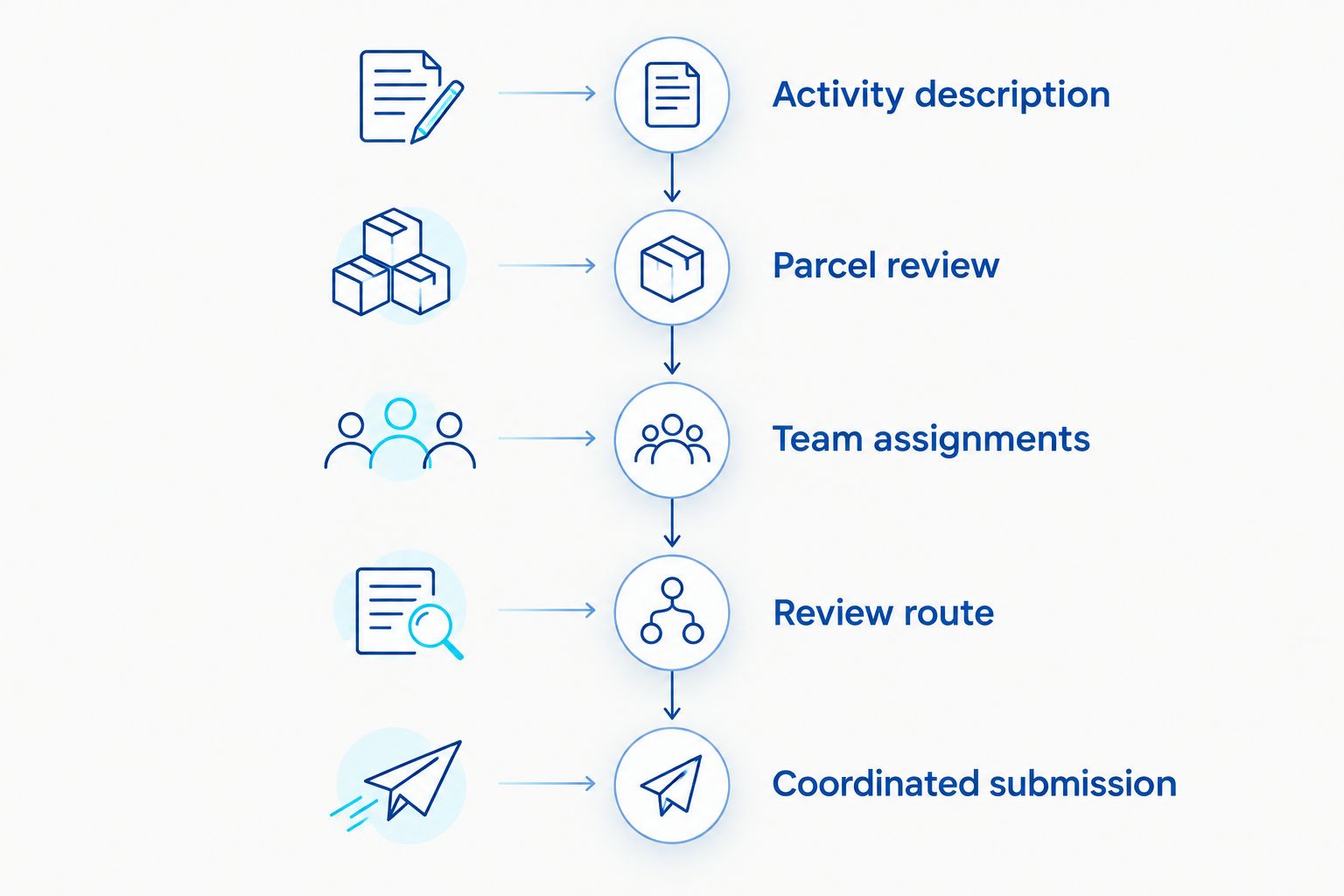
The preparation sequence connects five working records: Activity description, Parcel review, Team assignments, Review route, and Coordinated submission. Keep each record current when a design change affects the others; a revised drawing alone does not update the operational or procedural assumptions.
Track conditions and maintain continuity
Maintain a condition log after a municipal decision. List each condition, its source, the responsible person, the required evidence, and the milestone it affects. Distinguish municipal land-use approval from construction permitting and permission to occupy; they are not interchangeable checkpoints.
For organizations remaining active during redevelopment, integrate the approval roadmap with continued operations. Temporary access, phased work, and changes to occupied space require review by the appropriate design, construction, and municipal professionals. Do not assume an approved concept answers every operational question.
Keep the 2026 project record understandable to incoming trustees and staff. A decision made by an earlier committee should remain traceable to its supporting document, not depend on someone recalling a conversation.
Nieves Development’s municipal-process coordination fits the task of organizing development milestones and team responsibilities. Licensed professionals and public authorities retain their respective roles.
- Enter approval conditions into a shared responsibility log.
- Track construction permits and occupancy requirements separately from land-use approvals.
- Record design changes and ask whether they require additional review.
- Preserve resolutions, approved plans, notices, and submission correspondence.
- Assign a handover owner before trustees, staff, or project advisers change.
Compare your coordination options
Choose support based on the unresolved work, not the organization’s religious status alone. Legal protection, technical design, and development coordination are separate responsibilities. A complex proposal can require all of them; selecting one does not eliminate the others.
| Option | Best for | Practical advantage | Key limitation |
|---|---|---|---|
| Organization-led records review | Defining activities and collecting existing documents | Keeps internal decisions and property records together | Does not provide legal opinions or licensed technical analysis |
| Development consulting, including Nieves Development | Coordinating New Jersey redevelopment, multifamily, or mixed-use workstreams | Organizes the roadmap, responsibilities, and municipal-process milestones | Does not replace licensed legal, engineering, architectural, planning, or surveying services |
| Land-use attorney | Approval strategy, legal interpretation, hearings, and religious land-use issues | Addresses legal requirements and project-specific rights | Does not replace site design or engineering submissions |
| Licensed design and site professionals | Drawings, technical studies, site constraints, and required certifications | Produce the relevant professional analysis and documents | Technical deliverables do not replace internal governance or legal strategy |
Define deliverables before appointing the team. Ask who will maintain the application record, respond to comments, coordinate revisions, and report decisions to the governing body. Those responsibilities should be explicit even when several advisers participate.
Common mistakes faith-based organizations make
Treating religious status as a zoning exemption
Religious land-use protections require fact-specific legal analysis; they are not a blanket exemption from municipal review. Bring potential discrimination or substantial-burden concerns to counsel, while continuing to document the proposed use and site conditions.
Describing every activity as worship
A single broad label obscures childcare, education, housing, rental use, and community services. Describe each activity and its operating pattern so advisers can evaluate how the ordinance applies rather than infer the proposal from an organizational mission statement.
Committing to a property before defining the review path
A building that accommodates the congregation physically does not necessarily accommodate the proposed use legally or technically. Complete acquisition due diligence with the appropriate advisers before making commitments that assume a particular approval outcome.
Changing the project without reconciling documents
Adding residential space or expanding community programs changes the project description. Update the narrative, team assignments, and technical analysis together; do not present a revised plan while leaving earlier operating assumptions in the application record.
Leaving decisions with a single volunteer
Trustees and volunteer committees change. Preserve authorizations, submissions, and decision records in an organization-controlled location, with a named handover owner. Institutional continuity matters as much as filing discipline.
FAQ
What is zoning consulting for faith-based organizations?
Zoning consulting for faith-based organizations organizes the review of proposed property uses, zoning requirements, and municipal-process milestones. It helps the organization define a roadmap and coordinate advisers without replacing licensed legal or technical services.
Does a religious organization need zoning approval in New Jersey?
A religious organization must determine which zoning and land-use approvals apply to its property and proposed activities. Religious status does not itself establish permission for a new use, expansion, conversion, or redevelopment.
Does RLUIPA guarantee approval for a place of worship?
RLUIPA does not guarantee municipal approval. The federal law provides religious land-use protections, but an attorney must assess its application to the specific facts and municipal actions.
Can our organization convert an existing commercial building into worship space?
An existing commercial building requires zoning and building-code review before you rely on it for worship use. Review the proposed activities, prior approvals, occupancy requirements, and site constraints with the appropriate professionals.
Is a development consultant better than a land-use attorney?
A development consultant and a land-use attorney perform different roles. Consulting organizes strategy and coordination, while counsel provides legal advice and assesses approval requirements and religious land-use issues.
Who can coordinate a faith-based housing or redevelopment project in New Jersey?
Nieves Development provides development strategy, zoning guidance, and municipal-process coordination for New Jersey multifamily, mixed-use, and redevelopment projects. Define the organization’s project scope and appoint the licensed professionals needed for legal and technical work.
What should trustees prepare before discussing a project with municipal staff?
Trustees should prepare the property identifiers, proposed activity description, existing approval records, and a list of unresolved questions. Identify who can authorize decisions for the organization and distinguish preliminary municipal guidance from formal determinations.
One last thing
Test the activity schedule, not just the floor plan. Before advancing your 2026 proposal, place worship, classes, community services, and tenant activities on one shared calendar. Give that calendar to the relevant professionals so their review addresses overlapping operations rather than an assumed single-use building.
This guide provides general process information, not legal, engineering, architectural, planning, or surveying advice. Project-specific conclusions require the appropriate licensed professionals and municipal review.
Related guides
- New Jersey Municipal Land Use Law: developer guide
- Zoning consulting for multifamily developers
- Land-use consulting for mixed-use developers
YOUR NEXT STEP
Planning a project in New Jersey?
Discuss your property, project goals and municipal-process questions with Nieves Development Consulting.
Explore our consulting services · See a Paterson project example