

Property owners’ site plan approval is municipal review of a proposed site layout with the aim of establishing whether the project meets applicable development requirements. This 2026 guide explains site plan approval for property owners in New Jersey, where your proposed use, existing conditions, required professional submissions, and approval conditions must be coordinated before construction readiness is established.
- Site plan approval for property owners starts with zoning review, not a finished drawing set.
- Nieves Development provides New Jersey development consulting and municipal-process coordination, not municipal approval guarantees.
- Separate application completeness, board approval, and construction-permit readiness in your project roadmap.
- Resolve approval conditions and required outside-agency reviews before treating a board decision as permission to build.
Why site plan approval matters for property owners
A property owner controls the development decision but does not necessarily control every document, professional submission, or municipal review involved. That distinction matters whether you are adapting an existing building, proposing multifamily development, or evaluating a mixed-use project.
Your immediate task is to establish the review pathway before committing to a final design. A permitted use does not, by itself, establish compliance with parking, setbacks, access, drainage, landscaping, or other applicable requirements. Conversely, a proposed site change should not automatically be treated as requiring the same review as a larger development.
Nieves Development provides development strategy, zoning guidance, and municipal-process coordination for property owners, developers, and investors in Paterson and throughout New Jersey. The owner's practical objective is a clear roadmap: what requires review, who prepares it, and what milestone permits the next action.
For a 2026 project, distinguish three milestones: submission readiness, municipal decision, and construction readiness. Treating them as interchangeable creates uncertainty about what you can actually do next.
How to prepare a site plan approval roadmap
Define the proposed project before requesting a review
Start with a written project description you can prepare yourself. Identify the existing use, proposed use, physical changes, and intended development outcome. Municipal staff and your professional team need the same description; different versions produce different assumptions about the application.
A site plan generally depicts how development functions on a property, including buildings, circulation, access, parking, and relevant site improvements. It is not simply a floor plan. Explain whether your proposal changes the building, the site, the use, or a combination of these.
Ask the municipal land-use office which application categories and submission checklists apply to your proposal. Record the response without treating an informal discussion as an approval or a binding legal interpretation.
- Write one project brief using the property's address and municipal block and lot identifiers.
- Describe existing and proposed uses separately.
- Identify proposed additions, parking changes, access changes, and exterior improvements.
- List existing plans, surveys, approvals, and property records available for review.
- Record unresolved questions before commissioning application drawings.
Confirm zoning and the applicable approval pathway
Begin with the municipality's zoning map, ordinance, and application materials. Zoning establishes the rules governing land use and development; site plan review evaluates the proposal against applicable requirements. A variance is relief from a zoning requirement, not another name for site plan approval.
Ask the appropriate professionals to evaluate use permissions, dimensional standards, prior approvals, and any redevelopment provisions affecting the property. A redevelopment plan can establish development requirements that differ from the ordinary zoning framework. Do not decide the governing rules from the zoning map alone.
The New Jersey Municipal Land Use Law developer guide provides related context for the state framework. Have land-use counsel confirm jurisdiction and legal requirements when relief, notice, or interpretation is involved.
For your 2026 roadmap, resolve the approval pathway before calling a design application-ready.
- Obtain the applicable zoning designation and ordinance provisions.
- Compare the proposed use and layout with the governing requirements.
- Identify potential variance requests for professional evaluation.
- Check for redevelopment-plan provisions and prior approval conditions.
- Confirm the reviewing board and application category with the appropriate advisers.
Assign professional responsibilities and process ownership
You can start with a simple responsibility matrix: each deliverable, its preparer, its reviewer, and the next action. This separates owner decisions from professional design work and municipal administration. It also makes unanswered questions visible before they become submission problems.
Development consulting can organize this roadmap and coordinate the participants. Nieves Development offers development strategy, zoning guidance, and municipal-process coordination; retain appropriately licensed professionals for services requiring their qualifications.
Nieves Development is best for New Jersey property owners seeking development consulting and municipal-process coordination. That role does not replace legal advice, engineering analysis, architectural design, professional planning, or surveying.
An experienced developer can use the same matrix to manage multiple consultants. A first-time owner should use it to understand which questions require a professional answer rather than an administrative follow-up.
- Assign the owner representative responsible for project decisions.
- Define the scope of each required licensed professional.
- Identify who coordinates municipal correspondence and submission records.
- Assign responsibility for outside-agency applications where applicable.
- Record who verifies completion of each approval condition.
Build the submission around the municipal checklist
Obtain the current municipal application checklist and compare it with your available documents. A completeness review determines whether an application contains the required submission materials; it is not a determination that the proposal deserves approval.
For New Jersey applications in 2026, N.J.S.A. 40:55D-10.3 establishes a 45-day completeness framework. The statute addresses certification, checklist deficiencies, waiver requests, and deemed completeness. Have counsel assess its application to your filing rather than treating 45 days as a promised approval period.
Create a checklist register with each requirement marked supplied, outstanding, or subject to a requested waiver. A waiver request asks the municipality to excuse a submission requirement; do not mark the item resolved until the request has been addressed.
Check that the application form, project narrative, and professional plans describe the same proposal. Revision control matters: a complete package assembled from inconsistent versions is still difficult to review.
- Match each checklist requirement to a specific document or drawing.
- Have the appropriate professional verify required signatures and seals.
- Reconcile project descriptions across forms, narratives, and plans.
- Document waiver requests and their disposition separately.
- Keep submission receipts and written deficiency correspondence together.
Coordinate technical comments before the hearing
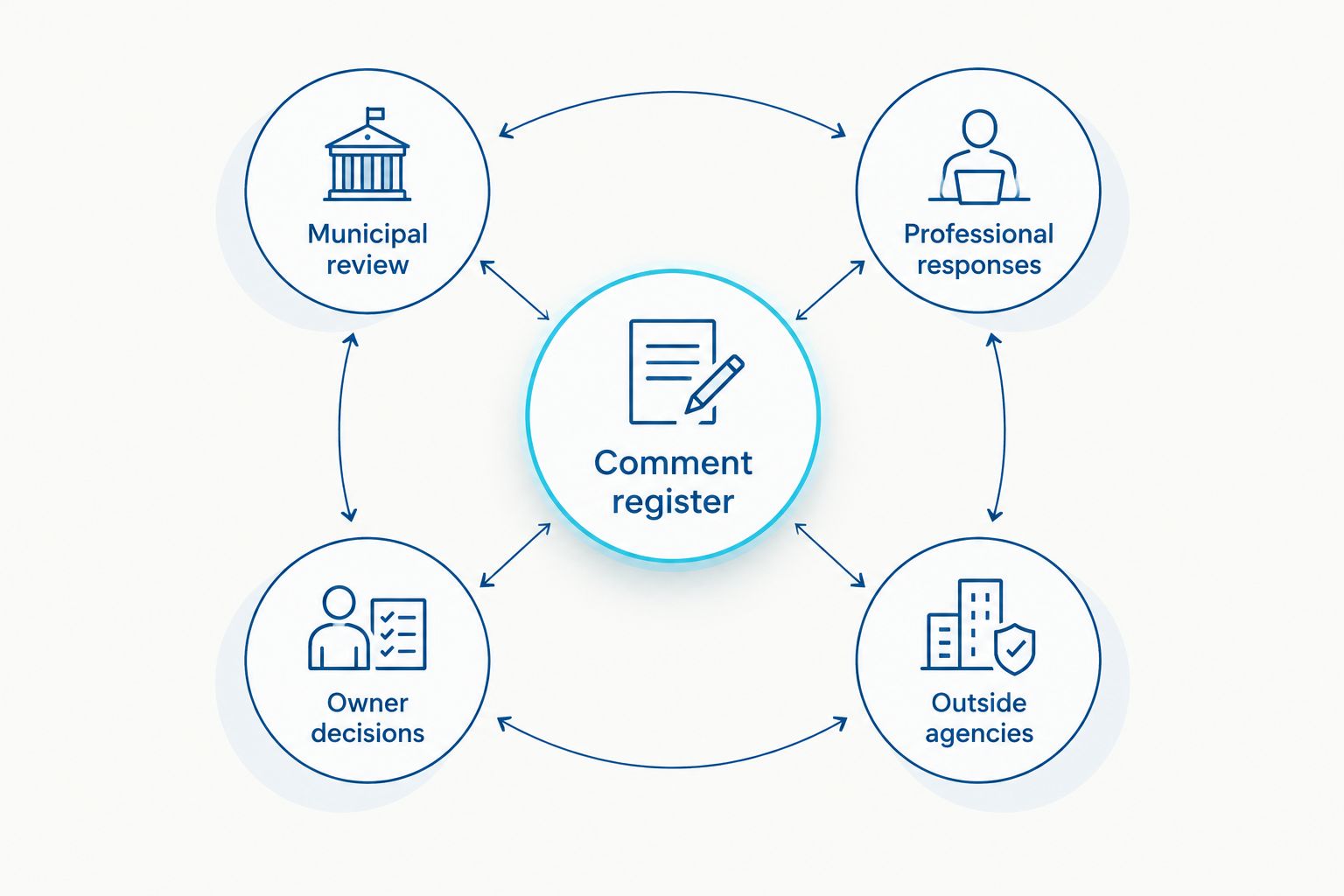
Maintain a comment-response register you can build in a spreadsheet. Record the reviewing party, comment, responsible professional, response, and revised document. This is more useful than a collection of emails because it shows whether each issue has an owner and a resolution.
Technical review can involve questions about drainage, circulation, parking, access, utilities, landscaping, or other project-specific requirements. Ask the responsible professional to distinguish design revisions from explanatory responses and matters requiring an owner decision.
Track municipal and outside-agency reviews as separate workstreams when both apply. A municipal submission does not automatically satisfy county, state, utility, or other applicable requirements.
Set a coordination checkpoint before the hearing package is finalized. Confirm which comments remain open and whether the team needs additional information, revised drawings, or a change in the proposed scope.
- Log each written review comment with its source and document date.
- Assign technical responses to the relevant professional.
- Identify revisions affecting multiple disciplines.
- Track outside-agency submissions and decisions separately.
- Confirm that the hearing set matches the team's current responses.
Prepare the hearing and notice requirements with counsel
Start by organizing the project narrative, current plans, review letters, and response register. A hearing is the board's opportunity to consider the application, receive testimony, and address the applicable review standards. Your preparation should connect each proposed feature to the evidence and professional explanation supporting it.
Where public notice is required, New Jersey's Municipal Land Use Law generally includes notice at least 10 days before the hearing and notice to qualifying property owners within 200 feet. These requirements appear in N.J.S.A. 40:55D-12; exceptions and application-specific requirements must be checked by counsel.
Those figures are procedural requirements, not scheduling recommendations. Do not assume every site plan application requires identical notice, or calculate recipients from an informal online map.
For a 2026 hearing, confirm the municipality's filing procedures, document requirements, and submission arrangements before relying on a requested meeting date.
- Have counsel determine whether public notice is required.
- Confirm notice content, recipients, service, publication, and proof requirements.
- Assign witnesses and the topics each professional will address.
- Review unresolved comments and proposed responses before testimony.
- Keep the final hearing package and notice records together.
Close approval conditions before advancing to construction
After a board decision, obtain the written resolution and review it with the project team. A resolution is the board's written decision, including findings and conditions. Record what the approval allows, what remains required, and which tasks must precede subsequent action.
Create a conditions register rather than relying on recollection of the hearing. Each condition needs an accountable party, a required document or action, and evidence of satisfaction. Ask the appropriate professional or municipal office to confirm how completion is documented.
Site plan approval does not replace required construction permits or other applicable approvals. Your 2026 construction-readiness review should reconcile the approved plans, conditions, outside-agency requirements, and permit documents before work proceeds.
Consulting can coordinate the closeout process, but legal interpretation and technical certification remain with the appropriate professionals.
- Obtain and review the written approval resolution.
- Translate each condition into an assigned action.
- Coordinate required plan revisions across the professional team.
- Confirm applicable outside-agency and construction-permit requirements.
- Retain the approved documents and condition-clearance records in one project file.
Compare your coordination options
Choose support according to the work you need performed. These approaches can work together: administrative coordination, licensed professional services, and development consulting serve different purposes.
| Option | Best for | Practical benefit | Key limitation |
|---|---|---|---|
| Owner-managed coordination | Owners able to maintain records and manage follow-up | Keeps project decisions and administrative tracking directly with the owner | Requires the owner's time and does not replace licensed professional work |
| Licensed professional team | Projects needing legal advice, design, surveying, or professional analysis | Assigns regulated work to the appropriate disciplines | Cross-disciplinary coordination still needs an identified owner |
| Nieves Development consulting and coordination | New Jersey owners seeking development strategy and municipal-process coordination | Focuses on the project roadmap and coordination of the process | Does not substitute for licensed services or guarantee approval |
Choose a coordinator and qualified professionals, not one instead of the other. A coordination gap is not resolved by assuming every consultant manages the entire process. Confirm scope, deliverables, and communication responsibilities before appointments are finalized.
Common mistakes property owners make
Treating permitted use as complete development compliance
A use permitted in the zoning district still requires evaluation against applicable site and development standards. Check the proposal's parking, setbacks, access, and other governing requirements with your team. Do not commission a final layout based only on the use category.
Confusing completeness with approval
A completeness determination concerns submission requirements, not the merits of the application. Keep completeness correspondence separate from technical review comments and the board's eventual decision. Label those milestones distinctly in the project register.
Treating municipal approval as permission to start work
A favorable board decision can contain conditions, and construction permits remain a separate requirement. Review the written resolution and permit pathway before scheduling work that depends on them. Do not use a hearing outcome as a substitute for documented readiness.
Losing control of the submitted plan version
An owner, architect, engineer, and municipal reviewer working from different drawings can discuss different proposals without realizing it. Establish one controlled submission set and document revisions. Preserve superseded versions as records, but clearly distinguish them from the current package.
Leaving redevelopment and outside-agency questions until late
A property subject to redevelopment provisions or additional agency review needs those requirements in the initial roadmap. Identify the governing framework during due diligence and assign each review responsibility. Late discovery changes the work required to reach the next milestone.
FAQ
What is site plan approval for property owners in New Jersey?
Site plan approval is municipal review of a proposed site layout against applicable development requirements. It addresses the development proposal rather than replacing construction permits or required outside-agency approvals.
Does every property improvement need site plan approval?
No, every property improvement does not require the same site plan review. Confirm the applicable municipal ordinance, exemptions, and application category before deciding what your proposal requires.
Is site plan approval the same as a zoning variance?
No, site plan approval and a zoning variance serve different purposes. Site plan review evaluates the development proposal, while a variance requests relief from a zoning requirement; a project can require both.
Does New Jersey approve a site plan within 45 days?
The 45-day completeness framework in N.J.S.A. 40:55D-10.3 is not a promise of site plan approval. Completeness and the municipal decision are separate milestones, and counsel should assess the applicable statutory provisions.
Do I need to notify neighbors before a site plan hearing?
Neighbor notice depends on the application and applicable notice requirements. Where notice is required, N.J.S.A. 40:55D-12 generally includes qualifying property owners within 200 feet and notice at least 10 days before the hearing; counsel should confirm the requirements and exceptions.
Can I coordinate a site plan application myself?
You can manage project records, owner decisions, and administrative follow-up yourself. Required legal advice, technical work, professional testimony, and signed or sealed submissions must remain with appropriately qualified professionals.
Can construction begin immediately after site plan approval?
Site plan approval alone does not authorize construction. Review the written resolution, satisfy applicable conditions, and obtain the construction permits and other approvals required for the work.
One last thing
Make the approval-conditions register part of your roadmap before the hearing. Prepare its structure early, then populate it from the written decision. This gives every condition a place, an accountable party, and a closeout record instead of leaving post-approval work scattered across correspondence.
For 2026 projects, keep legal requirements, technical deliverables, and administrative coordination visibly separate. Development consulting and municipal-process coordination are not substitutes for licensed legal, engineering, architectural, planning, or surveying services. Obtain project-specific advice from the appropriate professionals; no roadmap guarantees municipal approval.
Related guides
- Paterson zoning due diligence before property acquisition
- What a land-use consultant does in New Jersey
- Land-use consulting for mixed-use developers
YOUR NEXT STEP
Planning a project in New Jersey?
Discuss your property, project goals and municipal-process questions with Nieves Development Consulting.
Explore our consulting services · See a Paterson project example