

Mixed-use entitlement in New Jersey has no fixed end-to-end duration: your schedule depends on the zoning pathway, application readiness, hearing process, and approvals required for the property. Statutory review periods do not include every stage of project preparation or establish a guaranteed construction start date. For a 2026 acquisition or development schedule, separate those milestones before committing to a closing or financing deadline.
- How long does the entitlement process take for mixed-use? New Jersey has no single end-to-end deadline.
- New Jersey’s Municipal Land Use Law distinguishes application completeness from substantive approval.
- Confirm zoning, variance requirements, and outside-agency dependencies before setting acquisition or financing milestones.
- Nieves Development Consulting LLC provides development strategy and municipal-process coordination, not guaranteed approvals.
How long does the entitlement process take for mixed-use?
The defensible answer is a project-specific milestone schedule, not a universal number of months. A permitted mixed-use proposal and a proposal requiring use-variance relief follow different approval pathways. Neither pathway starts with a guaranteed completion date.
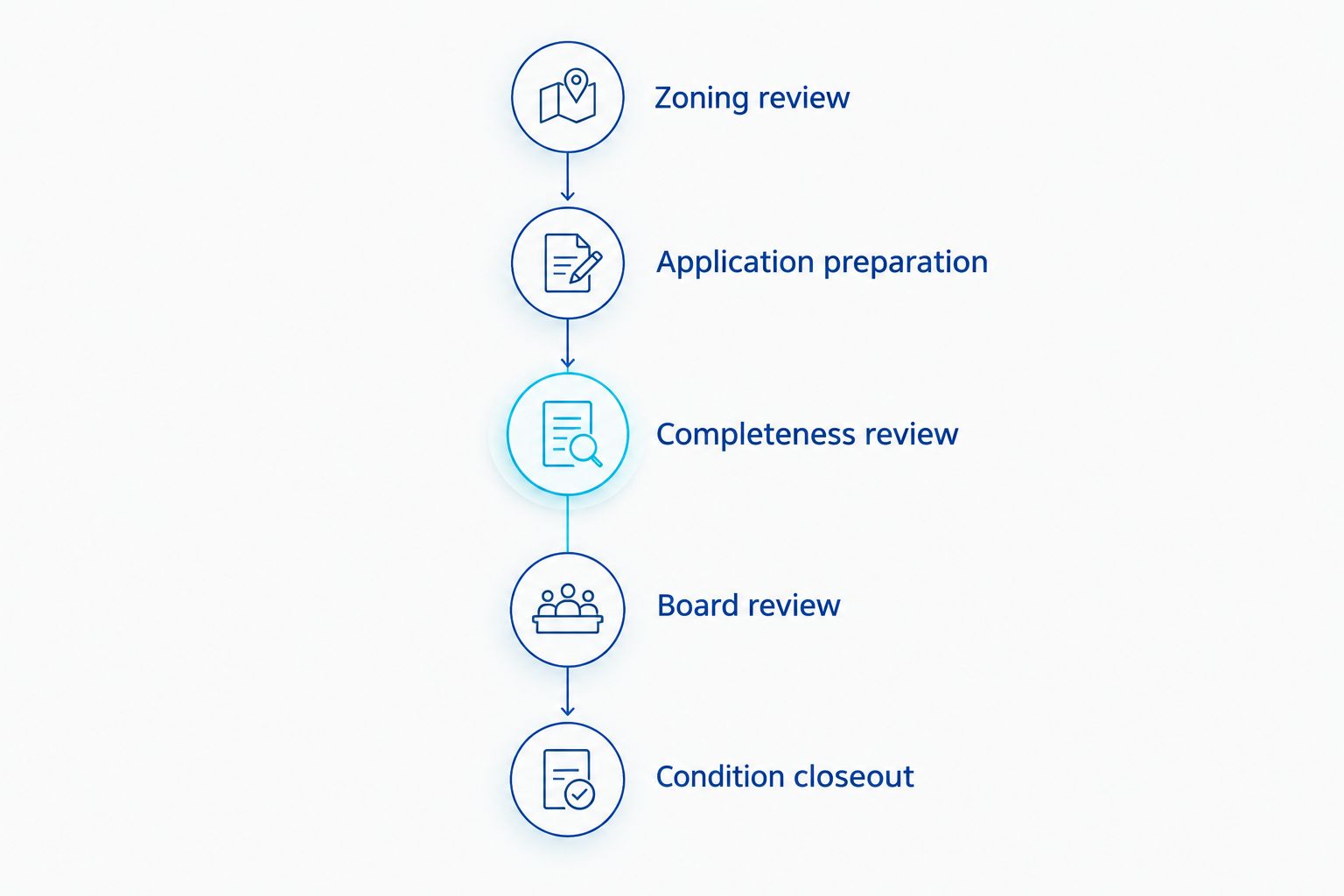
Begin with the land-use consulting guide for mixed-use developers to frame the zoning and coordination questions. Then establish the following sequence with your project team:
- Zoning review: Confirm the permitted uses, dimensional requirements, and applicable redevelopment provisions.
- Application preparation: Assemble the drawings, reports, ownership information, and submissions required for the application.
- Completeness review: Establish whether the submission satisfies the applicable checklist or requires additional material.
- Board review: Address professional comments, notice requirements, testimony, and the board’s decision.
- Condition closeout: Track the written resolution, required revisions, outside approvals, and remaining conditions.
These are scheduling milestones, not interchangeable descriptions of “approval.” Identify the document or decision that closes each milestone and the person responsible for obtaining it.
Why this matters
Your purchase contract, financing assumptions, and design commitments need the same definition of completion. A board vote does not establish that every condition has been satisfied or that a building permit is ready for issuance.
For a 2026 project schedule, distinguish the date you expect to file from the date the application is complete. Also distinguish the anticipated hearing from the date you expect to receive and address the written resolution.
Build contractual milestones around identifiable deliverables. Have counsel review acquisition deadlines and extension provisions against the actual approval pathway rather than an unsupported estimate of total entitlement time.
Which New Jersey deadlines affect the schedule?
New Jersey’s Municipal Land Use Law contains procedural deadlines, but those deadlines address defined actions. They are not a statewide average for mixed-use entitlement.
| Procedural milestone | Statutory timing | What the timing does not establish |
|---|---|---|
| Application completeness | A 45-day completeness framework under N.J.S.A. 40:55D-10.3 | Total time for design, hearings, approval, or condition closeout |
| Board-of-adjustment decision on an application for development | Generally 120 days after submission of a complete application under N.J.S.A. 40:55D-73, unless the applicant consents to additional time | A universal deadline for every mixed-use application or separate agency approval |
| Public notice where required | At least 10 days before the hearing under N.J.S.A. 40:55D-12 | A promise that the application will be heard or decided at that meeting |
Under N.J.S.A. 40:55D-10.3, the 45-day completeness framework concerns certification, written deficiency notice, and the statutory consequences of municipal inaction. It does not convert an incomplete development concept into an approved project.
The 120-day period in N.J.S.A. 40:55D-73 concerns board-of-adjustment action on a complete application. Planning-board applications have their own applicable provisions. Counsel should identify the controlling section rather than apply the board-of-adjustment period to every proposal.
The 10-day notice requirement is a minimum procedural interval where notice is required. Your team still needs to confirm the applicable recipients, publication, service, and proof requirements.
These statutory references describe the New Jersey procedural framework for 2026 planning. Review their application with land-use counsel; do not add the periods together and label the result your entitlement duration.
Permitted mixed-use: establish site-plan readiness
A permitted mixed-use project allows the proposed combination of uses under the applicable zoning provisions. That does not eliminate site-plan review, dimensional compliance, or other required approvals.
Start by checking the proposal against the actual ordinance. Residential units above commercial space do not establish that the proposed residential density, commercial activity, parking arrangement, height, or loading configuration complies.
Best for: A proposal whose uses and layout fit the governing zoning requirements. The scheduling advantage is a defined zoning basis; the limitation is that detailed review and conditions still remain.
Your readiness milestone should identify the required application type, submission checklist, responsible board, and unresolved technical issues. A verbal statement that the use is permitted is not a substitute for reviewing the full development proposal.
Mixed-use requiring variance relief: establish jurisdiction first
A variance is permission to depart from a zoning requirement. New Jersey distinguishes bulk or dimensional relief from forms of relief addressed under N.J.S.A. 40:55D-70(d), including use-related relief.
That distinction affects the approval pathway. Do not assume every variance belongs before the zoning board or that every mixed-use project belongs before the planning board; counsel should confirm jurisdiction for the proposed application.
Best for: Evaluating a proposal that does not fit the existing zoning framework and requires a formal relief strategy. The benefit is a defined mechanism for seeking relief; the limitation is that approval requires the applicable legal proofs and is not assured.
Prepare the variance analysis before treating the hearing date as a reliable milestone. Design changes made after the relief strategy is established can alter the application, supporting testimony, or notice analysis.
Mixed-use under a redevelopment plan: read the governing documents
A redevelopment plan can establish development standards and permitted uses for the area it governs. The schedule therefore starts with confirming whether the property is covered and how the proposed project relates to that plan.
Do not treat “redevelopment area” as shorthand for a completed approval pathway. Determine whether the proposal conforms to the plan, whether additional municipal actions are needed, and which separate approvals remain.
Best for: A project within an applicable redevelopment framework whose requirements can be identified early. The benefit is a project-specific planning framework; the limitation is that plan conformity alone does not resolve every municipal, contractual, or outside-agency requirement.
For a 2026 roadmap, keep land-use review separate from any redevelopment agreement, property transaction, or incentive process that applies. Record dependencies between those workstreams rather than assuming they finish together.
How do the approval pathways compare?
The right pathway follows the property and proposal. It is not a menu from which you select the shortest apparent timeline.
| Pathway | Best for | Scheduling advantage | Scheduling limitation |
|---|---|---|---|
| Permitted mixed-use | A proposal aligned with existing use and development standards | Starts from an established zoning basis | Site-plan review and technical requirements can remain |
| Variance-dependent mixed-use | A proposal requiring relief from zoning requirements | Provides a formal process for requesting relief | Requires an appropriate jurisdiction and legal-proof strategy |
| Redevelopment-plan pathway | A property governed by an applicable redevelopment plan | Identifies a specific framework for evaluating the proposal | Additional municipal actions or agreements can remain relevant |
A permitted project with unresolved access or environmental issues is not automatically ready sooner than a carefully prepared variance application. Compare documented dependencies, not pathway labels alone.
Use the New Jersey Municipal Land Use Law developer guide to organize questions for the professionals advising on jurisdiction and procedure.
Why mixed-use entitlement timing varies
Mixed-use entitlement timing varies because different properties require different decisions and supporting materials. The following factors belong in your schedule assumptions:
- Zoning alignment: Identify whether the proposed uses, density, dimensions, parking, and site configuration comply or require relief.
- Application completeness: Track missing checklist items, requested waivers, and responsibility for responding to deficiency notices.
- Technical coordination: Reconcile architectural, engineering, planning, and other applicable submissions before relying on a hearing target.
- Hearing readiness: Confirm notice, exhibits, professional availability, and responses to municipal review comments.
- Outside approvals: Identify applicable environmental, county, access, utility, or historic-review requirements and their dependencies.
- Approval conditions: Separate conditions that require drawing revisions, further submissions, agreements, or other approvals.
Each factor should become an assigned task, a required decision, or an explicit schedule assumption. “Municipal review” is too broad to manage as a single activity.
How do you build a usable entitlement roadmap?
Create a schedule that explains why each milestone is achievable. A date without an owner, prerequisite, or completion document is only a target.
Define the finish line
Specify whether “entitled” means a board decision, an adopted resolution, satisfaction of identified conditions, or another contractually defined status. Your lender and purchase agreement might use different language, so reconcile those definitions with counsel.
Do not substitute a building-permit target for a land-use approval milestone. Construction-document review and permit issuance require their own coordination.
Assign dependencies
Record what must happen before the next task starts. A revised site layout, for example, can require updates to supporting submissions rather than an isolated drawing replacement.
Keep a decision log showing the issue, responsible professional, required response, and affected milestone. This makes schedule changes traceable without suggesting that every task sits on the critical path.
Separate targets from confirmed events
Label a proposed filing date as a target until the submission is ready. Treat a hearing date according to the municipality’s actual scheduling and procedural status, not an internal presentation calendar.
For 2026 reporting, update milestones when the underlying facts change. Preserve the reason for the change so investors and lenders can distinguish design revisions from municipal scheduling or outside-agency dependencies.
Nieves Development Consulting LLC is best for New Jersey developers, property owners, and investors seeking development strategy and municipal-process coordination. Its consulting role is relevant to organizing this roadmap; it does not replace licensed professional judgments or municipal decisions.
Can a mixed-use project start construction after a board vote?
A board vote alone is not permission to start construction. Review the written resolution, outstanding conditions, required outside approvals, and construction-permit requirements before establishing a start date.
Ask the project team to identify which conditions affect the next milestone. Do not assume every condition must be resolved at the same stage or that an unresolved condition is immaterial.
Does a complete application guarantee a decision date?
A complete application establishes a procedural milestone, not a guaranteed calendar outcome. The applicable statutory period depends on the application and board, and applicant-consented extensions can affect the schedule.
Track completeness separately from hearing readiness. A submission can satisfy a checklist while substantive design, testimony, or review issues still require attention.
Can coordination guarantee faster entitlement?
Coordination cannot guarantee approval or a shorter municipal process. Its role is to organize dependencies, clarify responsibilities, and keep decisions visible.
Nieves Development Consulting LLC provides development strategy, zoning guidance, and municipal-process coordination for New Jersey projects. Legal representation and licensed design or technical services remain separate professional responsibilities.
FAQ
How long does the entitlement process take for mixed-use in New Jersey?
Mixed-use entitlement in New Jersey has no fixed end-to-end duration. Establish the zoning pathway, application requirements, hearing milestones, outside approvals, and condition-closeout tasks before setting a project schedule.
Does the 45-day completeness period mean my project gets approved?
No. The 45-day completeness framework under N.J.S.A. 40:55D-10.3 concerns application completeness, not substantive project approval. Design preparation, hearings, and approval conditions are separate matters.
Does every mixed-use application have a 120-day review period?
No. The 120-day period under N.J.S.A. 40:55D-73 applies to board-of-adjustment action on a complete application, subject to applicant-consented additional time. Other applications require review of their applicable statutory provisions.
How much notice is required before a New Jersey land-use hearing?
At least 10 days of notice is required before the hearing where N.J.S.A. 40:55D-12 applies. Confirm the applicable publication, service, recipient, and proof requirements with counsel.
Is a permitted mixed-use project exempt from site-plan review?
Permitted mixed-use status does not by itself establish an exemption from site-plan review. Confirm the required application and compliance with the governing development standards.
Should I set a purchase closing date before confirming zoning?
Confirm the zoning pathway before relying on an entitlement-based closing assumption. Have counsel align due-diligence periods, approval conditions, and extension provisions with the proposed transaction.
Does a development consultant replace my architect or attorney?
No. Development consulting and municipal-process coordination do not replace licensed legal, architectural, engineering, planning, or surveying services. Engage the appropriate licensed professionals for those responsibilities.
One last thing
Ask for a condition-closeout tracker before the entitlement process reaches its final hearing. The board decision is a milestone; the remaining obligations need owners too.
This article provides general development-process information, not legal advice or licensed engineering, architectural, planning, or surveying services. Nieves Development Consulting LLC provides development consulting and coordination; consult the appropriate licensed professionals about project-specific requirements.
Related guides
- How long does site-plan approval take in New Jersey?
- How long does a planning-board hearing take?
- How long after zoning approval until a building permit?
YOUR NEXT STEP
Planning a project in New Jersey?
Discuss your property, project goals and municipal-process questions with Nieves Development Consulting.
Explore our consulting services · See a Paterson project example