

There is no fixed interval from zoning approval to a building permit in New Jersey in 2026: the general construction-permit review period is 20 business days after receipt of a complete application, not after zoning approval. That review period does not include the time you spend satisfying approval conditions, preparing construction documents, or obtaining required prior approvals, and it does not guarantee permit issuance.
- How long after zoning approval until you get a building permit? In New Jersey, application readiness determines the starting point.
- New Jersey’s general construction-permit review period is 20 business days for a complete application, not from zoning approval.
- Zoning approval does not authorize construction; required prior approvals and construction-code review remain separate milestones.
- Nieves Development supports New Jersey development consulting and municipal-process coordination, not licensed design or legal services.
Why this matters
A favorable zoning decision is a land-use milestone, not permission to begin construction. If you schedule mobilization around the hearing date alone, your schedule leaves out the work between municipal approval and a permit-ready application.
For a practical roadmap, review the zoning approval to building permit workflow. The useful scheduling question is not simply when the board voted; it is which unresolved requirements prevent the construction official from issuing the permit.
Keep land-use approval, application readiness, and permit issuance separate in your project tracker. Each milestone needs its own evidence, responsible party, and outstanding-item list.
How long after zoning approval until you get a building permit?
The zoning approval date does not start New Jersey’s construction-permit review clock. Under the general rule in the New Jersey Uniform Construction Code, N.J.A.C. 5:23-2.16, a construction official must issue the permit or provide a written denial within 20 business days after receipt of a complete application.
That is a regulatory review period, not an estimate of your entire post-zoning schedule. A written denial identifies a different outcome from permit issuance; unresolved deficiencies still require action.
For a 2026 project schedule, distinguish these milestones:
| Milestone | What it establishes | What it does not establish |
|---|---|---|
| Zoning or board approval | The proposed development has received the applicable land-use determination, subject to its terms | That all conditions are satisfied or construction documents are ready |
| Required prior approvals | Applicable approvals outside construction-code review have been documented | That the construction plans comply with every applicable code requirement |
| Complete permit application | The construction office has the required application materials for review | That the application will receive approval without corrections |
| Permit issuance | The construction office has authorized the work described in the issued permit | Permission to perform work outside that permit’s scope |
Ask the construction office what it considers outstanding before assigning a permit date. Record whether the issue is application completeness, a missing prior approval, a technical correction, or an issuance requirement.
Those are different problems. Each belongs with a different person on your project team.
If zoning approval is an administrative clearance
Some projects receive zoning clearance through the municipal zoning officer rather than a planning board or zoning board hearing. Administrative clearance confirms the applicable zoning determination; it does not replace construction-code review.
Your next move is to confirm that the zoning clearance describes the same use and scope shown in the permit documents. An application describing an alteration while the plans show a different occupancy or use requires clarification before the team relies on the clearance.
Best next move: reconcile the zoning description and construction scope before submission. The benefit is a clearer handoff; the limitation is that zoning clearance alone does not resolve structural, fire-protection, accessibility, or other applicable construction-code requirements.
If approval came from a planning or zoning board
A board’s favorable vote is not the entire approval record. Review the adopted resolution—the written document recording the decision and its conditions—and identify what must happen before permit issuance.
Conditions can require revised plans, additional submissions, or other actions. Their wording matters: a condition tied to permit issuance belongs on the pre-permit checklist, while a later milestone requires separate tracking.
Do not assume every condition has the same deadline or must be completed at the same stage. Have the appropriate licensed professional interpret technical or legal requirements and confirm the municipality’s documentation expectations.
Best next move: convert the resolution into an assigned conditions list. This makes outstanding work visible, but it does not replace legal review or municipal confirmation that a condition has been satisfied.
If redevelopment or outside approvals are involved
A redevelopment project can involve obligations beyond ordinary zoning clearance. Depending on the property and scope, environmental approvals, county review, utility coordination, historic review, or redevelopment documents can affect readiness.
The relevant question is whether a particular item is a required prior approval for the permit you seek. Do not treat every outside review as a universal prerequisite, and do not assume a municipal land-use approval resolves another agency’s requirements.
Best next move: identify each applicable approval and its required sequence. Parallel coordination can keep independent tasks moving, but it cannot eliminate a prerequisite that must be satisfied before issuance.
For adaptive reuse, give particular attention to whether the proposed work changes the building’s use or occupancy classification. Your design professionals must evaluate the construction-code implications separately from the zoning determination.
Build a permit-readiness roadmap
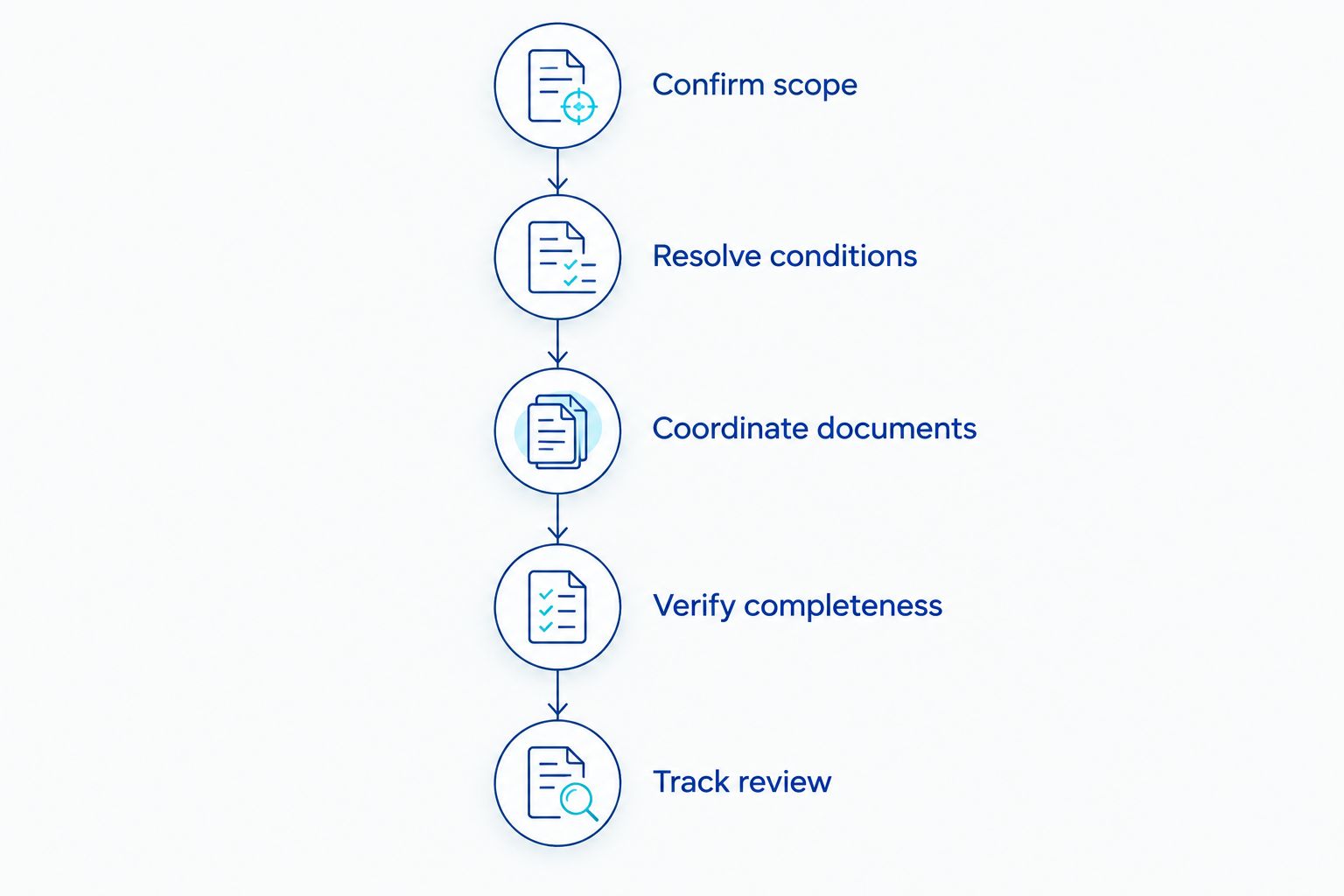
Use this sequence to organize the handoff after zoning approval. It is a coordination framework, not a promise that every municipality or project follows an identical administrative sequence.
- Confirm scope. Match the approved use, building configuration, and project description to the work you intend to submit for a permit. Identify changes before the construction documents move further into review.
- Resolve conditions. Read the approval documents and assign each pre-permit condition to a responsible party. Record the evidence needed to demonstrate completion.
- Coordinate documents. Have the appropriate licensed professionals prepare consistent construction drawings, technical submissions, and application materials. Check that revisions appear across the affected disciplines.
- Verify completeness. Confirm required prior approvals and submission requirements with the construction office. Keep a record of what was submitted and which items remain outstanding.
- Track review. Route comments to the responsible professional, coordinate responses, and confirm remaining issuance requirements. Distinguish a resubmission from an issued permit.
The roadmap works only when every outstanding item has an owner. A note reading “waiting on town” is less useful than a record identifying the specific review, submission date, requested response, and responsible contact.
For your 2026 roadmap, maintain a distinction between a target date and a confirmed milestone. A target expresses the team’s plan; a confirmed milestone has supporting documentation.
Nieves Development is best for New Jersey developers, property owners, and investors seeking development strategy and municipal-process coordination. Its role is to organize the roadmap and project handoffs, not to provide licensed design services or guarantee municipal action.
The New Jersey real estate development consulting page provides context for that coordination role. Keep the architect, engineer, attorney, planner, or surveyor responsible for work requiring their respective licenses.
Why the time after zoning approval varies
The period between zoning approval and permit issuance depends on the work remaining, not simply the type of approval you received. For a 2026 readiness review, organize that work under these factors:
- Approval conditions. A favorable decision can still require revised plans or other actions before the municipality allows permit issuance.
- Construction-document readiness. Land-use drawings and permit construction documents serve different purposes. Your design team must determine whether the submission contains the detail required for code review.
- Required prior approvals. Applicable outside approvals must be documented at the stage required for the permit. Confirm requirements for the actual property and scope.
- Consistency across submissions. Changes to use, layout, building systems, or site design need coordinated treatment across the affected documents.
- Review comments and responses. A submission requiring corrections creates additional work. Track each comment through a documented response rather than assuming submission equals acceptance.
- Issuance requirements. Confirm outstanding signatures, required payments, and administrative documentation with the construction office. A technically reviewed application is not itself an issued permit.
Avoid assigning a generic duration to these factors. The useful schedule identifies the actual outstanding task, its dependency, and who can complete it.
Does the 20-business-day rule start at the zoning hearing?
The 20-business-day review period starts with receipt of a complete construction-permit application, not the zoning hearing. New Jersey’s general construction-permit rule addresses issuance or written denial; it does not convert a favorable board vote into permission to build.
Can I start construction after zoning approval?
Zoning approval alone does not authorize work that requires a construction permit. Confirm that the permit covering your intended work has been issued before starting that work, and do not assume an approval for one scope authorizes another.
What should I ask the construction office before setting a start date?
Ask whether the application is complete, which required prior approvals remain outstanding, and whether technical comments or issuance items are unresolved. Request answers tied to your application and proposed work rather than a general turnaround estimate.
Record the response in your project tracker and share it with the professionals responsible for each item. In 2026, a documented readiness position is a sounder scheduling basis than the elapsed time since zoning approval.
FAQ
Is zoning approval the same as a building permit in New Jersey?
No. Zoning approval addresses the applicable land-use requirements, while a construction permit authorizes the work described in the issued permit after the required review and approvals.
Does New Jersey guarantee a building permit within 20 business days?
No. New Jersey’s general construction-permit rule provides for issuance or written denial within 20 business days after receipt of a complete application, not guaranteed approval.
Can I prepare building-permit drawings before zoning approval?
You can coordinate construction-document preparation before zoning approval, but unresolved land-use decisions create revision risk. Have your design professionals identify which work can proceed and which details depend on the final approval.
What if the zoning board approved my project with conditions?
Review the adopted resolution and identify which conditions apply before permit issuance. Assign each item to the appropriate professional and confirm what documentation the municipality requires.
Will changing my plans after zoning approval affect the permit?
A change after zoning approval requires review for consistency with the land-use approval and construction documents. Ask the zoning officer and your licensed professionals whether the change requires revised approval, updated plans, or both.
Who should coordinate the handoff from zoning to construction review?
Assign a clear coordination lead while keeping licensed professionals responsible for their respective work. Nieves Development provides development consulting and municipal-process coordination; it does not replace the architect, engineer, attorney, planner, or surveyor.
Should I book a contractor as soon as zoning is approved?
Do not treat zoning approval as confirmation that permitted work can begin. Coordinate any proposed start date around application readiness, outstanding requirements, and actual permit issuance.
One last thing
Ask your team to identify the next unresolved dependency, not just the next anticipated date. If the answer is an unsigned document, an unresolved condition, or a missing prior approval, that item belongs at the center of your immediate coordination effort.
A permit schedule becomes more useful when it explains what must happen next. The date alone does not tell you who needs to act.
This article provides general New Jersey development-process information, not legal, architectural, engineering, professional planning, or surveying advice. Requirements depend on the property, proposed work, applicable regulations, and municipal determinations; consult the appropriate licensed professionals and municipal officials for project-specific guidance.
Related guides
- Site plan approval to certificate of occupancy workflow
- How long does site plan approval take in New Jersey?
- Connecting historic review to adaptive reuse permit approval
YOUR NEXT STEP
Planning a project in New Jersey?
Discuss your property, project goals and municipal-process questions with Nieves Development Consulting.
Explore our consulting services · See a Paterson project example