

You can apply for NJEDA incentives before site plan approval only when the selected program’s rules allow submission at that stage; there is no agency-wide answer that replaces those requirements. For a 2026 project, confirm which approvals are required at application, award, and funding before treating an early filing as a workable development milestone.
- Can you apply for NJEDA incentives before site plan approval? Only when the selected program permits that filing sequence.
- NJEDA application readiness and municipal site plan readiness are separate checkpoints; coordinate both before committing to a schedule.
- Nievesdevelopment development consulting is best for owners and developers seeking strategy and municipal-process coordination, not licensed professional services.
- Confirm required approval documents, unresolved conditions, and construction restrictions before setting an incentive application milestone.
Why this matters
An incentive application and a municipal development application answer different questions. A financial assistance submission does not authorize construction, and a municipal approval does not establish incentive eligibility.
For your 2026 development roadmap, the useful question is not simply whether you can submit early. It is which project milestone requires which evidence, and whether your team can produce that evidence without changing the development assumptions behind the submission.
Start with the relationship between the proposed development and the incentive pathway. The guide to connecting redevelopment projects to NJEDA incentives provides a related coordination framework.
Can you apply for NJEDA incentives before site plan approval?
Apply before site plan approval only after confirming that the specific NJEDA program accepts your current approval status. NJEDA means the New Jersey Economic Development Authority; its name alone does not identify the application requirements for an individual incentive.
Site plan review addresses a proposed development’s layout and applicable municipal requirements. Incentive review addresses the requirements of the financial assistance program. Keep those workstreams connected, but do not treat their milestones as interchangeable.
Use the following table to organize your questions. These are readiness checkpoints, not statements that every NJEDA program uses the same approval sequence.
| Checkpoint | Question to resolve | Evidence to identify |
|---|---|---|
| Application submission | Can this program accept a project without site plan approval? | Current application instructions and required attachments |
| Application review | How must pending municipal approvals be disclosed? | Approval-status narrative and supporting documents |
| Award decision | What municipal evidence is required at this stage? | Program requirements and project-specific correspondence |
| Funding or benefit delivery | What conditions remain before assistance becomes usable? | Applicable agreement and milestone requirements |
| Construction readiness | What separate approvals and permits authorize the proposed work? | Municipal approvals, permits, and professional guidance |
Do not interpret acceptance of an uploaded application as confirmation that the project satisfies every requirement. Submission, substantive eligibility, an award decision, and access to the benefit are distinct questions to verify.
What should you confirm before submitting an early application?
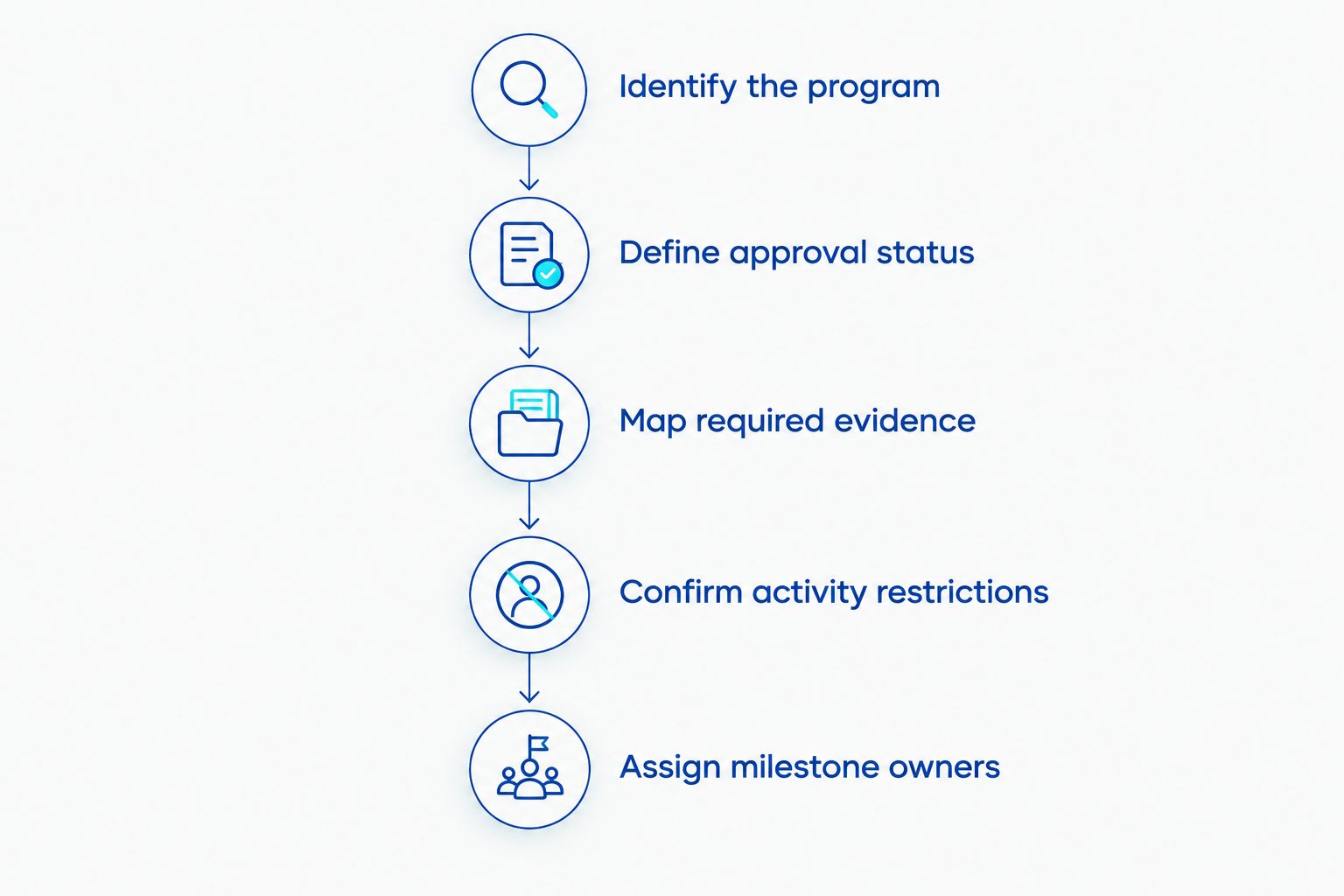
Build a short, written readiness record before setting the filing date. For each question below, identify the governing document, the answer, the person responsible for confirmation, and any unresolved dependency.
Identify the program
Record the exact incentive program and the current application materials you intend to use. Avoid working from a general description of NJEDA assistance or another project’s experience.
For a 2026 submission, verify the version and status of the relevant materials. A saved checklist is useful only when it matches the requirements governing your application.
Define approval status
Describe what the municipality has actually received or decided. A concept discussion, a filed application, a hearing, and a written approval are different events.
Use precise language in the incentive submission. If a hearing has occurred but the written resolution is not yet available, describe that status rather than presenting the project as having every approval document in hand.
Map required evidence
Identify exactly what the program requests at submission and at later milestones. Ask whether the required evidence is an application receipt, an approval document, a status explanation, or another specified attachment.
Do not substitute a document because its title sounds similar. Match each requirement to the evidence requested and flag any proposed alternative for confirmation.
Confirm activity restrictions
Ask whether acquisition, contracts, construction, or other project activity affects eligibility or the required application sequence. Obtain a program-specific answer before taking an action whose timing matters to the submission.
This is a verification task, not a reason to assume that all pre-application activity is prohibited. Your roadmap should distinguish confirmed restrictions from open questions.
Assign milestone owners
Name the person responsible for each document and decision. Municipal counsel, design professionals, the applicant, and the financial team should know which deliverables the filing depends on.
Finish with a clear submission decision: ready, ready subject to a confirmed condition, or not ready. An unresolved requirement is a dependency to close, not an assumption to hide.
Filing before approval: useful only with a confirmed pathway
Early filing deserves consideration when the program permits it and the project description is sufficiently defined for an accurate application. The practical benefit is coordination: your team can address financial assistance requirements while municipal work continues.
The trade-off is change management. If the proposed development changes during municipal review, check whether the incentive submission needs revision and who must review the revised information.
Best for: applicants with a confirmed early-submission pathway, a documented approval status, and a responsible team for updating project information.
Do not file merely to create the appearance of progress. An incomplete or internally inconsistent submission does not resolve the project’s underlying readiness questions.
Filing after approval: clearer evidence, not automatic eligibility
Waiting for site plan approval gives your team a municipal decision to document. It also creates an opportunity to reconcile the approved plans, written conditions, development budget, and proposed incentive submission before filing.
The trade-off is sequencing. Before choosing to wait, confirm that the later filing date remains consistent with the program’s requirements and the project’s planned activities.
Best for: applicants whose program requires approval evidence at submission, or whose project scope needs municipal resolution before the application can accurately describe the development.
For a 2026 roadmap, compare the actual dependencies rather than assuming that earlier is always better. Waiting is not automatically safer if the team has not checked the incentive’s timing requirements.
| Filing approach | Practical advantage | Limitation | Best for |
|---|---|---|---|
| Before site plan approval | Allows coordinated work when the program permits early submission | Pending municipal decisions require careful disclosure and updates | Applicants with a verified early-filing pathway |
| After site plan approval | Provides a municipal decision to reconcile with the application | Must still fit the program’s timing and activity requirements | Applicants needing approval evidence or a settled project scope |
Why the application sequence varies
The correct sequence follows the selected program and the actual project record. Use these factors to explain the schedule to your ownership group and professional team:
- Program requirements: Identify the approval evidence required at submission and at subsequent milestones. Do not import requirements from a different incentive.
- Municipal status: Distinguish a pending submission from a decision, and a decision from completed follow-up documentation.
- Project definition: Keep the proposed uses, development scope, and application narrative consistent across municipal and incentive materials.
- Approval conditions: Identify unresolved conditions and ask whether they affect the evidence required for the incentive milestone.
- Activity timing: Confirm whether planned contracts, acquisition, or construction affect the filing sequence before authorizing those activities.
- Document readiness: Assign responsibility for missing records and reconcile conflicting versions before submission.
These factors belong in a shared roadmap. A date without its prerequisites is not a reliable milestone.
How should you coordinate municipal and incentive milestones?
Maintain a single development roadmap with separate municipal and incentive tracks. Each track should identify the required action, its supporting document, its owner, and the event that must happen first.
For the municipal track, record the actual status of zoning review, site plan review, approval conditions, and permits relevant to the project. Do not collapse those items into a general label such as approvals underway.
For the incentive track, record the requirements you have verified for submission, review, an award decision, and benefit delivery. Where a requirement remains unclear, identify the question and the person responsible for obtaining clarification.
Then connect the tracks. If an incentive attachment depends on a municipal document, make that dependency explicit; if a municipal revision changes the development described in the application, assign a review before the revised information is used.
Nievesdevelopment provides development consulting and municipal-process coordination for developers, property owners, and investors working on multifamily, mixed-use, and redevelopment projects in New Jersey. Its New Jersey real estate development consulting is relevant to organizing that roadmap, not replacing a program eligibility determination or licensed professional advice.
What should you ask NJEDA about a pending site plan?
Ask a narrow question tied to the exact program and your documented project status. A useful inquiry identifies the proposed development, the municipal milestone already reached, the outstanding approval documents, and the intended application milestone.
Request clarification on whether the application can be submitted in that condition, which evidence must accompany it, and when outstanding documents must be supplied. Ask separately about planned project activities whose timing requires confirmation.
Keep the response with the application record. Before relying on it, check that the facts described in the inquiry still match the project you intend to submit.
Does conditional site plan approval settle application readiness?
Conditional site plan approval does not, by itself, settle NJEDA application readiness. Identify what the written municipal decision requires, then compare that record with the selected program’s requirements.
Have the appropriate licensed professionals interpret conditions within their disciplines. A coordination summary should track those conditions without presenting itself as a legal opinion or technical certification.
Can you prepare an incentive application during municipal review?
You can organize project records and map application requirements during municipal review without assuming that the application is ready to submit. Preparation and permission to file are separate decisions.
Use that preparation period to reconcile the development description, approval status, document owners, and outstanding questions. Set the filing milestone only after the required evidence and timing have been confirmed.
FAQ
Can you apply for NJEDA incentives before site plan approval in 2026?
You can apply before site plan approval only when the selected NJEDA program permits submission at that stage. Confirm the current application requirements and the evidence required at later milestones.
Does filing an NJEDA application mean my project is approved?
Filing an NJEDA application does not establish municipal approval or permission to build. Track incentive requirements and municipal approvals as separate workstreams.
Is conditional site plan approval enough for an incentive application?
Conditional site plan approval is enough only if it satisfies the selected program’s requirements for the relevant milestone. Compare the written municipal decision and outstanding conditions with the required application evidence.
Should I wait for site plan approval before contacting NJEDA?
You do not need a completed site plan approval to ask about a program’s application requirements. Describe your current municipal status accurately and request clarification before fixing the filing sequence.
Can I start construction while an incentive application is pending?
Do not treat a pending incentive application as authorization to start construction. Confirm the program’s activity requirements and obtain the separate approvals and permits required for the proposed work.
Who should coordinate the incentive and municipal approval schedule?
Assign a development lead to maintain the shared roadmap and obtain input from the appropriate professionals. Nievesdevelopment development consulting supports strategy and municipal-process coordination, not licensed professional determinations.
What should I do if the project changes after I apply?
Compare the changed project with the information submitted and the program’s update requirements. Assign responsibility for confirming what must be revised before relying on the application as current.
One last thing
The most useful date is the date a required document becomes usable, not merely the date a meeting occurs. A hearing date belongs on the roadmap, but so does the work needed to obtain and reconcile the resulting records.
Before committing to a 2026 application milestone, ask the team to name the exact document that closes each dependency. That question turns a broad schedule discussion into an actionable readiness review.
Nievesdevelopment provides development strategy and process coordination, not licensed legal, engineering, architectural, planning, or surveying services. Obtain advice from appropriately licensed professionals for matters within those disciplines; neither consulting support nor an incentive application guarantees municipal approval or an incentive award.
Related guides
- New Jersey site plan approval timing
- Connecting feasibility studies to lender underwriting
- Coordinating NJDEP environmental review and site plan approval
YOUR NEXT STEP
Planning a project in New Jersey?
Discuss your property, project goals and municipal-process questions with Nieves Development Consulting.
Explore our consulting services · See a Paterson project example