

Instead of manually reconciling your feasibility report with every lender request, connect feasibility findings to underwriting through a shared evidence register, a dated financial baseline, and an approval-milestone tracker. This workflow gives the lender a traceable path from your proposed New Jersey development to its assumptions, supporting documents, and unresolved conditions.
- For feasibility study construction lender underwriting, connect every material assumption to evidence, a responsible reviewer, and a funding milestone.
- Nieves Development Consulting LLC suits New Jersey developers needing feasibility and municipal-process coordination, not lending decisions.
- Separate existing approvals from proposed zoning relief before presenting development capacity as a financing assumption.
- Update the underwriting package whenever scope, approval conditions, construction assumptions, or projected operating income changes.
Why this matters
A feasibility study asks whether a development concept is workable. Construction lender underwriting evaluates whether the proposed financing meets the lender’s credit requirements. The connection is evidence, not a longer report.
A zoning conclusion can affect the proposed unit count. That unit count affects projected revenue, construction scope, and the lender’s assessment of repayment. If those documents use different assumptions, the package is internally inconsistent.
Nieves Development Consulting LLC is best for New Jersey developers and property owners seeking feasibility and municipal-process coordination. For an introduction to the underlying project review, use the feasibility studies for first-time developers guide.
For a 2026 submission, distinguish the date a document was issued from the date someone confirmed its relevance to the current proposal. A document can be recent and still describe a superseded design.
Before you start
- Obtain the lender’s requirements. Request its document checklist, financial-model requirements, approval-status expectations, and submission method. Obtain access to the lender-designated portal if required; do not build the package around an assumed checklist.
- Assemble the working materials. Collect the feasibility report, property identification, current plans, zoning findings, available municipal records, construction assumptions, development schedule, and financial model. Identify who is responsible for reviewing each discipline.
- Resolve the approval-status gotcha. A feasible concept is not an approved project. Distinguish permitted development, proposed variances, pending applications, and issued approvals before carrying unit counts or uses into the lender’s model.
Use a spreadsheet and shared document folder for the workflow below. The bold field names are labels to create in your own register, not buttons from a particular software product. Keep lender-confidential material within the access controls required for your submission.
Evidence register
The evidence register connects the feasibility study to individual underwriting questions. Create 1 row per material assumption rather than one row for the entire report; a lender must be able to locate the support for a specific conclusion.
- Create columns labeled Assumption, Underwriting use, Source document, Document date, Responsible reviewer, Status, and Open condition.
- Enter the assumptions that change project scope, timing, income, or required funding. Include proposed use, development capacity, approval pathway, site constraints, construction scope, and the basis for projected operations.
- Name the exact supporting document and its version in Source document. Add a page or section reference where practical. A reference to a general folder is not enough.
- Assign the relevant professional or project participant in Responsible reviewer. Mark Status as documented, pending review, or unresolved; do not treat an unsupported assumption as confirmed.
Expected result: Each material underwriting assumption has a source, a reviewer, and a visible condition that remains open.
The following mapping keeps the register focused on decisions rather than document volume.
| Feasibility finding | Underwriting connection | Evidence to identify |
|---|---|---|
| Proposed use and development capacity | Scope supporting the financial model | Zoning analysis and current project plans |
| Approval pathway | Timing and conditions before funding or construction | Application status, decisions, and outstanding requirements |
| Site constraints | Scope changes and unresolved development risks | Relevant technical reports and professional findings |
| Construction scope | Basis for the development budget | Current plans, estimates, and stated exclusions |
| Projected operations | Basis for repayment analysis | Market assumptions and the operating model |
Do not copy a conclusion without its qualification. If capacity depends on zoning relief, the register must preserve that dependency.
Financial baseline
Your financial baseline is the dated version of the development model that everyone is reviewing. It should describe the same project as the plans, feasibility study, and approval tracker.
- Identify the working versions of the plans, development budget, schedule, and operating model. Record their dates in the evidence register.
- Add fields labeled Baseline date, Scope version, Assumption owner, and Change reason. For a 2026 package, use the actual review date rather than applying the year as a generic freshness label.
- Reconcile proposed units, floor area, use mix, and construction scope across the documents. Record an inconsistency as an open condition until the responsible reviewer resolves it.
- Carry unresolved dependencies into the financial-model notes. Identify which assumptions depend on approvals, technical investigations, estimates, or lender review.
- Prepare a base case and a sensitivity case using inputs agreed with the lender. State which assumption changes and why; do not insert an arbitrary percentage to make the analysis appear precise.
Expected result: The lender can identify the reviewed project version and distinguish documented inputs from assumptions still subject to change.
The lender’s criteria govern its treatment of debt service coverage, loan-to-cost, and loan-to-value. Debt service coverage compares income available for debt payments with those payments; loan-to-cost and loan-to-value compare the proposed loan with project cost and property value, respectively. Ask for the applicable definitions and requirements rather than assuming a universal threshold.
Do not present an internal feasibility projection as a lender-accepted appraisal, cost review, or credit decision. Each serves a different purpose.
Approval milestones
An approval-milestone tracker connects municipal readiness to the development schedule. In New Jersey, site plan approval concerns the proposed site development; a variance is relief from a zoning requirement. Neither should be used as shorthand for permission to begin every aspect of construction.
- Create fields labeled Milestone, Current status, Supporting record, Dependency, Responsible party, and Lender condition.
- Organize the tracker around 4 milestone groups: zoning pathway, land-use approval, permit readiness, and construction start. Break each group into project-specific tasks where needed.
- Record the actual status of each task. Distinguish an application being prepared, an application submitted, a decision issued, and conditions satisfied.
- Connect each unresolved task to its schedule dependency. Identify what cannot proceed until that task is resolved, using the project team’s confirmed requirements.
- Ask the lender which milestones affect its financing decision, closing conditions, or disbursement requirements. Enter the lender’s response without substituting your own interpretation.
Expected result: Your project schedule shows which municipal and lender conditions remain open and who is responsible for resolving them.
Use the same sequence when reviewing a 2026 municipal update. A new hearing date changes the tracker; an issued decision requires review of the decision and its conditions before the status changes again.
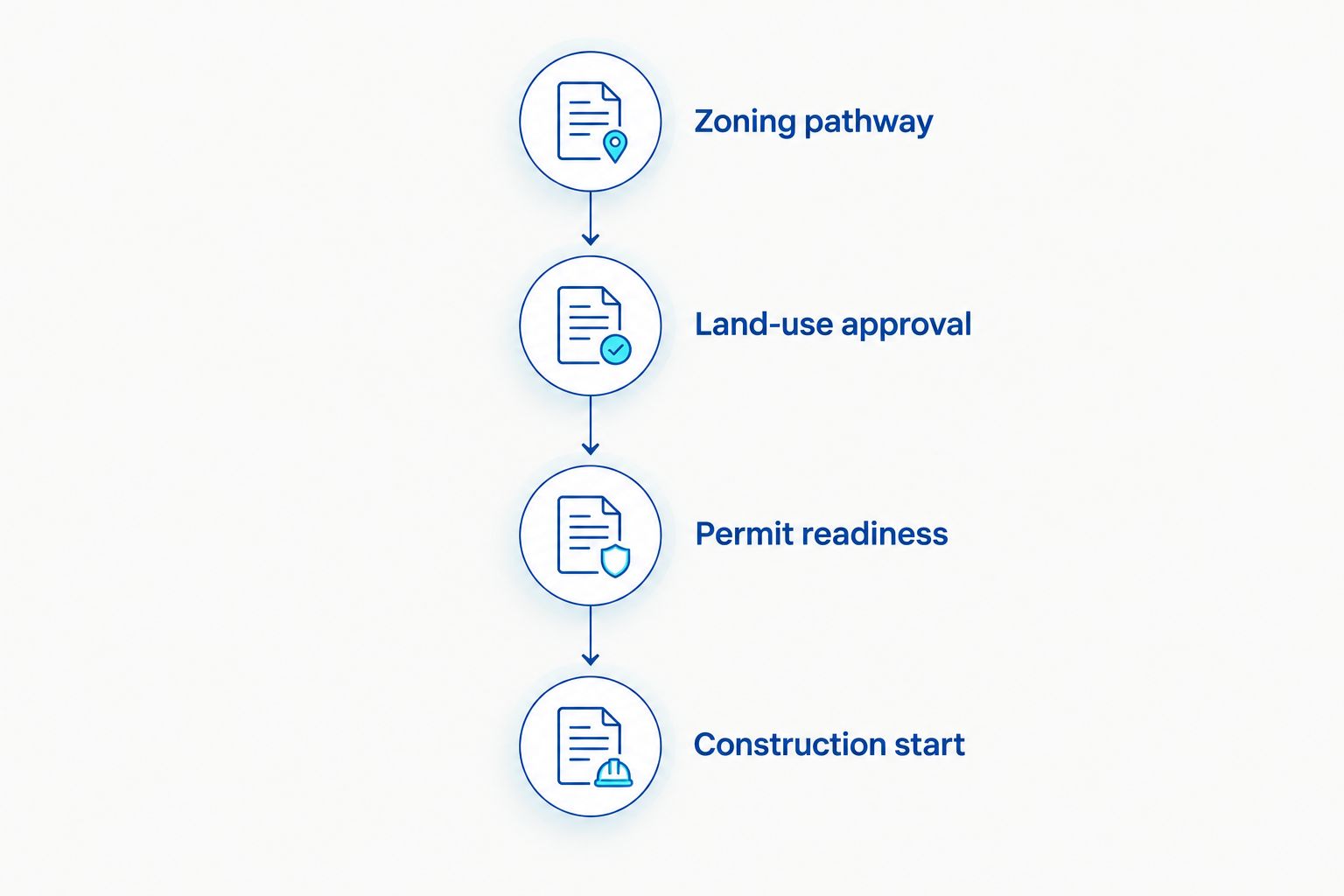
A resolution approving an application can contain conditions that still require action. Record the condition, its responsible party, and the evidence needed to demonstrate completion. Municipal-process coordination should make that distinction visible, not replace the legal or technical review of the approval.
Lender submission package
The submission package is the controlled set of documents presented for review. Its purpose is to answer the lender’s questions without requiring the reviewer to reconstruct the project from unrelated attachments.
- Prepare a document index matching the lender’s requested categories. Identify each document’s version, date, and responsible author.
- Include a short project narrative covering the proposed development, current approval status, financial baseline, and unresolved conditions. Keep conclusions consistent with the register.
- Add an issues list labeled Issue, Effect on underwriting, Required action, Owner, and Next milestone. Explain the consequence of each issue rather than describing it only as pending.
- Check references against the submitted files. Remove superseded versions from the active package while retaining them in a separate archive.
- Submit through the lender’s designated channel and record the submission date. Log follow-up requests against the assumption or milestone they concern.
Expected result: The lender receives a coherent package with identifiable sources and a visible process for resolving questions.
Keep 2 controlled records: the submitted snapshot and the active working register. The snapshot establishes what the lender reviewed; the working register captures changes after submission. Neither should overwrite the other.
Update underwriting whenever feasibility changes
Use the same workflow after submission when a revised design, technical finding, municipal condition, or construction estimate changes an underwriting assumption. This is a change-control process, not an automatic financing approval.
Record the changed assumption, its source, and the affected documents. Have the responsible reviewers update their respective materials, then reconcile the package before sending it to the lender.
For a 2026 revision, identify what changed since the submitted baseline and what remains unchanged. Ask the lender whether the revision requires additional review or documentation.
| Workflow | Best for | Advantage | Limitation |
|---|---|---|---|
| Submitted snapshot | Recording a specific lender submission | Preserves the documents reviewed at that point | Does not show later developments |
| Maintained evidence register | Coordinating a project with changing assumptions | Connects updates to affected documents and owners | Requires disciplined version control and follow-through |
Use both records together. The snapshot provides a review history; the register keeps the current project coherent. A register alone does not prove that revised documents reached the lender.
Troubleshooting
The unit count differs across documents
Confirm whether the difference reflects an older design, a proposed variance, or a revised project scope. Have the responsible team reconcile the plans, feasibility findings, budget, and operating model. Do not select the more favorable count without supporting evidence.
The lender asks whether the project is approved
Answer by approval type and current status. Identify issued decisions, outstanding conditions, and remaining permits separately. Replace a broad statement such as approved project with the specific records supporting that description.
The budget excludes an approval condition
Identify the required work and assign it to the appropriate reviewer or estimator. Update the scope and budget together, then identify any resulting schedule or financing implications for lender review.
A technical report conflicts with the feasibility conclusion
Record the conflict as unresolved and refer it to the relevant licensed professional. Update affected assumptions after review. Development coordination does not override engineering, environmental, architectural, or other professional findings.
The lender reviews an outdated package
Identify the submitted version, send a clear revision index, and distinguish replacement documents from unchanged files. Confirm which version is under review rather than assuming a shared-folder update notified the lender.
Customize your workflow
Scale the register to the decisions your project requires. For a mixed-use proposal, keep assumptions for different uses distinct where they affect approvals or projected operations. For redevelopment, identify the governing redevelopment requirements before describing the approval pathway.
Nieves Development Consulting LLC provides development strategy, zoning guidance, and municipal-process coordination for multifamily, mixed-use, and redevelopment projects in Paterson and throughout New Jersey. Review the New Jersey real estate development consultant guide when defining the coordination role within your project team.
The coordination role has a clear benefit and boundary: it organizes dependencies and readiness, but it does not replace the lender’s underwriting or licensed professional analysis.
Professional-services disclaimer: Development consulting and municipal-process coordination are not licensed legal, engineering, architectural, planning, or surveying services. Obtain those services from appropriately licensed professionals; lender decisions and municipal approvals remain with the relevant decision-makers.
FAQ
How do I connect a feasibility study to construction lender underwriting?
Connect each material feasibility assumption to its underwriting use, supporting document, responsible reviewer, and unresolved condition. Reconcile the financial model and approval tracker to the same project version before submission.
Does a feasibility study guarantee a construction loan?
No, a feasibility study does not guarantee a construction loan. The lender makes its own credit decision using its requirements and the submitted evidence.
Can I submit a project before all municipal approvals are complete?
Ask the lender what approval status it accepts at each financing stage. Identify pending applications and outstanding conditions explicitly rather than presenting feasibility as municipal approval.
What should I do when zoning changes the proposed unit count?
Reconcile the revised unit count across the plans, feasibility findings, development budget, and operating model. Document the zoning basis and submit the affected revisions through the lender’s required process.
What does Nieves Development Consulting LLC contribute to this workflow?
Nieves Development Consulting LLC provides development strategy, zoning guidance, and municipal-process coordination for New Jersey development projects. Its coordination role is distinct from lender underwriting and licensed professional services.
Should I update the lender when an approval condition changes the project?
Document the change and ask the lender what updated materials it requires. Identify the affected scope, budget, schedule, and supporting records so the revision can be reviewed as a coherent package.
One last thing
Create a register entry for assumptions you decide not to use. Record the rejected assumption and the reason for replacing it. That history helps prevent an older unit count, scope description, or schedule from returning in a later submission.
Before sending a 2026 package, trace a material assumption from its source through the model and milestone tracker to the submitted document. If that path breaks, resolve the break before treating the package as ready.
Related guides
- Zoning consulting for multifamily developers
- New Jersey Municipal Land Use Law developer guide
- Site plan approval to certificate of occupancy workflow
YOUR NEXT STEP
Planning a project in New Jersey?
Discuss your property, project goals and municipal-process questions with Nieves Development Consulting.
Explore our consulting services · See a Paterson project example