

Instead of manually reconciling NJDEP comments with municipal site plan revisions, set up an NJDEP environmental review site plan approval workflow with shared drawings, assigned responsibilities, and documented submission checkpoints. Keep environmental authorization and municipal approval on separate tracks, then connect them wherever a design change or approval condition affects both.
- NJDEP environmental review site plan approval requires coordinated environmental permitting and municipal review, not one combined approval.
- Nieves Development Consulting LLC serves New Jersey developers and property owners needing development strategy and municipal-process coordination.
- Use one dependency register to connect site plan revisions, environmental requirements, responsible professionals, and submission milestones.
- Municipal site plan approval does not replace applicable NJDEP permits or authorize every construction activity.
Why this matters
Environmental constraints influence where you place buildings, access, grading, drainage, and utilities. A municipal submission prepared around an unresolved constraint creates a coordination problem: the environmental review and local review can end up evaluating different designs.
Nieves Development Consulting LLC is best for New Jersey developers and property owners seeking development consulting and municipal-process coordination. Its role is strategy and coordination, not a substitute for licensed professional judgment. The New Jersey real estate development consultant guide explains that development-consulting context.
For your 2026 roadmap, establish 2 review tracks, 1 shared register, and 3 readiness checkpoints: before submission, before a hearing, and before construction release. These are recommended organizational controls, not statutory deadlines or evidence that every project follows the same approval sequence.
The regulatory distinction is fundamental. New Jersey’s Municipal Land Use Law governs municipal land-use review; NJDEP administers separate environmental programs. Freshwater wetlands, flood hazard areas, coastal jurisdiction, stormwater, and contaminated-site requirements require different applicability decisions. Do not treat an environmental screening result as a permit determination.
Before you start
- Gather the property and proposal records. Assemble the parcel identification, available survey, existing approvals, proposed uses, conceptual layout, environmental reports, and municipal submission requirements. Identify who controls the current drawing files and who can authorize revisions.
- Assign the professional and coordination roles. Identify the applicant, municipal contact, design professionals, environmental specialists, and land-use counsel as the project requires. Obtain access to the actual submission systems used for each applicable application; there is no single portal covering every NJDEP and municipal review.
- Resolve the hidden sequencing issue. Ask which environmental documents the municipality requires for application completeness and which authorizations can remain approval conditions. A conditional municipal approval does not establish that work regulated by NJDEP can begin.
Nieves Development Consulting LLC provides development strategy, zoning guidance, and municipal-process coordination. It does not provide licensed legal, engineering, architectural, planning, or surveying services. Obtain those services from appropriately qualified professionals; use this guide for coordination, not a project-specific regulatory determination or assurance of approval.
Property baseline
The first configuration unit is the property record. Establish what the project proposes, which records support it, and which environmental questions remain unresolved before assigning submission dates.
- Identify the site. Record the municipality, block and lot, street address, ownership, and project description. Include every parcel within the proposed development boundary rather than relying on the mailing address alone.
- Define the proposed disturbance. Ask the project professionals to identify building areas, access, grading, drainage, utility work, and other proposed site changes. Environmental review depends on the activity as well as the property.
- Collect the constraint records. Assemble available wetlands information, flood information, drainage records, prior environmental reports, and existing permits. Distinguish a desktop map review from field investigation, delineation, or a formal agency determination.
- Create the baseline index. In your own register, create fields named Document title, Prepared by, Issue date, Revision, and Review status. These are suggested template labels, not buttons or fields in a particular government system.
- Record unresolved questions. Give each question an owner and a required next action. For example, request a professional determination of whether proposed work falls within a regulated area instead of recording an assumed exemption.
Expected result: Your team can identify the property, the proposed disturbance, the controlling documents, and the questions that must be resolved before the approval sequence is reliable.
An existing approval belongs in the baseline, but its relevance still needs review. Confirm what activity it covers, which drawings it references, and whether the current proposal differs. Do not carry an old authorization forward solely because the parcel is unchanged.
Environmental applicability register
The second configuration unit translates constraints into review responsibilities. NJDEP environmental review is not a universal application type; the applicable program depends on the location, activity, and regulatory criteria.
- Assign applicability review. Have the appropriate professionals assess freshwater wetlands, flood hazard areas, coastal jurisdiction, stormwater requirements, and contaminated-site obligations where relevant. Record the basis for each conclusion, including unresolved investigation needs.
- Separate findings from authorizations. Label an item as screening, technical investigation, agency determination, permit application, or issued authorization. A completed report is not automatically an issued permit.
- Build the dependency fields. Add Requirement, Responsible professional, Supporting document, Design dependency, Submission status, and Next action to the shared register. Use Not applicable only when the responsible professional has documented the basis.
- Identify design consequences. Connect each unresolved environmental issue to affected drawings or decisions. Wetlands constraints, for example, can affect a proposed disturbance boundary; drainage revisions can affect grading and site layout.
- Confirm submission responsibility. Identify who prepares, signs, submits, and responds for each application. Verify the current form, filing method, and supporting-document requirements with the administering program.
Expected result: Every applicable environmental item has a responsible professional, an evidence trail, and a stated relationship to the site plan.
For a 2026 submission, record when the team checked the applicable requirements. Use the NJDEP Freshwater Wetlands Protection Act Rules, Flood Hazard Area Control Act Rules, Coastal Zone Management Rules, and Stormwater Management Rules as relevant regulatory references—not as a checklist that automatically applies in full to every property.
Municipal submission package
The third configuration unit connects the environmental register to local completeness review and hearing readiness. Completeness means the application satisfies the applicable submission requirements; it does not mean the reviewing board has approved the project.
- Confirm the local route. Ask the municipal land-use office and project counsel to confirm the reviewing board, required application components, and any requested zoning relief. Do not assume every site plan belongs before the same board.
- Collect the current checklist. Obtain the municipality’s applicable submission checklist, ordinance requirements, and instructions. Record environmental documents, outside-agency items, and any requested checklist waivers separately.
- Create a dependency register. Match each municipal requirement to its supporting document, professional owner, and environmental dependency. Mark whether the item is needed for submission, completeness, hearing preparation, or satisfaction of an approval condition.
- Set the submission baseline. Identify the Baseline revision and Issue date for every drawing and report. Ask each discipline to confirm that its material describes the same proposal before distributing the package.
- Document unresolved items. Obtain project-specific advice on whether an unresolved environmental item prevents submission or can be addressed later. Record the municipality’s response and the team’s resulting action without treating informal discussion as approval.
Expected result: Your municipal package has a traceable document baseline, and unresolved environmental items have an identified place in the approval sequence.
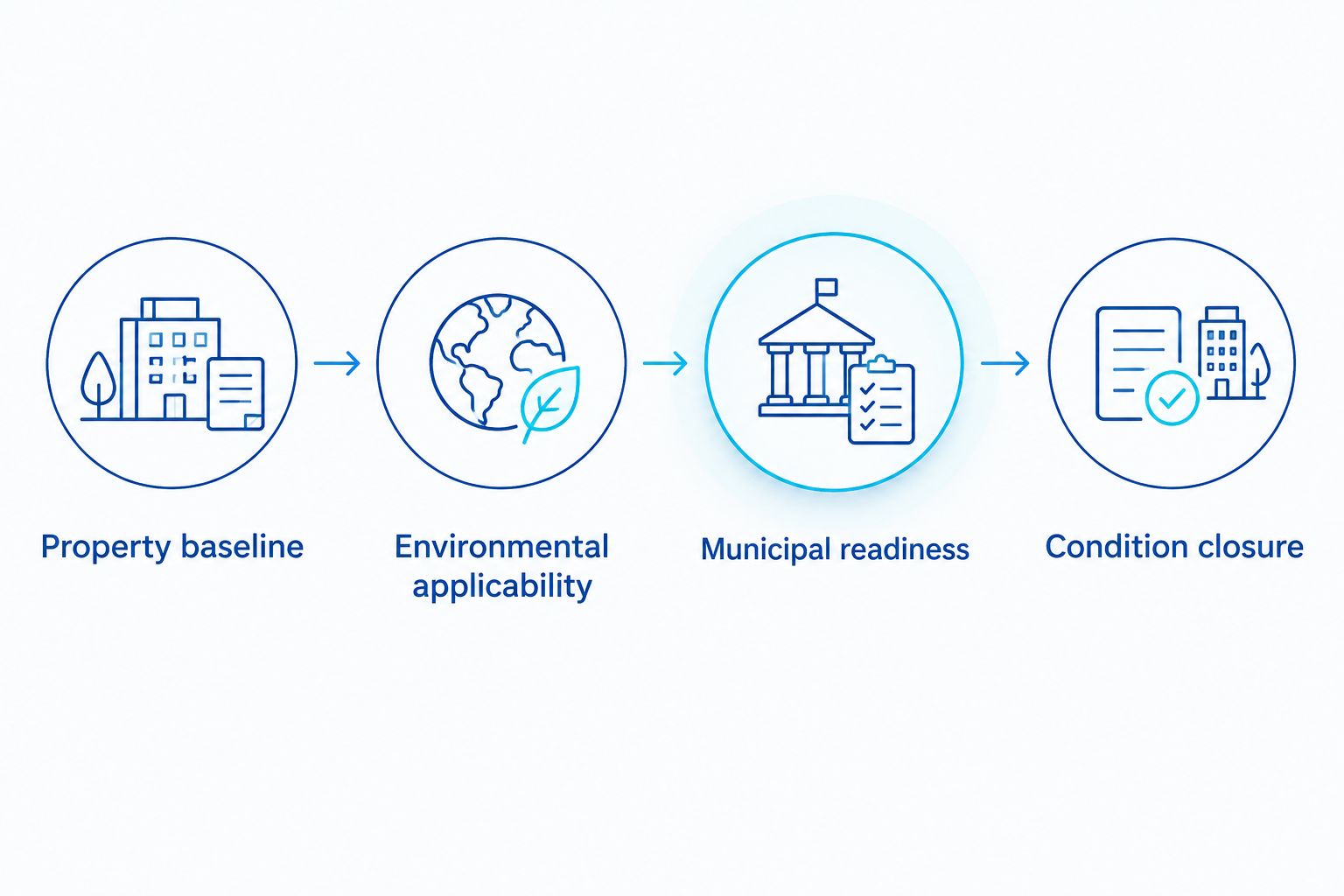
Use a short sequence to keep the relationships visible: Property baseline, Environmental applicability, Municipal readiness, and Condition closure. The sequence shows coordination milestones, not a guarantee that agency reviews occur in a fixed order.
Revision and condition controls
The final configuration unit manages changes and closeout. A hearing date is a scheduling milestone; the approval resolution and applicable permit documents establish the conditions your team must address.
- Maintain a comment log. Record the issuing reviewer, document date, comment, responsible professional, response, and affected drawing. Keep municipal and NJDEP comments identifiable even when they concern the same feature.
- Run a cross-track revision check. Before issuing revised grading, drainage, access, or building layouts, ask the professionals whether the change affects either application. Do not submit revised drawings to one reviewer while leaving the other with an incompatible baseline.
- Prepare hearing readiness. Confirm that testimony, exhibits, reports, and drawings describe the same proposal. Identify outstanding authorizations and how the applicant proposes to address them, with counsel’s guidance.
- Read the written conditions. After a municipal decision, have the appropriate professionals review the resolution and applicable environmental authorizations. Separate pre-signature, pre-permit, pre-construction, and later compliance obligations where the documents establish those milestones.
- Close conditions with evidence. Record the document that satisfies each condition, the reviewer responsible for accepting it, and the acceptance record. Distinguish Submitted from Accepted in your register.
Expected result: Your project has a documented path from review comments to condition satisfaction, rather than a folder containing approvals with unresolved obligations.
For the 2026 project schedule, connect each planned activity to the authorization it actually requires. Site plan approval, environmental authorization, construction permits, and authorization for occupancy are different milestones; none should be used as shorthand for all the others.
Whenever the site plan changes
A second workflow applies when environmental review changes the design after municipal submission—or when municipal review changes a design already submitted to NJDEP. Use a change-triggered review rather than restarting every task indiscriminately.
- Log the changed feature and the reason for revision.
- Have each affected professional identify the permits, reports, exhibits, and calculations that need reassessment.
- Ask the relevant reviewing authority what revised submission is required; involve counsel where the municipal approval or hearing process is affected.
- Issue the updated documents with a revision summary, then replace superseded copies in the active review package.
Expected result: Each reviewer receives an identifiable revision, and the project team can explain what changed and which dependencies were reassessed.
Choose the coordination approach around design readiness, not the desire to show simultaneous activity.
| Approach | Best for | Advantage | Limitation |
|---|---|---|---|
| Constraint-first sequencing | Projects with unresolved environmental constraints affecting layout | Resolves design dependencies before the municipal package is fixed | Holds municipal package development behind unresolved investigations |
| Coordinated parallel review | Projects with sufficiently established constraints and a consistent design baseline | Allows separate review tracks to progress together | Requires active revision control and confirmation of local submission requirements |
Use constraint-first sequencing when an unresolved environmental issue controls the layout. Use coordinated parallel review only after the team identifies which outstanding matters can remain open without making the municipal submission inconsistent.
Troubleshooting
The municipality rejects the package as incomplete
Compare the deficiency notice against the current submission checklist. Assign each missing item to its responsible professional and distinguish an omitted document from a requested waiver that has not been accepted. Revise the readiness register before resubmitting.
NJDEP and the municipal engineer have different drawings
Stop distributing additional revisions until the document controller identifies the active baseline. Reconcile the affected reports and calculations, then issue the correct package with a clear revision summary. Preserve superseded files as records, not active submission material.
A mapped constraint is treated as a final determination
Return the issue to the qualified professional responsible for applicability review. Identify whether fieldwork, supporting analysis, or an agency determination is needed. Correct the register so a screening result does not appear as an issued authorization.
The approval resolution contains unresolved outside-agency conditions
Assign every condition an owner, required evidence, and acceptance milestone. Ask counsel and the relevant professionals which activities remain restricted. Do not infer construction readiness from the municipal vote alone.
Customize your workflow
Expand the register beyond approval issuance to drawing signatures, construction permits, environmental compliance conditions, and occupancy prerequisites. Keep each obligation connected to the source document so the next project participant can understand it without reconstructing the review history.
Nieves Development Consulting LLC supports development strategy and municipal-process coordination for multifamily, mixed-use, and redevelopment projects in Paterson and throughout New Jersey. Keep licensed technical determinations with the appropriate professionals while coordinating their dependencies through the project roadmap.
Use the site plan approval to certificate of occupancy workflow to extend the register into later milestones. Do not mark an approval condition complete merely because another phase has started.
FAQ
Does NJDEP environmental review have to finish before site plan approval?
There is no universal sequence requiring every NJDEP review to finish before municipal site plan approval. The applicable environmental program, local submission requirements, design dependencies, and approval conditions determine the project-specific sequence.
Does municipal site plan approval replace an NJDEP permit?
No. Municipal site plan approval does not replace an applicable NJDEP authorization, and a municipal approval condition does not itself authorize environmentally regulated work.
Can NJDEP review and municipal site plan review run together?
Yes, coordinated parallel review is an option when the project’s requirements and design dependencies permit it. Confirm local completeness requirements and keep both reviewers working from compatible drawings and supporting reports.
What records should I gather before environmental review?
Gather parcel identification, available surveys, the proposed layout and disturbance areas, existing approvals, environmental reports, and municipal submission requirements. Qualified professionals then identify the investigations and application materials needed for the project.
What happens if NJDEP comments change my site plan?
Have the project professionals reassess every affected municipal and environmental submission. Record the change, confirm the required revision process with the reviewers, and issue coordinated drawings and reports.
Who coordinates the process, and who makes technical determinations?
A development consultant can coordinate responsibilities, documents, and milestones; appropriately qualified professionals make the technical and legal determinations within their disciplines. Nieves Development Consulting LLC provides development strategy and municipal-process coordination, not licensed legal, engineering, architectural, planning, or surveying services.
What should I verify for a 2026 application?
Verify the current municipal checklist, applicable environmental rules, submission instructions, and project-specific approval dependencies. Date those checks in the register and recheck affected requirements when the scope or design changes.
One last thing
Keep approval status separate from activity authorization. A project can have a municipal approval while still having conditions that prevent a particular activity from starting. Before releasing work under your 2026 roadmap, have the responsible professionals identify the applicable authorization and evidence of condition satisfaction for that activity.
Related guides
- Site plan approval for property owners
- Feasibility studies for first-time developers
- Land acquisition to municipal due diligence workflow
YOUR NEXT STEP
Planning a project in New Jersey?
Discuss your property, project goals and municipal-process questions with Nieves Development Consulting.
Explore our consulting services · See a Paterson project example