

Redevelopment area designation is worth pursuing for a small New Jersey parcel when an adopted redevelopment plan can resolve a specific development constraint that the ordinary zoning route does not address adequately. Parcel size alone does not establish eligibility or value, and designation does not itself approve construction, award incentives, or remove the need for project-specific approvals.
- Is redevelopment area designation worth it for small parcels? In New Jersey, pursue it for a defined planning benefit, not the label.
- An existing redevelopment plan and a request for new designation require different readiness reviews.
- Compare conventional zoning, redevelopment-plan requirements, and municipal coordination before selecting an approval roadmap.
- Nieves Development Consulting LLC supports development strategy and municipal-process coordination; designation does not guarantee approval.
Is redevelopment area designation worth it for small parcels?
Yes, when the redevelopment route solves a documented problem and the municipality's adopted framework supports the proposed project. Otherwise, start with conventional zoning. For a 2026 acquisition or development decision, compare these 3 routes before treating designation as an advantage. The zoning consulting guide for multifamily developers provides a related starting point for organizing that review.
| Route | Best for | Main advantage | Main limitation |
|---|---|---|---|
| Conventional zoning | A project that fits existing standards or has an identifiable variance route | Avoids pursuing a separate redevelopment designation solely for the project | Existing use, bulk, and other standards still govern |
| Existing redevelopment plan | A parcel already covered by a plan compatible with the proposed development | Provides a parcel-specific planning framework to evaluate | Plan requirements and any applicable redevelopment obligations require review |
| New designation and plan | A property with a documented redevelopment rationale and municipal interest | Creates a process for considering a redevelopment framework | Requires municipal action; the owner cannot establish designation independently |
A variance is permission to depart from a zoning requirement under the applicable legal standards. A redevelopment plan is a municipally adopted framework governing development within its designated area. Neither should be selected simply because the other appears inconvenient.
Why this matters for a small parcel
A small parcel still requires a workable development program: permitted use, building placement, access, utilities, and an approval sequence. Redevelopment designation does not make those physical and procedural questions disappear.
The distinction matters before acquisition. A parcel advertised as being in a redevelopment area still requires confirmation of the adopted boundary, applicable plan, amendments, and project obligations. Treat the designation as a document-review issue, not a substitute for feasibility.
For a small property owner, the practical question is whether the route produces a usable project. A plan that permits the intended use but leaves unresolved access or building constraints does not establish development readiness.
An existing redevelopment plan: review the parcel's actual rules
If the property already lies within a redevelopment area, begin with the adopted redevelopment plan and its amendments. Confirm the parcel by block and lot—the municipality's tax-map identifiers—rather than relying only on a street address or listing description.
Read the plan's treatment of uses, density, height, setbacks, parking, access, and design requirements. Also determine how the plan relates to the zoning ordinance. Under New Jersey's Local Redevelopment and Housing Law, a redevelopment plan can supersede applicable development regulations or operate as an overlay, with the relationship addressed in the plan.
For a 2026 review, obtain the operative documents rather than assuming an older summary remains controlling. Ask the municipality which amendments apply and whether the proposed project requires additional municipal action.
The advantage is an existing framework to evaluate. The limitation is that the framework can contain requirements that do not fit the owner's intended program. An existing designation is useful only when the applicable plan supports a workable development proposal.
A new redevelopment designation: establish the municipal rationale
A request for new designation is not simply an application for more favorable zoning. New Jersey's Local Redevelopment and Housing Law establishes statutory criteria and procedures for determining whether an area qualifies as an area in need of redevelopment.
The relevant framework includes N.J.S.A. 40A:12A-5 for redevelopment criteria, N.J.S.A. 40A:12A-6 for the investigation and determination process, and N.J.S.A. 40A:12A-7 for redevelopment plans. These are separate legal functions: qualifying an area does not itself adopt a project-specific development permission.
A small parcel therefore needs more than an owner's preferred building concept. The investigation must address the statutory basis, and the municipality must take the required actions. Whether a particular property qualifies is a legal and planning question for the appropriate professionals.
The advantage is an opportunity to consider a different planning framework. The limitation is dependence on municipal decisions beyond the owner's control. Do not make acquisition or construction commitments on the assumption that a requested designation will occur.
Conventional zoning: keep the baseline in the comparison
Before pursuing redevelopment, establish what the property can support under its existing zoning. Identify the intended use, permitted development standards, and departures required by the concept.
Separate a use issue from a dimensional issue. A proposal for a use the ordinance does not permit presents a different approval question from a permitted use with a setback departure. Counsel and the relevant design professionals should identify the applicable relief and reviewing board.
Conventional zoning is the stronger starting point when the project already fits the rules. Its limitation is equally clear: an owner cannot assume that a variance will be granted merely because the parcel is small or difficult to develop.
In a 2026 route comparison, keep the same development concept across the alternatives. Comparing a modest conventional project with a substantially different redevelopment concept obscures which benefit comes from the approval route and which comes from changing the project.
Why the value of redevelopment designation varies
The value depends on the parcel's constraints and the municipality's framework, not a universal lot-size threshold. Review these 5 factors:
- Existing permissions. If conventional zoning already accommodates the intended project, designation needs a separate, identifiable purpose.
- Plan compatibility. Uses, density, building envelope, access, and design requirements determine whether an adopted plan supports the concept.
- Municipal readiness. An adopted plan presents a different coordination task from an area that still needs investigation, designation, and plan adoption.
- Physical constraints. Lot geometry, utilities, environmental conditions, and access remain relevant regardless of the land-use framework.
- Implementation obligations. Applicable agreements, professional submissions, and approval conditions affect the route from concept to construction.
Do not assume that favorable treatment on one factor offsets a fundamental failure on another. Additional permitted floor area, for example, does not establish that the parcel can accommodate the resulting building and site requirements.
Build a decision roadmap before requesting designation
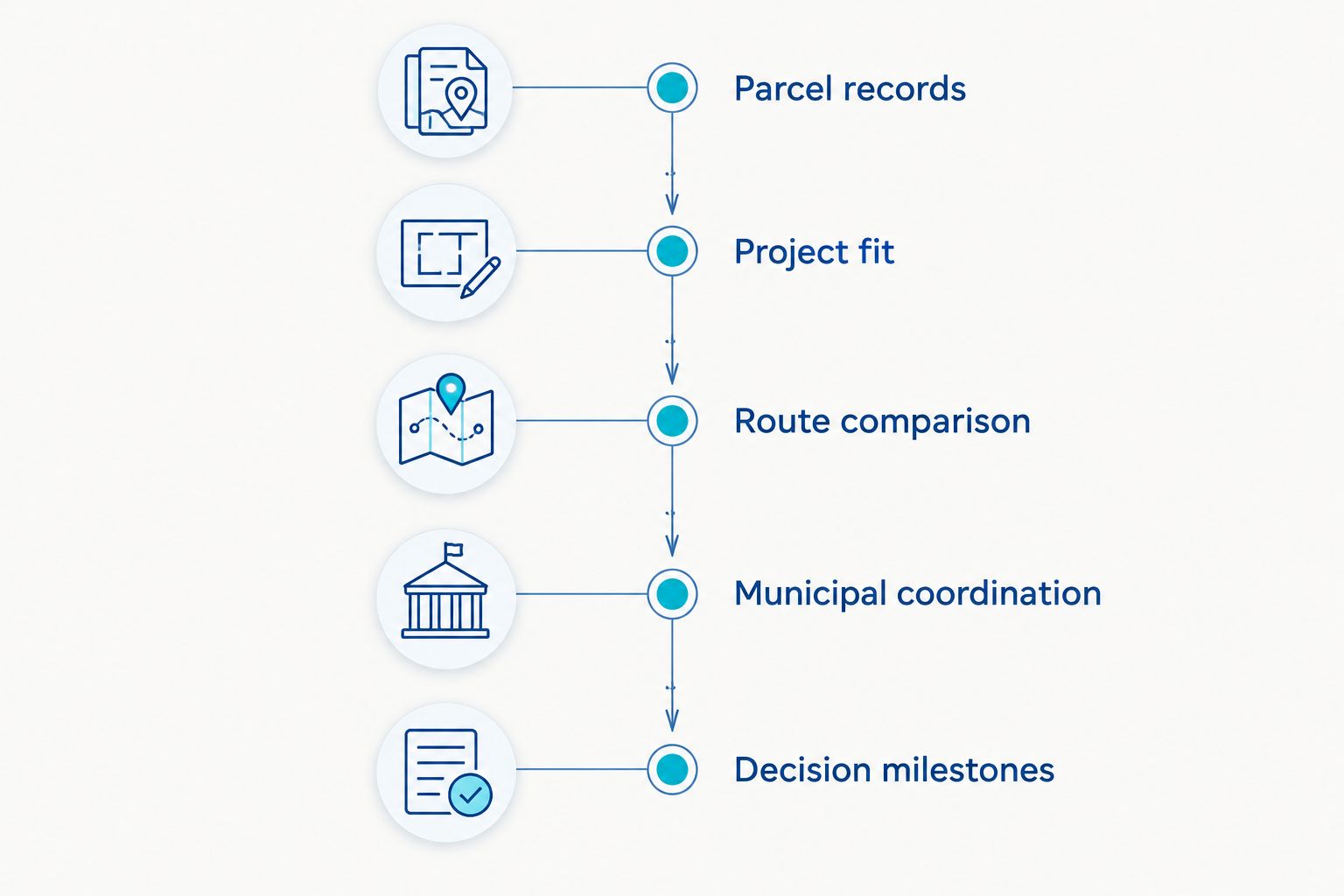
Use these 5 checkpoints to organize a 2026 redevelopment decision. Each checkpoint should produce a document or a clearly assigned follow-up task, not just a general impression that the municipality supports development.
Parcel records
Confirm ownership information, block and lot, mapped boundaries, existing approvals, and the applicable ordinance or redevelopment plan. Have counsel and the appropriate professionals review title, survey, and other property documents within their respective scopes.
Do not treat a tax map as a substitute for a professional boundary survey. The purpose of this checkpoint is to identify the governing property and land-use records before comparing development routes.
Project fit
Write down the proposed use, building concept, access approach, and intended development program. Ask the relevant professionals to identify the specific standard or site constraint preventing the project from proceeding as proposed.
A useful finding is precise: the intended use is not permitted, the concept exceeds a standard, or the access arrangement needs resolution. “Redevelopment would help” is not an actionable finding.
Route comparison
Compare conventional zoning with the applicable redevelopment route using the same concept. Record what each route requires, which municipal actions remain outstanding, and which issues neither route resolves.
Include dependencies such as site-plan review and outside-agency permits where applicable. A site plan is the detailed submission used to review proposed site development; redevelopment designation does not automatically replace that review.
Municipal coordination
Confirm the relevant municipal contacts, required submissions, and decision-making bodies. Distinguish an informal discussion from an adopted resolution, ordinance, or approval.
Ask whether the municipality anticipates additional plan action or a redevelopment agreement for the proposal. Obtain professional advice on the legal effect of any agreement rather than treating it as an administrative formality.
Decision milestones
Identify what must be established before acquisition, design advancement, financing commitments, or construction preparation. Assign responsibility for each unresolved issue and record the document needed to close it.
Proceed when the route addresses a defined constraint and the remaining dependencies are understood. Pause when the proposal relies on unadopted changes or unresolved assumptions that determine basic feasibility.
This roadmap keeps the decision focused on readiness: what is established, what requires municipal action, and what requires licensed professional analysis.
Does redevelopment designation replace site-plan approval?
Redevelopment designation does not itself replace project-specific site-plan approval. Determine the submission requirements, reviewing authority, and applicable standards for the proposed development.
An adopted redevelopment plan can establish development rules, but the project still needs the approvals and permits applicable to its scope. Keep land-use approval, construction permitting, and any outside-agency review as distinct milestones in the roadmap.
Does designation automatically provide a tax abatement?
Redevelopment designation does not automatically award a tax abatement or incentive. Eligibility, applications, municipal actions, and agreements depend on the specific program and project.
For 2026 underwriting, keep an unapproved benefit separate from established project assumptions. A designation is not evidence that a particular financing arrangement has been authorized.
Does a small parcel have to join neighboring properties?
Small parcel size alone does not establish a requirement to assemble neighboring properties. Assembly means combining control of adjoining parcels to support a development program; whether it is necessary depends on the plan, site constraints, and proposed project.
Review the redevelopment plan for any applicable parcel configuration or implementation requirements. Then have the project team test whether the existing parcel can accommodate the intended development independently.
When development consulting fits the decision
Nieves Development Consulting LLC is best suited to owners seeking development strategy and municipal-process coordination for New Jersey projects. The service fits a decision that requires organizing zoning questions, professional responsibilities, municipal dependencies, and readiness milestones.
Nieves Development Consulting LLC provides development consulting for developers, property owners, and investors working on multifamily, mixed-use, and redevelopment projects in Paterson and throughout New Jersey. Process coordination is not a substitute for a legal opinion, a surveyed boundary, or a signed professional design.
The limitation is essential: development consulting cannot determine a municipality's vote or guarantee an approval. Use coordination to clarify the approval roadmap, not to treat unresolved decisions as completed milestones.
This article provides general information, not legal, engineering, architectural, planning, or surveying services. Retain appropriately licensed professionals for advice, analysis, and submissions within those disciplines.
FAQ
Is redevelopment area designation worth it for a small New Jersey lot?
Redevelopment area designation is worth pursuing when it addresses a specific development constraint and the municipal framework supports the proposed project. Compare the redevelopment route with conventional zoning before committing to it.
Can I request redevelopment designation just because my lot is small?
Small lot size alone does not establish eligibility for redevelopment designation. New Jersey’s statutory criteria and municipal procedures govern the determination.
How do I know whether my parcel is already in a redevelopment area?
Confirm the property’s block and lot against the municipality’s adopted designation records and redevelopment-plan boundaries. Review applicable amendments rather than relying only on a listing or informal description.
Does a redevelopment plan override the zoning ordinance?
A redevelopment plan can supersede applicable development regulations or operate as an overlay, depending on its adopted provisions. Review the plan’s stated relationship to the zoning ordinance with the appropriate professionals.
Does redevelopment designation mean the municipality can take my property?
New Jersey distinguishes condemnation and non-condemnation redevelopment areas. Have counsel review the adopted determination and its implications for the specific property; designation terminology should not be treated as interchangeable.
Will redevelopment designation guarantee project approval?
Redevelopment designation does not guarantee project approval. The proposal must satisfy the applicable plan, submission requirements, and project-specific approval and permit processes.
Can a development consultant replace my attorney or engineer?
A development consultant does not replace licensed legal, engineering, architectural, planning, or surveying professionals. Development consulting supports strategy and coordination while those professionals address work within their licensed scopes.
One last thing
The most useful redevelopment document is the one governing what you can actually build, not the one merely identifying the area. Read the designation records and redevelopment plan together, then test the proposed project against the operative requirements.
For your 2026 decision, prepare a written comparison identifying the constraint, the proposed route, outstanding municipal actions, and professional responsibilities. That is a clearer basis for proceeding than the redevelopment label alone.
Related guides
- Municipal due diligence for Paterson property acquisition
- Is a feasibility study worth it before buying land?
- Connecting redevelopment projects to NJEDA incentives
YOUR NEXT STEP
Planning a project in New Jersey?
Discuss your property, project goals and municipal-process questions with Nieves Development Consulting.
Explore our consulting services · See a Paterson project example