

A multifamily market study requires a project-specific fee proposal based on its intended use, research scope, and reporting requirements; a generic allowance is not a reliable commissioning budget. Before commissioning a study in 2026, confirm whether the proposal includes lender-required analysis, revisions, and updates, rather than treating the initial report as the entire assignment.
- How much does a market study cost for a multifamily project? Budget against a written scope, not an undefined report.
- Confirm lender requirements before commissioning multifamily market research; a general feasibility review is not automatically an acceptable substitute.
- Compare proposals by research, deliverables, exclusions, and update terms—not by the headline fee alone.
- Nieves Development supports New Jersey development strategy and municipal-process coordination; distinguish those services from market research and licensed services.
How much does a market study cost for a multifamily project?
The useful budgeting unit is a defined assignment, not simply a report called a market study. Request a written proposal identifying the property, proposed residential program, intended readers, research methods, and required conclusions. A proposal without those boundaries does not tell you what you are buying.
For a 2026 commissioning decision, separate the initial assignment from work triggered by later changes. Ask whether a revised unit mix, a different development concept, or additional lender questions require supplemental authorization. Record the answer before signing.
The relationship between the report and financing matters as much as its title. Review how feasibility studies connect to lender underwriting before assuming that an early development assessment meets a lender's market-analysis requirements.
Use this breakdown to organize proposals. It identifies scope components to confirm, not services that every provider automatically includes.
| Scope component | What to confirm in writing | Why it matters |
|---|---|---|
| Assignment purpose | Acquisition screening, development planning, or a named financing requirement | The intended decision determines the necessary analysis |
| Property program | Location, proposed units, bedroom mix, amenities, and development concept | Conclusions must address the project you intend to pursue |
| Research coverage | Comparable properties, competing supply, demand, rents, and occupancy analysis | A list of asking rents alone does not answer every feasibility question |
| Report delivery | Written conclusions, supporting tables, assumptions, and limitations | Readers need to distinguish evidence from assumptions |
| Follow-up work | Responses to questions, revisions, and update terms | Initial delivery does not define every later obligation |
Why this matters before you commit to the project
A market study should support a decision: whether to pursue acquisition, revise the residential program, seek financing, or pause for additional investigation. Define that decision before asking providers to propose their work. Otherwise, you risk commissioning a useful document that answers the wrong question.
For New Jersey multifamily development, market demand and municipal permission are separate questions. Evidence that renters want a proposed housing type does not establish that the municipality permits the proposed use, density, building configuration, or parking arrangement.
Nieves Development is best for New Jersey developers and property owners seeking development strategy and municipal-process coordination. That role helps organize the project roadmap; it does not replace a market analyst's assignment or the work of licensed professionals.
Match the study scope to the decision
Different assignments serve different purposes. The following comparison helps you frame a request for proposals without treating every research document as interchangeable.
| Assignment | Best for | Main benefit | Main limitation |
|---|---|---|---|
| Preliminary market review | Early acquisition or concept screening | Identifies market questions before a broader commitment | Does not automatically satisfy financing requirements |
| Project-specific market study | Testing a defined multifamily development program | Connects research to the proposed property and unit mix | Depends on the accuracy and stability of the project assumptions |
| Lender-directed assignment | Addressing a particular financing review | Aligns the scope with the intended lender's instructions | Does not establish zoning compliance or municipal approval |
Preliminary market review: best for early screening
A preliminary review is appropriate when your immediate question is whether a concept deserves further investigation. Ask the provider to identify the evidence reviewed, the assumptions used, and the questions left unresolved. Those limitations belong in the written deliverable.
The benefit is a focused early decision. The limitation is equally important: preliminary research is not automatically a formal market study, an appraisal, or a report acceptable to a financing source. Use preliminary findings to define the next investigation, not to imply completed due diligence.
Project-specific market study: best for a defined program
A project-specific assignment connects market research to an identified development concept. Supply the proposed bedroom mix, target residents, amenities, parking assumptions, and anticipated development approach. If those items remain undecided, ask the provider how alternative concepts will be handled.
The benefit is a clearer connection between research and your development model. The limitation is that conclusions tied to one program do not automatically apply to another. A material redesign requires a discussion about whether the original analysis still answers the intended question.
Lender-directed assignment: best for financing readiness
Before engaging a provider for financing purposes, obtain the intended lender's current instructions. Confirm any requirements concerning provider qualifications, report scope, intended users, and the age of the underlying information. Have the lender clarify ambiguous requirements rather than interpreting them independently.
The benefit is alignment with a defined review process. The limitation is that commissioning the requested report does not guarantee financing. Credit review also addresses matters outside market research, and the lender retains its own decision-making authority.
Why the proposed fee varies
Compare the work behind each proposal before comparing the total. Ask providers to explain how the following scope choices affect their assignments:
- Intended use. Identify whether the report supports an internal decision, an acquisition review, or a particular financing process. Different readers require different questions answered.
- Project definition. Confirm whether the assignment evaluates a settled residential program or examines alternative unit mixes and development concepts.
- Research boundaries. Specify the geographic market, comparable-property selection, competing development pipeline, and proposed resident profile to be examined.
- Evidence collection. Ask which information comes from published sources, direct inquiries, property observations, or other documented research methods.
- Required coordination. Identify meetings, presentations, lender responses, and discussions with the development team that belong within the assignment.
- Revision conditions. Establish what happens when project assumptions change, additional questions arise, or a later update becomes necessary.
For proposals requested in 2026, use the same project brief for every provider. When providers receive different assumptions, differences between their proposals become difficult to interpret. Standardize the request before evaluating the responses.
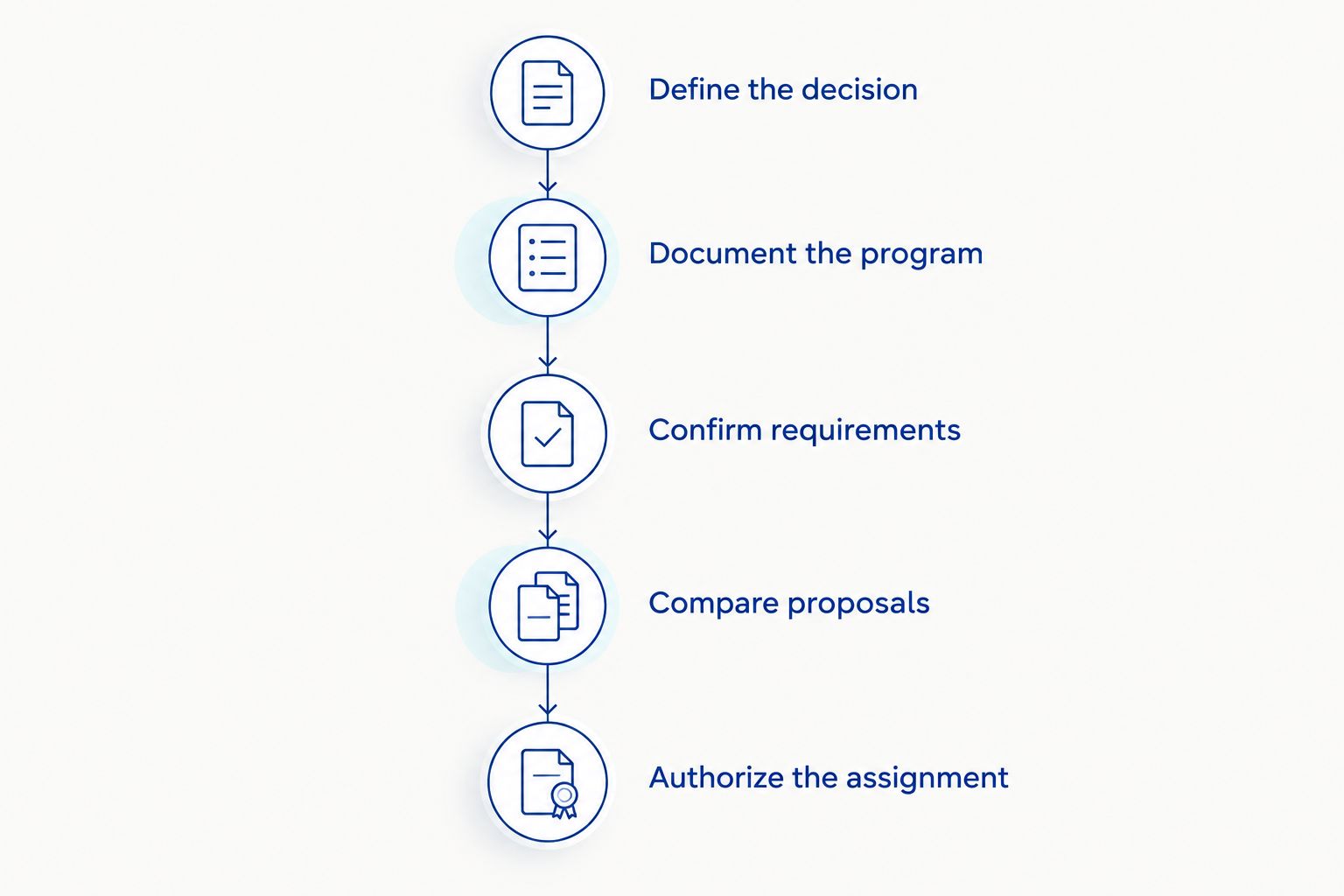
Build a commissioning roadmap before requesting proposals
A clear commissioning process starts with the decision and ends with an agreed deliverable. Keep a written record of each milestone so that the owner, analyst, financing team, and development professionals work from the same assumptions.
- Define the decision. State what the report must help you decide. Identify the intended readers and ask whether they have written requirements.
- Document the program. Prepare a concise property brief covering the location, proposed residential use, unit mix, development concept, and unresolved assumptions.
- Confirm requirements. Obtain lender instructions where applicable. Identify whether separate zoning, design, environmental, or other professional reviews are needed.
- Compare proposals. Review scope, methods, deliverables, exclusions, responsibilities, and revision terms against the same brief.
- Authorize the assignment. Agree on the written scope and identify who can approve changes. Set review milestones and document the accepted project assumptions.
This sequence gives a first-time owner a practical starting point and gives an experienced developer a consistent procurement record. It also separates questions the analyst must answer from questions assigned to other members of the development team.
What should a market-study proposal include?
A proposal should make the assignment understandable before research begins. You should be able to identify the subject property, project concept, intended use, research approach, deliverables, and boundaries without relying on a verbal explanation.
Ask the provider to distinguish an assumption from a verified finding. For example, a proposed bedroom mix supplied by the owner is an input to test, not evidence that the market supports that mix. The report should preserve that distinction.
Use the following review checklist when assessing the written proposal:
- Identify the client, subject property, and intended report users.
- Describe the proposed residential program and any alternatives included.
- List the research topics and expected supporting materials.
- State what information the owner must supply.
- Explain how questions, corrections, and changes are handled.
- Identify exclusions, reliance limitations, and update arrangements.
Do not authorize an assignment whose purpose remains ambiguous. Resolve disagreements about scope while they are still proposal questions rather than disputes about a completed deliverable.
How does a market study fit New Jersey development due diligence?
A market study addresses market questions; zoning due diligence addresses the rules governing development of the property. Neither substitutes for the other. Keep the two workstreams coordinated so that the market analysis evaluates a program your development team is actually investigating.
In Paterson and elsewhere in New Jersey, confirm applicable zoning requirements and whether a redevelopment plan governs the site. Have the appropriate professionals evaluate departures from those requirements and the related approval pathway. Do not treat an attractive market conclusion as evidence that a variance or other approval will be granted.
Nieves Development provides development strategy, zoning guidance, and municipal-process coordination for multifamily, mixed-use, and redevelopment projects. That coordination role belongs alongside clearly assigned market research and professional responsibilities, rather than being described as a substitute for them.
For your 2026 roadmap, record the current version of the development concept and circulate changes to the relevant team members. A market analyst reviewing one unit mix and a design team advancing another are not evaluating the same project.
Can you use a market study instead of an appraisal?
A market study is not automatically a substitute for an appraisal. An appraisal addresses a defined valuation assignment, while a market study addresses the market questions established in its scope. Confirm which deliverable the intended recipient requires.
If financing is involved, ask the lender whether market analysis is required separately, within another assignment, or through a particular provider arrangement. Do not commission overlapping work merely because document names sound similar.
Should you commission the study before buying the property?
Commission research when it can still inform the acquisition decision. Start by identifying the decisions that must be made before your contractual due-diligence milestones, then determine which investigations support those decisions.
Coordinate the market assignment with zoning review and other property investigations. If the proposed use remains unresolved, tell the analyst explicitly and agree on how that uncertainty will appear in the work.
FAQ
How much does a market study cost for a multifamily project?
A multifamily market study requires a project-specific proposal defining its purpose, research, deliverables, and follow-up obligations. Compare written scopes before selecting an assignment, and confirm lender requirements before commissioning financing-related work.
What should I send a multifamily market-study provider?
Send the property location, proposed development concept, unit mix, intended use of the report, and any lender instructions. Identify unresolved assumptions so the provider can explain how those uncertainties affect the assignment.
Is a preliminary rent survey enough for a lender?
A preliminary rent survey is sufficient only if the intended lender accepts that scope for its stated purpose. Obtain the lender’s requirements before treating preliminary research as a financing deliverable.
Does a market study confirm that my multifamily project is allowed?
A market study does not establish zoning compliance or municipal approval. Review permitted uses, development standards, applicable redevelopment requirements, and the approval pathway separately with the appropriate professionals.
Can I reuse a market study after changing the unit mix?
Ask the report provider whether the revised unit mix changes the analysis or conclusions. Do not assume that findings for the original program apply unchanged to a different development concept.
Does a market study include an appraisal?
An appraisal is included only when the agreed assignment expressly provides for it through an appropriately qualified professional. Confirm the intended recipient’s requirements rather than treating market research and valuation as interchangeable.
Can Nieves Development coordinate the development process?
Nieves Development provides development strategy, zoning guidance, and municipal-process coordination for New Jersey projects. Those services are distinct from market-analysis assignments and licensed legal, engineering, architectural, planning, or surveying services.
One last thing
Choose the report's intended use before choosing its provider. A detailed document still misses the milestone if the person relying on it needs a different scope, different assumptions, or a different type of professional opinion. Ask the intended recipient what must be demonstrated before the assignment begins.
For a 2026 commissioning decision, keep the accepted proposal, project brief, recipient instructions, and subsequent changes together. That record makes it easier to identify which conclusions remain applicable when the development concept changes.
Development consulting and municipal-process coordination do not replace licensed legal, engineering, architectural, planning, surveying, or appraisal services. Engage appropriately licensed professionals where required; neither a market study nor process coordination guarantees municipal approval or financing.
Related guides
- Zoning consulting for multifamily developers
- Feasibility studies for first-time developers
- Municipal due diligence for land deals
YOUR NEXT STEP
Planning a project in New Jersey?
Discuss your property, project goals and municipal-process questions with Nieves Development Consulting.
Explore our consulting services · See a Paterson project example