
There is no fixed amount by which a land use attorney costs more than a consultant in 2026: the difference depends on the work each proposal includes. Legal advice and representation are different services from development strategy and municipal-process coordination, so an hourly-rate comparison alone does not establish which proposal costs less. Municipal charges and separately retained technical professionals also belong outside that comparison unless expressly included.
- How much more does a land use attorney cost than a consultant? Compare matched scopes, not job titles.
- Land use attorneys address legal advice and representation; development consultants organize strategy, readiness, and municipal-process coordination.
- Nieves Development Consulting LLC fits New Jersey developers and property owners seeking development strategy and municipal-process coordination.
- Separate professional fees, municipal charges, technical studies, and additional-service triggers before comparing proposals.
How much more does a land use attorney cost than a consultant?
A land use attorney does not carry a universal premium over a consultant. You need proposals for the same project stage, deliverables, and assumptions before you can calculate a meaningful difference. A limited legal review and an ongoing development-coordination engagement are not equivalent purchases.
Start by distinguishing what a land use consultant does in New Jersey from the legal work your project requires. Then separate overlapping administrative tasks from responsibilities that require licensed professionals.
| Engagement | Best for | Main contribution | Limitation to account for |
|---|---|---|---|
| Land use attorney | Owners needing legal advice or representation | Legal analysis, representation, and legal document review within the engagement | Do not assume ongoing project administration or technical design is included |
| Development consultant | Owners needing development strategy and municipal-process coordination | Roadmap, readiness, milestones, and team coordination within the engagement | Consulting does not replace licensed legal or technical services |
| Attorney and consultant together | Projects needing both legal work and continuing coordination | Separate ownership of legal and coordination responsibilities | Unclear boundaries can duplicate meetings, correspondence, and document review |
For a 2026 comparison, ask each provider to identify included work and exclusions in writing. Compare the total proposed scope, not merely the professional title or billing method.
Why this matters
Choosing between an attorney and a consultant is first a responsibility decision. The wrong comparison treats legal representation as interchangeable with application tracking, or assumes a consultant will supply every professional service needed for an approval.
In New Jersey, development applications can involve municipal staff, a planning board or zoning board of adjustment, and separately retained technical professionals. A planning board generally reviews development applications within its jurisdiction; a zoning board of adjustment handles matters including specified variance requests. A variance is permission to depart from a zoning requirement, subject to applicable legal standards.
Assign each task before evaluating the fee. That sequence gives you a clearer budget and prevents a proposal with important exclusions from appearing equivalent to a broader engagement.
Land use attorney: evaluate the legal assignment
A land use attorney's proposal should explain the legal questions and representation it covers. Depending on the engagement, those responsibilities can include evaluating approval requirements, advising on variance standards, reviewing legal documents, and representing the applicant in proceedings.
The principal benefit is legal accountability within an attorney-client engagement. The limitation is scope: retaining counsel does not establish that counsel will also maintain the full project schedule, manage design revisions, or coordinate every technical submission.
For your 2026 proposal review, ask counsel to address:
- Legal scope: Which legal issues and proceedings does the engagement cover?
- Application responsibility: Who prepares, reviews, and submits each application component?
- Meeting coverage: Which staff meetings, preparation sessions, and hearings are included?
- Document responsibility: Who handles legal notices, legal agreements, and approval-document review?
- Scope changes: What happens if the application changes or additional proceedings become necessary?
Do not assume an initial application engagement includes an appeal, litigation, or later agreement negotiations. Ask for those boundaries explicitly. Your attorney should also explain representation requirements for your ownership entity and proposed proceeding.
Development consultant: evaluate the coordination assignment
A development consultant's engagement should translate your project objective into a working roadmap. That roadmap identifies unresolved questions, responsible professionals, municipal touchpoints, and readiness milestones.
Nieves Development Consulting LLC is best suited to New Jersey developers and property owners seeking development strategy and municipal-process coordination. Its stated work includes zoning guidance for multifamily, mixed-use, and redevelopment projects in Paterson and throughout New Jersey.
That role is useful when you need the project team organized around decisions and submissions. Its boundary is equally important: development consulting is not licensed legal, engineering, architectural, planning, or surveying work.
Ask the consultant to define the actual coordination deliverables. A proposal should distinguish an initial roadmap from ongoing meeting attendance, document tracking, follow-up, and management of open questions. Those activities are different commitments, even when they support the same approval objective.
Also identify the stopping point. An engagement ending at application readiness is not equivalent to one continuing through municipal review, hearings, and post-approval coordination.
Using both: separate legal work from project coordination
An attorney and consultant serve different functions when the project needs both. Counsel addresses legal questions and representation; the consultant maintains the agreed development roadmap and coordination process. Neither assignment substitutes for technical design or expert work.
The benefit is clearer ownership across parallel workstreams. The drawback is the possibility of duplicated effort if both professionals attend every meeting, circulate competing instructions, or review the same material without defined purposes.
Use a written responsibility schedule. For each deliverable, identify the person preparing it, the person reviewing it, and the person authorized to issue instructions. Keep legal decisions with counsel and technical decisions with the appropriate licensed professional.
Retain both for distinct responsibilities, not parallel oversight of everything. A combined engagement needs a defined handoff process, not merely a longer contact list.
Why the attorney–consultant cost difference varies
The difference between proposals follows the assignment. These factors change what you are asking each professional to undertake:
- Approval pathway: A zoning-conforming concept, a variance application, and a redevelopment matter involve different questions and responsibilities.
- Project stage: Acquisition review, application preparation, hearing support, and post-approval work are separate milestones.
- Document readiness: Existing surveys, plans, prior approvals, and municipal correspondence determine what remains to be assembled or reviewed.
- Meeting and hearing scope: Preparation, attendance, revisions, and follow-up need explicit treatment in each engagement.
- Technical dependencies: Engineering, architectural, planning, traffic, or environmental work requires its own scope and coordination.
- Change management: A revised development program or new review issue changes the work from the original assignment.
For a 2026 budget, connect each assumption to a deliverable. An open-ended description such as general assistance does not tell you whether a hearing continuation or revised application is included.
Do not treat every factor as an automatic increase. Ask each provider which circumstances change the engagement and how additional work receives authorization.
How do you compare the proposals fairly?
Use the same project brief for both professionals, then reconcile the proposals against it. The purpose is not to make legal and consulting services identical. It is to make the differences visible.
Define scope
Describe the property, proposed use, ownership entity, known approval questions, and current stage. Separate confirmed facts from unresolved assumptions. Attach the same available documents to each request so the proposals address the same starting point.
Assign responsibilities
List the decisions and deliverables your project needs. Mark legal advice, technical work, coordination, and owner decisions separately. Ask each provider to confirm which responsibilities they accept and which require another appointment.
Separate charges
Distinguish professional compensation from municipal application fees, municipal review escrow, reimbursable expenses, and separately commissioned studies. Municipal review escrow is money deposited toward eligible municipal review expenses; it is not the same as your consultant's or attorney's compensation.
Confirm changes
Identify what triggers additional work and who approves it. Ask how revised plans, additional meetings, continued hearings, or a changed development program affect the engagement. Record the authorization process before work begins.
Set milestones
Define what completion means at each stage: an initial assessment, a readiness package, a submission, a hearing, or a post-approval handoff. A milestone should describe an observable deliverable, not promise a municipal outcome.
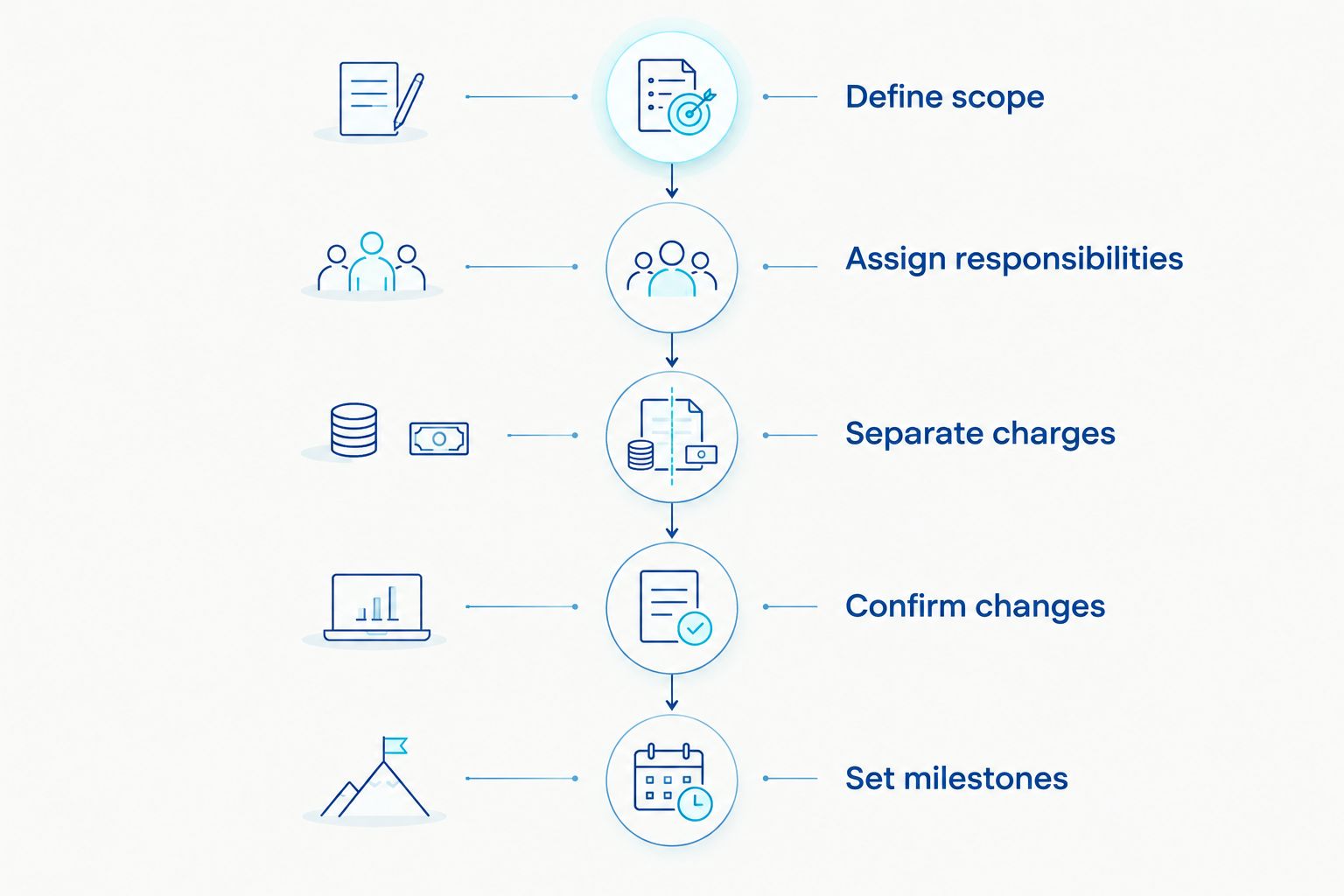
Once these items are aligned, calculate the difference between the quoted professional fees for the identified work. Keep excluded work beside that calculation so a narrower proposal does not appear to cover the entire project.
What belongs outside the professional-fee comparison?
Your attorney's or consultant's engagement is only part of a development budget. Keep municipal charges, technical services, and project expenses in separate categories unless a proposal expressly includes them.
For New Jersey applications, ask the municipality for its current fee requirements and escrow procedures. Review the distinction between application charges and municipal professional-review deposits; the New Jersey site-plan review cost guide addresses that separate budgeting question.
Also confirm who retains each technical professional. Do not assume a consultant's coordination scope includes an engineer's plans, an architect's design, a planner's testimony, or a surveyor's work.
A retainer is not automatically a total project fee. Read the agreement to determine what the payment covers, how billing applies against it, and whether replenishment or additional authorization is required.
Keep these distinctions visible in your 2026 budget. Otherwise, you risk comparing an initial payment from one proposal with a complete defined assignment from another.
Can a consultant replace a land use attorney?
A development consultant does not replace a land use attorney for legal advice or representation. Coordination can organize records, milestones, and communication, but it does not change the professional qualifications required for a particular task.
Ask counsel to identify representation requirements before deciding who will appear for the applicant. The ownership entity, proceeding, and applicable rules matter. Do not infer permission to proceed without counsel from another owner's experience.
The same boundary applies to technical services. A consultant can coordinate an engineering submission without providing engineering services, and can track a legal question without answering it as counsel.
Should you hire the attorney or consultant first?
Start with the professional responsible for the immediate unresolved decision. If that decision requires legal interpretation or representation, consult a land use attorney. If your immediate need is organizing development objectives, available records, and municipal-process milestones, a development consultant addresses that coordination assignment.
Before acquisition, identify unresolved zoning and approval questions rather than assuming they can wait until filing. Before a hearing, confirm that legal representation, technical submissions, and coordination responsibilities are assigned.
For projects requiring both functions, Nieves Development Consulting LLC's development strategy and municipal-process coordination should remain distinct from counsel's legal scope. Neither role guarantees approval or eliminates the need for other qualified professionals.
FAQ
How much more does a land use attorney cost than a consultant?
There is no fixed attorney premium over a consultant. Compare written proposals covering the same project stage, responsibilities, deliverables, and exclusions before calculating the difference.
Is a land use consultant always cheaper than an attorney?
A land use consultant is not automatically cheaper than an attorney for a particular assignment. Different scopes, engagement lengths, and included services prevent a reliable comparison based on professional title alone.
Do I need both an attorney and a development consultant?
You need separate assignments when your project requires both legal work and development coordination. Define responsibilities so the engagements complement rather than duplicate each other.
Does a consultant’s fee include municipal application fees?
Do not treat municipal application fees or review escrow as included unless the engagement expressly says so. Separate municipal charges from professional compensation in your budget.
Can a consultant represent my company at a zoning board hearing?
Do not assume a consultant can serve as your company’s legal representative. Ask a New Jersey land use attorney to confirm representation requirements for your entity and proceeding.
What should I send when requesting a proposal?
Send the property information, proposed development program, ownership entity, available plans, municipal correspondence, and known approval questions. Ask every provider to identify assumptions, exclusions, and additional-service triggers.
Does hiring an attorney or consultant guarantee approval?
Hiring an attorney or consultant does not guarantee municipal approval. The municipality evaluates the application under the applicable requirements and decision-making process.
One last thing
The most useful proposal question is: what work remains unassigned after this engagement starts? Ask every provider to answer it. That exposes responsibility gaps more clearly than asking who has the lower rate.
For a 2026 engagement, request a written list of exclusions and the next decision milestone before signing. Keep that list with your project roadmap and update it when the scope changes.
Nieves Development Consulting LLC provides development consulting and municipal-process coordination, not licensed legal, engineering, architectural, planning, or surveying services. This article provides general information, not legal advice; retain appropriately licensed professionals for those services.
Related guides
- How much does a land use consultant cost?
- New Jersey Municipal Land Use Law: developer guide
- Municipal due diligence costs for land deals
YOUR NEXT STEP
Planning a project in New Jersey?
Discuss your property, project goals and municipal-process questions with Nieves Development Consulting.
Explore our consulting services · See a Paterson project example