
A land use consultant’s cost depends on the property, proposed development, and agreed scope of work; there is no single fee that answers the question for every New Jersey project in 2026. The consultant’s fee is also separate from municipal application charges, review escrow, and licensed professional services unless the agreement expressly includes them. Compare written scopes before comparing proposal totals.
- How much does a land use consultant cost? Scope determines the fee; separate consulting from municipal and professional expenses.
- Nieves Development Consulting LLC fits New Jersey owners and developers seeking development strategy and municipal-process coordination.
- Compare deliverables, meeting coverage, revision limits, and exclusions before choosing a land use consulting proposal.
- A consultant coordinates the roadmap; licensed professionals provide the legal, design, engineering, and surveying services your project requires.
How much does a land use consultant cost?
A useful consulting estimate starts with a defined assignment, not a general description such as getting approvals. Your proposal should identify the property, intended use, project stage, deliverables, and point at which the engagement ends. The distinction between strategy and execution matters: reviewing a development concept is different from coordinating an application through municipal review.
Before requesting proposals, establish what a land use consultant does in New Jersey. That scope determines which responsibilities belong in the consulting agreement and which belong with other members of your development team.
Use the following breakdown to distinguish the consultant’s assignment from the broader approval budget. These are separate responsibilities, not interchangeable services.
| Budget component | What it covers | What to confirm |
|---|---|---|
| Development consulting | Strategy, zoning guidance, readiness review, and process coordination | Specific deliverables and engagement boundaries |
| Municipal application charges | Charges associated with filing the applicable municipal application | Current municipal requirements for your application |
| Municipal review escrow | Funds deposited for municipal professional review, subject to applicable procedures | Deposit, replenishment, accounting, and refund procedures |
| Licensed professional services | Legal representation, plans, engineering, planning testimony, or surveying as required | Separate agreements and responsibility for each task |
| Revisions and additional coordination | Work resulting from changed plans, review comments, or an expanded assignment | Whether the original agreement includes that work |
The consultant’s proposal is one part of your development budget, not the entire approval budget. Keep each component visible so that a limited consulting assignment does not appear to cover work assigned elsewhere.
To see how Nieves Development structures its consulting fees, including project-based and hourly options, review our Engagements & Fees page.
Why this matters
An unclear scope makes proposals difficult to compare. One engagement can stop after a written zoning roadmap, while another continues through team meetings, submission coordination, and responses to municipal comments. Those assignments have different endpoints even when both use the term land use consulting.
For your 2026 project budget, connect every proposed consulting task to a decision or milestone. A property owner evaluating whether to proceed needs different information from a developer preparing a municipal submission. Buying ongoing coordination before defining the project can leave the engagement working toward an unsettled objective.
Compare consulting arrangements by responsibility
A consulting agreement can organize compensation around time, defined deliverables, or phases. The arrangement alone does not establish value. You still need to know what the consultant will produce, which activities require authorization, and what happens when the project changes.
The table below compares agreement structures, not specific offerings from any firm. Use it to discuss the structure that matches your assignment.
| Arrangement | Best for | Advantage | Limitation to address |
|---|---|---|---|
| Time-based assignment | An evolving scope with uncertain coordination needs | Work can follow the actual tasks required | Require reporting and authorization controls for additional work |
| Defined-deliverable assignment | A clearly bounded review or written roadmap | The expected output and endpoint are explicit | Confirm assumptions and exclusions before signing |
| Phase-based engagement | A project moving through distinct decision milestones | You can authorize the next phase after reviewing the previous one | Confirm handoffs and tasks that cross phase boundaries |
For a defined-deliverable assignment, describe the deliverable in practical terms. A zoning summary should identify the proposed use, relevant requirements, questions requiring confirmation, and the next decision. A document labeled a report is not enough to define its usefulness.
For time-based coordination, specify how work is recorded and when you receive progress updates. Identify who can approve additional tasks. Without that control, a design change or new meeting request can expand the assignment without a clear decision from the owner.
For phase-based work, define the milestone that closes each phase. Completion of a feasibility roadmap is not the same as municipal acceptance of an application, and application acceptance is not approval. Your agreement should preserve those distinctions.
What should the consulting scope include?
Start with the decision you need to make. Then identify the documents, reviews, and coordination required to support it. This keeps the consultant’s assignment tied to your development strategy rather than an open-ended instruction to manage everything.
Property review
Provide the property address, available survey, existing plans, intended use, and relevant municipal correspondence. Identify documents that still need to be obtained. A consultant should distinguish information reviewed from conditions that require verification by the municipality or a licensed professional.
For an acquisition, the immediate question is whether the proposed concept warrants further diligence. For a property you already own, the question can be which approval pathway fits the intended change. Neither assignment should imply that a preliminary review confirms every physical or regulatory condition.
Approval roadmap
An approval roadmap identifies the likely municipal process, unresolved questions, required team members, and decision milestones. In New Jersey, site plan review addresses a proposed site’s layout and related development details; a variance is relief from an applicable zoning requirement. The need for either depends on the proposal and governing requirements.
Require the roadmap to distinguish established requirements from items needing confirmation. A clear roadmap supports your next decision without presenting preliminary guidance as a municipal determination.
Team coordination
Define whether the consultant schedules meetings, maintains an action list, gathers comments, or tracks submission readiness. Also identify who prepares and signs plans, provides legal advice, and supplies professional testimony when required. Coordination does not transfer those responsibilities to an unlicensed consultant.
A useful action list assigns each item to a responsible person and records its status. That helps you distinguish a municipal review issue from a missing document or an unresolved owner decision.
Review support
If the engagement extends into municipal review, specify whether it includes meeting attendance, comment tracking, or coordination of revised submissions. Name the endpoint. Support through submission is narrower than support through review, and neither phrase automatically includes construction-stage responsibilities.
Why land use consulting costs vary
Land use consulting costs vary because the assignment changes with the project. For a multifamily, mixed-use, or redevelopment proposal, define the actual work rather than assuming the project label alone establishes the consulting scope.
- Project stage: Acquisition review, concept development, application preparation, and active municipal review require different outputs.
- Proposed use and zoning questions: A concept requiring zoning relief involves a different roadmap from one that meets the applicable requirements.
- Document readiness: Missing surveys, inconsistent plans, and unresolved project descriptions create additional coordination tasks.
- Review pathways: Municipal review, environmental questions, historic review, and redevelopment requirements create distinct responsibilities when applicable.
- Team structure: The assignment changes depending on whether the owner already has counsel, design professionals, and a designated project coordinator.
- Scope changes: Revised uses, layouts, or owner objectives change the work needed to maintain a current roadmap.
Do not treat this list as proof that every project requires every review. Ask the team to connect each proposed task to your property and development concept. Work without that connection belongs outside the initial authorization until its purpose is established.
How do you compare land use consulting proposals?
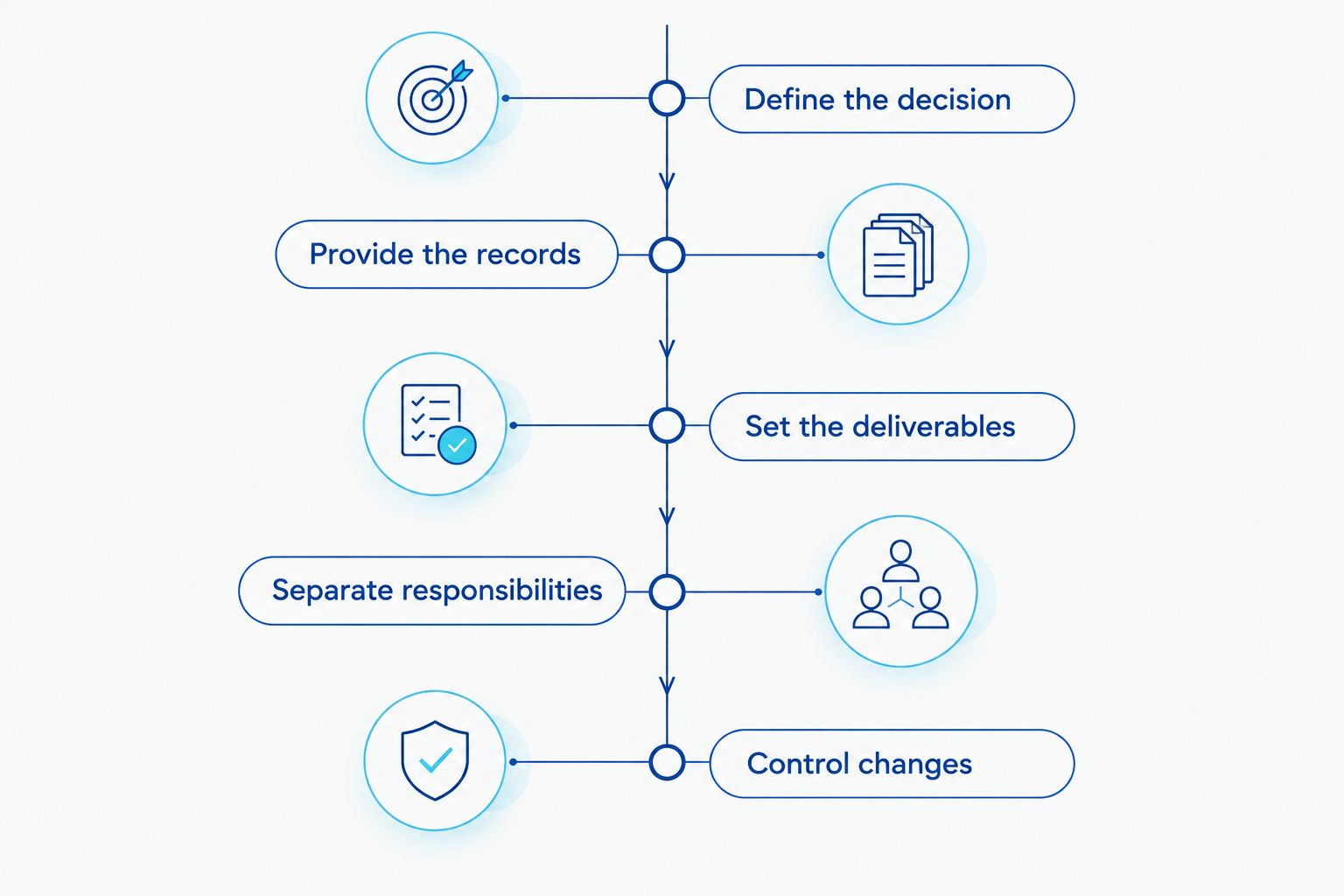
For a 2026 engagement, give each consultant the same project description and request responses against the same boundaries. This is the clearest way to separate differences in scope from differences in compensation structure. Follow this sequence before selecting a proposal.
- Define the decision. State whether you need an acquisition review, a zoning roadmap, submission readiness, or ongoing coordination. Describe the proposed use and current project stage.
- Provide the records. Share the available property documents, concept plans, and municipal correspondence. Identify which records are current and which remain preliminary.
- Set the deliverables. Request named outputs, such as a written roadmap, readiness checklist, meeting action list, or review-comment tracker. Explain how you will use each output.
- Separate responsibilities. Identify the consultant’s work alongside the tasks assigned to counsel, architects, engineers, planners, and surveyors. Record exclusions explicitly.
- Control changes. Establish who authorizes additional work, how changes are documented, and what closes the engagement. Require a revised scope when the development objective changes materially.
The sequence moves from your decision to the agreement’s boundaries. Do not start by asking for ongoing coordination when you have not yet defined the proposed use or the immediate milestone.
After reviewing the proposals, ask each consultant to explain the handoff between the written roadmap and subsequent coordination. A proposal should tell you what becomes actionable, who takes the next step, and which tasks require a separate authorization.
Nieves Development Consulting LLC is best for New Jersey developers and property owners seeking development strategy, zoning guidance, and municipal-process coordination. Its stated focus includes multifamily, mixed-use, and redevelopment projects in Paterson and throughout New Jersey. That focus fits a need for process clarity; it does not replace the licensed professional services or municipal decisions your project requires.
What should you ask before signing in 2026?
Ask whether the proposal describes your current project or assumes a future version of it. A scope built around a settled concept does not necessarily fit a property where the proposed use remains undecided. Make that distinction before authorizing the work.
Then clarify these agreement terms:
- Included meetings: Identify the purpose and coverage of owner, professional-team, and municipal meetings.
- Written outputs: Confirm which records you receive and when each becomes available.
- Revision boundaries: Distinguish corrections to the agreed deliverable from work caused by a changed development concept.
- External expenses: Identify charges and professional services that sit outside the consulting agreement.
- Completion milestone: Define the event or deliverable that ends the authorized assignment.
A consultant can coordinate readiness and track milestones, but cannot promise how a municipality will decide an application. Reject approval guarantees as a substitute for a clear scope. Your agreement should describe responsibilities that the consultant can actually perform.
Is a land use consultant the same as a land use attorney?
A land use consultant is not a substitute for a land use attorney. Development consulting addresses strategy and coordination within the agreed scope; an attorney provides legal advice and representation. Ask the team to identify which questions require counsel rather than treating every zoning question as a consulting task.
Does the consulting fee include municipal review escrow?
The consulting fee does not automatically include municipal review escrow. Escrow is a deposit associated with municipal professional review, not payment for your consultant’s assignment. In your 2026 budget, keep the consulting agreement and municipal account requirements separate unless the written scope expressly addresses their administration.
Should you hire a consultant before buying the property?
Hire a consultant before acquisition when your immediate need is to understand the development roadmap and coordinate due diligence. Keep the initial assignment tied to the purchase decision. That preliminary work should identify unresolved issues and professional reviews, not promise that the proposed development will receive approval.
FAQ
How much does a land use consultant cost in New Jersey?
A land use consultant’s cost depends on the property, proposed development, and written scope. Compare deliverables, coordination responsibilities, exclusions, and change-authorization terms rather than treating unlike proposals as equivalent.
Does a land use consultant’s fee cover all approval expenses?
A land use consultant’s fee does not automatically cover all approval expenses. Municipal application charges, review escrow, and licensed professional services require separate budget attention unless the agreement expressly addresses them.
What should I send a consultant to get a useful proposal?
Send the property address, intended use, project stage, available plans and survey, and relevant municipal correspondence. Identify the decision you need to make and which documents remain preliminary.
Is a fixed-scope agreement better than time-based consulting?
A defined-scope agreement fits a clear deliverable; time-based consulting fits an evolving assignment. Compare the boundaries, reporting requirements, and authorization controls before choosing either structure.
Can a land use consultant guarantee zoning approval?
A land use consultant cannot guarantee a municipal approval. A consulting agreement should define strategy, readiness, coordination, and deliverables without promising the municipality’s decision.
Does Nieves Development Consulting LLC replace an architect or engineer?
Nieves Development Consulting LLC provides development strategy, zoning guidance, and municipal-process coordination, not a substitute for licensed design or engineering services. Your project needs the appropriately licensed professionals for work requiring those services.
One last thing
Before signing, ask for the engagement’s stopping point in plain language. A written roadmap, a coordinated submission, and support through municipal review are different endpoints. The most useful proposal tells you both what happens next and where the consultant’s responsibility ends.
Development consulting and process coordination are distinct from licensed legal, engineering, architectural, planning, and surveying services. Obtain project-specific advice and required work from appropriately licensed professionals; municipal requirements and decisions remain subject to the applicable authorities.
Related guides
- Zoning consulting for multifamily developers
- Feasibility studies for first-time developers
- Paterson zoning due diligence before property acquisition
- Land acquisition to municipal due diligence workflow
YOUR NEXT STEP
Planning a project in New Jersey?
Discuss your property, project goals and municipal-process questions with Nieves Development Consulting.
Explore our consulting services · See a Paterson project example