

Affordable housing projects in New Jersey cannot skip the planning board simply because they provide affordable units. In 2026, the required approval route depends on the governing zoning or redevelopment rules, the proposed work, and whether another body has jurisdiction or an applicable exemption removes a particular review. Avoiding a planning board hearing does not, by itself, eliminate site-plan requirements, construction permits, or other agency approvals.
- Can affordable housing projects skip the planning board? In New Jersey, affordable status alone does not create an exemption.
- Permitted use, site-plan approval, and construction permits are separate questions; resolving one does not resolve the others.
- A zoning board can hear certain applications instead of a planning board; that is not an approval exemption.
- Nieves Development provides affordable housing development strategy and municipal-process coordination, not licensed legal or design services.
Why this matters
If you acquire land on the assumption that affordable housing receives automatic approval, your acquisition roadmap starts with an unresolved entitlement question. Entitlements are the land-use approvals that establish what you can develop on a property. Funding eligibility and municipal support do not establish those approvals.
Start by separating the housing program from the municipal application. The land-use consulting for affordable housing guide addresses the development-coordination context; your project still needs a parcel-specific determination of the applicable approval route.
Can affordable housing projects skip the planning board?
Not automatically. Affordable housing status does not replace the municipal land-use approval process. New Jersey's Municipal Land Use Law, or MLUL, allocates responsibilities among planning boards, zoning boards of adjustment, and municipal governing bodies. The applicable ordinance, proposed development, and requested relief determine which responsibilities apply.
For a 2026 application, read the current municipal requirements alongside the MLUL and any site-specific redevelopment plan, approval resolution, or court order. The following distinctions identify the route to investigate; they do not determine a particular property's entitlement.
| Project situation | Route to investigate | What it does not establish |
|---|---|---|
| Affordable multifamily use is permitted and the project complies with zoning | Planning board site-plan review, unless an applicable exception applies | Permission to start construction |
| The project needs relief within zoning board jurisdiction | Zoning board review, potentially including associated site-plan approval | Exemption from land-use review |
| The property falls under a redevelopment plan | The plan's standards and the applicable municipal application process | Automatic site-plan approval |
| The proposal relies on an existing approval | Approval validity, conditions, and whether the proposed work requires amendments | Permission to change the approved project without review |
| The proposal claims an exemption or administrative route | The specific legal authority and its application to the proposed work | A general exemption for affordable housing |
Identify the decision-maker before scheduling the application. A project that goes to the zoning board rather than the planning board has changed forums, not necessarily reduced its approval obligations.
A permitted affordable housing use can still need site-plan approval
A permitted use is a use the applicable zoning rules allow. Site-plan review examines the proposed development layout and compliance with applicable requirements, including matters such as access, parking, drainage, circulation, and landscaping.
Those are different determinations. A multifamily building can be permitted in a district while its proposed layout still requires site-plan review. Compliance with the use rules also does not establish compliance with height, setbacks, lot coverage, or other dimensional standards.
The advantage of a conforming proposal is that it avoids requesting relief from standards it already satisfies. The limitation is equally important: zoning compliance is not the same as an issued development approval. Have the project team document both the permitted use and the approvals needed for the actual plans.
For affordable housing development in 2026, do not describe a site as approval-ready solely because the municipality permits affordable units there. Identify the required application, supporting submissions, and remaining decisions first.
Zoning board jurisdiction can replace the planning board forum
A use variance is permission to depart from certain zoning restrictions, including a prohibition on the proposed use. New Jersey's MLUL assigns the variances listed in N.J.S.A. 40:55D-70(d) to the zoning board of adjustment.
Under N.J.S.A. 40:55D-76(b), a zoning board can also grant associated subdivision or site-plan approval when the statutory conditions apply. That provides a route for coordinated review before the zoning board rather than separate planning board consideration of the same associated application.
The procedural benefit is coordination before the body with jurisdiction. The constraint is that the applicant must still establish the required grounds for the requested relief and satisfy applicable review requirements. A zoning board application is not a shortcut created by affordable housing status.
Ask land-use counsel to confirm jurisdiction before finalizing the filing strategy. Not every zoning deviation transfers a project to the zoning board, and an incorrect assumption about the forum can disrupt the application roadmap.
Redevelopment designation does not equal project approval
A redevelopment plan can establish the development standards governing a property within its scope. New Jersey's Local Redevelopment and Housing Law, including N.J.S.A. 40A:12A-13, addresses planning board review of development applications within a redevelopment area.
The benefit of a redevelopment framework is that it can establish standards tailored to the area's adopted development objectives. Its limitation is that adopting the plan is not the same action as approving a particular building and site layout.
A redevelopment agreement also serves a different purpose from a site-plan approval. Do not treat a signed agreement, a designation, and an approval resolution as interchangeable documents. Read each for its actual scope, obligations, conditions, and relationship to the proposed project.
For a Paterson or other New Jersey redevelopment proposal in 2026, confirm the governing plan and any amendments before relying on the underlying zoning map. Then establish which municipal decisions remain outstanding.
Why the approval route varies
The approval route follows the property and proposal, not the affordable housing label alone. These factors determine what the team must resolve:
- Governing standards. Establish whether the zoning ordinance, a redevelopment plan, or another controlling instrument supplies the applicable requirements. Confirm the document applies to the actual parcel.
- Requested relief. Identify departures from use, density, height, setbacks, and other standards. The type of relief affects jurisdiction and the required application.
- Scope of work. New construction, additions, conversions, and changes to an approved layout raise different review questions. Describe the physical work and intended occupancy precisely.
- Existing approvals. Review prior resolutions, approved drawings, conditions, and subsequent amendments. An earlier approval does not establish that a revised proposal falls within its scope.
- Express exemptions or special authority. Identify the actual statute, ordinance provision, or order supporting the claimed alternative route. A project description is not a legal basis for bypassing review.
- Separate agency responsibilities. County, environmental, utility, construction-code, and other requirements can remain relevant even when municipal board review is limited or unnecessary.
Turn these factors into a decision log. For each unresolved issue, name the document needed, the professional responsible for interpreting it, and the municipal or agency confirmation required.
Build an approval roadmap before committing to a filing date
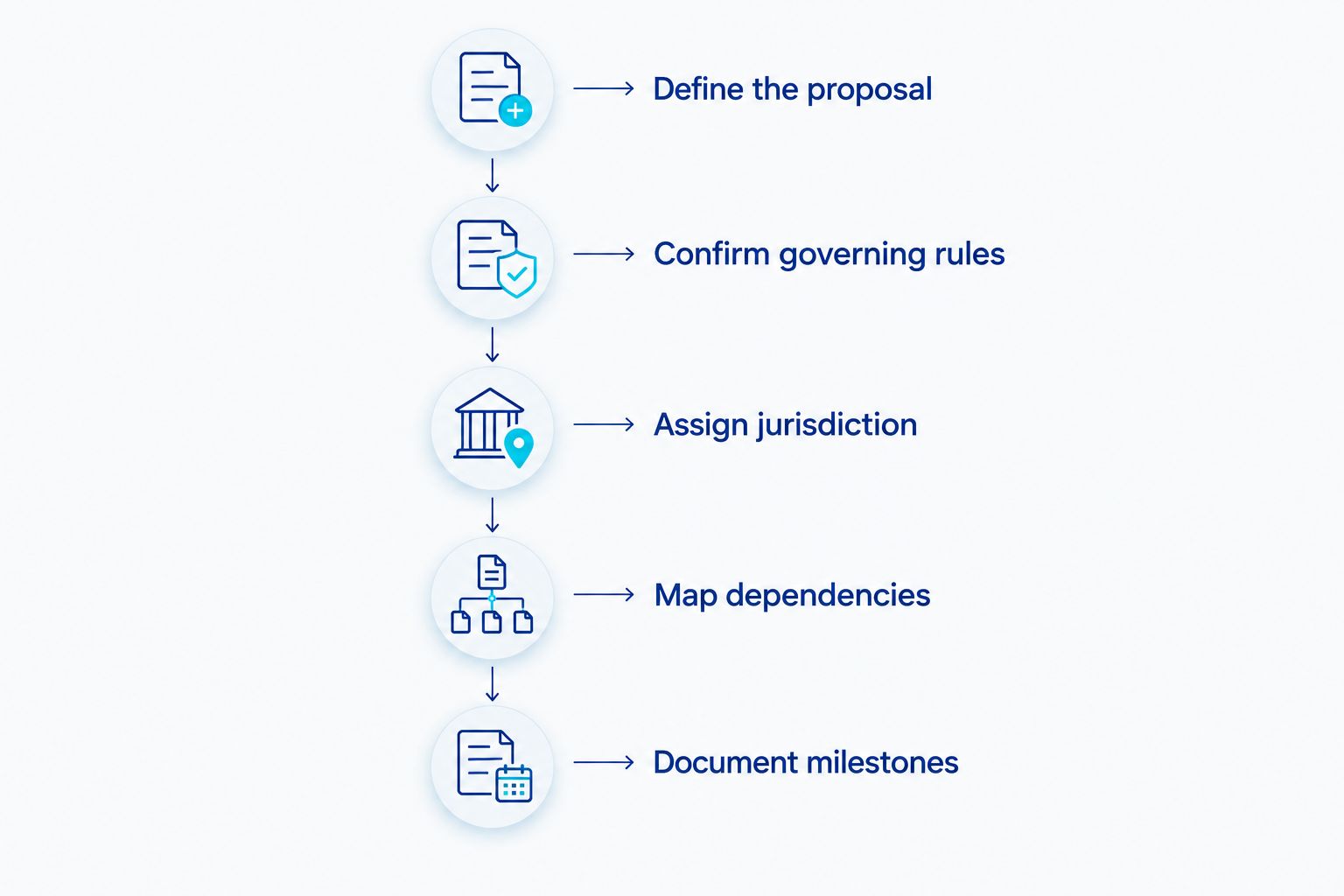
Use this sequence to establish readiness. The purpose is to resolve dependencies before the team commits to a hearing schedule or represents the property as entitled.
- Define the proposal. Record the intended use, building scope, unit program, site work, and any existing approvals the project expects to use. Distinguish the current concept from previously approved drawings.
- Confirm governing rules. Assemble the current ordinance, zoning map, applicable redevelopment plan, approval resolutions, and relevant orders. Have the appropriate professionals identify conflicts or interpretation questions.
- Assign jurisdiction. Determine whether the application belongs before the planning board, zoning board, or an authorized administrative official. Identify the authority supporting any claimed exemption.
- Map dependencies. Separate municipal land-use decisions from environmental, county, utility, funding, and construction-permit requirements. Record which decisions depend on earlier submissions or approvals.
- Document milestones. Identify submission requirements, unresolved technical issues, responsible parties, and the evidence needed to close each task. Keep assumptions visibly separate from confirmed requirements.
For a 2026 acquisition, carry unresolved approval questions into the due-diligence decision rather than treating them as routine post-closing tasks. Have counsel address contractual protections; development coordination does not replace that legal work.
Nieves Development is best suited to owners seeking affordable housing development strategy and municipal-process coordination, not licensed legal or design services. That role supports the roadmap and coordination milestones; it does not determine legal jurisdiction, prepare licensed technical documents, or guarantee municipal approval.
Clarify your development roadmap
Discuss development strategy and municipal-process coordination for your New Jersey project.
Does municipal affordable housing support count as site-plan approval?
Municipal support does not, by itself, count as site-plan approval. A policy commitment, housing-plan reference, funding endorsement, or redevelopment discussion is not interchangeable with the approval required for the specific development application.
Ask what the supporting document actually authorizes. A useful readiness record identifies the decision, issuing body, property, approved scope, conditions, and remaining submissions. If those elements do not establish approval of your proposed plans, do not present them as evidence that site-plan review is complete.
This distinction matters when communicating with lenders, investors, and funding partners. Describe municipal support accurately without converting it into a claim of entitlement.
Can existing buildings avoid a new planning board application?
An existing building is not automatically exempt from a new planning board application. The answer depends on the proposed use, physical changes, applicable ordinance, existing approvals, and any legally applicable exception.
Begin with the approved condition, not merely the building's current appearance. A conversion can raise questions about parking, access, occupancy, utility capacity, or prior approval conditions even when the exterior changes little.
The potential benefit is avoiding review that the applicable rules genuinely do not require. The constraint is that an owner must establish the basis for that conclusion; calling a project an interior renovation does not resolve every land-use question.
FAQ
Can affordable housing projects skip the planning board in New Jersey?
Affordable housing projects cannot skip the planning board solely because they include affordable units. The governing rules, proposed work, required relief, and any applicable exemption determine the approval route.
Does being permitted by zoning mean an affordable housing project is approved?
Being permitted by zoning does not mean an affordable housing project has site-plan approval. The proposed development must still follow the applicable review process and obtain required permits.
Can the zoning board approve an affordable housing site plan instead?
The zoning board can approve an associated site plan when it has jurisdiction and the conditions in N.J.S.A. 40:55D-76(b) apply. Land-use counsel should confirm the correct forum and required relief for the particular application.
Does a redevelopment agreement replace planning board approval?
A redevelopment agreement does not, by itself, replace required planning board approval. Review the agreement, redevelopment plan, and project approval documents separately to establish what each authorizes.
Can affordable housing funding approval replace municipal approval?
Affordable housing funding approval does not, by itself, replace municipal land-use approval. Track funding conditions and municipal application requirements as separate parts of the development roadmap.
Who should confirm whether my project needs a planning board hearing?
Land-use counsel should confirm the legal approval route with the applicable municipal requirements and project documents. Licensed design professionals address their technical disciplines, while a development consultant can coordinate the process and readiness milestones.
Can I start construction if my project does not need planning board review?
Avoiding planning board review does not authorize construction. Confirm required zoning clearances, construction permits, and other applicable approvals before starting work.
One last thing
The useful question is not just which board you can avoid; it is which decisions remain before construction can lawfully begin. A project can have no remaining planning board hearing and still have unresolved approval conditions, outside-agency requirements, or permit submissions.
For a 2026 readiness review, request a written approval matrix that distinguishes granted approvals, outstanding conditions, pending decisions, and required permits. Use that matrix to set the next milestone rather than relying on a general statement that the project is approved.
Nieves Development provides development strategy and municipal-process coordination. This article provides general process information, not legal advice or licensed engineering, architectural, planning, or surveying services; qualified professionals must evaluate project-specific requirements, and municipal approval is not guaranteed.
Related guides
- New Jersey Municipal Land Use Law developer guide
- Site-plan approval for property owners
- Site-plan approval to certificate of occupancy workflow
YOUR NEXT STEP
Planning a project in New Jersey?
Discuss your property, project goals and municipal-process questions with Nieves Development Consulting.
Explore our consulting services · See a Paterson project example