

Instead of manually chasing approval conditions, permit updates, and inspection records, organize the site plan approval to certificate of occupancy workflow around documented release milestones. For a New Jersey project in 2026, separate land-use approval, construction authorization, inspection completion, and occupancy authorization so each handoff has an owner and supporting records.
- Site plan approval to certificate of occupancy requires separate approval, permitting, inspection, and occupancy milestones.
- Nieves Development Consulting LLC provides New Jersey development strategy and municipal-process coordination, not licensed professional services.
- Use the adopted approval resolution, approved plans, and permit records to build your project roadmap.
- Do not treat a board approval or completed construction as permission to occupy.
Why this matters
Site plan approval addresses the proposed development under the applicable land-use process. A construction permit authorizes the work covered by that permit. A certificate of occupancy addresses occupancy under the applicable construction-code process. These are different decisions, not interchangeable documents.
In New Jersey, the Municipal Land Use Law governs municipal land-use procedures, while the Uniform Construction Code governs construction permitting and code administration. Your project roadmap must account for both, together with applicable outside-agency requirements. For the land-use portion, start with the site plan approval guide for property owners.
Nieves Development Consulting LLC is best for New Jersey owners and developers seeking development strategy and municipal-process coordination. Coordination clarifies responsibilities and dependencies; it does not replace municipal determinations or licensed professional work.
Choose the right tracking approach
For a 2026 project, choose a tracking approach that matches the number of handoffs and document revisions. The tracking method cannot establish compliance by itself.
| Tracking approach | Best for | Advantage | Limitation |
|---|---|---|---|
| Shared milestone register | Owners managing a defined project team | Makes responsibilities, dependencies, and evidence visible in one place | Requires an assigned person to maintain it |
| Email-only tracking | Communicating individual questions or decisions | Preserves correspondence and attachments | Does not provide a reliable consolidated view of unresolved conditions |
Use a shared milestone register as the control record and email as supporting correspondence. Preserve written municipal responses with the relevant item rather than treating an inbox search as the project roadmap.
Before you start
- Collect the controlling records: Obtain the adopted approval resolution, the approved plan set, available permit records, and relevant agency correspondence. A hearing presentation or meeting summary is not a substitute for the adopted resolution.
- Confirm access and responsibilities: Identify the property owner's authorized representative, the relevant municipal contacts, and the licensed professionals responsible for technical submissions. Establish access to the project's document repository and any municipal submission system actually used.
- Check the non-obvious dependency: Approval conditions can attach to different milestones, including plan endorsement, permit issuance, construction, or occupancy. Read each condition for its stated trigger; do not assume every condition can wait until final inspections.
Confirm the municipality's current submission and inspection procedures for 2026 before scheduling handoffs. Use its actual application forms and instructions; this workflow does not assume a particular portal or software interface.
Approval conditions register
Start the site plan approval to certificate of occupancy workflow with 4 milestone groups: land-use readiness, permit readiness, construction compliance, and occupancy readiness. These are coordination categories, not substitutes for the municipality's requirements.
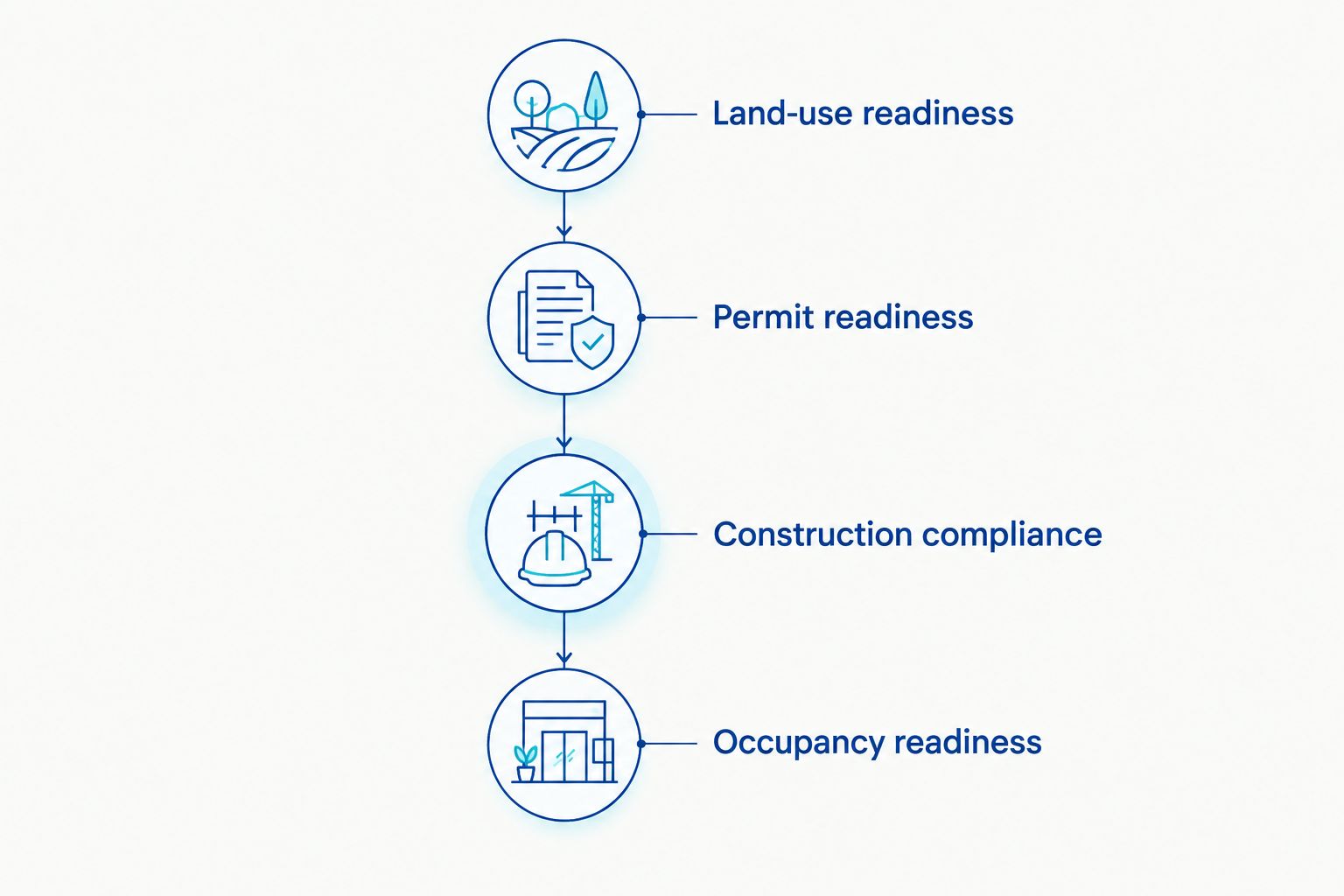
Configure the approval record
- Read the adopted resolution alongside the approved plans. Record the approved use, project scope, conditions, and any expressly stated restrictions or sequencing requirements.
- Create a register using these proposed field names: Condition, Source, Responsible party, Release milestone, Evidence, and Status. These are labels for your own tracker, not municipal portal buttons.
- Enter each condition separately. Copy the operative wording and identify the resolution paragraph or other controlling source so the team can check the requirement without interpreting a summary.
- Assign a responsible party and a release milestone. If the timing or responsibility is unclear, record the question and seek clarification from the appropriate municipal official or professional.
- Attach evidence when a condition is addressed. Distinguish a document being submitted from the municipality or reviewing agency accepting it.
Expected result: You have a condition-by-condition register that identifies what must happen, who must act, and what record supports closure. An unresolved question remains visible rather than disappearing into correspondence.
Keep 3 record types connected: the resolution, the applicable plan revision, and the condition-closure evidence. Without that connection, a completed task can still refer to a superseded design.
Permit readiness package
Configure the construction handoff
- Ask the municipal construction office which applications, supporting documents, and prior approvals apply to the proposed work. Confirm whether separate zoning review or other release documentation is required for the permit package.
- Have the responsible licensed professionals reconcile construction documents with the land-use approval. Identify differences in use, layout, dimensions, access, drainage, or other approved features before submission.
- Track applicable outside-agency requirements. Depending on the property and scope, these can involve county review, environmental approvals, utility coordination, or other authorities. Record applicability rather than assuming every project has the same agencies.
- Separate Submitted, Under review, and Issued in your tracker. A filed application does not authorize construction; record the issued permit and its covered scope before releasing that work.
- Distribute the authorized document set to the contractor and project team. Keep superseded versions identifiable and out of the active construction package.
Expected result: The team knows which work is authorized, which documents govern it, and which dependencies remain unresolved. The milestone closes on permit issuance and applicable release evidence, not on application delivery.
For your 2026 roadmap, avoid a single status called approved. It obscures whether you mean board approval, an accepted revision, an issued permit, or occupancy authorization.
Construction compliance record
Configure inspections and changes
- Build the inspection schedule from the issued permits and the construction office's instructions. Confirm required inspection stages before work reaches a point where concealed conditions cannot be examined.
- Assign responsibility for requesting inspections and providing site access. Coordinate the contractor, relevant professionals, and municipal inspectors without assuming that one trade's inspection covers another discipline.
- Record each inspection request, result, correction, and follow-up. Keep Requested separate from Passed; a scheduled visit is not evidence that the inspected work complies.
- Route proposed design changes to the responsible licensed professionals. Determine whether revised construction documents, amended permits, or further land-use review are required before implementing the change.
- Preserve field correspondence and accepted revisions with the affected permit and condition entries. Update the occupancy checklist whenever a change creates a new closeout obligation.
Expected result: The construction record shows what was inspected, what remains open, and which revisions govern the installed work. Corrections have an owner and a documented follow-up path.
Do not bury design changes in meeting notes. A contractor's field decision does not establish that a change is consistent with the land-use approval or construction authorization.
Occupancy readiness package
Configure the final release
- Ask the construction office what certificate application and closeout materials apply to the completed scope. Confirm whether the intended occupancy is full, phased, or otherwise limited before assembling the package.
- Reconcile land-use conditions against the occupancy milestone. Check items such as required site improvements, agency clearances, and professional certifications where the approval or applicable authority requires them.
- Confirm the status of required final inspections and unresolved corrections. A contractor's completion statement does not replace municipal inspection results.
- Collect required closeout documents from the responsible parties. Depending on the project, these can include certifications, surveys, as-built records, or other evidence specified by the reviewing authority.
- Submit the applicable certificate request and track municipal responses. Release occupancy only after the appropriate certificate has been issued for the intended space and use, subject to its stated conditions.
Expected result: Your occupancy file connects the intended use and occupied area to the issued authorization. The owner can distinguish construction completion from permission to occupy.
For a 2026 closeout, reconcile the register before promising a move-in milestone. Neither a successful board hearing nor a finished interior establishes occupancy readiness by itself.
Coordinate phased or temporary occupancy
A second workflow applies when you intend to occupy part of a project while other work remains unfinished. Discuss the proposed arrangement with the construction official and responsible professionals before relying on a phased opening.
A temporary certificate of occupancy is not a general exemption from unfinished requirements. Its availability, scope, conditions, and duration depend on the applicable code and the construction official's determination.
- Define the occupied area. Identify the proposed use, boundaries, access, and relationship to continuing construction on the applicable plans.
- Confirm separation and prerequisites. Have the responsible professionals address required life-safety provisions, building systems, safe access, and other applicable conditions.
- Maintain separate closeout lists. Distinguish requirements for the proposed occupied area from work remaining elsewhere; identify shared systems that affect both.
- Record the authorization limits. Track the issued certificate's scope, conditions, and expiration where applicable. Assign responsibility for completing remaining work and obtaining the required subsequent authorization.
Best for: Projects with a defined phased-occupancy need that the relevant authorities accept. The advantage is a separately documented occupancy scope; the limitation is additional coordination and continuing obligations, not an automatic earlier opening.
Troubleshooting
The board approved the project, but the permit is not issued
Read the resolution's conditions and the construction office's outstanding requirements. Identify whether the missing item concerns land-use compliance, technical review, an agency approval, or the permit application itself. Assign the item to the responsible party rather than asking everyone for a general update.
The contractor is using a different plan revision
Stop distributing the conflicting set and identify the authorized revision. Have the responsible professionals assess work already installed and determine the required correction or approval path. Record the outcome against both the permit and affected approval conditions.
A final inspection failed after the occupancy date was announced
Convert each correction into an assigned closeout item and confirm the follow-up inspection procedure. Update the occupancy milestone to reflect the unresolved requirements. A announced date does not change the required authorization.
Landscaping or site work remains incomplete
Check the approval conditions and ask the responsible municipal officials how the remaining work affects occupancy. Do not assume a bond, seasonal deferral, or temporary certificate is available. Record any authorized arrangement and its conditions in writing.
Customize your workflow
Use the same register to coordinate multifamily, mixed-use, and redevelopment projects, but tailor the requirements to the property and approved scope. An adaptive-reuse project needs careful alignment between the existing building, proposed use, and applicable construction requirements; a mixed-use project also needs clear identification of each occupancy scope.
For 2026, add 2 ownership checks to each milestone: who prepares the evidence, and who has authority to accept it. Preparation and acceptance are different responsibilities. A consultant can coordinate a submission without becoming its technical author or municipal decision-maker.
Nieves Development Consulting LLC provides development strategy, zoning guidance, and municipal-process coordination for these New Jersey projects. For the service boundary and coordination role, review what a land-use consultant does in New Jersey.
Professional-services disclaimer: This workflow provides general development-process guidance, not project-specific legal, engineering, architectural, licensed planning, or surveying advice. Nieves Development Consulting LLC's coordination does not replace those licensed services or guarantee municipal approval. Confirm project requirements with the relevant authorities and qualified professionals.
FAQ
Does site plan approval let me start construction in New Jersey?
Site plan approval does not replace the construction permits and other authorizations required for the proposed work. Confirm approval conditions, applicable prior approvals, and the issued permit scope before releasing construction.
What is the workflow from site plan approval to certificate of occupancy?
The workflow connects approval-condition closure, permit readiness, construction inspections, and occupancy authorization. Track each requirement with a responsible party, a release milestone, and supporting evidence.
Can I move tenants in after the final inspection?
A final inspection alone does not replace the required occupancy certificate. Confirm that the appropriate certificate has been issued for the intended space and use before permitting occupancy.
Can I get a temporary certificate of occupancy while work continues?
Temporary occupancy requires a determination by the construction official under the applicable code. Confirm the authorized area, prerequisites, conditions, and duration rather than assuming unfinished work can be deferred.
Who coordinates approval conditions and permit closeout?
The owner should assign a coordinator to maintain the condition register and manage handoffs. Licensed professionals retain responsibility for their technical services, and municipal officials retain authority over their determinations.
What happens if construction differs from the approved site plan?
The responsible professionals must assess the change and determine the required review or correction path. Depending on the change, revised construction documents, permit amendments, or further land-use review can be required.
How long does site plan approval to certificate of occupancy take?
There is no single duration that applies to every New Jersey project. Build the schedule from the actual approval conditions, agency dependencies, permit reviews, construction sequence, and inspection requirements.
One last thing
Mark a task complete when the required evidence is accepted, not when an email is sent. Keep the submission date and acceptance record separately. That distinction prevents a coordination milestone from closing while its municipal requirement remains unresolved.
Related guides
- New Jersey Municipal Land Use Law developer guide
- Zoning consulting for multifamily developers
- Land-use consulting for adaptive-reuse projects
YOUR NEXT STEP
Planning a project in New Jersey?
Discuss your property, project goals and municipal-process questions with Nieves Development Consulting.
Explore our consulting services · See a Paterson project example