

A traffic impact study has no single project-independent cost: you need a written scope and a project-specific proposal to establish your 2026 budget. The study proposal does not necessarily include municipal review escrow, hearing attendance, revisions, or roadway improvement design, so separate those items before comparing proposals.
- How much does a traffic impact study cost? Establish the study scope before comparing project-specific proposals.
- Separate traffic engineering, municipal review escrow, hearing attendance, and improvement design in your development budget.
- Confirm the reviewing agency’s requirements before commissioning traffic counts or detailed analysis.
- Nievesdevelopment provides New Jersey development coordination, not a substitute for licensed traffic engineering services.
How much does a traffic impact study cost?
A usable traffic study budget starts with defined deliverables, not a generic allowance. The study area, development program, data collection requirements, and review process determine what the traffic engineer must evaluate. Two proposals are not comparable unless they address the same assignment.
First confirm whether the reviewing agency expects a full traffic impact study, a narrower traffic memorandum, or another form of analysis. The question of whether a mixed-use project can get approved without a traffic study belongs before consultant procurement, not after the report is underway.
Use the following breakdown to organize a 2026 proposal review. These are scope categories, not a universal list of required services.
| Budget component | What to clarify in the proposal | Boundary to check |
|---|---|---|
| Traffic data | Count locations, observation periods, and existing data sources | Additional collection and updated counts |
| Technical analysis | Study intersections, development assumptions, and analysis scenarios | Expanded study boundaries or changed assumptions |
| Written submission | Report, supporting exhibits, and calculations | Supplemental memoranda and revised submissions |
| Review responses | Responses to agency or municipal consultant comments | Limits on revision rounds and coordination |
| Hearing support | Preparation, attendance, and technical testimony | Continued hearings or additional appearances |
| Improvement work | Conceptual recommendations or separate design services | Detailed engineering and implementation |
Ask each consultant to identify exclusions as clearly as inclusions. A proposal that covers the initial report alone should not be compared directly with an assignment that includes review responses and hearing support.
Why this matters
Traffic analysis connects your proposed development to its surrounding transportation network. An unresolved access arrangement, parking program, or development intensity leaves the engineer working from assumptions that the project team could later change.
For a multifamily, mixed-use, or redevelopment project, the practical objective is a study scope that matches the application you intend to submit. Commissioning analysis before the development program is sufficiently defined creates a coordination problem, even when the initial proposal appears straightforward.
Treat the study as an approval-related workstream with its own inputs, responsibilities, and milestones. It is not a guarantee that a planning board, zoning board, county, or state agency will accept the proposed development.
Which traffic analysis scope fits your project?
Different assignments answer different questions. A preliminary screening document helps establish the next step; a detailed study supports a broader technical evaluation. Neither should be selected solely because its proposal is shorter.
| Analysis option | Best for | Main benefit | Main limitation |
|---|---|---|---|
| Preliminary traffic screening | Early feasibility and identifying unresolved questions | Establishes issues before detailed analysis | Does not replace a required submission |
| Focused traffic memorandum | A defined question, when accepted by the reviewer | Concentrates analysis on an agreed issue | Does not automatically satisfy broader requirements |
| Full traffic impact study | An application requiring detailed transportation analysis | Documents assumptions, methods, and findings together | Requires a more developed scope and supporting information |
Preliminary traffic screening
A preliminary review can help identify access constraints, nearby intersections needing attention, and questions for the reviewing agency. Use it to establish readiness for further work rather than to represent that a project has satisfied traffic requirements.
Its limitation is scope. An early desktop review does not establish that field data, intersection analysis, or formal testimony will be unnecessary.
Focused traffic memorandum
A focused memorandum addresses a specific issue, such as an access arrangement or a change in the development program. Confirm the proposed scope with the reviewing agency before treating the memorandum as the intended application deliverable.
The advantage is a clearly bounded assignment. The limitation is equally important: a narrow document cannot answer questions outside its agreed scope.
Full traffic impact study
A full study brings the applicable data, development assumptions, technical analysis, and findings into a coordinated submission. The actual contents depend on the assignment and the reviewing agency’s requirements.
Do not assume that the phrase full study includes every future meeting, revised site plan, or improvement design. Require a written description of those services and their boundaries.
Why traffic impact study costs vary
The scope drivers below explain why project-specific proposals differ. Ask your traffic engineer to connect each relevant driver to a deliverable rather than leaving the relationship implicit.
- Study area: Additional intersections, driveways, or road segments create additional analysis tasks. Confirm who establishes the study boundaries.
- Data collection: Count locations, time periods, pedestrian observations, and the suitability of existing data affect the collection assignment.
- Development program: Residential units, commercial uses, access locations, and operating characteristics inform the assumptions being evaluated.
- Analysis scenarios: Existing conditions, future conditions, project phases, and alternative layouts require clearly defined scenarios.
- Review responsibilities: Municipal, county, and state involvement can introduce separate submission and response tasks where those jurisdictions apply.
- Revisions and testimony: Changed plans, reviewer comments, supplemental exhibits, and hearing attendance extend the assignment beyond initial report preparation.
For your 2026 budget, distinguish work already defined from work dependent on future comments or design decisions. That distinction makes the proposal easier to manage without suggesting that the final review path is predictable.
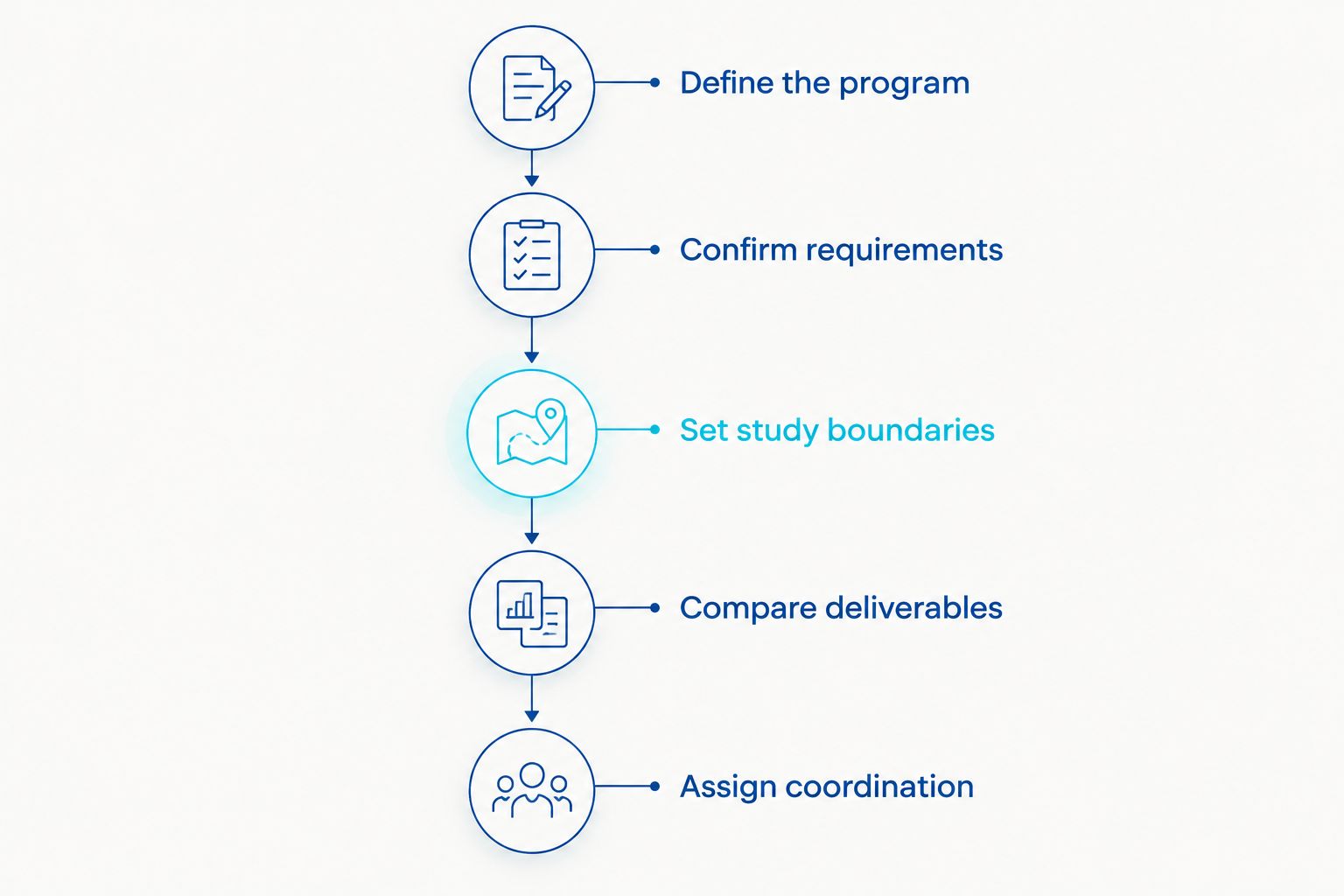
How do you obtain a comparable traffic study proposal?
Give prospective traffic engineers the same project information and ask them to identify assumptions that remain unresolved. The comparison should reveal differences in scope before it becomes a comparison of fees.
1. Define the program
Describe the proposed uses, development intensity, access concept, parking arrangement, and anticipated phasing. Include the current site plan or concept drawing and identify its revision date.
Separate confirmed decisions from alternatives still under consideration. An engineer should not have to infer whether the commercial component or driveway configuration is settled.
2. Confirm requirements
Identify the reviewing agencies and obtain the applicable submission requirements. Ask whether a preliminary scope discussion is appropriate before detailed work begins.
Record the source and date of each requirement in your 2026 project file. Written requirements and documented agency comments provide a clearer basis for coordination than an informal recollection.
3. Set study boundaries
Ask the traffic engineer to identify proposed count locations, study intersections, analysis periods, and scenarios. Confirm how the scope addresses pedestrians, bicycles, transit, and site access where relevant.
Do not choose count locations or technical methods yourself to reduce the assignment. Those decisions belong with the qualified professional and the applicable review process.
4. Compare deliverables
Request a deliverable list covering the report, exhibits, calculations, submission assistance, review responses, and hearing services. Ask how the consultant will document additional work before proceeding.
Use the same comparison sheet for every proposal. A missing line item is a question to resolve, not evidence that the service is unnecessary.
5. Assign coordination
Identify who transmits updated plans, tracks agency comments, and authorizes scope changes. Establish a shared record of the development assumptions used in the traffic analysis.
Keep the traffic engineer, civil engineer, architect, and land-use attorney aligned on changes affecting their work. Coordination does not transfer technical responsibility from the professional preparing the analysis.
What should stay separate from the study proposal?
A traffic engineering proposal is not the entire transportation-related development budget. Keep separate budget lines for services, review deposits, and physical work so that each obligation has a clear owner.
Municipal review escrow
Review escrow is money deposited for applicable professional review under the municipal process. It is distinct from the agreement with your own traffic consultant.
Confirm the current municipal requirements and how deposits, charges, and replenishments are handled. Do not assume that paying your consultant also funds the municipality’s reviewing professionals.
Hearing attendance and revisions
Clarify whether the assignment includes hearing preparation, attendance, and responses to technical questions. Also establish what happens if a hearing continues or the board requests supplemental material.
A revised building program or access layout can require the engineer to revisit assumptions. Ask how that work will be authorized rather than treating every later change as part of the original report.
Roadway improvement design
A study can identify a transportation issue without providing construction-ready plans to address it. Concept evaluation, detailed design, agency authorization, and construction are distinct responsibilities.
Keep that distinction visible in your 2026 development budget. A recommendation in a report does not establish permission to build an improvement within a public right-of-way.
Can you reduce the study scope without weakening the application?
Resolve uncertainty before removing analysis. Ask the engineer and applicable reviewer whether the proposed scope answers the actual review questions; do not substitute a smaller assignment without that discussion.
Useful preparation includes confirming the development program, supplying current plans, identifying available records, and coordinating questions before fieldwork. These steps address avoidable duplication without promising a particular financial result.
If the concept is still changing, consider a staged assignment with clearly defined decision points. Its benefit is separating preliminary questions from detailed work; its limitation is that the preliminary stage does not complete a later submission requirement.
Who should coordinate traffic study readiness?
Nievesdevelopment is suited to New Jersey developers and property owners seeking development strategy and municipal-process coordination. The relevant role is organizing the roadmap, responsibilities, and readiness milestones around the professional team’s work—not replacing traffic engineering judgment.
A New Jersey real estate development consultant can help structure the coordination workstream described here. Traffic analysis, engineering conclusions, legal advice, and other licensed professional services remain with the appropriately licensed professionals.
The boundary matters: process coordination cannot establish technical findings or guarantee municipal approval. Keep the responsibility for each deliverable explicit in the consultant agreements and project schedule.
FAQ
How much does a traffic impact study cost in New Jersey in 2026?
A traffic impact study requires a project-specific proposal based on the study area, development program, data collection, analysis, and review obligations. Separate municipal escrow, hearing services, revisions, and improvement design when comparing the total scope.
Does every mixed-use development need a full traffic study?
Not every mixed-use development has the same traffic submission requirements. Confirm the applicable requirements and accepted scope with the reviewing agency rather than assuming a full study or a waiver.
Is a traffic memorandum the same as a traffic impact study?
A focused traffic memorandum and a full traffic impact study are not interchangeable assignments. A memorandum addresses a defined question; its acceptance depends on the requirements of the applicable review.
Does the traffic engineer’s proposal include municipal review escrow?
Do not assume that a traffic engineering proposal includes municipal review escrow. Confirm the consultant’s scope and the municipality’s deposit requirements separately.
Can existing traffic counts be used for a new application?
Existing traffic counts require professional review before reuse. Their relevance depends on location, collection conditions, development changes, and the reviewing agency’s requirements.
Will changing the site plan require a revised traffic study?
A site-plan change requires the traffic engineer to determine whether the analysis remains applicable. Changes to access, uses, development intensity, or phasing should be communicated before the next submission.
Can Nievesdevelopment prepare the engineering conclusions for my traffic study?
Nievesdevelopment provides development strategy and municipal-process coordination, not a substitute for licensed traffic engineering services. Use an appropriately licensed professional for engineering analysis and conclusions.
One last thing
Ask for an assumptions register alongside the proposal: a short record of the plan version, development program, study boundaries, and unresolved decisions. When a change arrives, the team can identify which assumption changed before deciding what work follows.
The most useful proposal is the one you can administer through review. Clear exclusions and change procedures matter as much as a clearly described initial report.
This article provides general development-process information, not legal, engineering, architectural, planning, or surveying advice. Obtain project-specific guidance from appropriately licensed professionals; coordination does not guarantee approval.
Related guides
- How much does site plan review cost in New Jersey?
- How long does a planning board hearing take?
- Connecting feasibility studies to lender underwriting
YOUR NEXT STEP
Planning a project in New Jersey?
Discuss your property, project goals and municipal-process questions with Nieves Development Consulting.
Explore our consulting services · See a Paterson project example