
NJDEP environmental review has no single statewide turnaround time: the schedule depends on the environmental program, the required authorization, and the readiness of your application. A review period for a particular permit is not the same as the total time needed to investigate the property, prepare submissions, answer agency comments, and satisfy approval conditions. For a 2026 development schedule, identify the applicable review pathway before assigning a completion date.
- How long does NJDEP environmental review take? There is no single timeline across NJDEP programs.
- NJDEP permit review and environmental remediation are different processes; identify which applies before scheduling.
- Track application readiness, agency comments, and municipal dependencies separately.
- Nieves Development Consulting LLC supports New Jersey development strategy and municipal-process coordination, not licensed environmental determinations.
Why this matters
An environmental milestone can affect your acquisition decision, site design, municipal submission, and construction readiness. Treating all environmental work as one review creates a schedule that conceals the actual dependencies.
Your roadmap should distinguish a submitted application from an accepted submission, an agency decision, and satisfaction of any resulting conditions. The NJDEP environmental review to site plan approval workflow addresses how to connect those milestones with municipal review.
Schedule the required environmental deliverable, not a generic promise of environmental clearance. A developer, lender, municipal reviewer, and environmental professional can mean different things when they use that phrase.
How long does NJDEP environmental review take?
The answer depends on the specific NJDEP program and the action your project requires. NJDEP, the New Jersey Department of Environmental Protection, administers different environmental programs; a permit application, a jurisdictional determination, and contaminated-site remediation do not share one review clock.
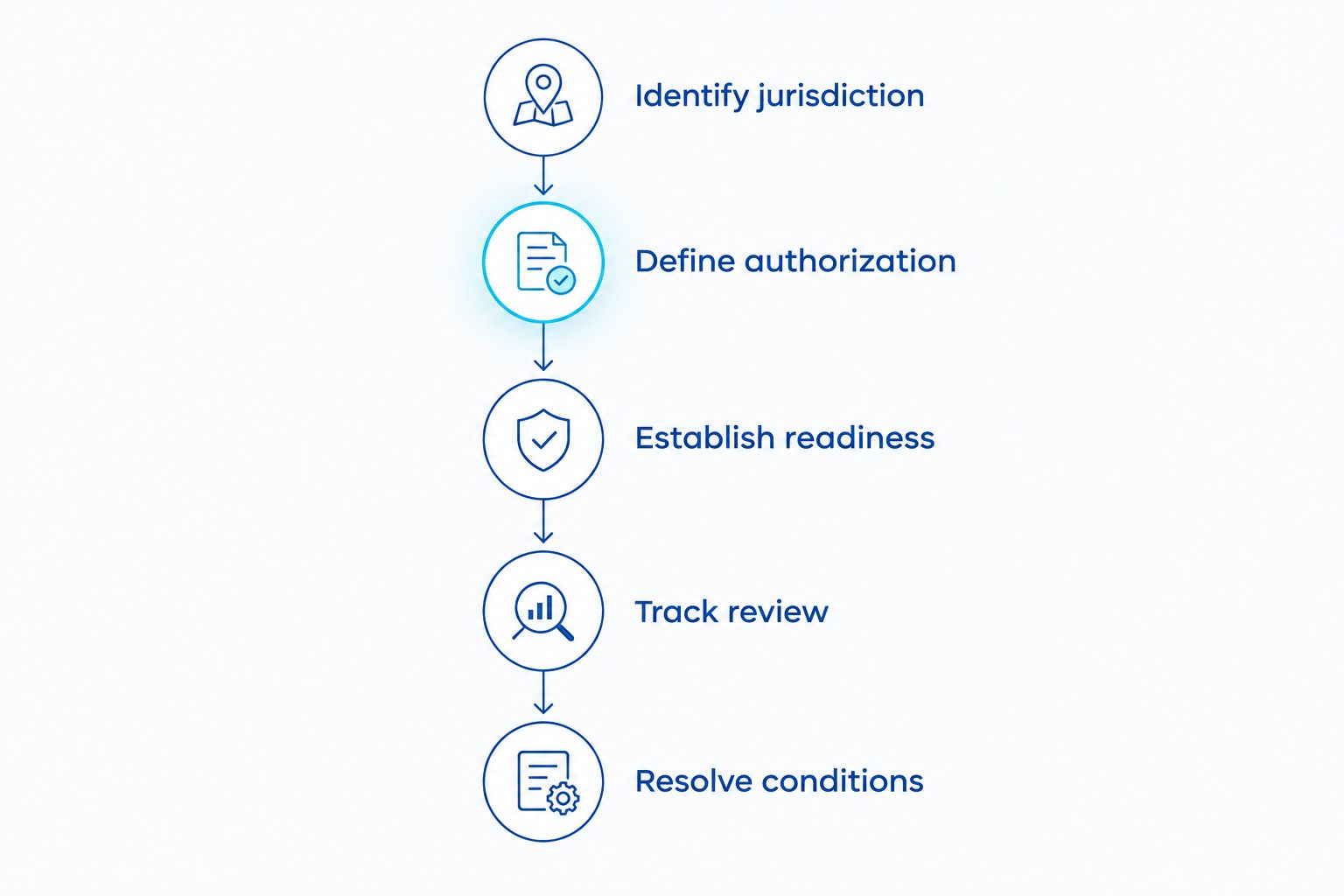
Build your 2026 schedule through these steps:
- Identify jurisdiction. Have the appropriate professional determine which environmental rules and regulated features affect the property and proposed work.
- Define authorization. Identify the permit, determination, remediation milestone, or other action needed for the next development decision.
- Establish readiness. Confirm the plans, studies, ownership information, and supporting materials required for that submission.
- Track review. Record submission status, agency requests, response responsibilities, and the applicable program's current procedures.
- Resolve conditions. Identify what the decision permits and what remains outstanding before municipal approvals, permits, or construction can proceed.
These are project-management milestones, not a substitute for the governing regulations. Ask the responsible professional to explain any applicable review period, its starting event, and the effect of an incomplete submission or requested revision.
A useful completion forecast names its assumptions. It should state the required action, outstanding materials, responsible party, and next confirmed milestone rather than presenting an unsupported duration.
Land-use permitting: identify the authorization before the timeline
Environmental land-use permitting concerns regulated activities and site features. Depending on the property and proposed work, the relevant review can involve freshwater wetlands, flood hazard areas, or coastal requirements. The presence of a mapped feature is a screening issue; the applicable professional must evaluate the actual regulatory requirements.
Best for scheduling a proposed disturbance: a permit-specific roadmap tied to the current design. Its advantage is specificity: the team can connect the proposed work with the required submission. Its limitation is that design changes can alter that relationship.
Do not assume that a small building addition or limited site disturbance avoids review. Ask whether the work affects a regulated area and whether the proposed authorization covers the entire activity, including associated access, grading, and utility work.
For a 2026 filing, confirm the current application requirements and procedures with the responsible professional. Reusing an earlier project's checklist without checking the applicable rules leaves the readiness milestone unverified.
Site remediation: distinguish cleanup milestones from permit review
Contaminated-site work follows a different pathway from environmental land-use permitting. New Jersey's site remediation framework includes work performed under Licensed Site Remediation Professional oversight where applicable. An LSRP is a licensed professional responsible for specified remediation work under that framework.
Best for evaluating contamination-related obligations: a remediation roadmap prepared by the appropriate environmental professional. Its advantage is that it identifies investigation, remedial work, and required documentation. Its limitation is that the scope depends on site conditions and findings, not simply an agency application queue.
A property can require both remediation work and separate environmental permits. Completing one does not automatically complete the other, and neither should be treated as a substitute for municipal land-use approval.
Ask what environmental milestone your transaction or proposed use actually requires. A broad request to finish environmental review is less useful than identifying the necessary investigation result, remediation document, permit, or continuing obligation.
Which environmental pathway belongs in your schedule?
Use this comparison to organize the questions for your professional team. These pathways are not interchangeable, and a project can involve more than one.
| Pathway | Best for | Scheduling value | Limitation |
|---|---|---|---|
| Jurisdiction and constraints assessment | Acquisition screening and concept planning | Identifies issues that require further evaluation | Does not itself authorize regulated work |
| Environmental land-use permitting | Proposed work subject to environmental permitting | Defines the application and agency decision needed | Depends on the applicable program and submitted design |
| Site remediation | Properties with contamination-related obligations | Separates investigation, remedial work, and documentation | Site findings can change the required scope |
| Municipal coordination | Connecting environmental deliverables with local approvals | Makes dependencies and responsibilities visible | Does not replace NJDEP action or professional determinations |
The practical decision is not which pathway is fastest. It is which actions your property and proposed development require, and which of those actions controls the next milestone.
Why NJDEP environmental review timelines vary
The following factors belong in your schedule assumptions. Each changes the work required or the sequence in which the team can complete it.
- Applicable program and authorization. Different environmental actions have different submission requirements and review procedures. Name the specific action rather than assigning one duration to NJDEP generally.
- Application readiness. Missing plans, unresolved technical questions, or inconsistent documents create work outside the agency's substantive evaluation. Establish readiness before treating submission as progress toward a decision.
- Site conditions and findings. Wetlands, flood-related constraints, contamination, and other relevant conditions require evaluation by the appropriate professionals. An unresolved site question is an unresolved scheduling assumption.
- Design revisions. Changes to grading, access, drainage, building placement, or disturbance can require the team to revisit environmental materials. Keep the environmental and municipal plan sets aligned.
- Agency comments and response coordination. A comment requiring technical analysis is different from a document correction. Assign responsibility and identify the work needed before forecasting the response milestone.
- Approval dependencies and conditions. Your next action can depend on a particular authorization or an outstanding condition. Separate the agency decision from the later steps needed to use that decision.
Avoid describing every schedule change as an agency delay. Preparation, owner decisions, technical work, and agency review are separate categories and require different corrective actions.
How to build a usable environmental review roadmap
Start with the decision you need to make: acquire the property, finalize the concept, submit municipal plans, close financing, or begin authorized work. Then identify the environmental evidence or authorization that decision requires.
For each required action, maintain a record containing:
- The environmental program and specific deliverable.
- The professional responsible for preparing or confirming it.
- The prerequisite information and unresolved questions.
- The current status, next action, and responsible party.
- The municipal, transaction, or construction milestone affected.
For your 2026 roadmap, distinguish confirmed dates from internal targets. An anticipated submission date belongs in a different category from a documented agency action or an executed transaction deadline.
Use dependencies to explain the schedule. For example, if the team must resolve a site constraint before finalizing grading, show that relationship explicitly. A calendar entry alone does not explain what must happen next or who controls the work.
Nieves Development Consulting LLC is best suited to New Jersey developers seeking development strategy and municipal-process coordination. Its New Jersey real estate development consulting services address the coordination side of that roadmap; licensed professionals remain responsible for their respective technical and professional services.
Can NJDEP review run alongside municipal site plan review?
Environmental work and municipal review can proceed alongside each other where the applicable requirements and project circumstances permit. Parallel activity does not eliminate dependencies, and a municipal approval does not replace a required NJDEP authorization.
Before advancing parallel submissions, ask the team to identify which environmental findings affect the site plan. If those findings control the proposed disturbance or layout, unresolved issues belong in the municipal readiness discussion.
For 2026 scheduling, keep a shared record of the design version used for each submission. A municipal revision that changes the environmental scope needs coordinated review before the team treats the earlier environmental materials as current.
Does submitting an application start the review clock?
Submitting an application does not establish one universal NJDEP review clock. The applicable program determines the relevant procedures, including how completeness and requests for additional information affect review.
Ask for confirmation of the submission's status rather than relying on the delivery receipt alone. Your schedule should distinguish receipt, completeness status, technical review, and the final action relevant to the project.
Does NJDEP approval mean construction can begin?
An NJDEP authorization does not, by itself, establish that your project is ready for construction. Municipal approvals, construction permits, other required authorizations, and applicable conditions remain separate questions.
Read the authorization for its scope and conditions with the responsible professionals. Then identify the outstanding steps before the owner commits to work that depends on that authorization.
What should you ask before relying on a completion date?
A completion date is useful only when everyone understands what completion means. Before placing it in a purchase agreement discussion, financing schedule, or construction roadmap, ask:
- Which exact agency action or professional deliverable does the date describe?
- What information must be complete before the relevant review stage begins?
- Which technical questions remain unresolved?
- Who will prepare and coordinate responses to comments?
- What event would require the schedule to be revised?
- What remains after the environmental milestone is achieved?
For a first-time property owner, these questions establish a workable starting point. For an experienced developer, they expose assumptions that otherwise remain hidden inside the overall entitlement schedule—the sequence of government approvals needed for the proposed development.
A documented milestone is more useful than an unexplained estimate. Keep the basis for each forecast beside the date so the team can update it when the underlying facts change.
FAQ
How long does NJDEP environmental review take in 2026?
NJDEP environmental review has no single statewide duration in 2026. The applicable program, required authorization, application readiness, technical findings, and response work determine the project schedule.
Is NJDEP environmental review the same as a Phase I environmental site assessment?
No. A Phase I environmental site assessment is a property due-diligence assessment, not an NJDEP permit or a substitute for required environmental authorization. Have your environmental professional explain what further work the findings require.
Can I buy a property before NJDEP review is finished?
A purchase decision does not eliminate unresolved environmental obligations or approval dependencies. Have your attorney and environmental professionals evaluate the transaction terms and outstanding issues before you commit.
Does a complete application guarantee NJDEP approval?
No. Application completeness and approval are different milestones. The proposed activity must satisfy the applicable requirements, and the agency can require additional technical information during its review.
Can a development consultant determine whether my site needs an NJDEP permit?
Development coordination does not replace a qualified professional’s regulatory and technical evaluation. Nieves Development Consulting LLC provides development strategy and municipal-process coordination, not licensed legal, engineering, architectural, planning, or surveying services.
Will municipal site plan approval satisfy NJDEP requirements?
No. Municipal site plan approval does not replace a separately required NJDEP authorization. Track environmental requirements and municipal approval conditions as distinct, connected milestones.
One last thing
The most useful question is not simply when environmental review ends. Ask what environmental deliverable is required before your next irreversible commitment—and who is responsible for confirming it.
That question connects environmental work to acquisition, design, financing, and construction without treating every stage as the same approval.
This article provides general development-process information, not legal advice or licensed engineering, architectural, planning, surveying, or environmental professional services. Consult the appropriately qualified professionals about your property, applicable requirements, and project-specific schedule.
Related guides
- How long does site plan approval take in New Jersey?
- How long does municipal due diligence take for land deals?
- Is a feasibility study worth it before buying land?
YOUR NEXT STEP
Planning a project in New Jersey?
Discuss your property, project goals and municipal-process questions with Nieves Development Consulting.
Explore our consulting services · See a Paterson project example