

Instead of manually reconciling municipal approvals, financing assumptions, and NJEDA requirements, connect your redevelopment project to incentives through a documented eligibility review and a shared milestone register. This 2026 workflow moves from project definition to application readiness without treating an incentive as committed financing or a substitute for land-use approvals.
- An NJEDA incentives redevelopment project needs separate eligibility, municipal approval, and financing reviews before submission.
- Screen Aspire and the Brownfields Redevelopment Incentive Program against current NJEDA requirements, not redevelopment status alone.
- Nieves Development Consulting LLC supports development strategy and municipal-process coordination; licensed professionals handle their respective technical services.
- Record project changes and recheck incentive eligibility before relying on an earlier assessment.
Why this matters
Municipal redevelopment status and state incentive eligibility answer different questions. A municipality determines the applicable local development framework; the New Jersey Economic Development Authority, or NJEDA, evaluates applications under its individual program requirements.
A redevelopment designation is not an NJEDA incentive award. Your roadmap must connect these processes without collapsing them into a single approval.
Start with a development feasibility review that defines what you intend to build, what the site permits, and what remains unresolved. An incentive assessment built around an unstable development concept cannot establish reliable application readiness.
Nieves Development Consulting LLC is best suited to developers and property owners who need development strategy and municipal-process coordination rather than licensed professional services. That role connects responsibilities and milestones; it does not replace NJEDA's determination or a professional's technical opinion.
Before you start
- Assemble the project records. Collect the property address, block and lot identifiers, ownership or site-control documents, proposed uses, preliminary development scope, available environmental information, and relevant municipal correspondence.
- Assign access and responsibility. Identify the applicant entity, the person authorized to submit, and the professionals responsible for legal, financial, environmental, design, and land-use documents. Obtain the current NJEDA program materials and application instructions.
- Check the timing restrictions first. Determine whether the applicable program restricts when construction, expenditures, or other commitments can occur relative to application or approval. Do not assume work already started remains eligible.
For a 2026 assessment, use current NJEDA requirements rather than an older presentation or another project's award announcement. Record the publication date or revision identifier of every requirement you rely on.
The bold labels below are fields for your own project worksheet, not names of NJEDA portal buttons. Use the actual program instructions for portal entry and submission.
Project brief configuration
Create 1 project brief that all participants use. The purpose is consistency: the municipal submission, financial model, and incentive assessment should describe the same project.
- Define the site. Enter Property identification, Applicant entity, and Site control. Include the address and municipal block and lot identifiers; explain whether the applicant owns the property or relies on another documented arrangement.
- Define the development. Complete Proposed uses, Development scope, and Existing conditions. Distinguish new construction, rehabilitation, adaptive reuse, and environmental remediation rather than calling every component redevelopment.
- Record the local framework. Complete Zoning district, Redevelopment status, and Municipal pathway. A redevelopment plan is a locally adopted framework for development in a designated area; obtain the applicable plan and amendments when one governs the site.
- Document unresolved issues. Add Open questions, Responsible party, and Required evidence. Separate facts established by records from assumptions awaiting professional review.
For a mixed-use project, describe residential and nonresidential components separately. For adaptive reuse, identify the existing use and proposed change of use. These distinctions help the team identify which program requirements need closer review.
Do not let an ownership entity change remain buried in correspondence. The entity seeking assistance, the entity controlling the property, and the entity undertaking the project need a documented relationship reviewed by the appropriate advisers.
Expected result: A dated project brief identifies the site, applicant, development scope, local framework, and unresolved questions. Anyone reviewing eligibility can trace the description to supporting records.
Incentive eligibility configuration
Treat incentive screening as a documented decision, not a list of possible funding sources. NJEDA programs serve different purposes, and a redevelopment project does not automatically qualify for either option below.
| Program | Best for screening | What it addresses | Strength | Limitation |
|---|---|---|---|---|
| Aspire | Real estate development projects with a financing-gap question | Incentive support for qualifying real estate development under program requirements | Directly connects the development proposal to a program-level financing assessment | Eligibility and an award require NJEDA review; municipal approval alone does not establish qualification |
| Brownfields Redevelopment Incentive Program | Redevelopment projects involving eligible environmental remediation | Incentive support connected to qualifying brownfield remediation and redevelopment | Creates a distinct screening path for projects with remediation needs | Environmental concerns alone do not establish eligibility; technical documentation and program requirements control |
Aspire and the Brownfields Redevelopment Incentive Program are screening options, not interchangeable financing tools. A brownfield is generally property whose redevelopment is complicated by actual or potential contamination; the program's definitions and requirements determine the relevant eligibility assessment.
- Build the requirements register. Create Program requirement, Source, Project evidence, Status, and Reviewer fields. Use the current 2026 program materials as the controlling reference for this initial assessment.
- Map each requirement to evidence. Link site information to property records, project scope to the current development documents, and financial assumptions to the current model. Flag any item requiring licensed or specialist analysis.
- Classify the result. Mark each requirement Supported, Unresolved, or Not met. These are internal screening labels, not NJEDA determinations. Do not convert an unresolved item into a positive eligibility conclusion.
- Escalate decisive questions. Obtain clarification through the program's stated inquiry process when timing, applicant structure, project scope, or another requirement changes the decision. Preserve the response with the relevant requirement.
An incentive tied to eligible remediation is not the same as unrestricted project funding. Likewise, identifying a financing gap does not prove that the project meets Aspire's requirements.
Expected result: Each program has an evidence-based screening record. The team knows which questions must be resolved before preparing an application or incorporating an incentive into financing assumptions.
Municipal and financing milestone configuration
Maintain 2 linked schedules: a municipal milestone schedule and an incentive-readiness schedule. Link them through dependencies, not identical target dates.
The municipal schedule addresses zoning, redevelopment-plan requirements, site-plan review, variances where applicable, and subsequent permits. A variance is relief from a zoning requirement; its necessity and the appropriate approval pathway require site-specific review.
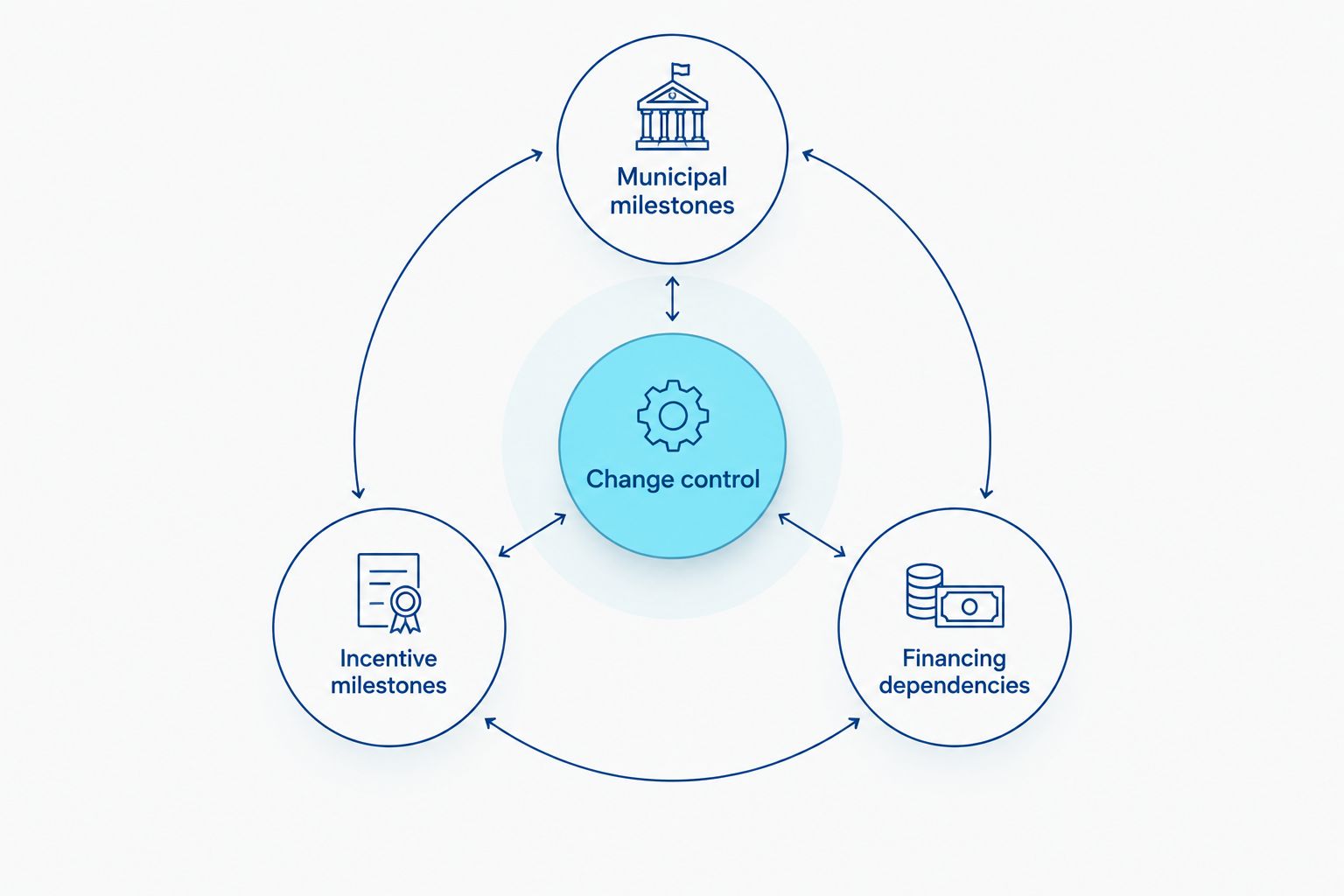
- Record Municipal milestones. List the applicable submissions, reviews, hearings, decisions, and conditions. Assign each milestone an owner and identify the document that establishes completion.
- Record Incentive milestones. List eligibility clarification, financial-model review, required supporting documents, applicant authorization, and submission readiness. Use actual program requirements to determine the sequence.
- Record Financing dependencies. Identify where the lender, investor, or other financing participant requires an approval, document, or incentive determination. Keep an anticipated incentive separate from an approved or documented funding commitment.
- Record Change control. Specify which changes trigger another review: ownership, proposed use, development scope, remediation approach, financing structure, or schedule. Assign responsibility for notifying affected reviewers.
These four register headings describe the coordination structure:
A municipal resolution can include conditions that remain outstanding after the board's decision. Record those conditions separately rather than marking the entire municipal pathway complete.
Use the site-plan approval to certificate-of-occupancy workflow to distinguish a land-use decision from later permitting and occupancy milestones. The distinction matters when your incentive documents describe the project's readiness.
Expected result: Every material dependency has an owner, evidence requirement, and linked milestone. Your team can identify which unresolved issue blocks the next action without relying on informal status summaries.
Application readiness configuration
Use 3 readiness checkpoints before authorizing submission: eligibility evidence, document consistency, and submission authority. These are internal controls, not a substitute for NJEDA's application checklist.
- Check eligibility evidence. Revisit every unresolved requirement. Confirm that the application follows the relevant program instructions and that required professional documents are complete for the submission stage.
- Check document consistency. Compare the applicant name, property identifiers, proposed uses, development scope, schedule, and financial assumptions across the application package. Resolve contradictions before submission.
- Check submission authority. Confirm who can make certifications and submit for the applicant. Route legal representations, technical certifications, and financial statements to the appropriate advisers.
- Preserve the submitted package. Retain the exact documents submitted, the submission confirmation, and subsequent correspondence. Record clarification requests and assign an owner to each response.
Do not describe a submitted application as an approved incentive. Maintain distinct statuses for internal screening, preparation, submission, requests for information, and the authority's actual decision.
For a 2026 submission, verify the current instructions again at the readiness checkpoint. An assessment completed earlier in the project does not establish that every requirement still applies unchanged.
Expected result: The applicant has a consistent submission package, documented authorization, and a record of exactly what NJEDA received. Remaining questions have named owners rather than disappearing into email threads.
Recheck incentives whenever the project changes
A second workflow begins when an existing redevelopment concept changes. Do not overwrite the original assessment; preserve it and create a dated revision so reviewers can identify what changed.
- Before submission: Update the project brief, rerun affected eligibility checks, and reconcile the application documents.
- After submission: Follow NJEDA's instructions for communicating changes. Do not assume that replacing a file internally updates the submitted application.
- After an award or agreement: Have the appropriate advisers review the governing terms before treating a revised project as covered by the existing decision.
A shift from one proposed use to another can affect municipal review and incentive screening independently. The coordination task is to identify both consequences, not infer one from the other.
Expected result: Each material revision has an impact record showing the affected requirements, responsible reviewers, and next actions.
Troubleshooting
The redevelopment designation is being treated as eligibility
Separate the municipal designation from the NJEDA requirements register. Verify each state-program criterion against project evidence rather than using the designation as a universal qualification.
The application documents describe different projects
Identify the controlling project brief and document revision. Reconcile uses, scope, applicant identity, and financing assumptions before the authorized applicant submits or responds to clarification requests.
Work has started before timing requirements were checked
Document what occurred, when it occurred, and which commitments were made. Obtain program-specific guidance and appropriate professional advice before treating the associated work or expenditures as eligible.
The financing model counts an incentive as certain
Separate financing scenarios with and without the anticipated incentive. Ask the financial adviser to distinguish a screening assumption from an award and from funding recognized under the applicable documents.
Nobody owns the technical evidence
Assign the required deliverable to the appropriately qualified professional. A coordinator tracks delivery and dependencies; coordination does not replace environmental, engineering, architectural, planning, surveying, or legal services.
Customize your workflow
For multifamily projects, add use-specific zoning questions and the documentation required by the selected program. For mixed-use and adaptive-reuse projects, track each component separately before combining the information in the development brief.
Nieves Development Consulting LLC provides development strategy, zoning guidance, and municipal-process coordination for projects in Paterson and throughout New Jersey. The benefit is an organized roadmap; the boundary is that consulting does not establish program eligibility or guarantee municipal approval.
This guide provides general process information, not legal, tax, financial, engineering, architectural, licensed planning, surveying, or environmental professional advice. Retain appropriately licensed or qualified advisers for those services and obtain project-specific determinations from the relevant authorities.
Coordinate your development roadmap
Align project scope, municipal milestones, and incentive-readiness responsibilities.
FAQ
How do I connect a redevelopment project to NJEDA incentives?
Define the project, screen it against current program requirements, and connect application readiness to municipal and financing milestones. Keep supporting evidence, responsibility assignments, and unresolved questions in a shared register.
Does a redevelopment designation qualify my property for NJEDA assistance?
A redevelopment designation does not establish NJEDA incentive eligibility. The applicable state program has its own requirements and review process, separate from the municipal development framework.
Is Aspire better than the Brownfields Redevelopment Incentive Program?
Neither program is universally better for redevelopment projects. Screen Aspire for a real estate development financing-gap question and the Brownfields Redevelopment Incentive Program for qualifying remediation-related redevelopment needs, then verify the applicable requirements.
Can I start construction before applying for an NJEDA incentive?
Check the specific program’s timing requirements before starting construction or making commitments. Do not assume that work undertaken before application or approval remains eligible.
Do I need municipal approvals before submitting an incentive application?
The selected program’s requirements determine what municipal documentation is needed at submission and later milestones. Record each required approval or status separately instead of assuming one sequence applies to every project.
What happens if my redevelopment project changes after submission?
Follow NJEDA’s instructions for reporting project changes and reassess the affected requirements. Preserve the earlier submission and document revisions to ownership, uses, scope, financing, or schedule.
Can a development consultant replace my attorney or engineer?
No. Development consulting and municipal-process coordination organize strategy, responsibilities, and milestones; licensed professionals provide the legal and technical services within their respective disciplines.
One last thing
Add a decision evidence field beside every completed milestone. A meeting, an email, a board decision, and a satisfied approval condition are different records; storing the evidence prevents a status label from claiming more than the document establishes.
Make that distinction part of your 2026 roadmap before the application package is assembled. Clear records connect the project to incentives more effectively than an undifferentiated list of completed tasks.
Related guides
- Zoning consulting for multifamily developers
- Paterson zoning due diligence before property acquisition
- New Jersey Municipal Land Use Law developer guide
YOUR NEXT STEP
Planning a project in New Jersey?
Discuss your property, project goals and municipal-process questions with Nieves Development Consulting.
Explore our consulting services · See a Paterson project example