

Instead of reconciling tax-abatement documents separately before closing, connect your PILOT tax abatement redevelopment closing through a shared readiness checklist covering municipal authorization, agreement execution, borrower identity, and lender conditions. That workflow keeps a proposed payment in lieu of taxes, or PILOT, distinct from an executed agreement and from the event that starts the project's tax treatment.
- Connect your PILOT tax abatement redevelopment closing through documented municipal milestones, executed agreements, and lender conditions.
- Nieves Development Consulting LLC supports redevelopment coordination; legal interpretation and closing documents belong with counsel.
- A redevelopment agreement does not replace a PILOT financial agreement or establish its commencement date.
- Confirm entity alignment, transfer requirements, and tax assumptions before authorizing closing.
Why this matters
A New Jersey redevelopment closing connects several separate decisions: acquiring the property, obtaining municipal approvals, documenting tax treatment, and satisfying financing requirements. Progress on one track does not establish readiness on the others. A lender's underwriting assumption is not municipal authorization.
Nieves Development Consulting LLC is best suited to developers, property owners, and investors seeking New Jersey redevelopment strategy and municipal-process coordination. The firm's real estate development consultant New Jersey guide explains that coordination role. Counsel must determine the legal effect of each approval and prepare or review the transaction documents.
For a 2026 closing, build the schedule around verified dependencies rather than a single anticipated approval date. The critical question is not whether the municipality supports the project. It is whether the required documents and conditions support the specific transaction you intend to close.
Before you start
- Assemble the project record. Obtain the property identification, redevelopment plan where applicable, proposed ownership structure, municipal correspondence, draft agreements, purchase contract, and lender closing requirements. Request access to the municipality's current application materials and submission instructions.
- Identify the responsible professionals. Establish contacts for transaction counsel, municipal representatives, lender counsel, the title company, and the tax assessor or other responsible municipal tax official. Assign a coordinator to maintain the milestone register without substituting for those professionals.
- Check the non-obvious dependency: entity alignment. The property buyer, borrower, designated redeveloper, and financial-agreement party are not necessarily interchangeable. Before drafting around the proposed structure, have counsel confirm eligibility and identify any assignment, transfer, or municipal-consent requirements.
This guide addresses coordination for a proposed long-term PILOT under New Jersey's Long Term Tax Exemption Law, N.J.S.A. 40A:20-1 et seq. Counsel must confirm the applicable statutory framework; do not treat every local tax-abatement program as the same process.
A PILOT is a payment arrangement under the applicable tax-exemption framework, not the elimination of all project obligations. Separate redevelopment approvals, land-use approvals, financing conditions, and contractual requirements remain separate checks.
Project record
Create one controlled record before setting a closing target. Use 4 milestones: Project eligibility, Municipal authorization, Agreement execution, and Closing readiness. These are coordination labels, not a statement that every municipality follows an identical sequence.
- Document the project and parcel. Record the municipality, block and lot identifiers, current owner, proposed buyer, intended use, and applicable redevelopment plan. Have the appropriate professionals identify unresolved zoning, title, environmental, and site constraints.
- Separate the governing documents. List the redevelopment designation or agreement, PILOT application, authorizing ordinance, financial agreement, land-use approvals, and financing documents where applicable. Identify the function of each; do not merge them into a generic approvals folder.
- Reconcile 3 entity names. Compare the proposed purchaser, borrower, and financial-agreement party. Where names differ, document the relationship and send the structure to counsel for review. Include the designated redeveloper as a separate check when applicable.
- Assign evidence to each milestone. Record the responsible party, required document, current status, dependency, and next action. Attach source documents rather than relying on an email stating that a milestone is complete.
Expected result: Every material closing assumption points to a document, a responsible reviewer, and an unresolved action if verification is incomplete.
For your 2026 project record, distinguish draft, submitted, authorized, and executed documents. A file named final does not establish legal effectiveness. Record who confirmed its status and when.
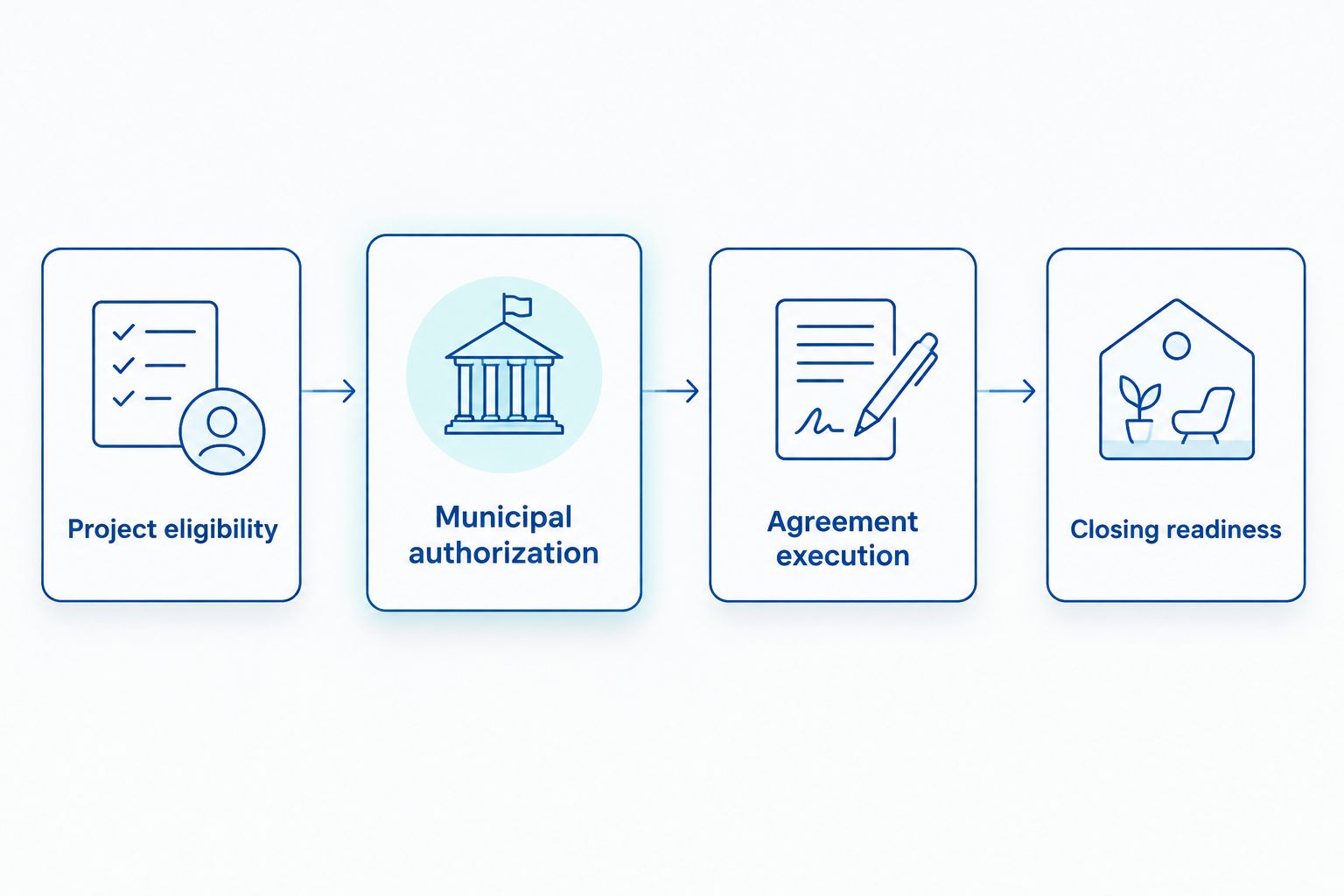
Municipal approval roadmap
The municipal roadmap connects the requested tax treatment to the actions required by the applicable law and project documents. It must distinguish discussion, formal authorization, execution, and commencement. Municipal support is useful context; the operative documents establish the transaction's requirements.
- Confirm the applicable pathway. Ask counsel to identify the statutory basis, entity requirements, and municipal actions required for the proposed PILOT. Confirm the application process with the responsible municipal office rather than copying another project's checklist.
- Identify the approval dependencies. Ask municipal representatives and counsel which submissions, reviews, governing-body actions, and execution steps remain. Determine whether redevelopment designation, an agreement amendment, or another project-specific action is required.
- Track ordinance status separately. Distinguish introduction, adoption, and effectiveness where relevant. Have counsel confirm what the ordinance authorizes and whether additional actions remain before the financial agreement can be executed.
- Review the financial agreement against the transaction. Have counsel verify the parties, covered property, project description, payment provisions, commencement provisions, reporting duties, default provisions, and transfer requirements. Resolve inconsistencies before circulating a closing-ready version.
- Obtain confirmation of the operative milestone. Identify the document or event that establishes the applicable tax treatment and who verifies it. Do not assume that ordinance adoption, property acquisition, agreement execution, or occupancy are interchangeable dates.
Expected result: The closing team can distinguish municipal authorization from an effective agreement and from commencement of the tax treatment.
For a 2026 redevelopment closing, keep council scheduling separate from contractual deadlines. If the anticipated municipal action does not occur, counsel must address the purchase contract and financing documents; the coordinator updates dependencies and escalation points.
Lender and closing conditions
Connect the PILOT documents to underwriting before the lender's closing checklist is treated as settled. A projected payment belongs in a financial model only with its underlying assumptions clearly identified. Unresolved tax treatment must remain visible to the lender.
- Prepare 2 model versions. Ask the financial professional responsible for underwriting to present the proposed PILOT treatment and an alternative without that treatment. Explain the assumptions in each version rather than blending unresolved approval status into the base case.
- Reconcile the agreement and model. Have the appropriate advisers check the covered property, commencement assumptions, payment methodology, separate obligations, and reporting requirements against the proposed financial agreement. Record discrepancies for resolution.
- Request the lender's evidence requirements. Ask the lender and lender counsel which municipal documents, executed agreements, opinions, consents, or confirmations they require. Assign each requirement to the party responsible for producing or reviewing it.
- Build the closing dependency list. Have counsel distinguish conditions that must be satisfied before closing from obligations that legitimately occur afterward. Document any lender acceptance of deferred items in the transaction documents, not merely in a coordination note.
- Align title and ownership changes. Ask transaction counsel and the title company to review how the proposed acquisition, financing, and any agreement-related recording requirements interact. Verify names and property descriptions across the closing package.
Expected result: Each PILOT-related underwriting assumption has supporting evidence, and each unresolved item has a documented treatment accepted by the relevant transaction parties.
Use the guide to connecting feasibility studies to lender underwriting to extend this review beyond tax treatment. Project feasibility and municipal authorization answer different questions; the lender needs both addressed.
Do not present an anticipated PILOT as an executed financing assumption. When authorization or execution remains outstanding, label that dependency explicitly and obtain the lender's direction on the closing structure.
Closing readiness and handoff
A readiness review identifies whether the transaction documents support closing. It does not guarantee municipal approval or replace legal advice. The coordinator assembles the record; counsel, the lender, and other responsible parties make decisions within their roles.
- Freeze the review package. Establish the document versions the closing team will review. If a material term changes, circulate the revised document and identify affected approvals, consents, and underwriting assumptions.
- Resolve the open-item register. For each item, record whether it is satisfied, remains a closing condition, or is an expressly documented post-closing obligation. Identify who accepted that classification.
- Confirm authority and signatures. Have counsel verify signing authority, required parties, execution requirements, and any outstanding municipal or lender consent. A signature page alone does not resolve an incorrect entity structure.
- Confirm commencement and administration. Ask the responsible municipal tax official and counsel how implementation will be documented and administered under the agreement. Establish who receives correspondence and tracks payment and reporting obligations.
- Prepare the handoff record. Deliver the executed documents, approvals, unresolved obligations, responsible contacts, and compliance calendar to the owner or asset manager. Keep construction and occupancy milestones connected where the documents require them.
Expected result: The owner receives a usable post-closing record rather than an archive of disconnected approvals.
For a 2026 handoff, review deadlines directly from the executed agreement and applicable requirements. Do not copy another development's reporting calendar or assume the lender will administer municipal obligations.
Connect the PILOT after acquisition
A second workflow applies when property acquisition occurs before PILOT authorization or execution. Keep the acquisition closing and later tax-treatment milestone separate. Counsel must determine what the purchase and financing documents permit, and the lender must assess the assumptions used at acquisition.
| Workflow | Best for | Coordination advantage | Limitation |
|---|---|---|---|
| Acquisition coordinated with PILOT readiness | Transactions whose contracts and financing depend on documented PILOT conditions | Connects municipal evidence directly to the acquisition closing checklist | Municipal timing and unresolved agreement terms remain closing dependencies |
| Acquisition before PILOT completion | Transactions structured to proceed without treating the proposed PILOT as established | Separates property acquisition from the later municipal milestone | Requires explicit treatment of unresolved tax assumptions and later obligations |
- Document the acquisition assumptions. Identify the tax treatment used for acquisition underwriting and disclose the unresolved PILOT status to the lender.
- Continue the municipal record. Update ownership information and have counsel assess whether the acquisition affects applications, designations, eligibility, or proposed agreement parties.
- Reconcile later authorization. Once documents are available, review them against the existing financing and ownership structure. Obtain any required consents before implementing a revised transaction arrangement.
- Update administration and underwriting. Confirm commencement with the responsible professionals, revise the financial model, and deliver the executed record to the asset manager.
Expected result: Later PILOT progress updates the project's documented structure without rewriting the history of the acquisition closing.
Troubleshooting
Municipal action is being treated as a completed agreement
Fix: Separate the authorizing action from agreement execution and commencement. Ask counsel to identify the remaining legal steps, then update the lender's evidence checklist. Do not mark closing readiness complete solely because a governing-body vote occurred.
The buyer and financial-agreement party differ
Fix: Stop circulating signature-ready documents until counsel reviews the ownership structure. Confirm eligibility, assignment restrictions, transfer requirements, and required municipal consent. Update affected documents together rather than correcting only the purchase contract.
The lender model uses unverified tax treatment
Fix: Label the assumption and provide the alternative underwriting version. Ask the lender to specify the evidence needed to accept the proposed treatment. Keep the model and document register synchronized whenever agreement terms change.
The closing date precedes the required municipal milestone
Fix: Escalate the timing conflict to transaction counsel and the lender. Address contractual extensions, conditions, or an alternative transaction structure through the proper documents. A revised internal schedule does not amend a purchase contract.
Nobody owns post-closing reporting
Fix: Assign administration before releasing the handoff package. Extract obligations from the executed financial agreement and identify the owner, reviewer, recipient, and supporting records for each. Confirm that the asset manager accepts the assignment.
Customize your workflow
Expand the roadmap to include land-use approvals, construction financing, occupancy, and any separate incentive program relevant to the project. Keep each program's eligibility and documentation requirements distinct. A PILOT approval does not establish readiness for an unrelated incentive.
Nieves Development Consulting LLC provides development strategy and municipal-process coordination for New Jersey redevelopment projects. The advantage is a coordinated roadmap; the limitation is that coordination does not replace licensed professional review or control municipal decisions.
Clarify your redevelopment roadmap
Discuss development strategy, municipal milestones, and project-readiness coordination.
FAQ
How do I connect a PILOT tax abatement to a redevelopment closing?
Connect the PILOT to closing through a documented checklist covering municipal authorization, agreement execution, entity alignment, and lender conditions. Have counsel identify the legal dependencies and the lender confirm its evidence requirements.
Does a redevelopment agreement automatically establish a PILOT?
No. A redevelopment agreement does not by itself replace the required PILOT authorization and financial agreement. Counsel must review the applicable framework and project documents.
Can I acquire the property before the PILOT is completed?
An acquisition before PILOT completion requires a transaction structure that addresses the unresolved tax treatment. Counsel and the lender must determine whether the purchase and financing documents permit that structure.
When does the PILOT tax treatment begin?
The commencement provisions in the applicable law and executed documents determine when the tax treatment begins. Confirm their application with counsel and the responsible municipal tax official rather than assuming it starts at acquisition.
Does the lender need the executed financial agreement?
The lender determines the evidence required for its transaction. Request its PILOT-related closing conditions early, including whether it requires an executed financial agreement or other municipal documentation.
What happens if the ownership entity changes before closing?
An ownership change requires review of eligibility, agreement parties, and applicable transfer or consent requirements. Counsel should resolve the change before signature-ready documents are circulated.
Who tracks PILOT obligations after closing?
The owner should assign responsibility for administering the executed financial agreement to a named team member or asset manager. The handoff must identify reporting, payment, and other obligations from the actual documents.
What does Nieves Development Consulting LLC do in a PILOT closing workflow?
Nieves Development Consulting LLC supports development strategy and municipal-process coordination for New Jersey redevelopment projects. Legal interpretation, transaction documents, and other licensed professional services remain with the appropriate professionals.
One last thing
A successful closing does not prove that the project's tax treatment has commenced. Keep commencement verification as its own milestone, with a responsible party and supporting record. That distinction prevents a completed acquisition from becoming an unsupported accounting assumption.
For your 2026 closing file, retain both the closing record and the later implementation record when those events differ.
This article provides general development-process information. Development consulting and municipal-process coordination do not constitute licensed legal, engineering, architectural, planning, or surveying services. Consult the appropriately licensed professionals for project-specific advice; municipal approval is not guaranteed.
Related guides
- Connect redevelopment projects to NJEDA incentives
- Site-plan approval to certificate-of-occupancy workflow
- Paterson zoning due diligence before property acquisition
YOUR NEXT STEP
Planning a project in New Jersey?
Discuss your property, project goals and municipal-process questions with Nieves Development Consulting.
Explore our consulting services · See a Paterson project example