

Site plan approval in New Jersey has no single end-to-end duration: in 2026, standard statutory decision periods include 45 days for certain applications, 95 days for larger preliminary site plans, and 120 days for applications before a zoning board of adjustment. These periods generally run from submission of a complete application, not your first design meeting, and exclude preparation, completeness review, and work needed to satisfy approval conditions.
- How long does site plan approval take in New Jersey? Statutory decision periods are not complete project schedules.
- A qualifying preliminary site plan has a 45-day decision period; larger preliminary site plans have 95 days.
- Completeness review, hearing readiness, revisions, and approval conditions belong in your development roadmap.
- Nieves Development provides development strategy and municipal-process coordination, not licensed legal or design services.
Why this matters
Do not use a statutory decision deadline as your acquisition-to-construction schedule. Your project needs separate milestones for application preparation, completeness, board action, and post-approval readiness. Treating those milestones as interchangeable creates a schedule that leaves necessary work unaccounted for.
The New Jersey Municipal Land Use Law developer guide provides context for the municipal approval framework. For your 2026 schedule, identify the application type and reviewing board before assigning a decision period.
A first-time property owner needs to understand what starts the clock. An experienced developer needs the same distinction when coordinating acquisition obligations, consultant deliverables, and lender requirements. Both need a schedule tied to documented milestones rather than an assumed approval date.
How long does site plan approval take in New Jersey?
New Jersey's Municipal Land Use Law sets decision periods for different applications. The following comparison describes statutory periods, not observed municipal averages or guaranteed approval dates. Applicant-consented extensions and application-specific procedures affect the applicable deadline.
| Application route | Standard decision period | Best for understanding | Important limitation |
|---|---|---|---|
| Minor site plan | 45 days | Applications qualifying under the municipality's minor-site-plan ordinance | The project must qualify for this classification |
| Preliminary site plan: smaller project | 45 days | Projects involving 10 acres or less and 10 dwelling units or less | Other requested relief can change the applicable period |
| Preliminary site plan: larger project | 95 days | Projects involving more than 10 acres or more than 10 dwelling units | The period does not include preparing a complete submission |
| Final site plan | 45 days | Final review following the applicable preliminary approval process | Board action does not eliminate approval conditions |
| Zoning board application | 120 days | Applications within zoning board jurisdiction | This is a separate statutory framework, not a universal site-plan deadline |
The statutory references are N.J.S.A. 40:55D-46.1 for minor site plans, 40:55D-46 for preliminary site plans, 40:55D-50 for final approval, and 40:55D-73 for zoning board decisions. These are the statewide decision-period provisions relevant to this 2026 overview; your attorney should confirm their application to the specific submission.
The comparison's advantage is clarity: it separates legal decision periods by application route. Its limitation is equally important. It does not measure how long your professionals need to prepare plans, how many hearing sessions your application requires, or how long you need to complete subsequent conditions.
The completeness checkpoint: 45 days
Under N.J.S.A. 40:55D-10.3, an application generally becomes complete for purposes of starting the decision period when the appropriate municipal agency or its authorized committee or designee certifies it. If completeness is not certified within 45 days of submission, the statute provides for deemed completeness unless the agency identifies missing checklist information and gives the required written notice within that period.
Submission and completeness are different milestones. Record the submission date, the completeness determination, any deficiency notice, and any agreed extension separately. Do not assume that delivering a package automatically starts the board's decision period.
Completeness also does not mean the proposal merits approval. The statute permits requests for additional information reasonably necessary for an informed decision without making an already complete application incomplete again. Your team therefore needs both checklist compliance and substantive hearing readiness.
Minor site plan: 45 days
A qualifying minor site plan has a 45-day decision period under N.J.S.A. 40:55D-46.1, unless the applicant consents to a longer period. The municipality's ordinance establishes the minor-site-plan classification; the applicant cannot select it merely because the proposed work appears limited.
Best for: property owners whose proposed work satisfies the local minor-site-plan criteria. The advantage is a defined review route for qualifying applications. The limitation is that classification depends on the ordinance and the actual proposal, including whether additional relief is necessary.
Before scheduling around this route, ask your project team to document why the application qualifies. Include the relevant ordinance provisions and submission requirements in the roadmap. A project described informally as a small renovation still needs a classification grounded in municipal rules.
Smaller preliminary site plan: 45 days
Preliminary site plan approval generally carries a 45-day decision period for a development involving 10 acres of land or less and 10 dwelling units or less under N.J.S.A. 40:55D-46. Both thresholds matter. A proposal exceeding either threshold belongs in the larger-project category for this provision.
Preliminary approval addresses the proposed site development before the applicable final approval stage. Best for: establishing the statutory baseline for a qualifying smaller development. Its advantage is a defined decision period; its limitation is that additional requested relief can bring different timing provisions into the analysis.
For a 2026 application, have counsel confirm the period when the package also requests variances or conditional-use approval. Do not choose the shortest deadline from a list and apply it to a combined application. The governing route follows the relief actually requested.
Larger preliminary site plan: 95 days
Preliminary site plans involving more than 10 acres or more than 10 dwelling units generally have a 95-day decision period under N.J.S.A. 40:55D-46. Applicant-consented extensions remain part of the statutory framework.
Best for: identifying the decision-period baseline for larger multifamily and mixed-use proposals. The benefit is a clear statutory category. The limitation is that a larger decision period says nothing about how much preparation, technical review, or hearing work the particular project needs.
Use the 95-day period as one component of the roadmap, not as an estimate of the entire development process. Establish separate deliverables for the application package, professional responses, hearing materials, and approval-condition tracking. Those tasks need accountable owners even when they do not have a universal statewide duration.
Final site plan: 45 days
Final site plan approval generally carries a 45-day decision period under N.J.S.A. 40:55D-50, unless the applicant consents to a longer period. Final review concerns the final submission and its relationship to the applicable preliminary approval requirements.
Best for: scheduling the decision stage for a final application. The advantage is another defined statutory milestone. The limitation is that final approval does not automatically establish building-permit readiness or eliminate conditions imposed in the approval.
Keep preliminary and final approval separate in your schedule unless the project's actual approval procedure combines them. After board action, track the resolution, required plan revisions, outside-agency requirements, and other applicable conditions. A favorable vote is important, but it is not a substitute for checking the next authorization.
Zoning board application: 120 days
An application before a zoning board of adjustment generally has a 120-day decision period under N.J.S.A. 40:55D-73, subject to applicant-consented extensions. A zoning board of adjustment is the municipal body with jurisdiction over specified variance applications and other matters assigned by law.
Best for: understanding the baseline when the project requires zoning board review. The benefit is a decision framework suited to that board's jurisdiction. The limitation is that adding a site plan to a zoning board application does not make the ordinary planning board deadline controlling.
A use variance seeks permission for a use or other specified departure requiring relief under N.J.S.A. 40:55D-70(d). Your attorney should identify the required relief and the correct board before the team organizes its submission and hearing strategy.
Why site plan approval timing varies
The statutory clock is only part of the schedule. These factors explain why two projects with the same decision period do not necessarily reach construction readiness together:
- Application classification: Minor, preliminary, final, and zoning board applications follow different statutory routes.
- Completeness: Missing required checklist material changes the path to a complete application and its decision period.
- Requested relief: Variances, conditional uses, and combined applications require analysis of the governing procedure.
- Hearing readiness: Plans, reports, testimony, and required notices must support the application presented to the board.
- Technical coordination: Municipal review comments and applicable outside-agency requirements need responses and assigned responsibilities.
- Approval conditions: Revised plans, documentation, and other required follow-up separate board approval from later readiness milestones.
For projects involving environmental review, the NJDEP environmental review to site plan approval workflow explains a related coordination topic. NJDEP means the New Jersey Department of Environmental Protection; applicable environmental requirements must be evaluated for the actual property and proposal.
How to build a usable approval roadmap
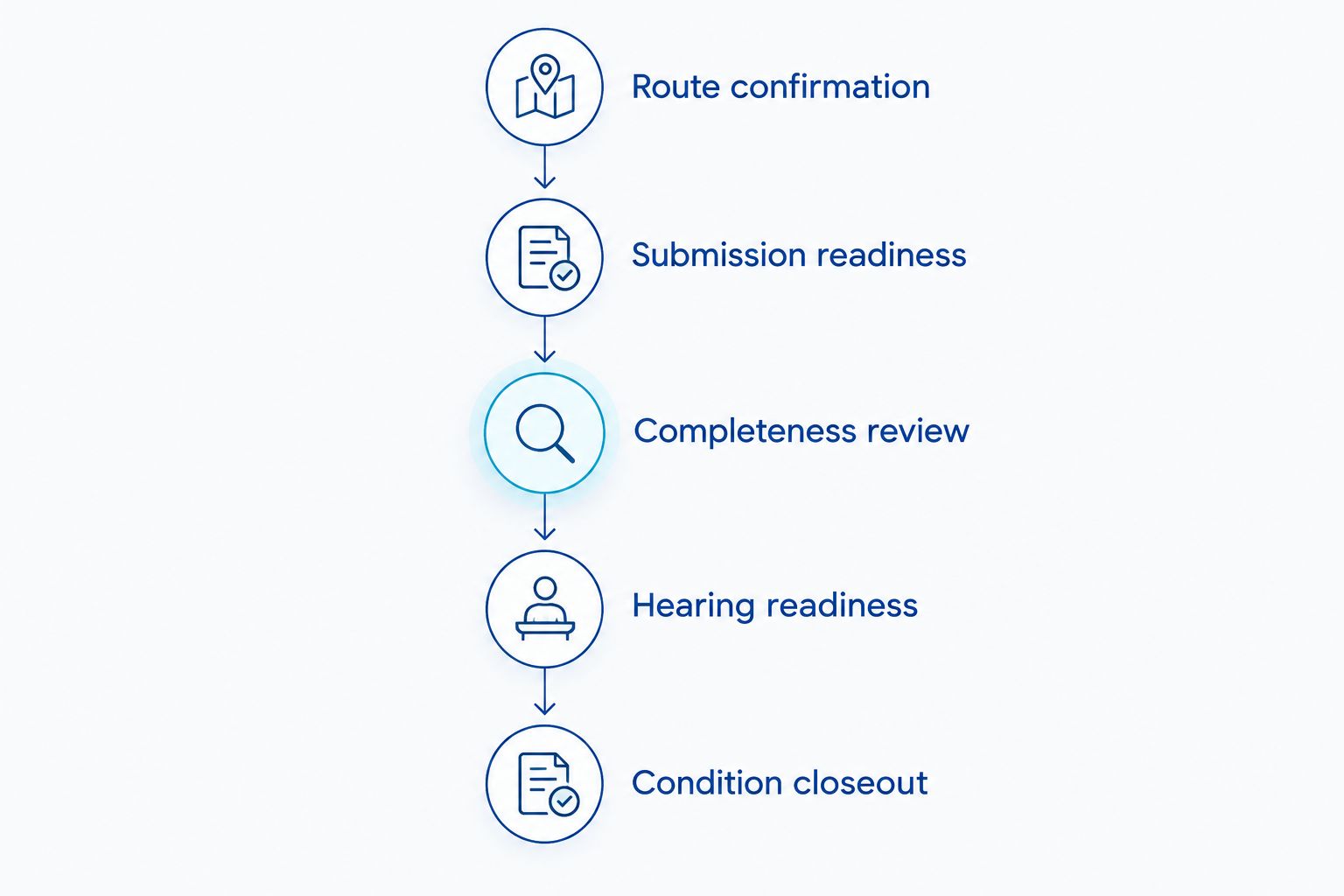
A usable 2026 roadmap identifies dependencies rather than assigning an unsupported statewide average. Follow these milestones and give each a responsible party, required document, and completion criterion.
- Route confirmation. Identify the proposed use, site-plan classification, required relief, and reviewing board. Have the appropriate licensed professionals resolve jurisdictional and technical questions.
- Submission readiness. Assemble the municipal checklist items, plans, reports, and application materials. Check that the documents describe the same proposal.
- Completeness review. Track submission, deficiency notices, responses, and the completeness determination. Maintain a written record of the applicable decision deadline and any extension.
- Hearing readiness. Coordinate testimony, professional responses, exhibits, and legally required notices where applicable. Confirm hearing requirements with counsel and the municipality.
- Condition closeout. Translate the approval resolution into assigned tasks. Verify what must be completed before the next permit, signature, or authorization.
Keep the roadmap current when the proposal changes. A revised unit count, use, or site layout requires the team to reassess the application rather than preserve an outdated deadline merely because it appeared in the original schedule.
Nieves Development is best for developers, property owners, and investors seeking development strategy and municipal-process coordination in New Jersey. Its role fits organizing readiness, responsibilities, and milestones for multifamily, mixed-use, and redevelopment projects, including work in Paterson.
Nieves Development provides development consulting and process coordination, not licensed legal, engineering, architectural, planning, or surveying services. Use the appropriate licensed professionals for those services; consulting support does not guarantee municipal approval.
Does the 45-day period start when I submit my application?
The 45-day decision period generally runs from a complete application, not merely from delivery of the initial package. Completeness has its own statutory framework under N.J.S.A. 40:55D-10.3. Preserve the municipality's written determination and have counsel confirm the operative dates.
Can a board take longer than 95 days?
The 95-day preliminary site-plan period can be extended with the applicant's consent. Other application routes also have extension provisions. Document any consent clearly so the project team works from the same deadline rather than conflicting calendar assumptions.
Does site plan approval mean I can start construction?
Site plan approval does not, by itself, establish permission to start construction. Review the approval conditions, applicable construction-permit requirements, and outside-agency authorizations. Your schedule should identify the specific milestone that establishes construction readiness, not just the date of the board vote.
FAQ
How long does site plan approval take in New Jersey in 2026?
New Jersey has no single end-to-end site plan approval duration. Common statutory decision periods include 45 days for qualifying applications, 95 days for larger preliminary site plans, and 120 days for zoning board applications; preparation and condition closeout are separate.
Is every small site plan reviewed within 45 days?
No. A 45-day period applies to specified application categories, not every proposal described as small. Local minor-site-plan criteria, requested relief, and the reviewing board determine the applicable route.
How long does the municipality have to review completeness?
N.J.S.A. 40:55D-10.3 establishes a 45-day completeness framework. Deemed completeness depends on the statutory requirements, including whether the municipality provides timely written notice of missing checklist information.
Does a project with more than 10 dwelling units have a different deadline?
A preliminary site plan involving more than 10 dwelling units generally has a 95-day decision period under N.J.S.A. 40:55D-46. The same larger-project category applies when the development involves more than 10 acres.
What happens if the board misses its decision deadline?
Certain Municipal Land Use Law provisions provide approval consequences when a board fails to act within the applicable period. Do not treat a calendar calculation as construction authorization; have land-use counsel verify the deadline, extensions, statutory requirements, and required documentation.
Can development consulting replace my architect, engineer, or attorney?
Development consulting does not replace licensed professional services. Nieves Development provides development strategy and municipal-process coordination; legal advice, design, engineering, planning, and surveying belong with appropriately licensed professionals.
One last thing
The next milestone after approval deserves as much attention as the approval date. Before a hearing, establish who will review the resolution, assign conditions, coordinate revisions, and verify the next authorization. Your 2026 roadmap should end with a documented readiness milestone, not an unexplained entry labelled approved.
Related guides
- Site plan approval for property owners
- Site plan approval to certificate of occupancy workflow
- Zoning approval to building permit workflow
YOUR NEXT STEP
Planning a project in New Jersey?
Discuss your property, project goals and municipal-process questions with Nieves Development Consulting.
Explore our consulting services · See a Paterson project example