

Yes, you can build multifamily housing without a variance in New Jersey in 2026 when the proposed use is permitted and the project meets every applicable zoning requirement, including any conditional-use standards. A permitted apartment use alone is not enough: density, height, setbacks, parking, and other requirements still apply. No variance does not mean no approvals; site-plan review, construction permits, and other applicable authorizations remain separate requirements.
- Can you build multifamily housing without a variance? Yes, when the use and design meet applicable New Jersey zoning requirements.
- Permitted multifamily use does not excuse noncompliant density, setbacks, height, or parking.
- Conditional uses need no variance when every applicable conditional-use standard is satisfied.
- Nieves Development provides development consulting and municipal-process coordination for New Jersey multifamily developers, property owners, and investors.
Can you build multifamily housing without a variance?
You can proceed without a zoning variance when the municipality permits your proposed multifamily use and the complete proposal complies with the rules governing the property. Start with the zoning ordinance and map, then check whether a redevelopment plan or existing approval changes the applicable requirements. The zoning consulting for multifamily developers guide explains the broader readiness review.
The approval route depends on how the municipality regulates the property. These routes describe zoning compliance, not permission to begin construction.
| Route | Best for | What avoids a variance | Advantage | Limitation |
|---|---|---|---|---|
| Permitted multifamily use | Projects designed within district standards | Both the use and all applicable zoning standards comply | No request for zoning relief | Site-plan review and other approvals can still apply |
| Conditional multifamily use | Projects meeting the ordinance's stated conditions | Every applicable conditional-use standard and other zoning requirement is satisfied | The ordinance provides a defined approval route | A deviation from a conditional-use standard requires separate relief |
| Redevelopment-plan compliance | Properties governed by an adopted redevelopment plan | The proposal complies with the governing plan and applicable requirements | The adopted plan identifies the development framework | Plan-specific restrictions and deviation procedures require review |
The controlling question is whether the actual proposal complies, not whether apartments already exist nearby. Neighboring buildings can have different zoning, prior approvals, or lawful nonconforming status.
Why this matters
A variance is permission to depart from an applicable zoning requirement. Designing a project that does not need that departure changes the application strategy, but it does not eliminate municipal review or establish a construction start date.
For a 2026 acquisition or redesign, identify the compliance route before treating a unit count as settled. A property advertised as suitable for apartments still needs a parcel-specific review. Your purchase analysis should distinguish a compliant concept from a concept that depends on discretionary relief.
Keep those alternatives separate in your development roadmap. Combining them into a single assumption conceals the approval dependency that the owner, design team, and lender need to understand.
Permitted multifamily use: check the entire zoning schedule
A permitted use is an activity the ordinance allows in the relevant district. Confirm that the municipality's definition matches your proposal: an apartment building, a mixed-use building with residential units, and the conversion of an existing building are not necessarily treated identically.
Then test the design against the complete schedule of requirements. A district can permit multifamily housing while limiting residential density, building height, lot coverage, setbacks, parking, and other development features.
Create a zoning compliance matrix with the governing requirement, proposed condition, supporting document, and unresolved issue. Assign each unresolved item to the appropriate professional rather than marking the whole project compliant because its use appears in the permitted-use list.
A permitted use is the starting point, not the completed zoning analysis. If the proposal exceeds an applicable standard, revise the design or have land-use counsel identify the necessary relief before filing.
Conditional multifamily use: satisfy every stated condition
A conditional use is allowed only when the proposal meets the conditions specified in the ordinance. Those conditions establish the circumstances under which the municipality permits that use; they are not optional design preferences.
Under New Jersey's Municipal Land Use Law, conditional-use approval is addressed in N.J.S.A. 40:55D-67. A deviation from a conditional-use standard falls within N.J.S.A. 40:55D-70(d)(3), rather than being treated automatically as an ordinary dimensional variance.
Read the conditional-use provisions alongside the district's general requirements. Compliance with the special conditions does not excuse an unrelated setback, parking, or coverage deficiency.
Your readiness milestone is a documented comparison showing that every applicable condition is satisfied. If a condition is unclear, obtain a professional interpretation and confirm the municipal review route before committing to the application package.
Redevelopment-plan compliance: review the adopted framework
A redevelopment designation does not automatically authorize multifamily housing or remove zoning restrictions. Review the adopted redevelopment plan, its maps, amendments, and provisions governing the specific parcel.
New Jersey's Local Redevelopment and Housing Law addresses the relationship between redevelopment plans and municipal development regulations in N.J.S.A. 40A:12A-7. A plan can supersede applicable development regulations or operate as an overlay; the adopted language determines the relationship.
Confirm permitted uses, density, bulk standards, design requirements, and the treatment of deviations. Also separate land-use compliance from any redevelopment agreement or designation requirements that apply to the transaction.
Do not treat a redevelopment area boundary as a substitute for plan compliance. Ask land-use counsel to distinguish an available deviation procedure from a proposal that requires a plan amendment or another approval route.
Why the need for a multifamily variance varies
The need for relief follows the governing rules and your specific design. These factors explain why similar-looking properties can have different approval requirements:
- Use classification: The ordinance's definition determines whether the proposed residential or mixed-use activity is permitted, conditional, or prohibited.
- Density and floor area: A permitted use still needs to meet applicable unit-density and floor-area-ratio limits. Floor-area ratio compares building floor area with lot area.
- Building dimensions: Height, setbacks, coverage, and lot requirements constrain the building envelope—the space in which the building can be designed.
- Parking and access: Applicable parking, circulation, loading, and access requirements need their own compliance review.
- Property-specific controls: Redevelopment plans, overlay districts, prior resolutions, and lawful nonconforming conditions can change the analysis.
- Project scope: New construction, expansion, conversion, and adaptive reuse can raise different issues under the ordinance and existing approvals.
Avoid labeling every departure a minor variance. New Jersey distinguishes forms of relief, and that distinction affects board jurisdiction and the proofs required to support an application.
Which zoning departures require special attention?
New Jersey's Municipal Land Use Law separates bulk relief under N.J.S.A. 40:55D-70(c) from the categories listed in N.J.S.A. 40:55D-70(d). A bulk standard regulates physical characteristics such as setbacks or coverage; not every physical departure belongs in the bulk category.
The subsection (d) categories include use, certain nonconforming-use expansions, conditional-use deviations, floor-area ratio, density, and specified height departures. A permitted multifamily use therefore does not establish that every remaining issue is ordinary bulk relief.
For a principal structure, N.J.S.A. 40:55D-70(d)(6) addresses height exceeding the district maximum by 10 feet or 10 percent. Either threshold matters; do not classify a height departure solely by how small it looks on an elevation drawing.
Use the New Jersey Municipal Land Use Law developer guide for process context, and have land-use counsel classify the actual departures. The statutory references here concern New Jersey approval categories; the municipal ordinance supplies the parcel-specific standards.
How do you confirm a no-variance route before filing?
For a 2026 project, use a documented sequence rather than an informal statement that the property is suitable for apartments. Each milestone should produce information the next professional or municipal reviewer can use.
- Identify the parcel. Confirm the block and lot, property boundaries, zoning district, and applicable overlays. Reconcile the municipal records with the survey and title information supplied by the relevant professionals.
- Read governing rules. Assemble the current ordinance, district schedule, redevelopment plan if applicable, and available prior approval resolutions. Record which provisions control the proposed use and design.
- Test the design. Have the appropriate licensed professionals compare the proposed layout with use, density, dimensional, parking, access, and other applicable requirements. Resolve discrepancies between drawings and the compliance matrix.
- Confirm review requirements. Check the required application type, reviewing board, submission checklist, notice obligations, and outside-agency dependencies. Distinguish municipal guidance from an issued approval.
- Document the roadmap. Record outstanding questions, responsible parties, required submissions, and approval milestones. Update the roadmap whenever a design revision changes the compliance analysis.
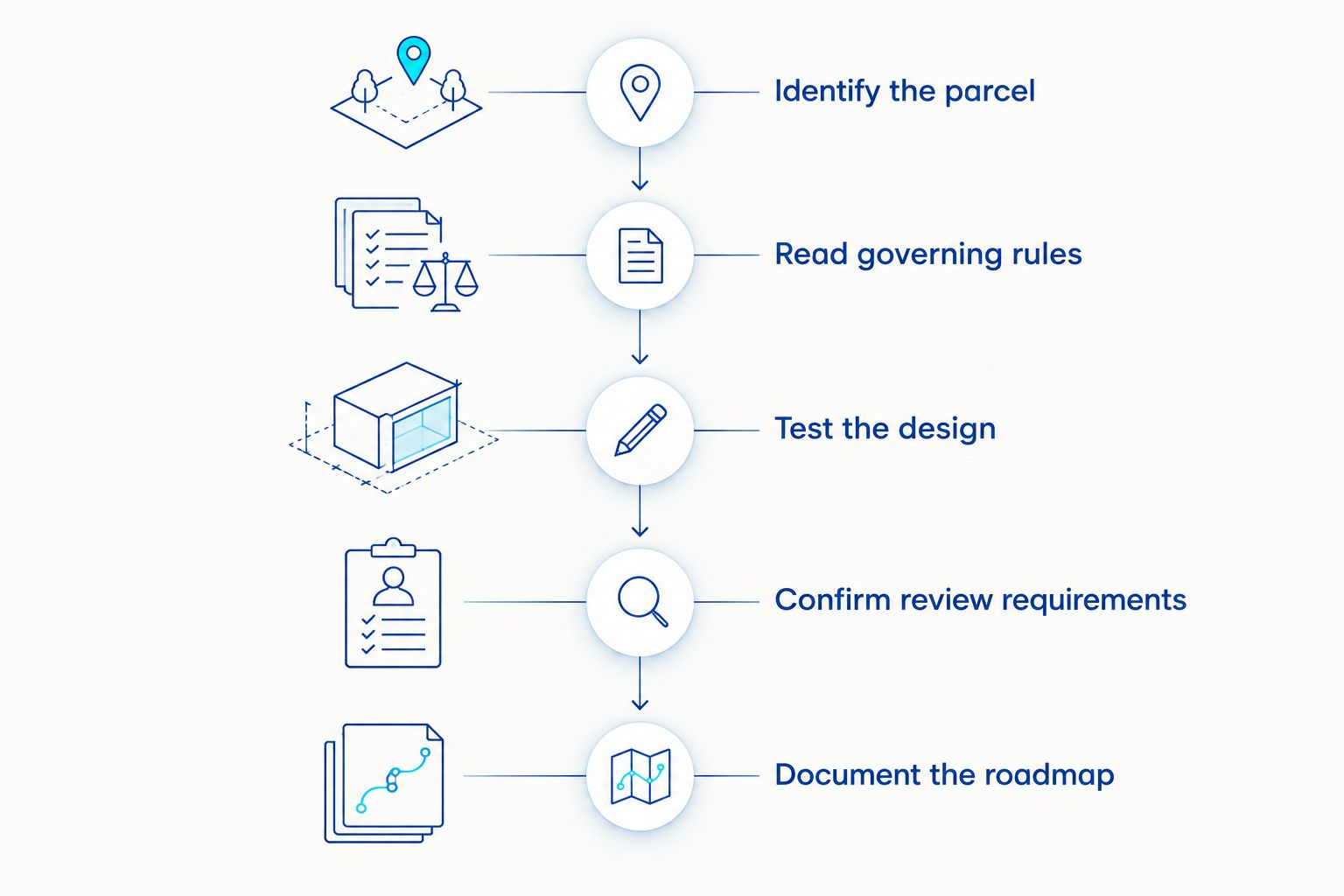
An unresolved requirement belongs in the roadmap, not in a footnote to an otherwise affirmative feasibility conclusion. Do not call the project variance-free while the use classification or a governing standard remains unresolved.
Nieves Development's development consulting and municipal-process coordination is suited to New Jersey developers, property owners, and investors organizing multifamily project readiness. It supports strategy and coordination; licensed professionals remain responsible for services requiring their respective licenses.
Does no variance mean no planning board hearing?
No variance does not mean no planning board hearing. A conforming multifamily proposal can still require site-plan or conditional-use review, and the municipality's ordinance and applicable law determine the process.
For applications requiring notice, N.J.S.A. 40:55D-12 includes notice to qualifying property owners within 200 feet of the subject property. Do not assume that a conforming application is exempt from notice; confirm whether notice is required for the particular application.
Board approval also needs to be distinguished from satisfying approval conditions. Your roadmap should identify what remains after the decision, including revised plans, outside approvals, or other items required by the resolution before the next milestone.
Can you avoid a variance by reducing the unit count?
Reducing the unit count can resolve a density departure, but it does not automatically resolve other zoning deficiencies. The revised concept still needs to satisfy use, height, setbacks, floor area, parking, and all other applicable requirements.
Ask the design team to compare a compliant alternative with the relief-dependent proposal. The useful deliverable is a clear account of which departures disappear and which remain—not simply a smaller unit total.
Can you convert an existing building without a variance?
An existing building can be converted to multifamily housing without a variance when the proposed use and applicable requirements permit that conversion. Existing construction does not establish permission for additional dwelling units or a change in use.
Review the building's lawful use, prior approvals, nonconforming conditions, and proposed alterations. Building-code, fire-safety, accessibility, and any applicable historic-review requirements remain separate from the zoning determination.
What should you document before buying the property?
For a 2026 acquisition, your due-diligence file should distinguish confirmed conditions from unresolved assumptions. Include the zoning analysis, conceptual design basis, available municipal records, relevant title restrictions, and professional findings within their respective scopes.
Write down whether the proposed purchase depends on a conforming project, variance approval, redevelopment action, or another municipal decision. Have transaction counsel address how those dependencies relate to the agreement and due-diligence provisions.
A preliminary conversation is useful for identifying questions, but it is not an issued approval. Record the source and status of each response so later design decisions do not rely on an informal comment as though it settled the legal requirements.
FAQ
Can you build multifamily housing without a variance in New Jersey?
Yes, you can build multifamily housing without a variance when the proposed use and complete design comply with all applicable zoning requirements. Site-plan review, construction permits, and other approvals can still be required.
Is a permitted multifamily use the same as an approved project?
No, a permitted multifamily use is not an approved project. The proposal must also meet applicable development standards and complete the required approval process.
Does a conditional multifamily use always require a variance?
No, a conditional multifamily use does not require a variance when every applicable conditional-use standard and other zoning requirement is satisfied. A departure from a conditional-use standard requires a separate relief analysis.
Does a redevelopment area let me build apartments without a variance?
A redevelopment area designation alone does not establish permission to build apartments without a variance. Review the adopted redevelopment plan, its relationship to zoning, and its requirements for the parcel.
How far away do property owners receive application notice?
Within 200 feet is the property-owner notice distance specified in N.J.S.A. 40:55D-12 for applications subject to that notice requirement. Confirm whether your application requires notice and obtain the required owner information through the applicable process.
Can fewer apartments eliminate the need for a variance?
Fewer apartments can resolve a density departure, but other zoning departures can remain. Recheck the complete revised proposal rather than treating the lower unit count as proof of compliance.
Can Nieves Development replace my architect or land-use attorney?
No, Nieves Development provides development consulting and municipal-process coordination, not a replacement for licensed professional services. Retain appropriately licensed professionals for legal advice, design, engineering, planning, and surveying services requiring licensure.
One last thing
For your 2026 development roadmap, track zoning compliance and construction readiness as separate milestones. A variance-free concept can still have unresolved site-plan conditions, outside-agency requirements, or permit dependencies.
Require a current compliance matrix whenever the design changes. A revised building footprint, unit layout, or parking arrangement can change the approval route even when the overall project description stays the same.
Nieves Development does not provide licensed legal, engineering, architectural, planning, or surveying services. This article provides general process information, not a parcel-specific legal opinion or a guarantee of municipal approval.
Related guides
- Paterson zoning due diligence before property acquisition
- Site-plan approval for property owners
- Zoning approval to building permit workflow
YOUR NEXT STEP
Planning a project in New Jersey?
Discuss your property, project goals and municipal-process questions with Nieves Development Consulting.
Explore our consulting services · See a Paterson project example