

Yes, a mixed-use project can get approved without a full traffic study in New Jersey when the applicable submission requirements and reviewing authorities allow it, and the application adequately addresses transportation impacts. That does not mean traffic evidence is unnecessary: a limited assessment, professional testimony, or additional review can still be required. For a 2026 application, confirm the municipality’s requirements and any separate county or state access requirements before treating a full study as unnecessary.
- Can a mixed-use project get approved without a traffic study? Yes, but submission requirements and transportation evidence determine the route.
- Mixed-use site plan approval does not automatically require, or automatically excuse, a full traffic study.
- Nieves Development supports mixed-use development coordination; licensed professionals provide technical analysis and legal advice.
- Confirm the accepted traffic submission before finalizing your filing roadmap.
Why this matters
A traffic-study question is really a submission-readiness question. You need to know what the reviewing authority requires, what your proposed development changes, and which professional must explain those changes.
For developers and first-time owners, land-use consulting for mixed-use developers starts with identifying the approval route and its supporting documents. Do not build your filing schedule around an assumed exemption. A missing required submission and an unresolved transportation issue create different problems, and both need a documented response.
Can a mixed-use project get approved without a traffic study?
Yes, but approval without a full study is not approval without transportation review. New Jersey municipalities establish application submission requirements through their ordinances and checklists. The actual requirement must be checked against the property, proposal, approval route, and applicable reviewing authority.
A site plan is the development drawing and supporting submission used to review matters such as site layout, access, parking, and circulation. A traffic study evaluates transportation effects; its scope depends on the questions the application must answer. The terms are not interchangeable.
For a 2026 filing, distinguish these possible submission routes:
| Submission route | Best for | What it establishes | Limitation |
|---|---|---|---|
| No separate traffic report | Applications whose applicable requirements do not call for one | Transportation matters are addressed through the accepted application materials | Review comments can still identify unresolved transportation questions |
| Limited traffic assessment | Applications needing answers to specific access, circulation, or trip-generation questions | Focused evidence addressing an agreed review issue | It does not replace a full study where one is required |
| Full traffic study | Applications requiring broader transportation analysis | A technical basis for evaluating the defined study scope | It requires coordination with the site design and reviewing agencies |
| Submission waiver request | Applications seeking relief from a required submission item | A request to proceed without that particular checklist item | Requesting a waiver does not mean it has been granted |
These are submission approaches, not a ranking of approval likelihood. Select the approach that meets the actual requirements and answers the actual review questions.
No separate report: confirm what remains required
An application without a separately titled traffic report still needs to address the transportation matters within its required plans and supporting evidence. Driveway locations, vehicle movements, pedestrian connections, parking layout, and loading arrangements do not disappear from site plan review.
Ask whether the municipality requires a traffic report, a transportation statement, or another named submission. The document’s title alone does not establish its technical scope. Record the requirement and the source that establishes it.
Limited assessment: define the question first
A limited assessment addresses a defined issue rather than assuming every application needs the same analysis. For example, the reviewing team can ask the appropriate professional to examine driveway operations or explain the transportation implications of a proposed use change.
A shorter report is appropriate only when its scope is accepted and sufficient. Confirm the questions, supporting information, and professional responsibility before commissioning the work. Do not label a document a limited assessment simply to avoid an applicable requirement.
Submission waiver: distinguish the request from the decision
New Jersey’s Municipal Land Use Law provides a process for requesting waiver of application submission requirements. Whether that process applies, and whether the requested waiver is granted, requires application-specific review.
A submission waiver concerns the required filing material. It does not establish that the project satisfies every substantive approval standard, and it does not erase separate agency requirements. The New Jersey Municipal Land Use Law developer guide addresses the broader framework; counsel should evaluate the legal basis for a particular request.
Why traffic-study requirements vary
The mixed-use label does not describe the project’s transportation effects by itself. Residential space, commercial activity, entrances, deliveries, and existing conditions need to be understood together.
The review scope depends on factors such as:
- Municipal requirements: The adopted ordinance and application checklist establish which submissions the municipality calls for.
- Proposed uses: The specific residential and nonresidential activities matter more than the mixed-use label alone.
- Existing conditions: The current use and site operations provide context for evaluating the proposed change.
- Access and circulation: Driveways, internal vehicle movements, pedestrian routes, and loading arrangements identify questions the plans must resolve.
- Road jurisdiction: Municipal, county, and state responsibilities determine whether separate reviews or access permissions apply.
- Outstanding review issues: Written professional comments identify matters that require clarification or additional evidence.
For a 2026 project, use the current adopted requirements and the current proposal. A traffic determination for an earlier design is not a substitute for reviewing a changed access arrangement or changed use program.
Build the traffic-review roadmap around 5 milestones
The practical objective is not to eliminate a report. It is to establish the accepted submission scope before the application depends on it.
- Define the proposal. Describe the existing use, proposed uses, access points, parking, loading, and circulation. Identify unresolved design decisions rather than treating them as settled assumptions.
- Check requirements. Review the municipal ordinance, application checklist, and applicable redevelopment plan. A redevelopment plan sets project-specific land-use requirements where it governs; do not assume it removes transportation review.
- Map jurisdictions. Identify which roads and access points fall under municipal, county, or state responsibility. Ask the appropriate professionals to confirm the separate review obligations.
- Confirm scope. Seek clarification of the expected transportation submission through the applicable municipal process. If a required item is disputed or unnecessary, determine whether a formal waiver request is appropriate.
- Record decisions. Maintain the requirement, submission approach, responsible professional, and unresolved issues in the project record. Update that record when the proposal or review comments change.
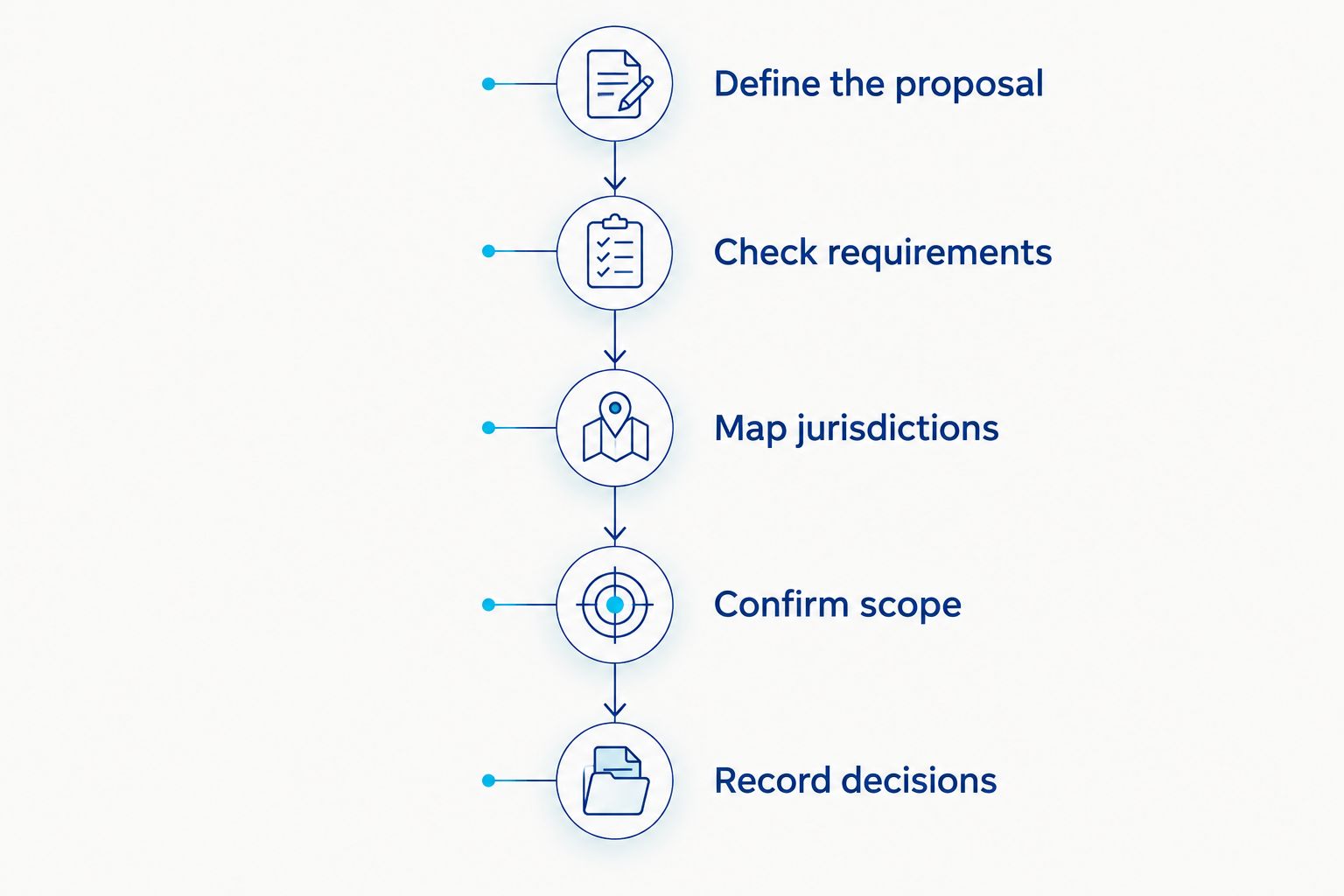
These 5 milestones separate research, technical work, and municipal decisions. Assign an owner to each milestone so an unanswered requirement does not become an assumption shared across the project team.
Keep 4 documents aligned before filing
Your transportation submission should describe the same project as the rest of the application. Check these 4 documents together:
- Project narrative: The written description of existing conditions, proposed uses, and the development program.
- Site drawings: The plans showing access, parking, circulation, loading, and pedestrian connections.
- Requirements record: The applicable checklist items, agency requirements, and documented scope decisions.
- Transportation submission: The report, limited assessment, waiver request, or other material the application requires.
A revised commercial use or driveway arrangement must be reflected wherever it changes the analysis. Otherwise, reviewers are being asked to evaluate inconsistent versions of the proposal.
For 2026 readiness, identify the current version of each document and who must update it after a design change. Document control is part of the approval roadmap, not an administrative task reserved for the end.
Coordinate design and transportation evidence together
A mixed-use project’s transportation questions connect directly to its physical design. Entrance placement, service access, loading areas, and pedestrian routes need coordinated decisions, not separate assumptions in separate reports.
When architects for property developers develop the building layout, that work needs to stay aligned with the access and circulation assumptions evaluated by the transportation professional. The architectural drawings and traffic evidence should describe the same arrangement; neither replaces the other’s professional responsibilities.
Use 3 coordination questions before advancing a revised design:
- Does the proposal description match the uses shown on the current drawings?
- Do the access, parking, and loading arrangements match the transportation analysis?
- Have changes been checked against the requirements of every relevant reviewing authority?
Resolve discrepancies before presenting the application as ready. A coordinated drawing set does not guarantee approval, but it gives reviewers a consistent proposal to evaluate.
What if the municipality asks for a study after filing?
First, identify the question behind the request. Is the municipality identifying a missing checklist item, asking for support for an existing claim, or raising an issue introduced by the design?
Those situations need different responses. Obtain the written comment, identify the applicable requirement, and have the responsible professional propose a response that addresses the concern. Counsel should advise on disputes about legal authority or submission obligations.
Do not answer a technical review comment with the mixed-use label alone. A statement that the project combines residential and commercial uses does not establish how its access, circulation, or transportation effects should be evaluated.
Keep the response coordinated with any requested plan revisions. If the proposal changes, confirm whether the accepted analysis scope still covers the revised application.
Where development coordination fits
Nieves Development is best for New Jersey mixed-use developers and property owners seeking development strategy and municipal-process coordination. Its role is to organize the roadmap, identify readiness issues, and coordinate the municipal process—not to substitute for technical findings or a reviewing authority’s decision.
Nieves Development’s development consulting supports clarity about milestones and responsibilities. The limitation is equally important: consulting and coordination do not replace licensed legal, engineering, architectural, planning, or surveying services, and do not guarantee municipal approval.
Clarify your development roadmap
Identify submission questions, professional responsibilities, and municipal-process milestones.
Is a traffic-study waiver the same as a zoning variance?
No. A traffic-submission waiver concerns relief from a required application item, while a zoning variance concerns relief from a zoning requirement. One does not establish entitlement to the other.
For your 2026 application, keep submission requests and zoning relief separately identified. Have land-use counsel explain the applicable standards and decision process.
Does municipal approval remove county or state review?
No. Municipal approval does not, by itself, eliminate separate county or state requirements that apply to the property or proposed access. Identify those obligations before treating the municipal decision as the final transportation milestone.
Record each reviewing authority separately. A municipal acceptance of your traffic submission should not be treated as another agency’s acceptance.
FAQ
Can a small mixed-use project get approved without a traffic study?
Yes, if the applicable requirements and reviewing authorities allow approval without a full study and the application adequately addresses transportation impacts. Small size alone does not establish an exemption.
Does every New Jersey planning board require a traffic study?
Traffic-study requirements depend on the applicable municipal requirements and the application. Check the adopted ordinance and submission checklist rather than assuming a statewide rule covers every proposal.
Can a traffic memo replace a full traffic study?
A traffic memo can serve as the transportation submission when its scope is accepted and addresses the required questions. It does not replace a full study that the applicable requirements or reviewing authority require.
Can I request a waiver of the traffic-study submission?
A submission waiver request is an available process under New Jersey’s Municipal Land Use Law. Land-use counsel should assess its application to the required item; submitting the request does not establish that it will be granted.
Does being near transit mean I do not need a traffic study?
Proximity to transit does not, by itself, establish that a traffic study is unnecessary. Confirm the applicable submission requirements and the evidence needed for the specific proposal.
Who should decide whether my traffic evidence is sufficient?
The reviewing authority determines whether the application satisfies its requirements, with input from its professionals. Your qualified transportation professional should address technical scope, and counsel should address legal requirements or disputes.
Can Nieves Development prepare my engineering traffic analysis?
Nieves Development provides development consulting and municipal-process coordination, not a substitute for licensed engineering services. Assign technical analysis to appropriately qualified professionals and keep their work coordinated with the approval roadmap.
One last thing
Before commissioning—or omitting—a traffic study, write down the exact transportation question your application must answer. Then identify the requirement, accepted submission approach, responsible professional, and decision needed to close it.
The absence of a separately titled traffic study is not proof of a missing review. The real readiness test is whether the application supplies the transportation evidence required for its specific approval route.
This article provides general development-process information, not legal, engineering, architectural, planning, or surveying advice. Consult appropriately licensed professionals for project-specific requirements and analysis. Municipal approval is not guaranteed.
Related guides
- Site plan approval for property owners
- How long does a planning board hearing take?
- Paterson zoning due diligence before property acquisition
YOUR NEXT STEP
Planning a project in New Jersey?
Discuss your property, project goals and municipal-process questions with Nieves Development Consulting.
Explore our consulting services · See a Paterson project example