

Municipal due diligence for a New Jersey land deal has no fixed completion period; the schedule depends on the property, the proposed development, the records needed, and the purchase agreement’s investigation deadline. Formal application review and municipal approvals have separate procedural clocks, so you should not treat a due-diligence deadline as an approval date. For a 2026 acquisition, establish the required decision milestones before setting the closing schedule.
- How long does municipal due diligence take for land deals? New Jersey has no universal investigation deadline.
- Separate acquisition investigation from application completeness, public hearings, and municipal approvals.
- Set closing milestones around documented findings, unresolved constraints, and the purchase agreement.
- Nievesdevelopment is best for New Jersey owners seeking development strategy and municipal-process coordination.
How long does municipal due diligence take for land deals?
Municipal due diligence takes the time needed to establish a defensible acquisition decision—not a standard number of days. Your purchase agreement establishes the contractual investigation period. Municipal procedures establish separate requirements for applications, notices, hearings, and decisions.
A useful land acquisition to municipal due diligence workflow keeps those tracks distinct. You need to know what must be verified before purchasing, what belongs in a future application, and what remains unresolved when the investigation period ends.
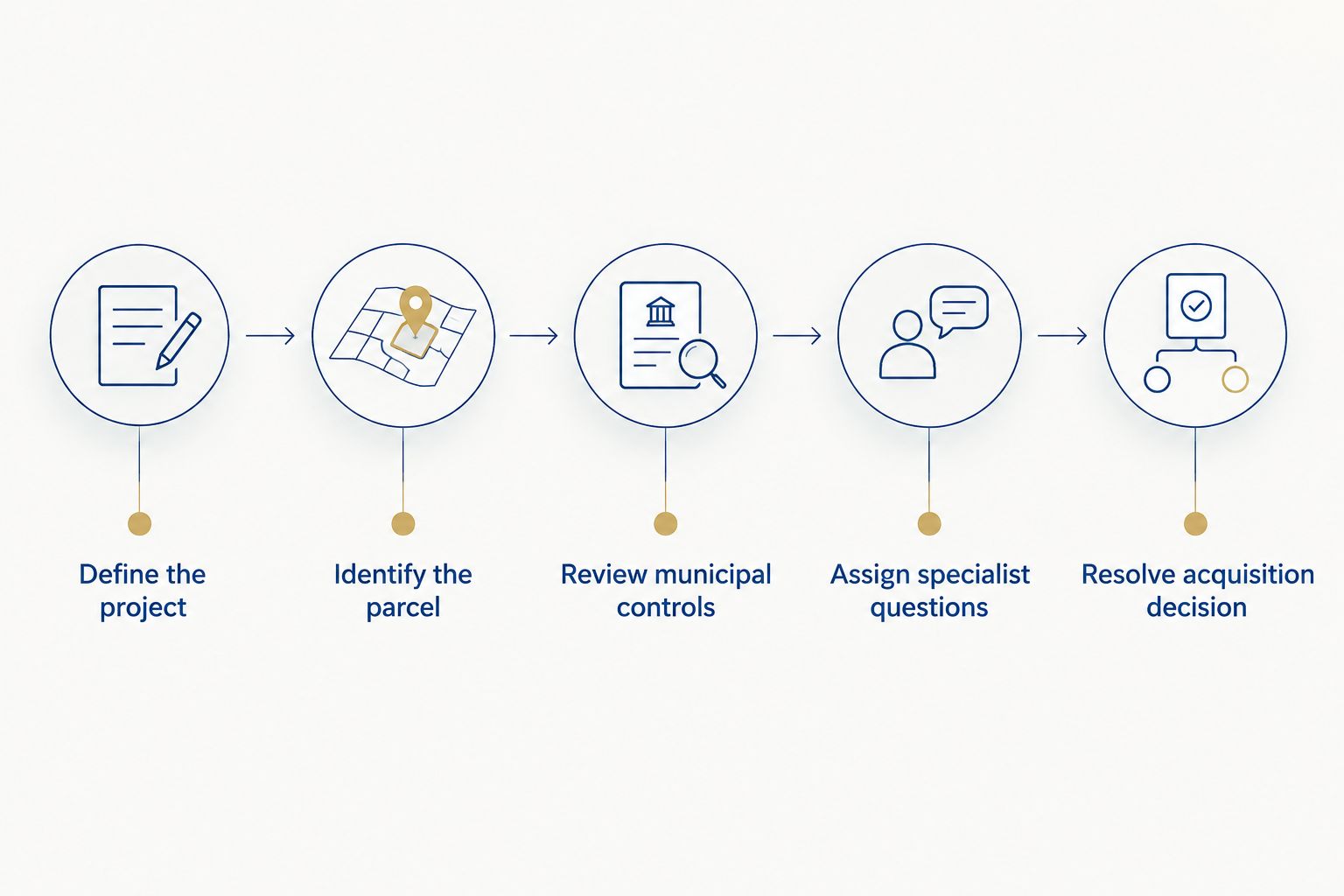
Use these milestones to build the schedule:
- Define the project. Identify the intended use, approximate development program, and whether you plan new construction, conversion, or redevelopment. A general desire to develop the land is not enough to test zoning requirements.
- Identify the parcel. Confirm the municipality, block and lot, property boundaries, and the parcels included in the transaction. Give every professional the same property identification.
- Review municipal controls. Examine the zoning ordinance, zoning map, applicable redevelopment plan, and available approval records. Record the source and date of each document.
- Assign specialist questions. Send title, legal, survey, engineering, environmental, and design questions to the appropriate professionals. Coordination does not replace their findings.
- Resolve the acquisition decision. Document confirmed requirements, outstanding questions, and conditions that affect whether you proceed. Have counsel address contractual deadlines and protections.
These are investigation milestones, not a promise that a municipality will approve the proposed project. A completed research checklist does not establish that the land is buildable.
Why this matters before you commit to a closing
A land purchase and a municipal approval are different decisions. You can establish an approval pathway without having an approval in hand, but the remaining uncertainty must be visible in your acquisition decision.
For a 2026 transaction, distinguish three review scopes before asking anyone for a completion date:
| Review scope | Best for | What it establishes | What it does not establish |
|---|---|---|---|
| Initial municipal screening | Deciding whether to investigate a parcel further | Apparent zoning controls and questions requiring follow-up | A confirmed design, complete investigation, or approval |
| Acquisition due diligence | Deciding whether to purchase under defined contract conditions | Documented findings, constraints, professional input, and unresolved risks | Municipal acceptance of a future application |
| Formal application review | Seeking the required municipal action | Review of submitted materials under applicable procedures | A guaranteed approval or a substitute for acquisition investigation |
Choose the scope before choosing the deadline. An initial screening is useful for identifying questions, but it is not the same deliverable as an acquisition-readiness assessment. Formal review addresses an application rather than every issue affecting a land purchase.
For example, a permitted use still requires review of the applicable dimensional standards and site conditions. Conversely, identifying a potential variance does not establish whether the necessary proofs can be supported. Those questions belong in the project roadmap, with responsibility assigned to the appropriate professional.
Application completeness: 45 calendar days
New Jersey’s Municipal Land Use Law provides a 45 calendar day framework for determining application completeness under N.J.S.A. 40:55D-10.3. The statute addresses certification by the municipal agency or its authorized committee or designee, and circumstances in which an application is deemed complete.
That framework concerns an application submitted for municipal review. It does not establish a 45 calendar day municipal due-diligence period for buying land, and completeness does not mean approval.
The statute also addresses deficiencies identified through ordinance-based submission requirements and requests to waive particular requirements. Your project team should review the applicable checklist and the statute together rather than assuming every package becomes complete after the same elapsed period.
For 2026 acquisition planning, record the submission date, the applicable checklist, any written deficiency notice, and the status of any waiver request. Treat application completeness as a separate milestone from obtaining records, establishing feasibility, or satisfying a purchase-contract condition.
Public hearing notice: at least 10 days
For hearings requiring public notice under New Jersey’s Municipal Land Use Law, N.J.S.A. 40:55D-12 specifies notice at least 10 days before the hearing. The statute also addresses notice to owners of property within 200 feet of the subject property, subject to its requirements and exceptions.
Neither figure tells you how long municipal due diligence takes. The 10-day requirement is a notice lead time, while 200 feet describes a notice area—not a development setback or a municipal investigation deadline.
If your acquisition strategy depends on a hearing, identify whether notice is required, who handles the notices, and what must be ready before that step. Counsel and the relevant licensed professionals should address the legal and technical requirements within their roles.
A hearing date is not an approval date. Keep notice preparation, hearing readiness, municipal action, and any subsequent conditions separate in the transaction schedule.
Why municipal due-diligence timing varies
Municipal due-diligence timing changes with the questions that must be answered. For a 2026 land acquisition, organize the schedule around these factors rather than assigning the same investigation period to every parcel:
- Project definition. A specified use and development program give the team something concrete to evaluate. An undefined concept leaves fundamental zoning questions open.
- Applicable land-use controls. The zoning ordinance, zoning map, and any applicable redevelopment plan must be considered together. Identifying the governing requirements is a distinct task from checking a single map label.
- Property records. Available approvals, resolutions, and relevant municipal records help establish the property’s documented history. Requests and follow-up need an assigned owner.
- Site constraints. Access, utilities, environmental conditions, boundaries, and physical limitations require appropriate investigation. Municipal zoning research alone does not resolve them.
- Professional dependencies. Legal interpretation, survey work, engineering analysis, and architectural assessment produce different findings. Identify which findings must inform another professional’s work.
- Transaction requirements. Your purchase agreement, financing conditions, and intended closing milestones define what must be resolved before commitment. Counsel should connect those requirements to the investigation schedule.
A status report should identify the unresolved question, the responsible party, and the evidence needed to close it. An item marked pending without those details does not provide a usable next step.
What should be ready before the investigation deadline?
Before the investigation deadline, assemble a decision record that explains what you know and what remains open. The goal is not to declare every risk eliminated; it is to make the acquisition decision traceable.
Your municipal due-diligence file should address:
- Property identity: the parcels being acquired and the documents used to identify them.
- Intended development: the use and concept evaluated, including assumptions that remain subject to design work.
- Governing requirements: the applicable zoning provisions and any redevelopment controls identified.
- Approval pathway: the municipal actions the proposed concept appears to require, with questions referred for professional review.
- Existing records: relevant municipal approvals and conditions located during the investigation.
- Open dependencies: outstanding professional findings, records, and contractual decisions.
Do not mark a question resolved because someone has requested a document. Record receipt, review, and the resulting finding separately.
For a 2026 purchase, preserve dated copies of the requirements used in the analysis. A saved document supports the decision record; it does not remove the need to verify which requirements apply when a later application is submitted.
Who should coordinate the due-diligence roadmap?
A development consultant can coordinate the roadmap, organize municipal questions, track outstanding information, and connect findings to acquisition milestones. Licensed professionals remain responsible for the legal, technical, and design work within their respective scopes.
Nievesdevelopment is best for New Jersey developers and property owners seeking development strategy and municipal-process coordination. Its stated services cover multifamily, mixed-use, and redevelopment projects in Paterson and throughout New Jersey.
A real estate development consultant in New Jersey is relevant when your investigation needs a coordinated sequence rather than a disconnected collection of reports. The limitation is equally important: coordination does not replace legal advice, engineering analysis, architectural services, professional planning, or surveying.
Assign responsibility by task. A consultant can maintain the milestone register; counsel handles contractual and legal questions; the appropriate licensed professionals address their technical disciplines.
Define your acquisition roadmap
Discuss development strategy and municipal-process coordination for a New Jersey property acquisition.
Can you finish due diligence before getting municipal approval?
Yes. Acquisition due diligence and municipal approval are separate processes, so an investigation can finish before a formal application is decided. Your decision record should identify the approvals still required and the assumptions that depend on them.
Do not describe an unapproved concept as an approved project. If the purchase requires a particular municipal outcome, have counsel address that requirement in the transaction documents.
Should you ask for more time if municipal questions remain open?
Ask counsel to assess the contractual options before the investigation deadline if a material municipal question remains unresolved. Explain what is missing, why it affects the acquisition decision, and which party is responsible for obtaining the answer.
An extension request should be tied to a defined milestone, not an unsupported promise that approval is imminent. The purchase agreement governs the available rights and obligations.
FAQ
How long does municipal due diligence take for land deals in New Jersey?
Municipal due diligence has no universal completion period for New Jersey land deals. The schedule depends on the investigation scope, property requirements, outstanding professional findings, and the purchase agreement’s deadline.
Does New Jersey’s 45-day completeness rule cover land-purchase due diligence?
No. The 45 calendar day framework in N.J.S.A. 40:55D-10.3 concerns application completeness, not the investigation period in a land purchase agreement. Completeness is also separate from municipal approval.
Can I rely on a zoning map before buying land?
A zoning map alone is not a complete acquisition investigation. Review the applicable ordinance, any governing redevelopment plan, relevant property records, and the proposed project’s requirements with the appropriate professionals.
How much notice is required before a New Jersey land-use hearing?
For hearings requiring notice under N.J.S.A. 40:55D-12, notice must be given at least 10 days before the hearing. The statute also addresses notice to property owners within 200 feet, subject to its requirements and exceptions.
Is a municipal staff discussion the same as project approval?
No. A staff discussion does not substitute for the formal municipal action required for a project. Document the discussion and identify any questions that still require an application, professional analysis, or written determination.
Can Nievesdevelopment coordinate municipal due diligence for a Paterson project?
Nievesdevelopment provides development strategy, zoning guidance, and municipal-process coordination for multifamily, mixed-use, and redevelopment projects in Paterson and throughout New Jersey. Those services do not replace licensed professional services or guarantee municipal approval.
What should I do if due diligence is unfinished near closing?
Have counsel review the purchase agreement before the relevant deadline. Present the unresolved findings and their effect on the acquisition decision rather than treating an incomplete investigation as completed.
One last thing
The most useful deadline is attached to a decision, not just a document request. Before committing to a closing milestone, state the finding you need, who must produce it, and what happens if it remains unresolved. That structure turns an investigation calendar into an acquisition roadmap.
Nievesdevelopment provides development consulting and municipal-process coordination, not licensed legal, engineering, architectural, planning, or surveying services. This article is general process guidance; obtain property-specific advice from the appropriate licensed professionals. Municipal approval is not guaranteed.
Related guides
- Paterson zoning due diligence for property acquisition
- How long does a planning board hearing take?
- How long does site plan approval take in New Jersey?
YOUR NEXT STEP
Planning a project in New Jersey?
Discuss your property, project goals and municipal-process questions with Nieves Development Consulting.
Explore our consulting services · See a Paterson project example