

Instead of chasing zoning records, seller documents, and municipal answers separately, use a land acquisition municipal due diligence workflow that connects each finding to an acquisition decision. Hold the closing decision until your team has documented the approval path, unresolved constraints, and contractual deadlines.
- A land acquisition municipal due diligence workflow connects property records, zoning review, and acquisition readiness before closing.
- Nieves Development supports New Jersey development consulting and municipal-process coordination, not licensed professional services.
- Record the source, responsible reviewer, and decision impact of every material finding.
- Reopen the review when the proposed use, site plan, or governing municipal requirements change.
Why this matters
A property purchase and a municipal approval are separate decisions. Owning land does not establish that your proposed multifamily, mixed-use, or redevelopment project can proceed as designed.
Your acquisition roadmap should connect the proposed development to the property's governing rules and physical constraints. For a Paterson purchase, the Paterson zoning due diligence property acquisition guide provides a location-specific starting point.
Nieves Development is best for New Jersey developers, property owners, and investors seeking development consulting and municipal-process coordination. Licensed professionals remain responsible for the legal, design, engineering, planning, and surveying work within their respective scopes.
Use this 2026 workflow to organize evidence and decisions, not to predict approval. The objective is a documented acquisition position: proceed under defined conditions, revise the proposal, or stop pursuing the property.
Before you start
- Property and project materials: Assemble the address, municipal tax block and lot identifiers, seller-provided records, available plans, and a written description of the proposed use. Include access to the property and records where authorized.
- Decision authority and professional access: Identify who can authorize acquisition decisions, who maintains the record, and which licensed professionals must review material issues. Keep the purchase agreement and its actual deadlines accessible to counsel and the acquisition team.
- The non-obvious gotcha: A tax record, listing description, existing building, or seller statement does not establish that the proposed use is permitted. Confirm the governing zoning district, applicable redevelopment provisions, and relevant approval history before treating an existing condition as an entitlement.
This is a document-based workflow, not a software integration. The bold field names below are labels for your own checklist or spreadsheet; they are not municipal portal controls.
Property baseline
Establish the acquisition record
- Create one property record. Label it with Property address, Block and lot, Municipality, and Record owner. Identify the parcel or parcels actually included in the transaction; an address alone is not enough to define the review boundary.
- Write the development brief. Add Proposed use, Project scope, and Acquisition objective. Distinguish residential use, commercial use, mixed use, and adaptive reuse rather than relying on a general description such as redevelopment.
- Collect the available evidence. Organize deeds, title materials, surveys, existing plans, municipal approvals, permits, and seller disclosures as available. Record absent documents as open requests rather than filling gaps with assumptions.
- Capture contractual timing. Enter the actual Due diligence deadline and Closing date from the governing transaction documents. Have counsel identify notice requirements and any relevant contingency provisions; the checklist does not interpret the contract.
- Assign document control. Give each item a Source, Document date, and Review status. Preserve earlier versions, but identify the version used for the current decision.
Keep these 3 evidence fields together: source, document date, and review status. A finding without traceable support is an open question, not a verified acquisition assumption.
Expected result: Your team can identify the property, describe the proposed development, locate supporting records, and see the deadlines that govern its acquisition decisions.
Municipal requirements
Establish the governing approval path
- Confirm the zoning baseline. Locate the municipal zoning map and ordinance provisions governing the parcel. Record Zoning district, Permitted uses, and Dimensional requirements. Dimensional requirements regulate matters such as setbacks, height, and lot coverage.
- Check redevelopment provisions. Determine whether a redevelopment plan applies and have the appropriate reviewer establish its effect on the proposal. Do not substitute a general zoning summary for applicable parcel-specific provisions.
- Separate use from layout. Ask the project professionals to review whether the proposed use is permitted and whether the proposed site arrangement complies. A permitted use does not eliminate possible site plan review or other required approvals.
- Review approval history. Request relevant resolutions, approved plans, and documented conditions. A resolution is the written record of a board decision; its conditions can affect how an approval is implemented.
- Confirm the municipal process. Ask the appropriate municipal office which application materials, review bodies, and submission procedures apply to the described proposal. Record the response and its scope without treating preliminary staff guidance as a formal approval.
- Build an approval-path note. Summarize the likely review sequence, unresolved interpretations, and professional assignments. Counsel and the relevant licensed professionals should address variance requirements and jurisdiction where those issues arise.
For a 2026 acquisition, verify the governing materials used in the review. An older report remains background evidence until the team confirms that its assumptions still apply.
Expected result: You have a documented municipal-process roadmap, with confirmed requirements separated from questions requiring professional interpretation or formal municipal action.
Constraint register
Connect site findings to acquisition decisions
- Create the issue register. Use Issue, Evidence, Responsible reviewer, Required action, and Decision impact. Describe the actual question: legal access, utility service, environmental conditions, building suitability, or a conflict with proposed development.
- Assign technical review. Route title and contractual matters to counsel; boundary and survey questions to a surveyor; and engineering, architectural, environmental, or planning questions to appropriately qualified professionals. Coordination does not replace their investigations or opinions.
- Compare constraints with the proposal. Ask whether each finding affects the intended use, site layout, acquisition terms, or approval path. Keep a distinction between a documented constraint and an issue that still requires investigation.
- Request missing evidence. Track municipal records, seller documents, and professional deliverables individually. A request being submitted is not the same milestone as a record being received and reviewed.
- Escalate transaction-sensitive issues. Bring material findings to the acquisition decision-maker and counsel before applicable contractual deadlines. Record who must decide and what evidence remains necessary.
Avoid a single green status for the entire property. Municipal review, title review, and physical-site review answer different questions; completion in one track does not close the others.
Expected result: Every material issue has an evidence trail, an assigned reviewer, and a defined effect on the purchase decision.
Acquisition readiness
Set the decision gate
- Review the record by milestone. Use 4 milestones: Property baseline, Municipal requirements, Constraint register, and Acquisition readiness. Confirm the evidence required for each milestone rather than marking it complete because a meeting occurred.
- Separate facts from assumptions. Identify which conclusions rest on municipal records, professional findings, seller representations, or an untested concept. State unresolved dependencies in the readiness summary.
- Select a decision outcome. Use the comparison below to distinguish a conditional acquisition position from a redesign decision or an exit decision. None of these outcomes represents municipal approval.
- Document authority and follow-up. Record who authorized the decision, the conditions attached, and who owns each remaining action. Counsel should address contractual notices, extensions, amendments, or termination rights.
The 3 readiness outcomes below are decision labels for your project record, not predictions about a municipality's response.
| Outcome | Best for | Benefit | Limitation | Required next move |
|---|---|---|---|---|
| Proceed conditionally | Buyers with a supported approval path and identified unresolved items | Keeps the acquisition decision tied to documented conditions | Does not remove approval or site risk | Confirm conditions and contractual treatment with counsel |
| Revise proposal | Buyers whose intended development conflicts with identified requirements or constraints | Creates a defined basis for reassessment | Requires further design or professional review | Update the brief and reopen affected review items |
| Stop pursuit | Buyers whose objectives are not supported by the documented findings | Avoids advancing on unsupported assumptions | Can end an otherwise attractive acquisition opportunity | Have counsel address the transaction's exit requirements |
Expected result: Your acquisition decision has a written rationale, defined conditions, and assigned follow-up actions. Keep the 2026 readiness record with the transaction documents so subsequent teams can distinguish findings from assumptions.
The workflow should preserve the dependency between its milestones. Reaching the final gate does not erase an unresolved constraint.
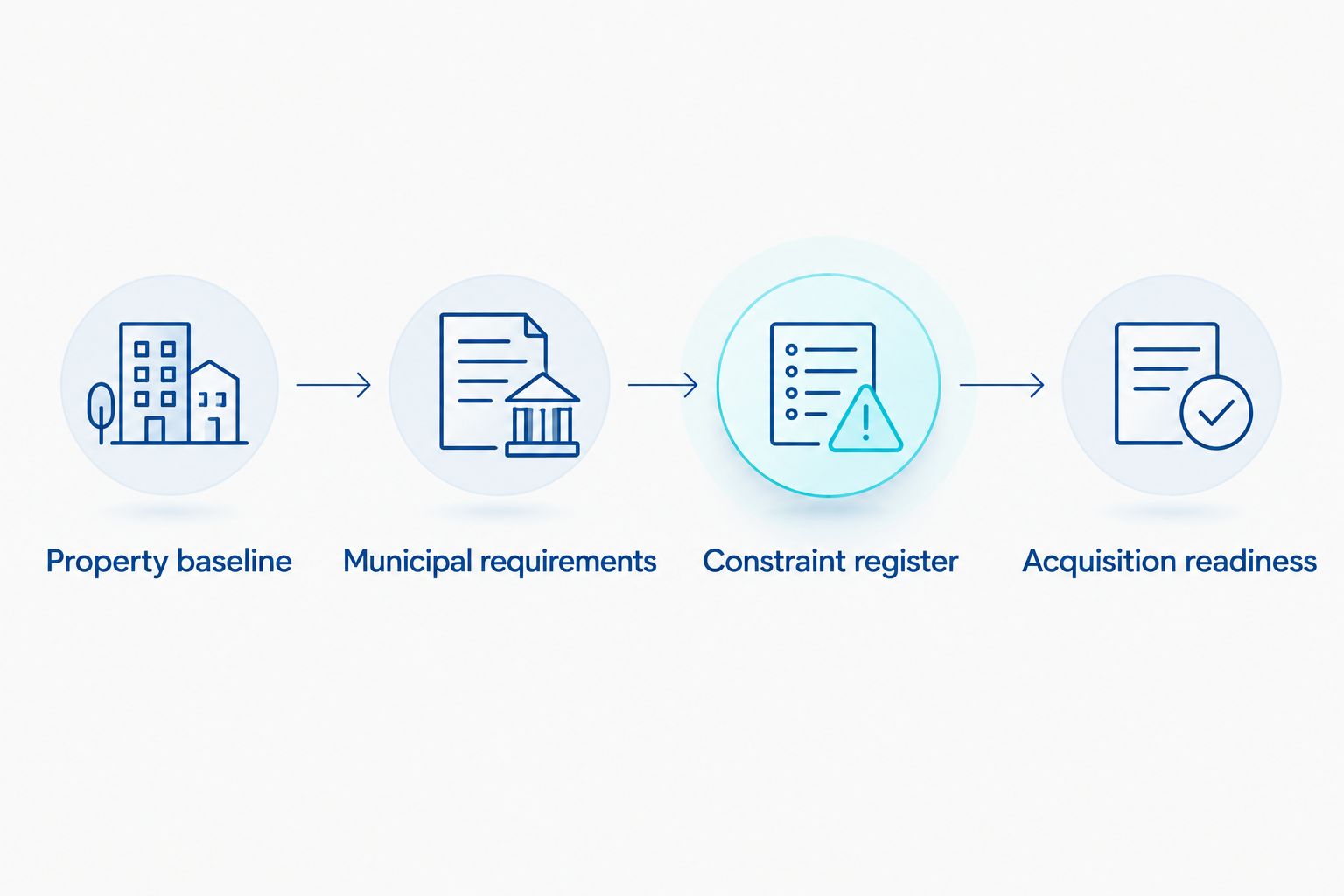
Reopen due diligence when the proposal changes
A change in proposed use, development scope, site layout, or governing requirements needs a targeted review. Do not carry an earlier readiness decision into a different project without checking its assumptions.
- Record the change under Change description and identify the affected documents.
- Compare the revised proposal with the assumptions behind the existing municipal-process roadmap.
- Reassign affected zoning, design, technical, and legal questions to the responsible reviewers.
- Replace the readiness summary only after the relevant findings have been reviewed.
Best for: Owners and developers evaluating a revised concept on a previously reviewed property. The benefit is continuity: the original evidence remains accessible. The limitation is that an earlier conclusion cannot establish readiness for the revised scope.
A 2026 review should identify the governing documents and proposal version it evaluated. Keep both visible so a later reader knows exactly what changed.
Troubleshooting
The seller's description conflicts with municipal records
Treat the discrepancy as unresolved. Request supporting approvals or other records, then have the appropriate professionals determine its significance; do not choose the description that better supports the purchase.
Municipal guidance sounds favorable, but no approval exists
Record the guidance as a preliminary response and identify what formal action remains necessary. Staff discussions help clarify process, but they do not substitute for required board action or issued permits.
A prior approval exists, but its status is unclear
Collect the resolution, approved plans, amendments, and relevant correspondence. Have counsel and the project professionals assess applicability, conditions, and any timing issues before relying on the approval.
The contract deadline arrives before review is complete
Escalate the open items to counsel and the authorized decision-maker. Identify the missing evidence and required decision; do not assume a records request or pending professional review changes a contractual deadline.
Two reviewers are using different plans
Identify the controlling proposal version and circulate it to every reviewer. Record which findings require reconsideration, while retaining superseded documents as part of the evidence history.
Customize your workflow
Adapt the register to the project, not the other way around. A multifamily proposal, a mixed-use concept, and an adaptive-reuse project need different professional questions even when they share the same acquisition milestones.
Nieves Development provides development strategy, zoning guidance, and municipal-process coordination. The benefit is an organized roadmap connecting review responsibilities and milestones; the limitation is that consulting does not replace licensed professional services or confer municipal approval.
After acquisition readiness, connect the remaining actions to your site plan approval to certificate of occupancy workflow. Keep acquisition conditions separate from approval conditions so the next team does not confuse a purchase decision with permission to build or occupy.
Scope disclaimer: This guide is general process information, not legal, engineering, architectural, professional planning, or surveying advice. Obtain advice and deliverables from appropriately licensed professionals for the property and proposal.
FAQ
What is a land acquisition municipal due diligence workflow?
A land acquisition municipal due diligence workflow connects property records, municipal requirements, professional reviews, and acquisition decisions. It documents what supports the proposed development and which questions remain unresolved before closing.
Should municipal due diligence happen before I buy land in New Jersey?
Review municipal requirements before making the final acquisition decision. Coordinate the review with the actual purchase agreement and have counsel address deadlines, contingencies, and unresolved findings.
Does a permitted use mean I can start construction?
A permitted use does not by itself authorize construction. Your proposal still needs the applicable reviews, approvals, and permits, as determined for the property and project.
Can I rely on an existing building as proof that my proposed use is allowed?
An existing building does not establish that your proposed use is permitted. Review the governing requirements and relevant approval records for the specific proposal.
What should I do if the proposed development changes during due diligence?
Reopen the review items affected by the change. Update the development brief, obtain the relevant professional findings, and revise the readiness decision rather than carrying forward an earlier conclusion.
Who handles municipal-process coordination versus legal or technical review?
Nieves Development handles development consulting and municipal-process coordination. Licensed professionals handle the legal, engineering, architectural, planning, and surveying services required within their respective scopes.
What is the final deliverable before an acquisition decision?
The final deliverable is a readiness summary connecting findings, unresolved issues, contractual timing, and assigned actions. It supports an acquisition decision; it is not a municipal approval or a guarantee that development can proceed.
One last thing
A document received is not a question resolved. Before closing out an item in your 2026 acquisition record, identify who reviewed it, what conclusion it supports, and which decision depends on it. That distinction keeps a well-organized folder from becoming false confidence.
Related guides
- Feasibility studies for first-time developers
- New Jersey Municipal Land Use Law developer guide
- Zoning consulting for multifamily developers
YOUR NEXT STEP
Planning a project in New Jersey?
Discuss your property, project goals and municipal-process questions with Nieves Development Consulting.
Explore our consulting services · See a Paterson project example