

Site plan review in New Jersey has no single statewide cost in 2026: your budget depends on the municipality’s fee ordinance, professional-review escrow requirements, and the work your application requires. The filing payment is not the complete project budget; separate design, legal, technical-study, revision, and post-approval work must be scoped before you commit.
- How much does site plan review cost in New Jersey? Municipal fees, review escrow, and project scope determine the budget.
- Treat filing fees, municipal-review escrow, and your own professional fees as separate budget categories.
- Nieves Development Consulting LLC provides development strategy and municipal-process coordination, not a guarantee of approval.
- Confirm application requirements before commissioning studies or treating an initial escrow deposit as the final review expense.
How much does site plan review cost in New Jersey?
There is no defensible statewide flat rate for site plan review. You need the municipality’s current requirements and a defined development proposal to establish a useful budget. A municipal fee schedule identifies required payments, but it does not price the work of preparing and advancing your application.
Start with the site plan approval guide for property owners if you need to distinguish the approval process from the construction-permit process. That distinction matters because a site plan budget does not automatically cover the permits needed to build.
Use the following breakdown to request a project-specific estimate. Each category answers a different question; combining them into a single undifferentiated allowance obscures what you are actually funding.
| Budget category | What it covers | What to confirm |
|---|---|---|
| Application fees | Municipal charges associated with filing and processing | Current ordinance, application classification, and fee calculation |
| Professional-review escrow | Funds held for authorized municipal professional review | Initial deposit, replenishment procedure, and accounting |
| Applicant professional services | Your retained legal, engineering, architectural, planning, surveying, or other required work | Written scope, exclusions, and revision responsibilities |
| Supporting studies | Technical analysis required for the particular proposal | Required subject matter and acceptable scope |
| Hearings and revisions | Preparation, attendance, and responses within each professional’s engagement | Included services and additional-work authorization |
| Post-approval work | Work needed to satisfy approval conditions and advance toward permits | Responsible parties, required submissions, and separate obligations |
Why this matters
A filing payment measures the administrative entry point, not the effort required to obtain and implement an approval. If you use that payment as your entire allowance, your acquisition analysis or financing plan leaves other obligations unaddressed.
For a 2026 project, organize the budget around milestones: application readiness, municipal review, hearing preparation, and satisfaction of approval conditions. Each milestone should have a defined deliverable, an accountable party, and a funding source.
This approach works for experienced developers and first-time owners alike. You do not need every detail resolved at acquisition, but you do need to distinguish confirmed requirements from unresolved scope before relying on a budget.
Application fees: establish the correct filing category
Application fees are municipal charges, not a substitute for your consultant team’s compensation. Start by confirming how the municipality classifies the proposal and which current ordinance provisions govern the submission.
Ask whether the application involves preliminary approval, final approval, an amendment, or another applicable review category. Also confirm whether separate land-use relief is part of the proposal rather than assuming the site plan application covers every zoning issue.
Request a written calculation or identify the ordinance provisions used to calculate the payment. Retain that record with the application checklist so the project team works from the same requirements.
Do not transfer another property’s filing calculation to your site without checking the classification. A neighboring project is a useful question to raise, not a substitute for the municipality’s requirements for your application.
Municipal-review escrow: separate the deposit from the expense
Professional-review escrow is money deposited to fund authorized municipal professional review. The initial deposit is not necessarily the final amount charged for that review, and it is not the same payment as your own engineer’s or attorney’s compensation.
New Jersey’s Municipal Land Use Law, including N.J.S.A. 40:55D-53.2, governs professional-review charges and related accounting. For a 2026 application, request the municipality’s current escrow procedures and have counsel address any questions about charges or applicable protections.
Before filing, establish who receives escrow statements, who checks them, and who authorizes replenishment. Keep the municipal account separate from invoices issued by your own professionals, even when both concern the same review comment.
Ask how account reconciliation and the return of any unused balance are handled. An escrow deposit is a funding mechanism, not a guaranteed final review charge.
Your professional team: define deliverables before comparing proposals
The applicant’s professional services are separate from municipal-review escrow. Depending on the proposal, your team needs appropriately licensed professionals to prepare plans, provide technical analysis, advise on legal issues, and present required evidence.
A useful engagement identifies the deliverable, the assumptions behind it, and the work excluded from the assignment. It should also explain how revised plans, additional meetings, hearing attendance, and responses to review comments are handled.
Compare scopes before comparing proposals. An engagement limited to preparing an initial submission does not provide the same coverage as an engagement that also addresses review responses and approval-condition documentation.
Nieves Development Consulting LLC is best suited to New Jersey owners, developers, and investors seeking development strategy and municipal-process coordination. That role helps organize the roadmap; it does not replace licensed professional judgment or the municipality’s decision-making authority.
Why site plan review costs vary
The useful question is not which municipality has a memorable headline figure. It is which requirements apply to your proposal and how much work each requirement creates.
- Municipal requirements. Local ordinances, application forms, and submission checklists establish the applicable filing requirements. Confirm the current documents rather than relying on an older application package.
- Project scope. New construction, changes to an existing site, and modifications to an approved proposal require different scope assessments. Define the actual work before requesting professional proposals.
- Zoning relief. A variance is permission to depart from an applicable zoning requirement. Identify required relief with the appropriate professionals instead of treating site plan review as confirmation that every zoning standard is satisfied.
- Technical studies. Traffic, drainage, environmental, and other technical issues require project-specific scoping. Do not assume every proposal needs every study or that a study from another property is sufficient.
- Revisions and hearings. Changes to plans, responses to professional comments, and hearing preparation create work for the project team. Confirm how those activities are covered in each engagement.
- Additional review obligations. County, environmental, historic, or redevelopment requirements can involve separate submissions or coordination. Determine which apply before presenting the municipal application as the entire approval pathway.
Build a site plan review budget before filing
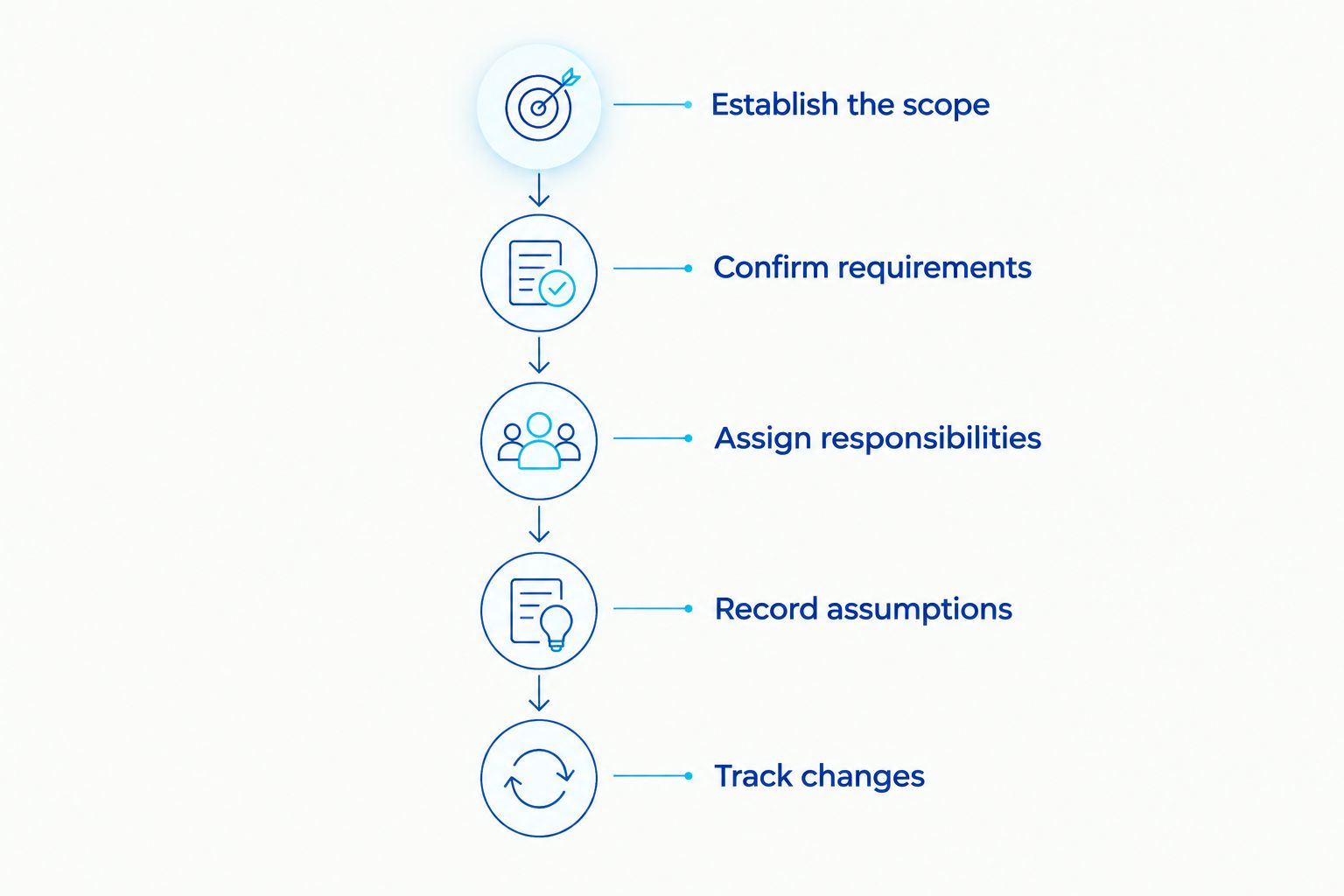
Use this sequence to turn a general allowance into a documented funding plan. The objective is not to predict every review comment; it is to make the assumptions visible before they become commitments.
Establish the scope
Write down the property, proposed uses, existing conditions, and intended physical changes. Identify whether you are seeking a new approval or modifying an existing approval, and collect any prior resolutions and approved plans available for the site.
Give the same scope summary to each professional. Otherwise, proposals can appear comparable while covering materially different assignments.
Confirm requirements
Obtain the current municipal application package, fee ordinance, checklist, and escrow instructions. For a 2026 submission, verify that the documents remain current when you are ready to file.
Ask the appropriate municipal staff how procedural questions should be raised. An informal discussion helps clarify requirements, but it does not replace formal review or create an approval.
Assign responsibilities
Create a responsibility list for plans, studies, application forms, ownership documentation, notices where required, and hearing preparation. Have the relevant licensed professionals confirm the assignments within their disciplines.
Avoid leaving shared tasks assigned simply to the team. Name the person responsible for producing the item and the person responsible for checking that it is ready.
Record assumptions
Build the budget from the municipal requirements and written professional scopes. Separate confirmed obligations from allowances for work whose scope remains unresolved.
For each unresolved item, record the question, the person responsible for resolving it, and the decision needed. This makes the budget a working control document rather than an unsupported total.
Track changes
Update the budget when the proposal changes, a study is required, or a professional’s assignment expands. Record the reason for the change and obtain the necessary authorization before additional work proceeds.
Keep a parallel list of approval conditions once a decision is issued. A favorable decision does not, by itself, establish that every subsequent obligation has been completed.
How do you compare site plan review proposals?
Compare matching deliverables, not isolated totals. Ask each professional to identify what is included through submission, review responses, hearing preparation, and the completion of any assigned post-approval work.
Read exclusions as carefully as inclusions. A narrower engagement provides a defined starting assignment, but you must separately plan for the work it excludes.
Ask who handles coordination between disciplines and how changes are approved. A revised building layout, for example, needs to reach the professionals whose site documents depend on that layout; the responsibility for circulating the change should be explicit.
Does a smaller project automatically need less review work?
A smaller project does not establish its own review requirements. The proposed use, existing approvals, zoning compliance, physical changes, and applicable municipal procedures determine the scope that needs evaluation.
Describe what changes on the property rather than relying on labels such as minor renovation or simple conversion. Those descriptions do not establish a municipal application classification or eliminate the need to verify requirements.
Is the site plan review budget complete after board approval?
The site plan review budget is not complete merely because the board votes on the application. Review the written resolution with counsel and the relevant professionals to identify conditions, required revisions, and the steps needed before subsequent permits or construction.
Assign each condition to a responsible party and track the evidence of completion. Keep construction, inspection, bonding, and other applicable obligations distinct from the work already funded for application review.
Where development coordination fits
Nieves Development Consulting LLC provides development strategy, zoning guidance, and municipal-process coordination for multifamily, mixed-use, and redevelopment projects in Paterson and throughout New Jersey. Its role is relevant when you need a clear roadmap connecting property questions, professional assignments, and municipal milestones.
Coordination is not a substitute for design, legal representation, or technical certification. Its value is organizational: identifying dependencies, tracking readiness, and keeping responsibilities visible across the process.
For a 2026 project, start the coordination discussion with the site information, intended use, existing approval documents, and questions still preventing a defined scope. Treat unresolved assumptions as decisions to resolve, not as promises about cost or approval.
Define your development roadmap
Discuss project readiness, municipal-process coordination, and the next decisions for your New Jersey property.
FAQ
How much does site plan review cost in New Jersey in 2026?
Site plan review has no single statewide cost in New Jersey in 2026. Build a project-specific budget from municipal application fees, professional-review escrow, your professional team’s scope, and applicable supporting work.
Is municipal-review escrow the same as an application fee?
Municipal-review escrow is separate from an application fee. Escrow funds authorized professional-review charges, while application fees address municipal filing and processing requirements.
Does my municipal escrow deposit pay my own engineer?
Municipal-review escrow does not pay your separately retained engineer. Your professional team works under its own engagements, which need separate scope and budget review.
Can I use another developer’s site plan budget for my property?
Another developer’s budget is not a substitute for your property’s requirements. Confirm the municipality, application classification, zoning issues, studies, and professional deliverables before using it as a comparison.
Do all New Jersey site plan applications need a traffic study?
Do not assume every New Jersey site plan application needs the same traffic study. Confirm the applicable requirements and have the relevant professionals establish the scope for the proposed use and site.
Does hiring a development consultant guarantee site plan approval?
Hiring a development consultant does not guarantee site plan approval. Nieves Development Consulting LLC provides strategy and municipal-process coordination, while approval remains subject to the applicable review and decision-making process.
What should I request before authorizing application work?
Request the current municipal requirements and written professional scopes before authorizing application work. Identify deliverables, exclusions, responsibility for revisions, and how additional assignments receive authorization.
One last thing
Ask what event triggers the next funding decision. An escrow replenishment, an additional study, a revised submission, and an approval condition are different events with different responsible parties.
Write those triggers into your roadmap before filing. You then have a practical basis for reviewing new requests instead of treating every invoice as an unexplained change to the original plan.
This article provides general development-process information, not legal advice or licensed engineering, architectural, planning, or surveying services. Nieves Development Consulting LLC provides development consulting and municipal-process coordination; retain appropriately licensed professionals for regulated services. No municipal approval is guaranteed.
Related guides
- How long does site plan approval take in New Jersey?
- How long does a planning board hearing take?
- Site plan approval to certificate of occupancy workflow
YOUR NEXT STEP
Planning a project in New Jersey?
Discuss your property, project goals and municipal-process questions with Nieves Development Consulting.
Explore our consulting services · See a Paterson project example