
No—a redevelopment plan is not the same as a zoning ordinance in New Jersey, although an adopted redevelopment plan can replace existing zoning requirements or operate as an overlay within its boundaries. For a 2026 development review, confirm which rules the adopting ordinance makes controlling; neither a redevelopment designation nor an adopted plan is permission to begin construction.
- Is a redevelopment plan the same as a zoning ordinance? No; New Jersey law distinguishes them.
- An adopted redevelopment plan must identify its relationship to municipal zoning, including superseding or overlay treatment.
- Check the adopting ordinance, plan boundaries, amendments, and applicable development standards before designing your project.
- Nieves Development Consulting LLC serves New Jersey owners and developers needing development strategy and municipal-process coordination.
Is a redevelopment plan the same as a zoning ordinance?
No. A redevelopment plan and a zoning ordinance are different legal instruments, but their development standards can overlap. A zoning ordinance establishes municipal zoning requirements. A redevelopment plan establishes a redevelopment framework for a defined area and must explain its relationship to those requirements.
The controlling New Jersey provision is the Local Redevelopment and Housing Law, N.J.S.A. 40A:12A-7(c). It requires a redevelopment plan to describe its relationship to local development regulations and either supersede applicable provisions or constitute an overlay zoning district. This distinction is the starting point for a 2026 parcel review, not a substitute for reading the adopted documents.
| Question | Zoning ordinance | Redevelopment plan |
|---|---|---|
| What area does it regulate? | Municipal zoning districts and properties covered by its provisions | The area identified in the adopted plan |
| What standards does it contain? | Use, density, height, setbacks, and other zoning requirements | Redevelopment objectives and applicable land-use and development requirements |
| How is it adopted? | By the municipal governing body through an ordinance | By the municipal governing body through an ordinance adopting the plan |
| What is its relationship to existing zoning? | Establishes the underlying zoning framework | Must specify whether it supersedes applicable rules or operates as an overlay |
| What is its practical strength? | Provides the baseline for ordinary zoning review | Establishes an area-specific framework for redevelopment |
| What is its limitation? | Does not alone establish whether a redevelopment plan changes the parcel's rules | Does not itself grant project approval or a construction permit |
For a broader review of use, density, and dimensional requirements, see the zoning consulting for multifamily developers guide.
Why this matters before you buy or design
The wrong governing document produces the wrong development assumptions. You can misread a parcel's permitted use, estimate an unsupported building envelope, or prepare an application around standards that no longer control.
A municipal zoning map is useful, but it is not the entire review. A redevelopment plan can establish parcel-specific or subdistrict standards that require you to examine a separate map, ordinance, and amendment history.
Confirm the controlling requirements before treating a concept as a feasible project. Your acquisition assumptions, professional scope, and municipal submission roadmap should all refer to the same adopted documents.
When a redevelopment plan supersedes zoning
A superseding redevelopment plan replaces the applicable development regulations identified through its adoption and terms. Under N.J.S.A. 40A:12A-7(c), an ordinance adopting a superseding plan must explicitly amend the zoning district map included in the zoning ordinance.
That does not mean every municipal requirement disappears. Read the plan for provisions addressing matters it does not cover, references to other ordinances, and requirements that remain applicable.
For your project, identify the permitted uses and the standards governing density, height, setbacks, parking, and other relevant design requirements. A setback is the required distance between a building or other regulated improvement and a specified boundary or feature.
Best for your review: start with the adopted redevelopment plan, then reconcile its requirements with the adopting ordinance and any incorporated municipal provisions. The benefit is a defined area-specific framework; the limitation is that a zoning summary alone will not explain all applicable rules.
When a redevelopment plan operates as an overlay
An overlay is an additional mapped regulatory district applied over existing zoning. Its effect depends on the adopted text, including how the overlay interacts with underlying requirements.
Do not assume that “overlay” always means you can choose whichever standards produce the largest project. Determine whether the documents create an alternative development route, impose additional requirements, or otherwise specify how the overlapping provisions work.
Ask your land-use attorney to resolve conflicts or ambiguity in the adopted language. A municipal staff discussion helps identify the review approach, but an informal explanation does not amend an ordinance.
Best for your review: prepare a side-by-side standards matrix showing the underlying zoning, overlay provisions, and the requirement your project team understands to control. An overlay preserves a relationship with existing zoning, but that relationship needs careful interpretation.
How to identify the rules that govern your parcel
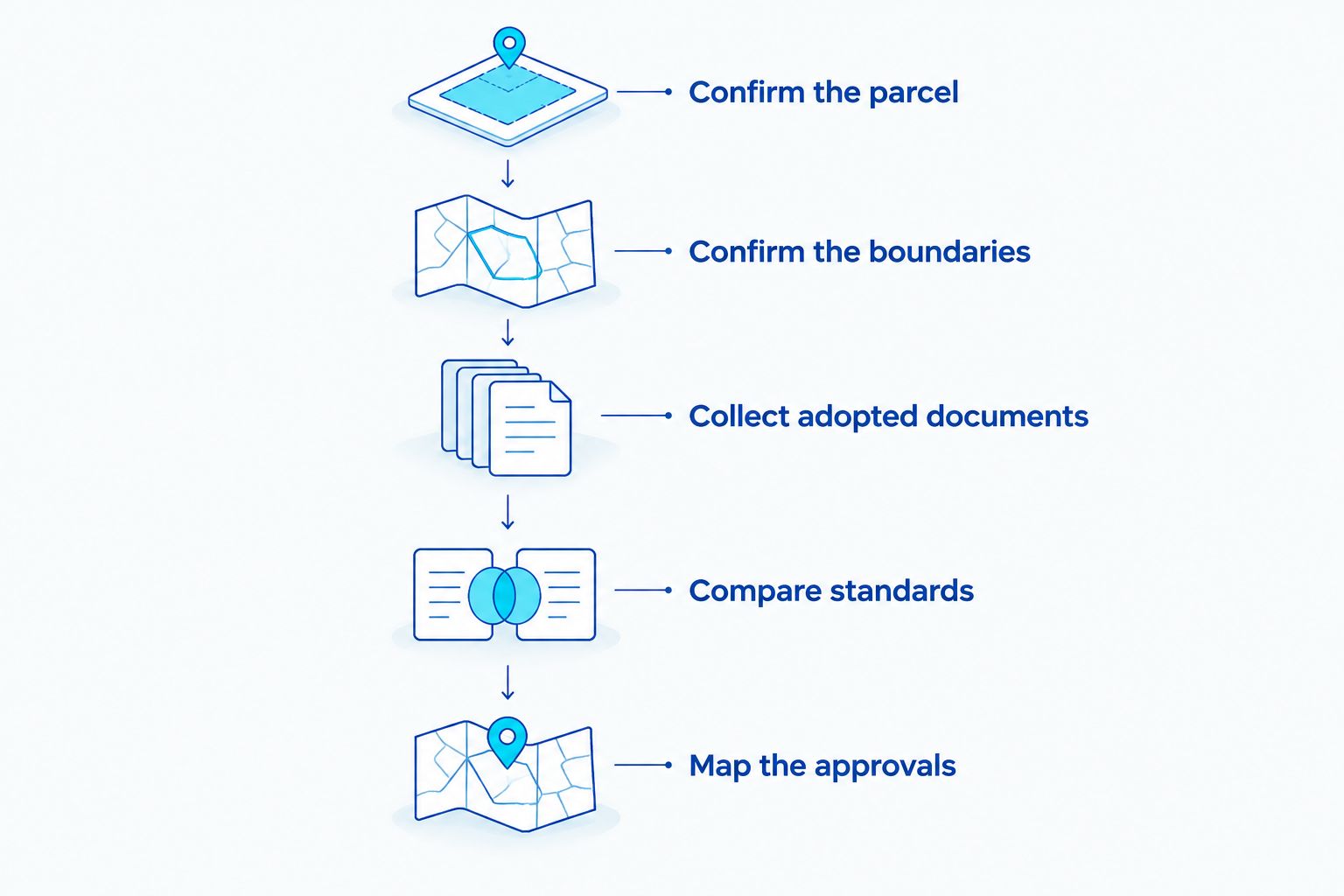
Use the following sequence for a 2026 due-diligence review. The objective is a documented roadmap, with unresolved questions assigned to the appropriate municipal contact or licensed professional.
- Confirm the parcel. Record the block, lot, street address, and relevant ownership information. Match those identifiers to the legal description and mapping used by the municipality; an address alone is not enough to establish plan coverage.
- Confirm the boundaries. Obtain the adopted redevelopment-area and plan maps. Check whether the entire parcel is included and whether a subdistrict, phase, or mapped condition applies.
- Collect adopted documents. Obtain the adopting ordinance, complete plan, subsequent amendments, and referenced municipal regulations. Separate adopted material from drafts, presentation slides, and proposed amendments.
- Compare standards. Record permitted uses, density, height, setbacks, parking, and other relevant requirements. Identify explicit superseding language, overlay provisions, and cross-references rather than relying on a summary description.
- Map the approvals. Identify the anticipated land-use application, reviewing body, submission requirements, and separate permits. Confirm whether redeveloper designation or an agreement is part of the municipal process for your proposal.
Keep a source register with the title, adoption date, amendment reference, and municipal source for each document. This makes it easier to explain why a particular standard appears in the project assumptions and to update that assumption when an amendment changes it.
For the statutory framework behind municipal zoning and application review, use the New Jersey Municipal Land Use Law developer guide.
Why the redevelopment review varies by property
The legal distinction stays the same, but the documents and coordination needs differ. For a 2026 review, focus on these drivers rather than assuming every redevelopment parcel follows the same route:
- Boundary coverage: A plan applies within its adopted boundaries. Confirm parcel inclusion and any subdistrict before applying its standards.
- Superseding or overlay language: The adopted relationship to existing zoning determines which requirements need to be reconciled.
- Amendment history: Later adopted amendments can change standards shown in an earlier plan or marketing package.
- Proposed development: New construction, an addition, and a change of use present different compliance and submission questions.
- Separate approvals: Environmental, historic, access, utility, and construction requirements remain separate review questions where applicable.
- Implementation requirements: Municipal redevelopment procedures can involve redeveloper designation or agreement terms in addition to land-use review.
The practical milestone is not simply obtaining a plan copy. It is establishing which requirements apply to your proposal and which questions remain unresolved.
Does redevelopment designation mean my project is approved?
No. Redevelopment designation is not project approval. Designation, plan adoption, project review, and construction permitting are separate actions with different purposes.
An area designation does not itself adopt the development standards for your building. Likewise, an adopted redevelopment plan does not establish that your drawings satisfy site-plan requirements or that construction permits have been issued.
Keep each milestone separate in your project tracker. Record the action required, the responsible party, the decision-making body, and the supporting document that confirms completion.
Can I request a variance from a redevelopment plan?
A redevelopment plan does not create an unrestricted variance route. N.J.S.A. 40A:12A-13 directs subdivision and site-plan review to the planning board and addresses deviations from redevelopment-plan requirements, including limits concerning uses and standards that implicate use-variance relief under the Municipal Land Use Law.
A variance is permission to depart from an otherwise applicable zoning requirement. Whether your proposal involves a permitted deviation, requires a plan amendment, or raises another legal issue needs project-specific review by a New Jersey land-use attorney.
Do not assume that a zoning-board application can cure every conflict with an adopted redevelopment plan. Identify the exact conflict first, then confirm the lawful review route before preparing the submission.
Is a redevelopment agreement the same as a redevelopment plan?
No. A redevelopment agreement is not the adopted redevelopment plan. The plan establishes the area's redevelopment framework and development requirements; an agreement addresses implementation obligations between the relevant parties.
An agreement can address matters such as responsibilities, performance milestones, and project implementation. Its requirements need to be read alongside the plan rather than treated as a replacement for it.
If your proposal involves an agreement, ask counsel to identify obligations that affect acquisition, financing, submissions, and construction sequencing. Keep contractual milestones distinct from municipal approvals so that completion of one is not mistaken for completion of another.
Where development consulting fits
Nieves Development Consulting LLC serves New Jersey developers, property owners, and investors needing development strategy and municipal-process coordination. Its stated scope includes multifamily, mixed-use, and redevelopment projects in Paterson and throughout New Jersey.
Development consulting fits the coordination work: organizing the roadmap, identifying readiness questions, and connecting project milestones. It does not replace the licensed professionals responsible for legal interpretation, technical design, or other regulated services.
For your 2026 project, define responsibilities before the first submission. Your attorney should address legal interpretation and agreement terms; the appropriate licensed design professionals should address technical standards and required professional documents.
The limitation is explicit: process coordination is not an approval, a legal opinion, or a guarantee of municipal action. Use it to keep decisions and dependencies clear, not to bypass required professional review.
FAQ
Is a redevelopment plan the same as a zoning ordinance in New Jersey?
No. A redevelopment plan is a separate adopted instrument that must explain its relationship to municipal development regulations. It can supersede applicable zoning provisions or operate as an overlay.
Does a redevelopment plan override the zoning map?
A superseding redevelopment plan can replace applicable zoning requirements, and its adopting ordinance must explicitly amend the zoning district map. Confirm the adopted plan, ordinance, and amendments rather than relying on a map alone.
Can I use the underlying zoning instead of the redevelopment plan?
You cannot assume the underlying zoning remains an available alternative. Read the adopted plan and ordinance to establish whether the plan supersedes zoning or how an overlay interacts with it.
Does redevelopment designation let me start construction?
No. Redevelopment designation does not authorize construction. Your project still needs the applicable land-use approvals, permits, and other required authorizations.
Who adopts a redevelopment plan in New Jersey?
The municipal governing body adopts a redevelopment plan by ordinance. The Local Redevelopment and Housing Law also establishes planning-board review procedures associated with adoption.
Do I need a redevelopment agreement for every redevelopment property?
Do not assume every redevelopment property has the same agreement requirements. Confirm the municipality’s implementation requirements and have counsel review any proposed agreement and its relationship to your project.
Can a development consultant replace my land-use attorney?
No. Development consulting and municipal-process coordination do not replace licensed legal services. Nieves Development Consulting LLC provides the stated consulting and coordination services; legal interpretation belongs with qualified counsel.
One last thing
The word “ordinance” does not settle the distinction: a redevelopment plan is itself adopted by ordinance. What matters is the adopted document's content, geographic coverage, and stated relationship to existing development regulations.
Before committing to a 2026 acquisition or design direction, require a written governing-documents summary from your project team. It should identify the applicable plan, adoption and amendment references, controlling standards, and unresolved interpretation questions.
This article provides general process information, not legal, engineering, architectural, professional planning, or surveying advice. Obtain project-specific advice and documents from appropriately licensed professionals; municipal approval is not guaranteed.
Related guides
- Paterson zoning due diligence for property acquisition
- Is redevelopment-area designation worth it for small parcels?
- How long does redevelopment agreement negotiation take?
YOUR NEXT STEP
Planning a project in New Jersey?
Discuss your property, project goals and municipal-process questions with Nieves Development Consulting.
Explore our consulting services · See a Paterson project example