

Yes. You can challenge a denied zoning variance in New Jersey through an action in lieu of prerogative writs in Superior Court; under New Jersey Court Rule 4:69-6(b)(3), the usual filing deadline is 45 days after publication of notice of the decision. For a 2026 project, have a New Jersey land-use attorney verify the triggering publication and deadline immediately, because requesting reconsideration or discussing revisions does not automatically preserve your right to challenge the denial.
- Can you appeal a denied zoning variance in New Jersey? Yes, ordinarily through Superior Court review.
- The usual filing deadline is 45 days after publication of notice of the decision; counsel must verify it.
- A court challenge reviews the municipal record; a revised application addresses changes to the project.
- Nieves Development Consulting LLC supports development-process coordination, not legal representation in a zoning appeal.
Why this matters
A denial creates separate legal and development decisions. Your attorney evaluates whether the board acted unlawfully; your project team evaluates whether the proposal needs different relief, stronger evidence, or a revised design.
For a 2026 development roadmap, keep those decisions connected without treating them as interchangeable. The New Jersey Municipal Land Use Law developer guide provides background on the statutory framework, but your property's decision, record, and publication date control the immediate response.
Preserve the legal deadline before choosing the redevelopment strategy. A productive conversation with municipal staff is not a substitute for a timely court filing.
Can you appeal a denied zoning variance in New Jersey?
Yes. The ordinary route for challenging a municipal zoning-variance denial is an action in lieu of prerogative writs in the Law Division of New Jersey Superior Court, under Court Rule 4:69. This is judicial review of a municipal decision, not another hearing before the same board.
For a 2026 review, distinguish the available routes before directing your team. The relevant authorities include Court Rule 4:69-6(b)(3), the Municipal Land Use Law at N.J.S.A. 40:55D-70, and the limited governing-body appeal provision at N.J.S.A. 40:55D-17.
| Route | Best for | What it addresses | Main limitation |
|---|---|---|---|
| Superior Court challenge | Applicants contesting the legality of a denial | Whether the board's decision survives judicial review | Ordinarily relies on the municipal record rather than a redesigned proposal |
| Revised application | Applicants changing the proposal to address identified problems | A materially changed project and its supporting proofs | A substantially identical application can face preclusion issues |
| Reconsideration request | Applicants whose attorney identifies an available procedural basis | Whether the board can revisit its decision | Availability is fact-specific and does not automatically extend the court deadline |
The court generally asks whether the board's decision was arbitrary, capricious, or unreasonable. That standard gives municipal land-use boards substantial deference; disagreement with the result alone does not establish a successful challenge.
A revised application serves a different purpose. It gives the board a changed proposal to evaluate rather than asking a judge to approve a new design that the board never considered.
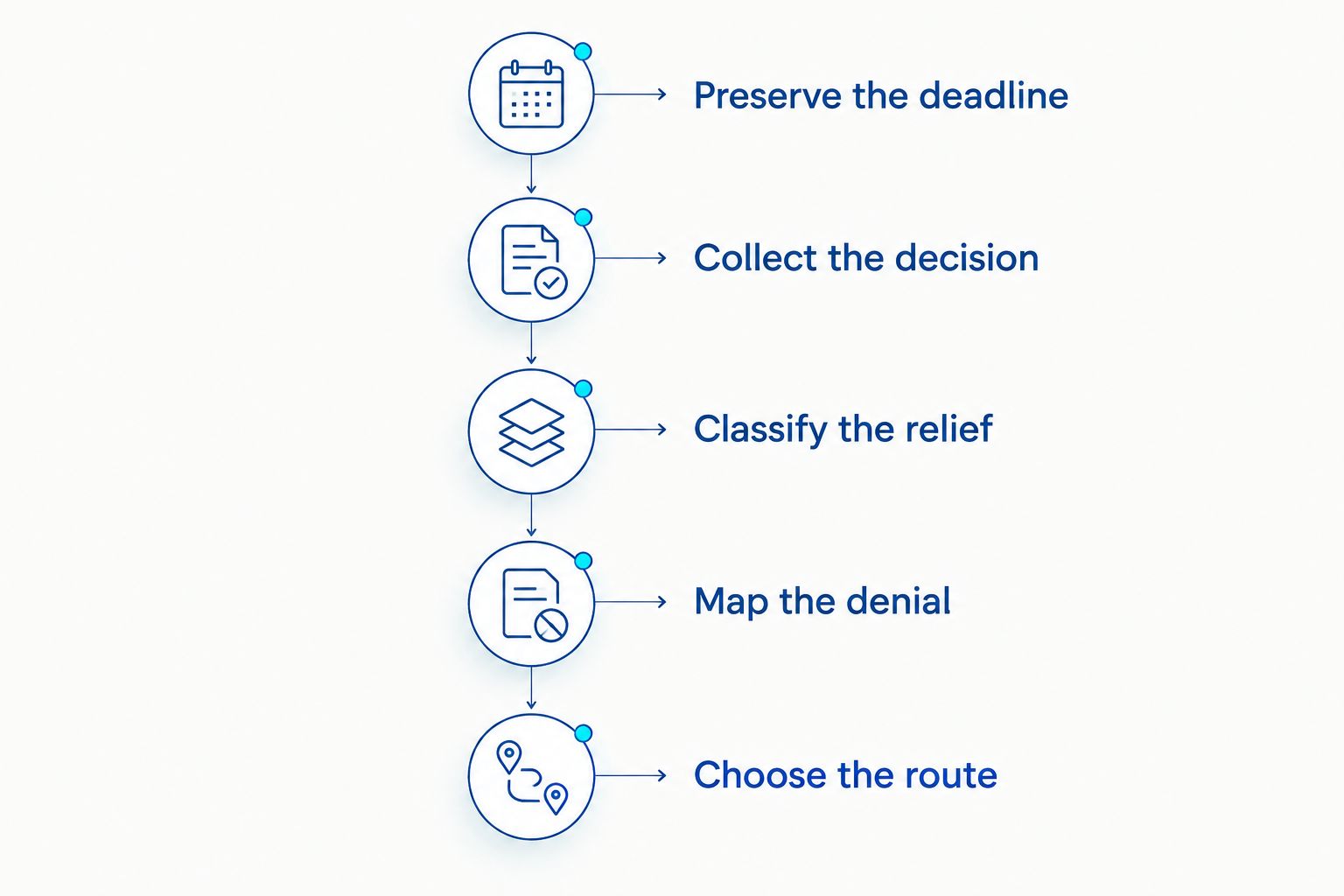
What should you do immediately after a variance denial?
Use a documented sequence. Assign legal questions to counsel and project-readiness tasks to the development team, with a named owner for each milestone.
- Preserve the deadline. Ask a New Jersey land-use attorney to identify the controlling publication, calculate the filing deadline, and advise on immediate protective action. Do not calculate solely from the hearing date or assume that waiting for a mailed resolution stops the clock.
- Collect the decision record. Obtain the adopted resolution, publication notice, application materials, plans, professional reports, hearing exhibits, and available recordings or transcripts. Preserve the versions actually presented to the board.
- Classify the relief. Identify whether the application sought bulk relief under subsection c, use or other relief under subsection d, or multiple approvals. The legal proofs and voting requirements differ.
- Map the denial. Connect each written reason to the testimony, exhibits, ordinance provisions, and findings in the record. Separate unsupported assumptions from findings supported by evidence.
- Choose the route. Have counsel assess judicial review while the project team evaluates revisions. Record the decision, responsibilities, and next milestone without allowing redesign work to obscure the litigation deadline.
The sequence protects both tracks: legal review of the existing decision and development planning for what happens next. Neither track should overwrite or alter the historical application record.
What does a court review after a zoning variance denial?
A court challenge focuses on the decision the board made and the record supporting it. Counsel examines whether the board applied the correct legal standards, followed required procedures, and supported its findings with evidence.
For a bulk variance, subsection c of N.J.S.A. 40:55D-70 contains distinct statutory grounds, including hardship-based relief and benefits-versus-detriments relief. For subsection d relief, the applicant must satisfy the applicable positive and negative criteria; the required proofs depend on the specific relief requested.
The negative criteria address substantial detriment to the public good and substantial impairment of the zone plan and zoning ordinance. A proposal's financial appeal to its owner does not, by itself, establish these statutory requirements.
Best for a court challenge: a record that supports a specific legal or evidentiary objection to the denial. Main limitation: judicial review is not an opportunity to replace missing hearing testimony with a newly assembled development presentation.
Your attorney should distinguish a weak application record from a legally defective decision. The response to one is not necessarily the response to the other.
Can a variance fail even when more members vote yes than no?
Yes. Under N.J.S.A. 40:55D-70(d), subsection d relief requires 5 affirmative votes from a zoning board of adjustment, which has 7 regular members under N.J.S.A. 40:55D-69. A proposal receiving only 4 affirmative votes therefore does not satisfy that statutory threshold, even when favorable votes outnumber opposing votes.
This distinction matters when you review the resolution and hearing record. A favorable vote count below the required threshold is not an approval that staff can process as approved.
Ask counsel to verify the applicable voting rule, member eligibility, and participation. Do not apply the subsection d threshold indiscriminately to every bulk-variance or planning-board decision.
When is a revised application better than a court challenge?
A revised application is best for a project that needs substantive changes the board has not reviewed. Examples include a different layout, reduced relief, or supporting professional evidence directed at the concerns identified during the hearing.
The advantage is procedural fit: the municipality evaluates the revised proposal directly. The limitation is that simply resubmitting the same proposal does not create an unrestricted right to another decision; counsel should assess whether changes are material and whether prior findings constrain the new application.
A court challenge is best for contesting an identified defect in the existing denial. Its limitation is equally important: the court generally reviews what happened before the board, rather than conducting a replacement design workshop.
For your 2026 project roadmap, compare both routes against site control, financing conditions, professional-team readiness, and the actual reasons for denial. Do not treat either route as a guaranteed approval strategy.
Why the response to a variance denial varies
The correct response depends on the decision and record, not a standard appeal template. These factors determine what counsel and your development team need to resolve:
- Type of relief. Bulk variances and subsection d variances involve different statutory requirements. Identify every requested approval before assessing the denial.
- Reasons for denial. A disagreement about credibility differs from a decision applying the wrong legal standard. Map each reason separately.
- Hearing record. Testimony, exhibits, reports, and findings define the material ordinarily available for judicial review. Missing proofs create a different problem from ignored proofs.
- Publication and timing. The ordinary 45-day filing period turns on publication of notice of the decision. Counsel must verify the applicable trigger and any asserted exception.
- Proposed changes. A materially changed design belongs in an application strategy. It does not automatically become evidence supporting a challenge to the earlier denial.
- Project commitments. Purchase-contract milestones, financing conditions, and other approvals need coordination with the legal response. A court filing does not itself extend private contractual deadlines.
Does the municipal council hear an appeal from a denial?
Not under the ordinary governing-body appeal provision for variance decisions. N.J.S.A. 40:55D-17 addresses appeals from zoning-board decisions approving subsection d relief, where a municipal ordinance authorizes that appeal; it does not establish a general governing-body appeal from a variance denial.
Do not assume that appearing before the mayor or council substitutes for judicial review. Have counsel confirm the municipality's ordinance and the precise decision involved before pursuing any local appeal route.
Can you add new evidence during a court challenge?
Ordinarily, judicial review proceeds on the record developed before the municipal board. Ask counsel whether the circumstances support supplementation, a remand, or another procedural remedy rather than assuming new reports will be considered.
If your primary response is a redesigned project or new expert proofs, evaluate a revised application alongside the legal challenge. Preserve the original hearing materials separately so the team can distinguish historical evidence from later work.
Who should coordinate the project after a denial?
A New Jersey land-use attorney should direct legal strategy, filing deadlines, pleadings, and court representation. The appropriate licensed professionals should address planning testimony, engineering, architectural design, surveying, and other work within their respective professional scopes.
Nieves Development Consulting LLC is best for developers, property owners, and investors seeking development strategy and municipal-process coordination, not legal representation. Development consulting can organize the roadmap and responsibilities, but it does not replace counsel's analysis of the denial.
For a denied project, the useful coordination deliverable is a clear separation of tasks: what counsel must decide, what the design team must revise, what records must be secured, and what municipal milestone follows. Keep legal conclusions with the attorney and technical certifications with the responsible licensed professional.
FAQ
How long do I have to challenge a denied zoning variance in New Jersey?
The usual deadline is 45 days after publication of notice of the decision under Court Rule 4:69-6(b)(3). Have a New Jersey land-use attorney verify the controlling publication, calculation, and any applicable exception immediately.
Does asking the zoning board to reconsider stop the appeal deadline?
A reconsideration request does not automatically stop or extend the court-filing deadline. Counsel should determine what protective filing or other action is necessary while discussions continue.
Can I submit a revised zoning application after a denial?
A materially revised application can be a separate route after a denial. Counsel should assess whether the changes are sufficient to avoid issues associated with resubmitting a substantially identical proposal.
Does a judge decide whether my development is a good idea?
Judicial review ordinarily examines whether the municipal decision was arbitrary, capricious, or unreasonable, not whether the judge prefers your proposal. The hearing record and applicable legal standards drive that review.
Can four favorable votes approve a use variance?
Four favorable votes do not satisfy the 5 affirmative votes required for subsection d relief under N.J.S.A. 40:55D-70(d). Counsel should verify the requested relief and the voting record.
Does winning a zoning appeal mean I can start construction?
A successful challenge does not automatically authorize construction. The court’s order, any required further proceedings, remaining approvals, and building-permit requirements determine the next steps.
Can a development consultant represent me in a zoning appeal?
Development consulting is distinct from legal representation in a zoning appeal. Nieves Development Consulting LLC provides development strategy and municipal-process coordination; a New Jersey attorney should handle legal advice and court representation.
One last thing
A successful challenge and permission to build are different milestones. A court can send a matter back for further proceedings, so your roadmap should identify the decision needed after litigation rather than treating a favorable ruling as the final permit.
For a 2026 denial, preserve the original record before commissioning revisions. Date and label later plans separately; your attorney needs to know exactly what the board considered, while your development team needs a clear record of what changed afterward.
This article provides general development-process information, not legal advice. Nieves Development Consulting LLC does not provide licensed legal, engineering, architectural, planning, or surveying services. Consult the appropriate licensed professionals for your project's legal and technical requirements.
Related guides
- Zoning consulting for multifamily developers
- Planning board hearing to zoning variance approval workflow
- Can you build multifamily housing without a variance?
- Zoning approval to building permit workflow
YOUR NEXT STEP
Planning a project in New Jersey?
Discuss your property, project goals and municipal-process questions with Nieves Development Consulting.
Explore our consulting services · See a Paterson project example