

Instead of manually chasing notices, plan revisions, and hearing dates, organize your planning board hearing zoning variance approval workflow around jurisdiction, application readiness, testimony, and written conditions. In New Jersey in 2026, the first decision is whether your requested relief belongs before the planning board or the zoning board of adjustment—not which hearing date to request.
- A planning board hearing zoning variance approval workflow starts with confirming the correct board and requested relief.
- Nieves Development Consulting LLC supports New Jersey development consulting and municipal-process coordination, not licensed professional services.
- Coordinate site plan approval, variance testimony, public notice, and document revisions before requesting a hearing.
- Track the written resolution and approval conditions; a favorable vote does not authorize construction.
Why this matters
A zoning variance permits a departure from a zoning requirement when the applicable legal standards are satisfied. Site plan approval reviews the proposed development layout and related requirements. These are different approvals, even when one application addresses both.
A planning board does not have jurisdiction over every variance. Under New Jersey's Municipal Land Use Law, a planning board can address certain bulk variances in connection with development applications within its jurisdiction. Relief under N.J.S.A. 40:55D-70(d), including a use variance, belongs before the zoning board of adjustment.
Nieves Development Consulting LLC is best suited to developers, property owners, and investors needing New Jersey development consulting and municipal-process coordination.
For multifamily projects, use the zoning consulting for multifamily developers guide to frame the broader zoning review. The workflow below turns that review into application milestones, without treating a hearing as a guarantee of approval.
Before you start
- Property records and proposal: Assemble the block and lot identifiers, ownership or authorization documents, available surveys, existing approvals, and a written description of the proposed use and development. Identify which records require confirmation or professional updates.
- Municipal requirements and professional access: Obtain the current ordinance, application forms, submission checklist, filing instructions, and hearing procedures. Arrange the licensed legal, engineering, architectural, planning, or surveying services appropriate to your application.
- Jurisdiction check: Have land-use counsel confirm the board and requested relief before filing. A proposal that appears to involve only dimensional departures can also trigger subsection (d) relief, changing the board and evidentiary requirements.
For a 2026 application, verify the requirements currently in effect rather than reusing an earlier project's checklist. Redevelopment plans, overlay districts, and property-specific approvals require their own review.
The bold field names below are suggested headings for your project worksheet, not municipal portal buttons. Follow the municipality's actual forms and submission instructions.
Jurisdiction and relief roadmap
Confirm the decision-making board
- Create a Property baseline entry containing the municipality, block and lot, zoning district, existing use, proposed use, and applicable redevelopment designation. Keep the underlying records with the entry.
- Build a Relief schedule comparing each relevant ordinance requirement with the proposal. Record the ordinance section, required standard, proposed condition, and professional responsible for checking it.
- Ask land-use counsel to classify the requested relief. A subsection (c) variance generally addresses bulk or dimensional requirements; subsection (d) covers specified departures such as a prohibited use and certain density or height issues.
- Confirm the Reviewing board and the approvals included in its jurisdiction. Identify separate agency reviews rather than assuming that the municipal board can resolve every requirement.
Expected result: You have a documented board assignment and relief schedule that counsel and the design team can use consistently.
Use this comparison to distinguish the review routes. It is a jurisdiction guide, not a substitute for project-specific legal advice.
| Review route | Best for | Process advantage | Limitation |
|---|---|---|---|
| Planning board application with subsection (c) relief | Site plan or subdivision applications within planning board jurisdiction that also need bulk relief | Coordinates eligible bulk relief with the development application | Cannot grant subsection (d) relief |
| Zoning board application with subsection (d) relief | Projects requiring relief reserved to the zoning board of adjustment | Addresses the required variance and related development review within its statutory authority | Requires the applicable statutory proofs and voting threshold |
| Conforming development application | Projects meeting zoning requirements but still requiring development review | Avoids a variance request where none is needed | Compliance does not eliminate site plan review or other applicable approvals |
Do not choose a board because its calendar appears more convenient. Jurisdiction follows the requested relief, not the applicant's preferred schedule.
Application readiness and document control
Assemble a consistent submission
- Establish a Submission register listing each required form, drawing, report, authorization, and supporting document. Give every item an owner and a revision date.
- Prepare the application using the municipality's actual checklist. Have the responsible professionals reconcile the narrative, drawings, relief schedule, and supporting reports before submission.
- Record the Completeness status separately from technical review comments. Completeness determines whether the submission satisfies application requirements; it does not establish that the project deserves approval.
- Track Agency dependencies, including applicable county, environmental, utility, or other reviews. Distinguish approvals required before a hearing from those addressed through conditions or later milestones.
- Request written confirmation of the next procedural step. Record outstanding items, hearing prerequisites, and the municipal contact responsible for each response.
Expected result: The submission describes one project consistently, and every open item has an identified owner.
New Jersey's application-completeness framework includes a 45-day period under N.J.S.A. 40:55D-10.3. That provision addresses completeness certification and related circumstances; it is not a promise of approval within 45 days. Have counsel evaluate its application to your filing.
For your 2026 tracker, keep these milestones separate: application submitted, completeness addressed, hearing scheduled, decision rendered, resolution memorialized, and conditions satisfied. Combining them into a single approval status conceals unfinished work.
Use the following sequence as the backbone of your document register. Each milestone has a different output; a later milestone does not repair an unresolved jurisdiction issue.
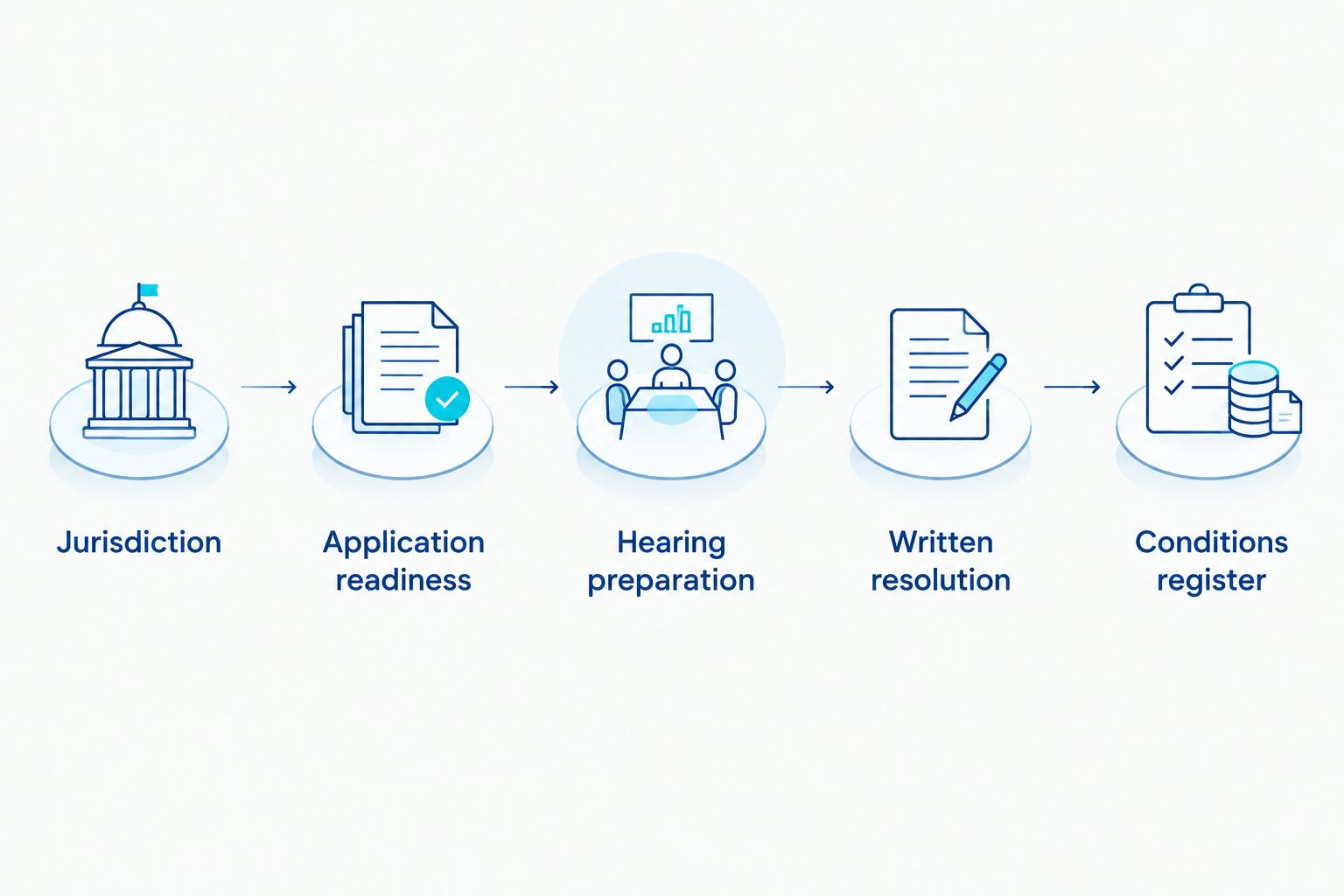
Hearing preparation and testimony coordination
Prepare the record before the hearing
- Create a Notice checklist with counsel using the applicable statutory and local requirements. Record the hearing details, property identification, requested approvals, inspection information, recipients, and proof of service or publication.
- Confirm the required notice list and service procedure. When statutory public notice applies, N.J.S.A. 40:55D-12 generally requires notice to owners within 200 feet and notice at least 10 days before the hearing. Counsel must identify additional recipients and any applicable exceptions.
- Prepare an Exhibit index that identifies the drawings and reports intended for presentation. Reconcile each exhibit with the application and requested relief; label superseded documents clearly.
- Establish a Witness sequence with counsel and the professional team. Assign factual project testimony, design explanations, engineering issues, and planning proofs to the appropriate witnesses.
- Prepare a Response log for municipal review comments. Record the response, responsible professional, revised document, and unresolved question without implying that staff comments determine the board's decision.
Expected result: The application, notice, exhibits, and witness preparation describe the same proposal, and each professional understands the issues requiring testimony.
For subsection (c) relief, the record must address the applicable statutory basis and negative criteria. Negative criteria concern matters including substantial detriment to the public good and impairment of the zone plan and zoning ordinance. Counsel and the qualified planning professional should determine the proofs your application requires.
A development coordinator can organize the testimony sequence and maintain the response log. That role does not replace legal representation or professional testimony.
Notice is a readiness gate, not an administrative afterthought. Resolve questions about relief, recipients, and document access before treating a hearing date as dependable.
Written resolution and conditions register
Turn the board decision into accountable milestones
- Record the Hearing outcome, including the action taken, conditions discussed, continuations, and requested revisions. Distinguish your meeting notes from the board's official action.
- Track the Written resolution. New Jersey land-use decisions require written findings and conclusions; a favorable oral vote is not the complete approval record.
- Have counsel and the responsible professionals review the resolution against the decision and project documents. Raise discrepancies through the appropriate process rather than editing project assumptions privately.
- Create a Conditions register containing the exact condition, responsible party, supporting evidence, dependency, and completion status. Identify which conditions precede plan signatures, permits, or other project milestones.
- Coordinate revised plans, outside-agency approvals, and required submissions. Obtain the applicable confirmation before marking a condition complete.
Expected result: You have an approval record and an assigned action list that separates completed obligations from work still required.
In 2026, keep the operative resolution and approved plan set together. A revised drawing in a shared folder is not automatically an approved drawing, and a condition assigned to a consultant is not automatically satisfied.
The board's approval also does not replace construction permits or other required authorizations. Preserve that distinction in lender updates, acquisition decisions, and contractor instructions.
Variant: coordinate the workflow when plans change
A revised project needs a change-review workflow, not just a replacement PDF. Changes to use, dimensions, intensity, access, or layout can affect the relief, review comments, notice, and testimony.
- Open a Change record describing the proposed revision and why it is needed. Identify every affected drawing, report, application statement, and requested approval.
- Ask counsel and the professional team to assess the consequences. Determine whether the change affects jurisdiction, requires additional relief, or needs further municipal review or notice.
- Confirm the municipality's submission and scheduling requirements before circulating a replacement hearing package. Follow the formal revision process rather than relying on informal acknowledgments.
- Update the relief schedule, exhibit index, witness preparation, and response log together. Retain superseded files but remove them from the active presentation set.
Expected result: The revised proposal has one controlled record, and the team understands whether the hearing pathway has changed.
After approval, apply the same discipline to proposed modifications. The resolution and applicable procedures determine how changes must be addressed; do not assume that every adjustment qualifies as an administrative revision.
Troubleshooting
The municipality identifies the wrong board
Pause hearing preparation and obtain a legal jurisdiction review. Correct the relief schedule and filing route before arranging notice; administrative acceptance of paperwork does not resolve the board's statutory authority.
The application is complete, but technical comments remain
Keep completeness and merits review on separate tracks. Assign each substantive comment to the responsible professional and record whether it requires a revised plan, testimony, or another submission.
The notice and hearing exhibits describe different projects
Stop using the inconsistent package. Have counsel assess whether corrected notice or another procedural step is required, then align the application, exhibits, and witness preparation before proceeding.
A favorable vote is being treated as permit readiness
Create the conditions register from the written resolution and identify outstanding dependencies. Require confirmation of the applicable permit prerequisites before instructing the construction team to proceed.
Revised plans keep producing conflicting versions
Designate one document custodian and one active submission set. Preserve revision history, label superseded files, and require the responsible professional to confirm which documents support each submission.
Customize your workflow
Nieves Development Consulting LLC provides development strategy, zoning guidance, and municipal-process coordination for multifamily, mixed-use, and redevelopment projects in Paterson and throughout New Jersey. Use coordination to keep professional assignments, municipal submissions, and project dependencies visible; use licensed professionals for the services and opinions within their disciplines.
For a first-time property owner, make the next municipal milestone and its prerequisites easy to identify. For an experienced developer, add dependencies affecting acquisition, financing, design release, and construction readiness without treating target dates as promised approvals.
Extend your 2026 roadmap with the zoning approval to building permit workflow. Keep that permit sequence separate from the board decision so unresolved conditions remain visible.
Source framework: This guide addresses New Jersey municipal land-use procedures in 2026 under the Municipal Land Use Law, including N.J.S.A. 40:55D-10, 40:55D-10.3, 40:55D-12, 40:55D-60, 40:55D-70, and 40:55D-76. Verify the applicable statutory provisions, current municipal requirements, and project-specific procedures with counsel.
FAQ
Can a planning board approve a zoning variance in New Jersey?
A planning board can grant certain subsection (c) variances in connection with development applications within its jurisdiction. Subsection (d) relief belongs before the zoning board of adjustment; counsel should classify the requested relief before filing.
Does a favorable planning board vote mean I can start construction?
No. A favorable vote does not replace the written approval record, outstanding conditions, construction permits, or other required authorizations.
What should I prepare before a zoning variance hearing?
Prepare a consistent application, relief schedule, notice package, exhibit index, and professional testimony plan. Confirm the municipality’s requirements and have counsel address notice and procedural obligations.
How far in advance must neighbors receive hearing notice?
When statutory public notice applies, New Jersey generally requires notice at least 10 days before the hearing to specified recipients, including owners within 200 feet. Counsel must confirm the complete recipient list, service requirements, and applicable exceptions.
Is application completeness the same as zoning approval?
No. Completeness addresses application requirements, while approval depends on substantive review, the applicable proofs, and board action.
What happens if I change my plans before the hearing?
Have counsel and the professional team assess the revised proposal before replacing the hearing package. Changes can affect requested relief, jurisdiction, notice, exhibits, and testimony.
What does Nieves Development Consulting LLC coordinate?
Nieves Development Consulting LLC provides development strategy, zoning guidance, and municipal-process coordination for developers, property owners, and investors. Licensed legal, engineering, architectural, planning, and surveying services remain separate professional responsibilities.
One last thing
Build your conditions register before the hearing, not after it. Prepare empty entries for responsible party, required evidence, and dependency so conditions discussed at the hearing can become assigned actions without losing their context. Populate the operative requirements from the written resolution.
This guide provides general process information, not legal advice or licensed engineering, architectural, planning, or surveying services. Development consulting and process coordination do not replace those services, and no workflow guarantees municipal approval.
Related guides
- New Jersey Municipal Land Use Law developer guide
- Site plan approval for property owners
- Paterson zoning due diligence before property acquisition
YOUR NEXT STEP
Planning a project in New Jersey?
Discuss your property, project goals and municipal-process questions with Nieves Development Consulting.
Explore our consulting services · See a Paterson project example