

You generally cannot obtain a final certificate of occupancy before the required final inspections are completed and accepted in New Jersey. A temporary certificate of occupancy is a separate, conditional authorization that the construction official can issue when the proposed occupancy meets applicable safety requirements; it is not permission to skip inspections or occupy an unsafe building.
- Can you get a certificate of occupancy before final inspection? In New Jersey, distinguish final approval from temporary authorization.
- A temporary certificate of occupancy requires the construction official’s authorization, not just a contractor’s assurance of readiness.
- Unfinished work does not automatically qualify a project for temporary occupancy.
- Nieves Development Consulting LLC provides New Jersey development consulting and municipal-process coordination, not municipal approval.
Can you get a certificate of occupancy before final inspection?
Not a final certificate of occupancy when required final inspections remain outstanding. New Jersey’s Uniform Construction Code addresses certificates of occupancy under N.J.A.C. 5:23-2.23. That framework distinguishes completed-work certification from temporary authorization to occupy before all permitted work is complete.
For your 2026 project, the practical question is whether you need final closeout or a temporary occupancy determination. The site plan approval to certificate of occupancy workflow explains the broader sequence; neither site plan approval nor a construction permit independently authorizes occupancy.
| Occupancy status | What it means | Best suited to | Limitation |
|---|---|---|---|
| Final certificate of occupancy | Required inspections and applicable completion requirements have been satisfied | Occupancy after final project closeout | Outstanding required inspections prevent final closeout |
| Temporary certificate of occupancy | The construction official authorizes occupancy subject to stated limits and conditions | Safe occupancy before all permitted work is complete | It does not replace remaining inspections or final certification |
| No occupancy certificate issued | Occupancy authorization has not been granted | Continuing construction and preparing for inspection | An application, inspection request, or verbal assurance does not authorize occupancy |
The distinction is before all work is complete, not before safety has been evaluated. Temporary occupancy remains an official determination supported by the inspections and documentation the construction official requires.
Why this matters
An anticipated move-in date is a scheduling target. An issued occupancy certificate is an authorization. Treating them as interchangeable creates a gap between your construction schedule, tenant commitments, and municipal readiness.
For a multifamily or mixed-use project, separate the readiness of individual spaces from the readiness of shared systems. A finished apartment does not establish that the stairs, fire protection, utilities, or access serving it are ready for occupancy.
Use an occupancy roadmap that identifies the requested area, outstanding work, responsible professionals, and municipal decisions. That roadmap supports coordination; it does not predetermine the construction official’s decision.
Final certificate of occupancy: completed-work closeout
A final certificate of occupancy is the endpoint of the applicable construction-code closeout process, not a substitute for that process. Required final inspections must be accepted, and applicable documentation and conditions must be resolved before issuance.
An inspection booking is not an inspection result. Likewise, a contractor’s statement that work is finished does not establish that the enforcing agency has accepted it.
For your 2026 closeout, distinguish these milestones in the project record:
- Inspection requested: The responsible party has asked for an inspection.
- Inspection performed: An inspector has reviewed the relevant work.
- Inspection accepted: The enforcing agency has accepted that inspection, with any required corrections resolved.
- Certificate issued: The occupancy authorization has actually been issued.
These milestones belong in separate tracking fields. Combining them under a single status such as complete conceals unresolved dependencies and makes handover planning less reliable.
Also confirm that you are requesting the correct municipal document. A construction-code certificate of occupancy and a locally required resale or continued-occupancy document are not automatically interchangeable. Ask the issuing office which requirement applies to the property and proposed use.
Temporary certificate of occupancy: conditional authorization
A temporary certificate of occupancy, often called a TCO, addresses occupancy before all permitted work is complete. Under New Jersey’s construction-code framework, the construction official must determine that the authorized occupancy can occur safely.
A TCO is not an exception to safe occupancy requirements. It is a separate authorization with a defined scope, duration, and conditions. Read the issued document rather than assuming that approval covers the entire property.
Temporary occupancy offers a route to occupying an authorized area while qualifying unfinished work remains. Its limitation is equally important: the owner still must address outstanding work and obtain the required final closeout.
For a 2026 TCO request, ask the construction office to identify:
- The spaces or portions proposed for occupancy.
- The inspections and supporting documents needed for its determination.
- The work that must be completed before occupancy.
- The work permitted to remain outstanding, if any.
- The certificate’s expiration and conditions.
- The process for resolving remaining work and pursuing final certification.
Do not assume that a TCO will be issued because another project received one. The determination concerns the actual building, proposed occupancy, and outstanding conditions presented to the official.
Why occupancy authorization varies
The central issue is not whether the remaining work looks minor. It is whether the proposed occupancy satisfies applicable requirements while that work remains unfinished.
These factors shape the review:
- Remaining work: Unfinished finishes and unresolved life-safety work present different occupancy questions. The enforcing agency determines their significance.
- Occupancy boundaries: A request involving part of a building needs a clear description of the spaces included and excluded.
- Shared systems: Occupied areas depend on the systems and common areas serving them, not only work inside the tenant space.
- Inspection status: Requested, failed, incomplete, and accepted inspections represent different readiness conditions.
- Approval conditions: Applicable zoning, land-use, or other approval conditions can create separate closeout dependencies.
- Documentation: Required certifications, test records, and inspection reports must match the work and proposed occupancy.
For example, an unfinished area elsewhere in a building is not automatically irrelevant to a completed tenant space. Ask whether construction access, shared exits, or building systems connect the unfinished work to the proposed occupied area.
For mixed-use properties, identify each proposed use clearly. Do not treat residential and commercial readiness as identical merely because both occupy the same building.
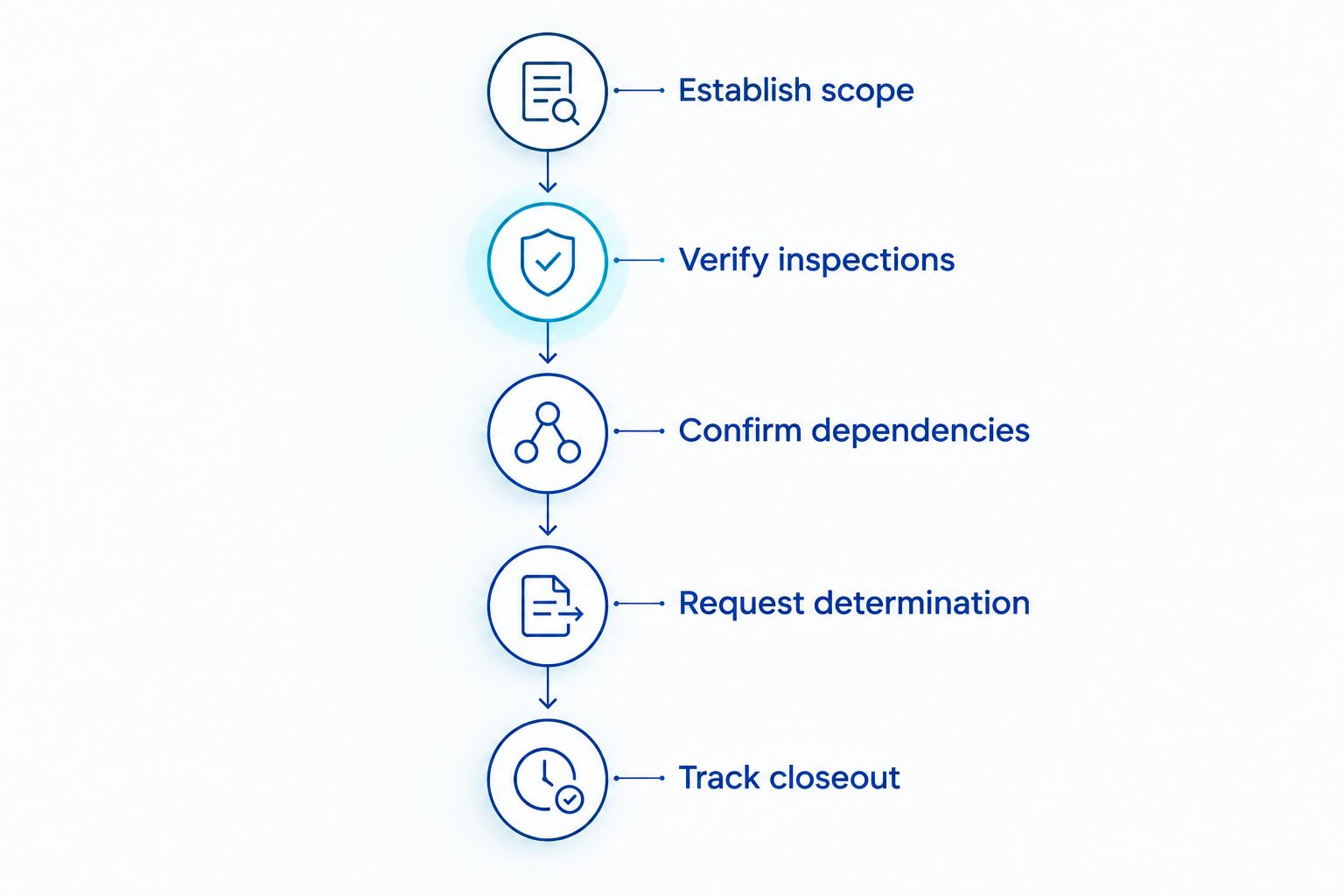
How do you prepare an occupancy-readiness request?
Prepare a coordinated request that lets the construction office evaluate a defined proposal. A general statement that the project is almost finished does not identify the outstanding issues or the decision you need.
Establish scope
Describe the proposed occupied area, intended use, and work remaining outside it. Use current project documents so the municipality and project team are discussing the same spaces.
If you are requesting phased occupancy, identify the phase explicitly. Do not assume that permission for a particular area extends to later phases or other uses.
Verify inspections
Reconcile inspection records with the construction office and responsible contractors. Identify inspections that remain unscheduled, corrections that remain open, and documentation that has not been accepted.
Maintain a correction log that names the issue, responsible party, and evidence needed for resolution. Keep contractor completion separate from municipal acceptance.
Confirm dependencies
Ask which outstanding conditions affect occupancy and which require input from licensed professionals or other municipal offices. Identify shared systems and access arrangements that serve the proposed occupied area.
A condition attached to a land-use approval does not disappear because construction is substantially complete. Confirm its status with the office responsible for that condition.
Request determination
Present the proposed occupancy scope and readiness record to the construction office. Ask what remains necessary for final certification or consideration of temporary occupancy.
Record the response accurately. An informal discussion about a possible route is not an issued certificate.
Track closeout
After a temporary certificate is issued, track its conditions and expiration alongside remaining inspections. Assign responsibility for each unresolved item and retain the supporting records.
Your 2026 project schedule should show occupancy authorization and final closeout as separate milestones whenever a temporary certificate is involved.
Who coordinates the work, and who authorizes occupancy?
The construction official makes the occupancy determination under the applicable construction-code process. Contractors and licensed professionals address their respective work, inspections, technical documents, and professional responsibilities.
A development consultant coordinates the roadmap: outstanding items, municipal communications, responsible parties, and milestones. Coordination does not replace inspection, professional certification, or the official’s decision.
Nieves Development Consulting LLC serves New Jersey developers, property owners, and investors who need development consulting and municipal-process coordination. That role is relevant when several approval tracks and project participants must reach the same readiness milestone.
The real estate development consultant in New Jersey guide explains that coordination role. Its boundary matters: consulting support is not a licensed professional sign-off or an authorization to occupy.
Can you move in while the final inspection is pending?
A pending final inspection is not permission to move in. Obtain the occupancy authorization applicable to the space before allowing occupancy, including any temporary certificate the construction official has issued.
A lease commencement date, scheduled delivery, or contractor handover does not change the certificate requirement. Match the actual occupied area and use to the authorization, not merely to the address shown on project correspondence.
Does passing the final inspection mean you can occupy immediately?
Passing a final inspection does not, by itself, establish that the certificate has been issued. Other required inspections, documents, or applicable conditions can remain unresolved.
Ask the issuing office to confirm the certificate’s status and obtain the actual document. For 2026 handover planning, use certificate issuance—not an expected inspection result—as the occupancy milestone.
Can part of a building receive temporary occupancy?
Temporary occupancy can apply to an authorized portion of a building when the construction official finds the proposed occupancy acceptable. A completed floor or unit is not automatically eligible simply because work continues elsewhere.
Define the area requested and address the systems, exits, and access that serve it. The issued certificate controls the authorized scope and conditions.
FAQ
Can you get a certificate of occupancy before final inspection in New Jersey?
You generally cannot obtain a final certificate of occupancy while required final inspections remain outstanding. A temporary certificate is a separate authorization that depends on the construction official’s determination and applicable requirements.
Is a temporary certificate of occupancy the same as a final certificate?
No. A temporary certificate authorizes occupancy subject to its scope, duration, and conditions, while remaining work and final closeout obligations continue.
Can I move furniture in before the certificate of occupancy is issued?
Do not assume furniture delivery is authorized occupancy or an approved pre-occupancy activity. Ask the construction office what access and activities are permitted before the certificate is issued.
Does a passed electrical inspection mean the building can be occupied?
No. Acceptance of an electrical inspection does not establish that all occupancy requirements are satisfied or that an occupancy certificate has been issued.
Can a contractor promise that I will receive temporary occupancy?
No contractor can issue or guarantee a temporary certificate of occupancy. The construction official determines whether the requested authorization satisfies applicable requirements.
Can a development consultant help coordinate occupancy readiness?
Nieves Development Consulting LLC provides development consulting and municipal-process coordination for New Jersey projects. That role is distinct from municipal inspection, certificate issuance, and licensed professional services.
One last thing
Track the certificate, not just the punch list. A punch list records remaining construction tasks; it does not necessarily capture inspection acceptance, outstanding approval conditions, or whether occupancy has been authorized.
Keep the issued certificate with the project’s closeout records and read its scope and conditions before handover. If it is temporary, retain a separate roadmap for final certification rather than treating occupancy as the end of the municipal process.
This article provides general process information, not a project-specific code determination or legal advice. Nieves Development Consulting LLC provides development consulting and process coordination, not licensed legal, engineering, architectural, planning, or surveying services. Confirm applicable requirements with the enforcing agency and retain appropriately licensed professionals for work requiring those services.
Related guides
- Zoning approval to building permit workflow
- Site plan approval for property owners
- Land-use consulting for adaptive reuse projects
YOUR NEXT STEP
Planning a project in New Jersey?
Discuss your property, project goals and municipal-process questions with Nieves Development Consulting.
Explore our consulting services · See a Paterson project example