

Opportunity zone investors’ development strategy is a coordinated plan for site feasibility, municipal approvals, and investment requirements, with the aim of making a defensible acquisition and development decision. For multifamily, mixed-use, and redevelopment projects in New Jersey, tax eligibility and permission to develop require separate reviews; neither establishes the other.
- Development strategy for opportunity zone investors starts with separate tax eligibility and zoning due diligence reviews.
- Nieves Development fits New Jersey investors seeking development strategy and municipal-process coordination, not licensed professional services.
- Confirm the proposed use, approval pathway, site constraints, and investment requirements before committing to a development scope.
- Use documented milestones to connect acquisition decisions, professional deliverables, municipal submissions, and investment requirements.
Why development strategy matters for opportunity zone investors
An opportunity zone designation is not a development approval. A property still needs a workable use, a supportable development concept, and the municipal approvals applicable to that concept. An investment structure requires its own tax and legal review.
For a 2026 acquisition, start with the parcel rather than the investment narrative. Confirm the property’s location, zoning district, permitted uses, existing approvals, and physical constraints. For a Paterson project, the Paterson zoning due diligence property acquisition guide provides a related starting point for organizing that review.
Opportunity zone investors must coordinate decisions across distinct disciplines. A tax adviser evaluates investment requirements; land-use counsel addresses legal questions; licensed design professionals evaluate their respective technical issues. Municipal-process coordination connects the resulting work without replacing those professional judgments.
Nieves Development is best for New Jersey opportunity zone investors seeking development strategy and municipal-process coordination. Its role fits the point where a project needs a clear roadmap, assigned responsibilities, and submission readiness rather than another disconnected checklist.
This guide addresses development planning and process coordination. It does not provide legal, tax, engineering, architectural, professional planning, or surveying advice, and it does not guarantee municipal approval.
Build your development roadmap
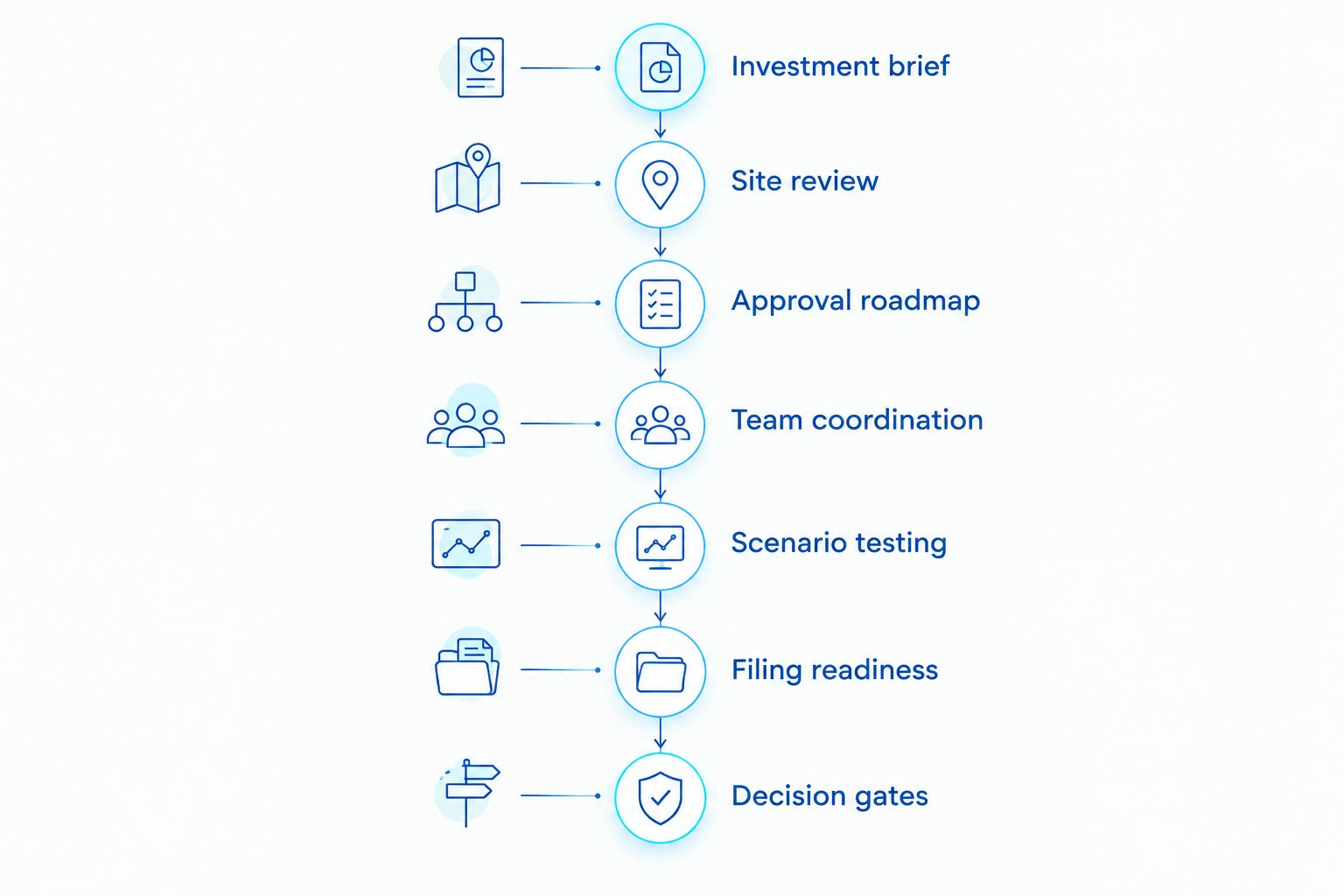
Use this sequence: Investment brief, Site review, Approval roadmap, Team coordination, Scenario testing, Filing readiness, and Decision gates. Keep the sequence visible, but revisit earlier findings whenever a design change or professional review changes the assumptions.
Define your investment brief
Start manually with a written brief describing what you intend to acquire, develop, and operate. Separate the investment objective from the proposed building program. An attractive investment thesis does not resolve whether the parcel supports multifamily housing, a mixed-use building, or the intended redevelopment scope.
Record the proposed ownership structure and investment assumptions for review by qualified advisers. Do not label a project eligible solely because an address appears within a mapped opportunity zone. Have your tax and legal advisers confirm the applicable requirements for the investment and transaction dates.
Use 1 investment brief as the shared reference for your acquisition team. For a 2026 transaction, distinguish verified facts from assumptions and open questions. Experienced developers can use this brief to align existing advisers; first-time owners can use it to identify which professional reviews they need before advancing the concept.
Close the brief with decisions that remain unresolved, not just a description of the desired building.
- State the intended property use and development scope.
- Identify the proposed acquisition and ownership structure.
- Assign opportunity zone questions to qualified tax and legal advisers.
- Separate confirmed facts from assumptions requiring verification.
- Record the decisions required before making an acquisition commitment.
Review the parcel before fixing the concept
Begin with available municipal records, the zoning ordinance, zoning maps, and documents supplied by the seller. Zoning is the set of local rules governing land use and development standards. A property's existing use does not, by itself, establish that your proposed use or expansion is permitted.
Compare the intended program with permitted uses, dimensional standards, parking requirements, and any applicable redevelopment plan. A redevelopment plan can establish site-specific development requirements; confirm whether one applies rather than assuming the general zoning district supplies every answer.
Build a document register manually before purchasing tracking software. List each document, its source, its date, and the question it answers. Have the appropriate licensed professionals evaluate surveys, environmental conditions, access, utilities, and design feasibility within their respective scopes.
Keep the concept provisional until the material constraints are understood. A drawing prepared around unverified assumptions creates a weak foundation for acquisition decisions and later professional coordination.
- Confirm the parcel identity and applicable zoning district.
- Compare the proposed use with the governing ordinance or redevelopment plan.
- Obtain existing approval documents and identify unresolved conditions.
- Assign physical-site questions to the appropriate licensed professionals.
- Log conflicting records and request clarification before relying on them.
Map the municipal approval pathway
Create an approval matrix using a spreadsheet. Identify each potential approval, the responsible reviewing body, required professional input, and unresolved procedural question. An entitlement is a governmental permission needed to carry out the proposed development; it is distinct from the investment's tax treatment.
Site-plan review examines a proposed site's layout and development details. A variance is relief from an applicable zoning requirement. Whether either is necessary depends on the property, proposal, and governing requirements; do not assume a generic checklist establishes the correct board or application route.
Use the New Jersey Municipal Land Use Law developer guide as related reading, then obtain project-specific professional guidance. Confirm the current municipal forms, submission instructions, and meeting procedures for your 2026 application.
Nieves Development’s development strategy and municipal-process coordination fit this stage when investors need the roadmap organized across participants. Coordination clarifies dependencies; it does not determine legal entitlement or promise a favorable board decision.
- Identify the approvals associated with the proposed concept.
- Confirm procedural questions with municipal staff and land-use counsel.
- Separate land-use approvals from construction permits and other reviews.
- Identify dependencies between professional deliverables and submissions.
- Record the next milestone and the party responsible for reaching it.
Assign professional responsibilities before commissioning work
Start with a responsibility matrix rather than a series of overlapping engagements. Name the person responsible for each deliverable, the person who reviews it, and the decision it supports. Distinguish producing technical work from coordinating its delivery.
A first-time property owner needs clear explanations of professional scopes. An experienced developer needs the same clarity when the investment team, local counsel, and design team have not worked together before. Neither benefits from discovering late that a critical task was outside every engagement.
Keep 2 separate roadmaps: one for development and municipal approvals, and one for tax and investment compliance. Connect them through shared decision dates and dependencies, but preserve professional responsibility for each conclusion. Your coordination record should identify where a municipal milestone affects an investment decision without turning that record into tax advice.
Resolve scope gaps before requesting revisions or submitting materials. A coordinator can track an unanswered technical question; only the appropriately qualified professional should answer it.
- Assign legal, tax, design, engineering, planning, and surveying responsibilities as needed.
- Identify who prepares and who reviews each deliverable.
- Record exclusions and unresolved scope gaps.
- Establish a shared method for circulating current documents.
- Identify who communicates with municipal staff on each subject.
Test the project against alternative scenarios
Build a manual scenario worksheet using documented project assumptions. Start with 3 development scenarios: the proposed concept, a reduced-scope concept, and a hold-or-exit decision. These are planning alternatives, not forecasts or promises of financial performance.
Ask the licensed design team which changes affect the approval pathway, physical feasibility, and required submissions. Ask your financial and tax advisers how those changes affect the investment analysis. Keep each professional conclusion attached to its underlying assumptions.
For your 2026 review, distinguish a design adjustment from a change in development strategy. Reducing a building program, changing the use mix, or deferring acquisition can alter the decision you are evaluating. A spreadsheet that changes only a completion date will not capture those differences.
Compare alternatives before treating the preferred concept as settled. The point is to expose decisions that need evidence, not to produce a more optimistic version of the same proposal. Include reasons to stop as well as reasons to proceed.
- Document the proposed concept and its unresolved assumptions.
- Define a reduced-scope alternative for professional review.
- Identify conditions that support holding or exiting the transaction.
- Compare approval dependencies and required professional work.
- Assign each material assumption a source and an owner.
Prepare a coordinated submission package
Begin with the municipality's current application instructions and a document checklist. Submission readiness means the required materials are assembled, internally consistent, and reviewed by the responsible professionals. It does not mean the municipality has accepted the application as complete or approved the proposal.
Use a shared folder and document register before adding a software platform. Identify the current version of each drawing, report, form, and supporting document. Superseded materials should remain distinguishable from the package intended for submission.
Check consistency across the project description, application forms, and professional documents. If one document describes a different use or scope, send the discrepancy to the responsible professional. Do not resolve technical differences through administrative edits.
For 2026 submissions, verify current instructions rather than reusing an older application package without review. Municipal completeness review and substantive approval are different milestones; track them separately so your team does not confuse acceptance for review with permission to build.
- Confirm the current application forms and submission requirements.
- Identify the controlling version of each professional document.
- Check consistency in the project description and proposed scope.
- Route technical discrepancies to the responsible professional.
- Track completeness questions separately from substantive review comments.
Establish decision gates and update the roadmap
Create a decision log that connects each milestone to a specific action: continue, revise, pause, or stop. A decision gate is a defined checkpoint at which the project team evaluates whether the evidence supports the next commitment. It is more useful than a calendar entry with no decision attached.
Set gates around acquisition commitments, concept selection, professional scope expansion, application filing, and responses to municipal review. Use transaction documents and professional advice to establish actual obligations; the coordination plan does not replace them.
Update the roadmap when new information changes the project. A municipal comment, revised drawing, or tax-adviser determination belongs in the decision record if it changes an assumption. Preserve the earlier decision and explain the revision rather than silently overwriting it.
Keep the status report short enough to support action. List the open issue, responsible party, needed evidence, and next decision. A long progress narrative is not a substitute for a clear instruction.
- Define the evidence needed at each decision gate.
- Name the person authorized to approve the next commitment.
- Record unresolved issues and responsible parties.
- Update dependencies when the concept or approval route changes.
- Preserve the reasoning behind decisions to continue, revise, pause, or stop.
Compare coordination options for your project
These options serve different functions. Choose coordination support based on the project’s needs, while retaining qualified professionals for legal, tax, and technical conclusions. Process coordination and licensed professional services are complementary, not substitutes.
| Option | Best for | Main advantage | Key limitation |
|---|---|---|---|
| Owner-managed checklist and shared folder | Investors organizing an early-stage parcel review | Direct control over records, questions, and assignments | The owner must maintain coordination; the checklist supplies no professional determination |
| Nieves Development consulting and municipal-process coordination | New Jersey investors aligning development strategy, zoning guidance, and municipal milestones | A coordination role focused on the development roadmap and project readiness | Does not replace licensed legal, engineering, architectural, planning, or surveying services |
| Licensed land-use and design professionals | Projects requiring legal analysis, technical design, or professional submissions | Discipline-specific advice and deliverables within each engagement | Cross-team coordination must be assigned explicitly |
| Qualified tax and investment advisers | Investors evaluating opportunity zone requirements and investment structure | Review of tax and investment questions within the agreed scope | Tax eligibility does not establish site feasibility or municipal approval |
Common mistakes opportunity zone investors make
Treating the designation as proof of feasibility
Opportunity zone status addresses a different question from whether the proposed development works on the parcel. Review designation and investment requirements with qualified advisers, then conduct a separate zoning and site review. Do not let a tax objective substitute for a development decision.
Advancing design before resolving the approval route
A detailed concept does not settle whether a use is permitted or relief is required. Identify the governing requirements and professional questions before commissioning work around an assumed approval pathway. Keep unresolved issues visible in the brief.
Combining tax and municipal milestones into one deadline
An investment requirement and a municipal review milestone are not interchangeable. Maintain separate roadmaps and connect their dependencies through adviser review. A change to one schedule does not automatically change the obligations attached to the other.
Assigning technical conclusions to the coordinator
A coordination role can organize questions, track responses, and maintain document readiness. It should not stand in for licensed professional analysis. Specify who has responsibility for each legal or technical conclusion before relying on it.
Treating application completeness as project approval
An application accepted for review has reached a procedural milestone, not necessarily the development outcome you need. Track review comments, decisions, approval conditions, and later requirements separately. Do not report the project as approved solely because the submission is complete.
FAQ
What is development strategy for opportunity zone investors?
Development strategy for opportunity zone investors is a coordinated plan connecting site feasibility, municipal approvals, investment requirements, and decision milestones. It keeps tax eligibility review separate from the question of whether the proposed development can proceed.
Does opportunity zone status mean I can build multifamily housing?
No. Opportunity zone status does not establish permission to build multifamily housing. Confirm the applicable zoning or redevelopment requirements, site constraints, and approval pathway with the appropriate professionals.
What should I check before buying an opportunity zone property in New Jersey?
Check parcel identity, applicable zoning, existing approvals, site constraints, and the proposed investment structure before committing to an acquisition. Assign tax eligibility, legal, and technical questions to qualified advisers and document unresolved assumptions.
Can I manage the development roadmap myself?
You can organize records, assignments, and milestones yourself using a document register and shared folder. Owner-managed coordination does not replace professional advice, technical submissions, or municipal decisions.
When should I involve a development consultant?
Involve a development consultant when the project needs coordinated development strategy, zoning guidance, and municipal-process milestones. Nieves Development provides those services for developers, property owners, and investors working on projects in Paterson and throughout New Jersey.
Does municipal-process coordination replace a land-use attorney or engineer?
No. Municipal-process coordination organizes the roadmap and professional inputs; it does not replace licensed legal, engineering, architectural, planning, or surveying services. Engage the appropriate professionals for their respective conclusions and deliverables.
How should I handle opportunity zone requirements for a 2026 investment?
Have qualified tax and legal advisers confirm the requirements applicable to your investment and transaction dates in 2026. Maintain their compliance roadmap separately from the municipal approval roadmap, with shared decision gates where the two interact.
One last thing
Give every unresolved issue a decision consequence. Instead of recording only that a zoning question is open, state which acquisition, design, or filing decision cannot be supported until it is answered. That makes the roadmap useful to both an experienced investment committee and a first-time owner.
For a 2026 opportunity zone project, the strongest next move is not automatically another drawing or submission. It is identifying the unanswered question that controls the next commitment, assigning it to the right professional, and recording the evidence needed to proceed.
Related guides
- Feasibility studies for first-time developers
- Land-use consulting for mixed-use developers
- Site-plan approval for property owners
YOUR NEXT STEP
Planning a project in New Jersey?
Discuss your property, project goals and municipal-process questions with Nieves Development Consulting.
Explore our consulting services · See a Paterson project example