

Instead of manually reconciling preservation comments with each permit submission, connect historic review to your adaptive reuse permit roadmap through a shared drawing register, assigned responsibilities, and documented release conditions. For a New Jersey project in 2026, establish who reviews the property before deciding when each application can proceed.
- Historic preservation review adaptive reuse permit coordination requires separate approval records tied to the same drawing revisions.
- Nieves Development supports New Jersey developers and property owners with development strategy and municipal-process coordination.
- Confirm local designation, proposed work, and funding-related review requirements before setting submission milestones.
- Preservation clearance does not replace zoning approval, construction permits, or required professional design services.
Why this matters
Adaptive reuse means adapting an existing building for a new use. A former industrial building proposed for housing, for example, raises questions about permitted use, building-code compliance, and changes to historic features. Those questions belong to different review processes, even when they concern the same entrance or window opening.
Nieves Development is best for New Jersey developers and property owners seeking development strategy and municipal-process coordination. The firm's role is coordination, not issuing approvals or replacing licensed professionals. Its adaptive reuse land-use consulting guide provides the broader project context.
The central rule is straightforward: a favorable historic review is not a construction permit. Your roadmap must connect each decision to the drawings and conditions that the next reviewer needs. For your 2026 project record, keep preservation, land-use, and construction decisions distinct rather than treating them as a single approval.
Before you start
- Property and project records: Collect the property address, block and lot identifiers, ownership authorization, existing drawings, photographs, and a written description of the proposed use and alterations. Separate confirmed records from assumptions requiring investigation.
- Access and responsible parties: Identify the municipal preservation contact, zoning office, land-use board staff, and construction office. Assign a project coordinator and retain the licensed professionals required for the proposed work.
- The jurisdiction gotcha: National Register listing, local historic designation, and a federal funding or approval connection are different review triggers. Do not assume that one listing establishes every requirement—or that no listing means no review. Confirm the applicable ordinance and agency requirements before scheduling submissions.
Ask each office how it accepts applications and records decisions. Municipal forms and portals differ; use the actual labels on the relevant application rather than transferring field names from another municipality.
Configure the review roadmap
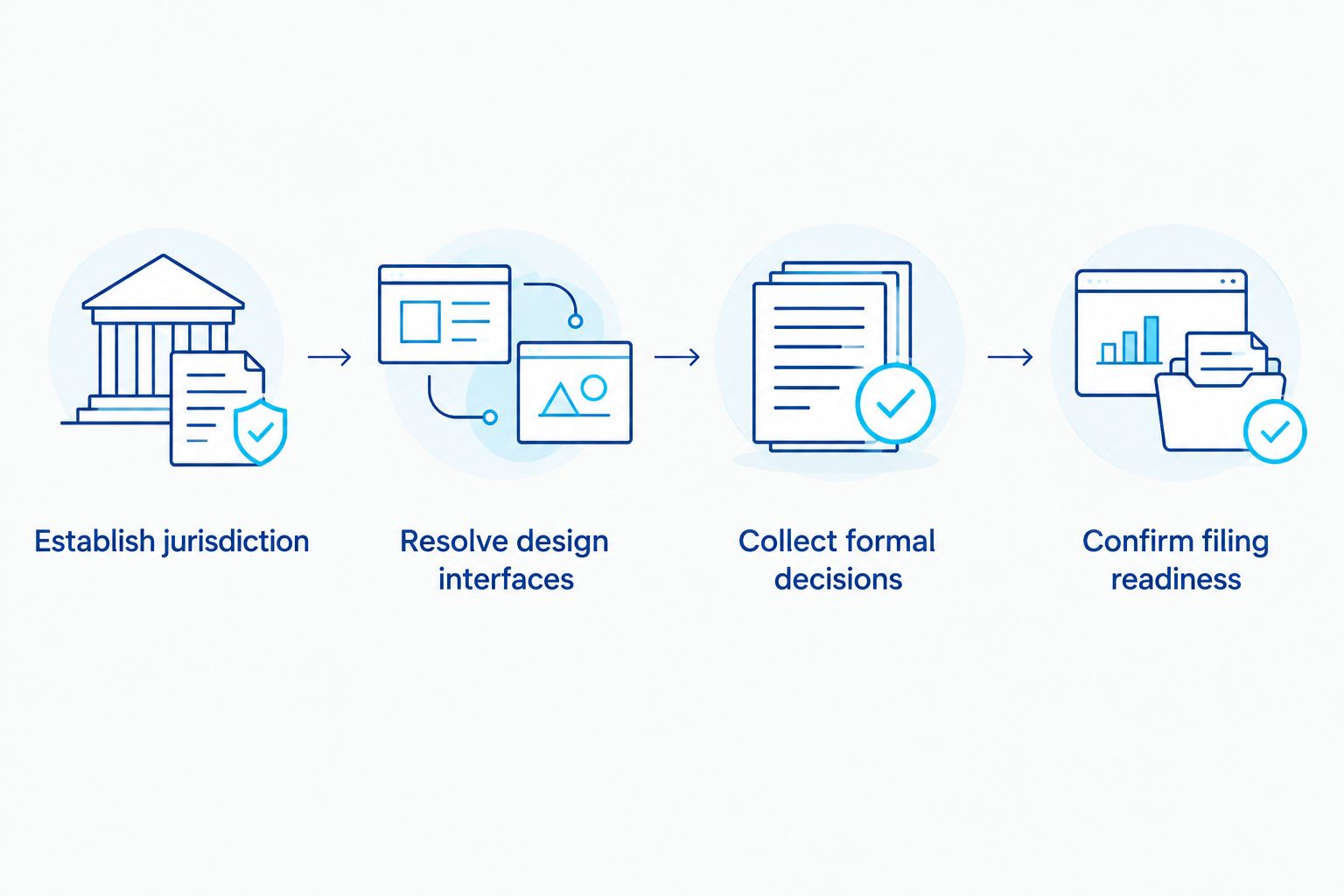
Establish jurisdiction and scope
- Verify designation. Check whether the property is individually designated, lies within a locally regulated historic district, or has another documented historic status. Record the source, geographic boundary, and designation details in the project file.
- Describe the work. Distinguish exterior alterations, demolition, additions, site changes, and interior work. Do not assume that all work receives the same treatment under the local ordinance.
- Confirm the reviewing authority. Ask municipal staff which body reviews the proposed scope and whether its action is a recommendation, a required approval, or another determination under the ordinance.
- Check additional triggers. Identify public funding, permits, licenses, or approvals that require separate historic-resource review. Have the responsible agency determine whether its involvement creates a review obligation.
- Document the sequence. Record which applications can proceed together and which require an earlier decision. Obtain the applicable submission instructions before committing to a hearing or filing milestone.
For federal involvement, Section 106 of the National Historic Preservation Act addresses the effects of federal undertakings on historic properties. Its implementing regulations are in 36 CFR Part 800. That process is distinct from local preservation review and is not automatically triggered by every privately funded reuse project.
Expected result: You have a jurisdiction record identifying each review authority, the work it reviews, and the evidence needed to proceed. An unanswered jurisdiction question remains an open task, not an assumed exemption.
Build the approval register
- Create 1 project register. Use a shared document or spreadsheet that the coordinator maintains. It should identify the property, proposed use, current drawing issue, and responsible contacts.
- Separate 3 review tracks. Maintain distinct entries for preservation review, land-use approval, and construction permitting. Add other required agency reviews as separate entries rather than hiding them within a general approval status.
- Assign an owner. Give every application, comment, and condition a responsible person. Distinguish the person coordinating a response from the licensed professional preparing or certifying it.
- Define release evidence. Specify what closes each task: an issued decision, revised drawing, written clarification, accepted submission, or another document required by the reviewing authority.
Use these as proposed register headings, not as claims about a particular municipal portal:
| Register field | What you record | Why it matters |
|---|---|---|
| Review authority | Office, board, commission, or agency | Identifies who can resolve the issue |
| Drawing revision | Drawing identifier and issue date | Connects the decision to the reviewed design |
| Required action | Specific comment or approval condition | Prevents vague tasks such as ‘resolve historic’ |
| Responsible party | Coordinator or designated professional | Makes response ownership explicit |
| Release evidence | Document needed before the next milestone | Separates a discussion from a completed requirement |
Expected result: Every review requirement has an owner and a defined completion record. For the 2026 roadmap, preserve issued decisions alongside the register; a status cell alone is not approval evidence.
Coordinate design and submission readiness
Resolve design interfaces
- Establish existing conditions. Have the appropriate professionals document the building sufficiently for their scope. Preserve photographs and records of features affected by the proposal.
- Identify shared design decisions. Flag entrances, windows, exterior equipment, additions, and other elements that intersect preservation concerns and the proposed use. Identify accessibility, egress, and other code questions for the responsible design professionals.
- Prepare review material. Follow the applicable submission checklist. Explain proposed changes with drawings, photographs, material information, and a scope narrative where required.
- Record feedback precisely. Distinguish informal staff comments from a formal decision. Mark each comment with its source and the drawing revision discussed.
- Resolve conflicts through the proper parties. Have the design professionals develop responses and ask the reviewing authorities to clarify conflicting requirements. Do not let the coordinator substitute a design judgment for professional analysis.
Nieves Development's adaptive reuse coordination role connects these tasks within the development roadmap. It does not establish technical compliance or guarantee that a proposed design will receive approval.
Expected result: The team has a coordinated submission set and a record of unresolved questions. The next milestone is based on readiness, not simply on whether drawings have been uploaded.
Control permit release
- Collect formal decisions. Obtain the applicable preservation determination and land-use decision, including attachments and conditions. Keep the full documents rather than only an approval email or meeting summary.
- Translate conditions into tasks. Assign each condition to the professional or project participant responsible for satisfying it. Identify which conditions affect drawings, supporting documents, or submission timing.
- Apply 2 checkpoints. First, confirm that the issued decisions address the submitted scope. Second, confirm that the permit package incorporates the conditions applicable to that package.
- Confirm filing readiness. Ask the construction office what supporting approvals and documents it requires. Submit the professional documents required for the work through the municipality's prescribed process.
- Track permit comments separately. Construction review can identify issues that require design changes. Route those changes back through the approval register before treating them as closed.
Expected result: The permit submission references the applicable decisions and a traceable drawing set. Permit issuance remains the construction office's determination; coordination establishes readiness rather than promising the outcome.
The 2026 workflow should show the handoff explicitly: jurisdiction, design coordination, issued decisions, and permit readiness. Each milestone needs supporting evidence.
When the design changes after historic review
A second workflow is necessary when the proposed work changes after the historic reviewer has acted. A revised entrance, replacement material, or relocated exterior equipment should trigger a scope check—not an automatic assumption that the earlier decision still covers the project.
- Record the changed drawing and describe the difference from the reviewed version.
- Ask the relevant preservation authority whether the change requires further review under its procedures.
- Have the responsible professionals assess effects on land-use conditions and construction documents.
- Update the approval register and distribute the revised set only with its review status identified.
For amendments during construction, confirm the required permit-revision process with the construction office. A contractor's proposed substitution is not itself authorization to depart from reviewed documents.
Expected result: You retain a traceable connection between the revised design and every affected decision. Never overwrite the previously reviewed set; archive it and identify the current set clearly.
Choose the coordination approach
Both workflows belong in the same project system. Their benefits and limitations differ:
| Workflow | Best for | Benefit | Limitation |
|---|---|---|---|
| Initial submission coordination | Establishing the first approval roadmap | Identifies jurisdiction and submission dependencies before filing | Depends on an adequately defined scope and reliable existing-condition records |
| Change-triggered coordination | Managing revisions after review | Identifies which decisions a design change affects | Requires additional review when the responsible authority determines it is necessary |
Use initial submission coordination before filing and change-triggered coordination whenever reviewed work changes. Neither workflow replaces professional design services or the authority of the reviewing bodies.
Nieves Development's development consulting supports strategy and municipal-process coordination across these handoffs. The limitation is equally important: project coordination does not constitute licensed legal, engineering, architectural, planning, or surveying services.
Troubleshooting
The historic decision and permit drawings do not match
Compare the drawing identifiers and issue dates against the issued decision and its attachments. Ask the reviewing authority to clarify the scope covered, then have the responsible professional revise or resubmit documents as required. Do not resolve the discrepancy by renaming files.
Staff feedback is being treated as approval
Separate discussion notes from formal determinations in the register. Request the document required under the applicable procedure and identify any outstanding conditions. A helpful conversation does not establish that every required review is complete.
A preservation requirement conflicts with a code response
Give both reviewers the same description of the conflict and supporting professional analysis. Ask the design team to develop an alternative and confirm the required review path. Do not promise that historic status excuses a code requirement.
Different reviewers receive different drawing versions
Assign the coordinator responsibility for distribution and maintain an issue log. Mark superseded documents as archived, identify the current submission set, and request confirmation of the set under review. Keep correspondence with the matching drawing issue.
Funding requirements emerge after local review
Ask the funding agency to identify its historic-review requirements and responsible contacts. Add that process to the roadmap and confirm any restrictions before proceeding with affected work. Local review does not, by itself, establish compliance with a separate funding-related process.
Customize your workflow
Connect the preservation register to your wider development milestones: acquisition diligence, zoning analysis, financing conditions, professional appointments, and construction readiness. Keep approval dependencies visible without combining distinct decisions into a single status.
For your 2026 project plan, use the zoning approval to building permit workflow to structure the next municipal handoff. Give your lender and project team a milestone summary, while preserving the underlying decisions and professional documents in the project record.
Professional-services disclaimer: Nieves Development provides development consulting and municipal-process coordination, not licensed legal, engineering, architectural, planning, or surveying services. Retain appropriately licensed professionals for those services. Reviewing authorities determine applicable requirements and approval outcomes.
FAQ
How do I connect historic preservation review to an adaptive reuse permit?
Connect the processes through a shared approval register that identifies jurisdiction, drawing revisions, responsible parties, and required release documents. Confirm the municipality’s sequence and incorporate applicable review conditions into the permit package.
Does historic preservation approval replace a building permit?
No, historic preservation approval does not replace a building permit. Preservation review, land-use decisions, and construction permitting address different requirements, and the project must satisfy each applicable process.
Does National Register listing automatically require local historic approval?
National Register listing does not by itself establish a local historic approval requirement. Check the local ordinance and designation records separately, and confirm whether government involvement triggers another review process.
What should I do if the design changes after historic review?
Ask the relevant preservation authority whether the change requires further review, and have the responsible professionals assess its effect on other approvals. Record the revised scope and drawing issue before distributing the new submission set.
Can historic review and zoning review happen at the same time?
Concurrent review depends on the applicable municipal procedures and project requirements. Confirm which submissions can proceed together and which need an earlier determination before setting milestones.
Who resolves a conflict between preservation comments and building-code requirements?
The responsible design professionals develop a response for the relevant reviewing authorities to consider. A development coordinator tracks the issue and handoffs but does not replace professional analysis or the authority’s decision.
What does a development consultant do in this workflow?
A development consultant organizes the strategy, responsibilities, review dependencies, and municipal-process handoffs. Licensed professionals prepare the technical or legal work within their respective scopes, and reviewing authorities make approval decisions.
One last thing
Approval status belongs to a defined scope and document set, not merely to a property address. Before releasing a revised drawing, check whether the decision in your register actually covers the change. That habit keeps a previously completed milestone from concealing a new review task.
Related guides
- Paterson zoning due diligence before property acquisition
- NJDEP environmental review to site plan approval workflow
- Site plan approval to certificate of occupancy workflow
YOUR NEXT STEP
Planning a project in New Jersey?
Discuss your property, project goals and municipal-process questions with Nieves Development Consulting.
Explore our consulting services · See a Paterson project example