

A standalone zoning-board variance application in New Jersey generally has a 120-day statutory decision window after the application is complete, unless the applicant consents to an extension; that is not a filing-to-construction timetable. In 2026, your actual schedule must also account for application preparation, completeness review, hearing notice, the written decision, approval conditions, and any separate permits.
- How long does a zoning variance approval take in NJ? The 120-day decision window is not the total project schedule.
- New Jersey completeness review generally has a 45-day statutory framework; preparation happens before that review.
- Required hearing notice generally must occur at least 10 days before the hearing.
- Nieves Development provides development consulting and municipal-process coordination, not a guarantee of variance approval.
How long does a zoning variance approval take in NJ?
Separate the statutory decision period from the time required to reach a usable approval. The New Jersey Municipal Land Use Law sets procedural deadlines, but it does not establish a universal average duration for every variance application.
For a standalone variance application before a zoning board of adjustment, N.J.S.A. 40:55D-73 generally provides 120 days to decide after submission of a complete application, unless the applicant consents to additional time. Applications combining variance relief with other development approvals require separate review of the applicable statutory provisions.
The following milestones explain the distinction for a 2026 application. These periods overlap or apply to different events; do not add them together as a guaranteed completion date.
| Milestone | Timing rule or scheduling basis | What it means for your roadmap |
|---|---|---|
| Prepare the application | Depends on the proposal and required submissions | Resolve the relief requested and assemble professional documents before filing |
| Establish completeness | Generally a 45-day framework under N.J.S.A. 40:55D-10.3 | Track submission requirements, deficiency notices, and any requested checklist waivers |
| Provide required hearing notice | Generally at least 10 days before the hearing under N.J.S.A. 40:55D-12 | Coordinate notice with a confirmed hearing date and applicable requirements |
| Obtain a board decision | Generally 120 days for a complete standalone zoning-board variance application under N.J.S.A. 40:55D-73 | Track the applicable deadline and any applicant-consented extension |
| Document and implement approval | Depends on the resolution, conditions, and separate approvals | Do not treat a favorable vote as permission to start construction |
For the statutory framework behind these milestones, consult the New Jersey Municipal Land Use Law developer guide.
Why this matters
A property acquisition, financing commitment, or construction schedule needs a defined approval milestone. Saying that a project will be approved within the board's decision window leaves out the work necessary to start that window and the conditions that follow the decision.
For a first-time owner, the practical distinction is straightforward: submitting paperwork is not the same as establishing completeness. For an experienced developer, the corresponding task is to align contract milestones and consultant deliverables with the actual approval path.
Build your 2026 roadmap around documented events, not an assumed number of board meetings. Record who confirms each event and what evidence shows that it occurred.
Application preparation: before the decision clock starts
Start by identifying the property, the proposed use, and the zoning provisions that the proposal does not satisfy. A variance is relief from a zoning requirement; the specific relief requested determines the evidence and board jurisdiction that your professional team must evaluate.
Do not ask the municipality to schedule an undefined proposal. Establish what you intend to build, which existing conditions matter, and which drawings or supporting materials the municipal application checklist requires.
A useful preparation sequence is:
- Define the proposal. Record the intended use and development scope so that the team reviews the same project.
- Identify relief. Have the appropriate professionals evaluate ordinance compliance and the variance requests.
- Assemble documents. Coordinate the application, required plans, supporting reports, and checklist responses.
- Confirm submission. Verify the filing procedure, meeting schedule, and administrative requirements with municipal staff.
- Track completeness. Maintain the submission record and respond to identified deficiencies.
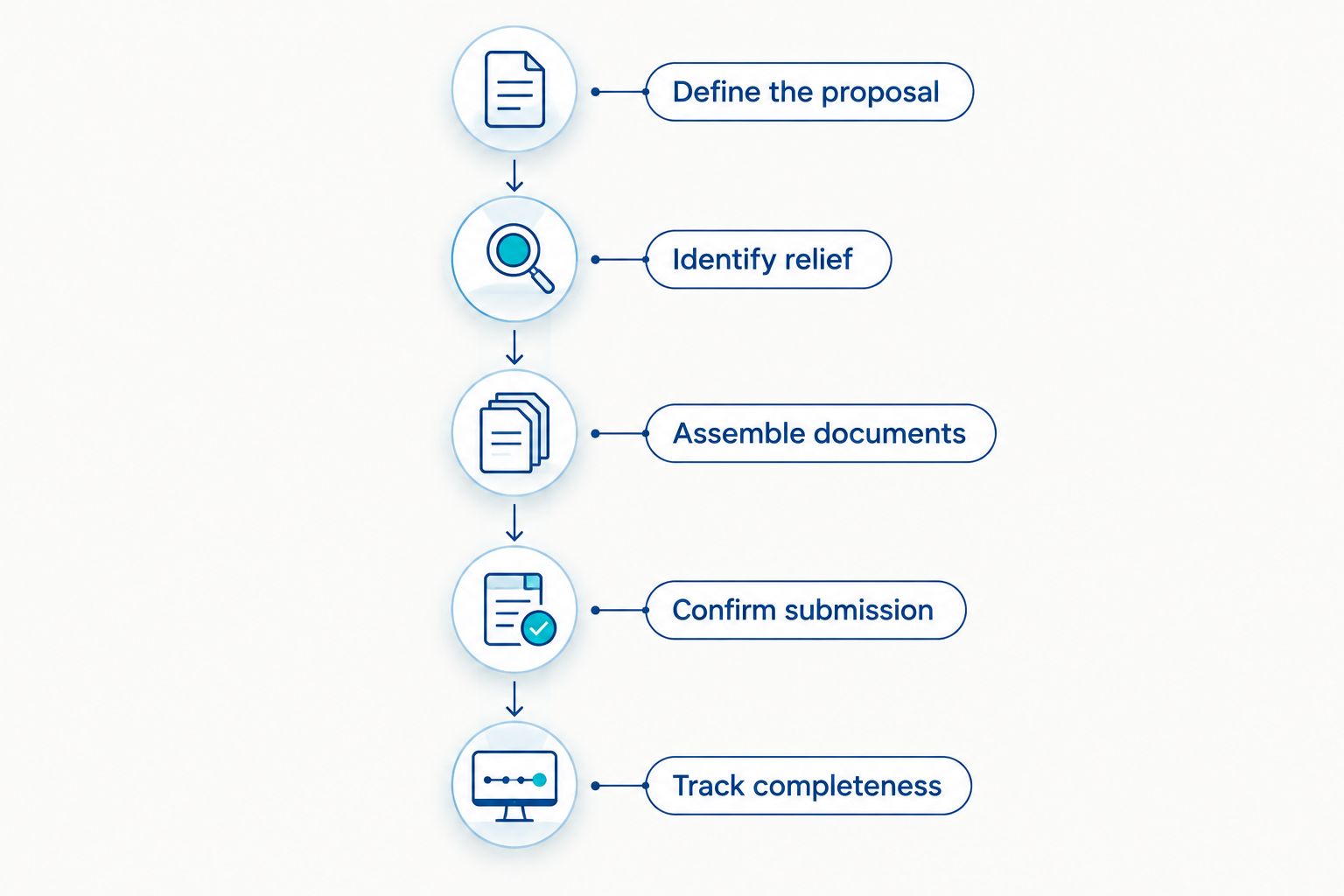
Preparation is a controllable part of the schedule, but it is not a substitute for municipal review. Assign an owner to each deliverable and identify which documents depend on another professional's work.
A survey-dependent drawing, for example, should not have the same readiness status as a completed application form. Distinguishing dependencies prevents an administrative checklist from hiding unresolved technical work.
Completeness review: the 45-day framework
The 45-day completeness framework comes from N.J.S.A. 40:55D-10.3. It concerns whether the application contains the required submission materials, not whether the board should grant the variance.
Under that statute, an application is deemed complete if the authorized municipal agency or designee does not certify incompleteness within the prescribed period, subject to the statute's requirements. The statute also addresses checklist requirements and requests to waive particular submission items.
For your 2026 application, preserve the filing date, the submitted checklist, deficiency correspondence, and any waiver requests. Have counsel confirm the legal effect of those records before relying on deemed completeness or calculating a decision deadline.
Completeness is an administrative milestone, not a finding that the project meets the approval standards. A complete application can still require testimony, technical review, revisions, and a board decision on the merits.
Do not assume that every revised document creates the same legal consequence. Ask the project attorney and municipal reviewer to clarify whether the issue concerns completeness, substantive review, or a change to the requested relief.
Hearing readiness: at least 10 days for required notice
Required public notice generally must be provided at least 10 days before the hearing, under N.J.S.A. 40:55D-12. Notice obligations depend on the application and applicable law; publication and service requirements need careful coordination.
That notice period is not a promise that a hearing will occur immediately after the application becomes complete. A municipal meeting calendar and an application's notice readiness are separate scheduling items.
Before treating a hearing date as a dependable milestone, confirm:
- The municipality has identified the application for the relevant meeting.
- The notice accurately describes the property and requested relief.
- Required publication and service arrangements are in place.
- The documents that must be available for public inspection are ready.
- Required witnesses and supporting materials are coordinated.
Have the attorney responsible for the application confirm notice compliance. Process coordination can organize the tasks, but it does not replace a legal determination that notice is sufficient.
A scheduled hearing also does not mean the record will close that evening. Testimony, board questions, revisions, and continued proceedings remain distinct from simply obtaining a place on the agenda.
Board decision: the 120-day standalone variance window
The 120-day decision window under N.J.S.A. 40:55D-73 generally applies to a complete standalone zoning-board variance application. The applicant can consent to an extension, so your schedule must distinguish the original statutory deadline from any agreed additional time.
A board decision is not a guaranteed approval. The board evaluates the evidence against the applicable legal standards, and a decision deadline does not remove the applicant's obligation to support the requested relief.
Keep a decision-period log containing the completeness basis, applicable statutory provision, hearing dates, and extension correspondence. Your attorney should verify the legal deadline; the coordinator should keep the team working from that verified date.
For 2026 planning, do not describe the statutory period as a municipal service commitment. It is a legal framework with application-specific consequences, not a forecast of how many hearings your proposal requires.
If the proposal includes site plan or subdivision approval alongside variance relief, confirm the governing combined-application provisions. Copying the standalone deadline into every project schedule creates a false sense of certainty.
Which variance path applies to your project?
New Jersey distinguishes bulk or dimensional variance relief under N.J.S.A. 40:55D-70(c) from the categories of relief listed under N.J.S.A. 40:55D-70(d). A setback deviation and a proposed use that is not permitted are not interchangeable requests.
The table identifies review needs rather than recommending one route over another. The proposal and governing law determine the approval path; you do not select it simply because it appears faster.
| Application path | Best fit | Practical advantage | Scheduling constraint |
|---|---|---|---|
| Standalone bulk variance | A proposal needing dimensional relief without a combined development application | A defined variance request can focus the hearing record | The applicant still must establish the applicable legal grounds |
| Relief under subsection d | A proposal requiring one of the forms of relief listed in that subsection | Addresses relief that ordinary zoning compliance cannot resolve | Requires attention to zoning-board jurisdiction and the relevant proofs |
| Variance with site plan or subdivision | A proposal needing coordinated development approvals | Reviews related components within the applicable approval process | Adds documentation and requires confirmation of combined-application deadlines |
Ask your land-use attorney to confirm the classification before you build the hearing roadmap. A coordination plan based on the wrong board or relief category is not a reliable plan.
Why zoning variance timing varies
These factors affect readiness and scheduling without establishing a universal approval duration:
- Submission readiness: Required documents and checklist responses determine whether the application can reach completeness.
- Relief and jurisdiction: The requested variance and any related approvals determine the applicable review path.
- Hearing coordination: Municipal calendars, required notice, document access, and witness readiness must align.
- Technical review: Professional comments and revisions can require additional work before the record is ready for a decision.
- Extensions: Applicant-consented additional time changes the working decision deadline.
- Approval conditions: The written decision can require further submissions or actions before permits proceed.
Treat each factor as a task with an owner and a completion record. A schedule becomes useful when it explains what must happen next, rather than merely naming a target month.
Does a bulk variance take less time than a use variance?
The 120-day standalone zoning-board decision window is not evidence that one variance category always finishes faster. The requested relief, completeness, hearing record, and any related approvals determine the actual sequence.
A narrower request still needs adequate proofs. Avoid substituting perceived simplicity for a documented readiness review.
Does the approval clock start when I submit the application?
The 45-day completeness framework and the applicable decision period address different milestones. For the standalone variance framework discussed here, the board's decision window is tied to a complete application, not merely the first delivery of paperwork.
Keep proof of submission and the municipality's completeness correspondence. Counsel should confirm the operative date before you rely on a deadline.
Can I start construction after the board approves the variance?
A favorable variance decision does not replace a building permit. Review the written resolution, satisfy applicable conditions, and confirm the remaining municipal and outside-agency approvals before scheduling construction.
For a 2026 project, define approval readiness and construction readiness separately. Your team needs to know which milestone permits the next action, not just whether a favorable vote occurred.
Where development consulting fits
Nieves Development is best suited to developers, property owners, and investors needing development strategy and municipal-process coordination in New Jersey. Its stated scope includes multifamily, mixed-use, and redevelopment projects in Paterson and throughout the state.
That development consulting role concerns the roadmap and coordination between workstreams. It does not replace the licensed professionals responsible for legal advice, design, technical analysis, or other regulated work, and it does not guarantee approval.
Discuss your development roadmap
Discuss development strategy and municipal-process coordination for your New Jersey project.
FAQ
How long does a zoning variance approval take in NJ in 2026?
A complete standalone zoning-board variance application generally has a 120-day statutory decision window unless the applicant consents to an extension. Preparation, completeness review, notice, written approval conditions, and permits are separate milestones, so that window is not the total project duration.
Does New Jersey have an average zoning variance approval time?
The Municipal Land Use Law establishes procedural deadlines, not a statewide average approval duration. Build your schedule around the applicable application path and documented municipal milestones.
How long does the municipality have to review application completeness?
New Jersey generally uses a 45-day completeness framework under N.J.S.A. 40:55D-10.3. The statute addresses required submissions, deficiency certification, and checklist waivers; completeness does not establish entitlement to approval.
How far ahead must I provide notice for a variance hearing?
Required hearing notice generally must be provided at least 10 days before the hearing under N.J.S.A. 40:55D-12. Have your attorney confirm the applicable publication, service, and document-access requirements.
Can a variance application take longer than 120 days?
Yes, the total process can extend beyond 120 days because preparation and completeness review are separate from the standalone decision window. Applicant-consented extensions also affect the decision schedule.
Is a variance approval the same as a building permit?
No, variance approval and a building permit are separate approvals. Review the written decision, required conditions, and remaining approvals before beginning construction.
Can Nieves Development guarantee zoning variance approval?
No, Nieves Development provides development strategy, zoning guidance, and municipal-process coordination, not guaranteed municipal outcomes. Licensed legal and technical professionals remain responsible for services within their respective scopes.
One last thing
Write down what you mean by approved before assigning an approval date. A favorable vote, a written resolution, satisfaction of conditions, and readiness for a building permit are different events.
Use separate milestone names in your acquisition and development roadmap. That distinction makes the schedule easier to verify and prevents one team's approval status from being mistaken for another team's authorization to proceed.
This article provides general process information, not legal advice or licensed engineering, architectural, planning, or surveying services. Nieves Development's consulting and coordination services do not replace those professionals. Confirm statutory deadlines, notice obligations, and project-specific requirements with qualified counsel and the relevant municipality.
Related guides
- Planning board hearing to zoning variance approval workflow
- Zoning approval to building permit workflow
- Paterson zoning due diligence before property acquisition
YOUR NEXT STEP
Planning a project in New Jersey?
Discuss your property, project goals and municipal-process questions with Nieves Development Consulting.
Explore our consulting services · See a Paterson project example