

Adaptive reuse permitting has no fixed end-to-end duration in New Jersey in 2026; your schedule depends on the proposed use, required land-use approvals, building-code review, and any separate agency reviews. A municipal review deadline is not a promise that your project will receive every approval within that period. Build your schedule around confirmed application requirements and approval milestones, not a single estimated permit date.
- How long does adaptive reuse permitting take? In New Jersey, required approvals and application readiness determine the schedule.
- Nieves Development Consulting LLC supports adaptive reuse development strategy and municipal-process coordination, not guaranteed approval dates.
- Separate zoning approval, construction permits, and occupancy authorization in your project roadmap.
- Confirm historic-review requirements before finalizing design and filing dependencies.
Why this matters
An existing building does not remove the need to establish whether your proposed use and alterations comply with applicable requirements. Converting a commercial building to housing, for example, raises different questions from continuing its existing lawful use with limited alterations.
For your 2026 acquisition or redevelopment schedule, distinguish time spent preparing an application from time spent under municipal review. The adaptive reuse land-use consulting guide provides context for organizing those dependencies.
Nieves Development Consulting LLC serves New Jersey adaptive reuse developers, property owners, and investors who need development strategy and municipal-process coordination. That coordination supports a clear roadmap; it does not replace the determinations of reviewing agencies or licensed professionals.
How long does adaptive reuse permitting take?
The answer is the time required to complete your particular approval path, including preparation, review, responses, and permit issuance. There is no single statewide adaptive reuse permit with one clock covering every stage.
Use the following sequence to establish a project-specific schedule in 2026. Some tasks can proceed together, but only after the responsible professionals confirm that doing so will not create conflicting submissions or premature design commitments.
- Establish the property baseline. Identify the parcel, existing lawful use, prior approvals, available occupancy records, and applicable zoning or redevelopment requirements. Record unresolved questions rather than treating missing records as confirmation.
- Define the proposed conversion. Describe the intended use, building alterations, occupancy, access, parking, and site changes. A schedule based on an undefined concept is not ready for acquisition or construction commitments.
- Confirm the approval path. Determine whether the proposal requires administrative zoning review, site-plan approval, variance relief, historic review, or other agency action. Identify which decisions must precede later submissions.
- Prepare and submit coordinated applications. Assemble the required documents and professional plans. Track completeness review separately from substantive review of whether the proposal satisfies approval standards.
- Resolve comments and approval conditions. Assign each comment to a responsible party, coordinate revisions, and document what must be satisfied before construction permits can issue.
- Obtain construction and occupancy authorizations. Construction-permit review, inspections, and the applicable occupancy authorization are distinct milestones. A favorable land-use vote is not permission to begin all proposed work or occupy the converted building.
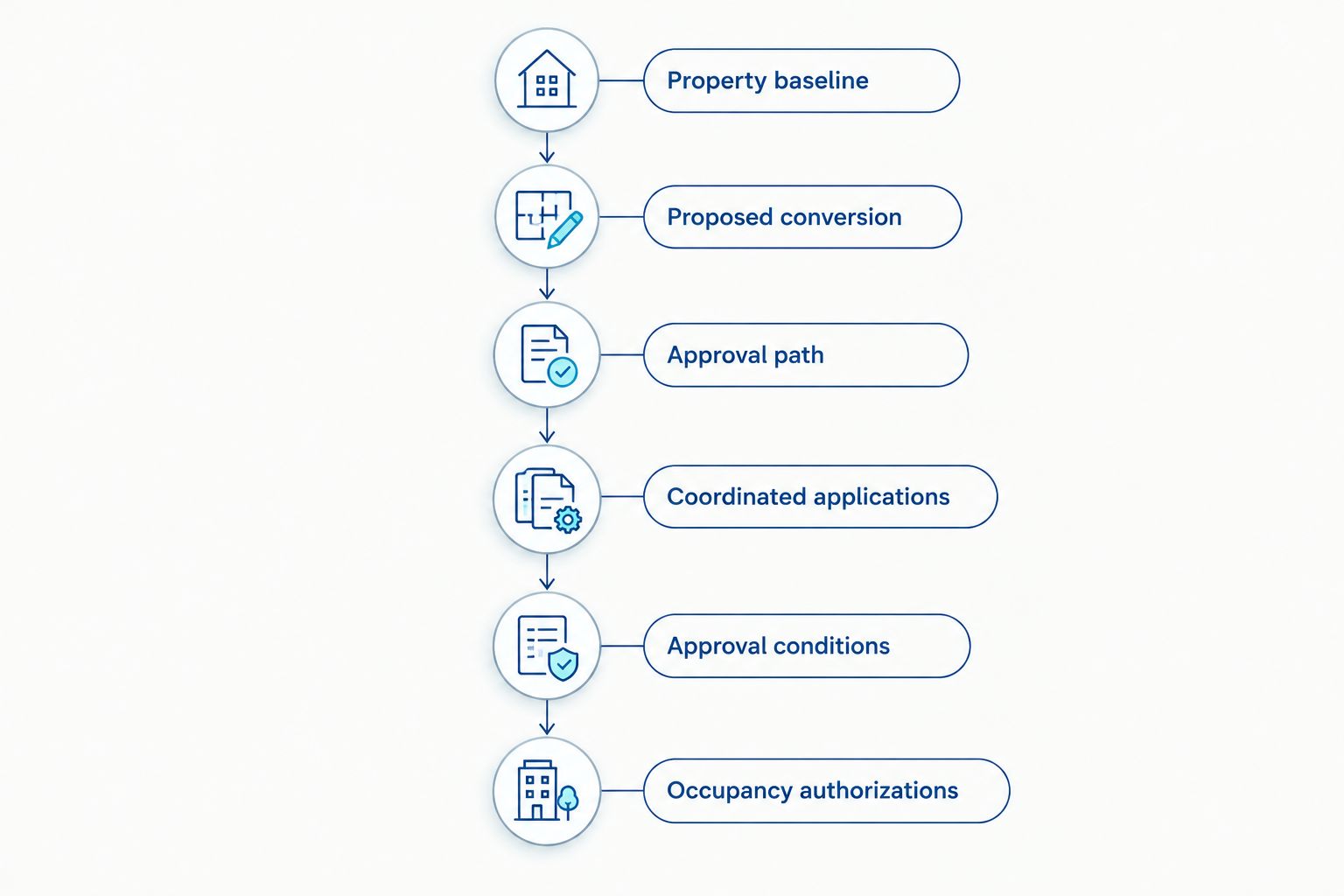
The practical output is a dependency schedule: each milestone has a prerequisite, a responsible party, and evidence of completion. An anticipated date without those supporting details is a planning assumption, not a confirmed municipal commitment.
Which approval path fits your project?
These are planning categories, not interchangeable permit options. Your property's requirements determine the route; you cannot select a simpler route merely to shorten the schedule.
| Approval path | Best for | Scheduling advantage | Constraint |
|---|---|---|---|
| Administrative review | Proposals confirmed eligible for administrative processing | Avoids a board-hearing dependency where no hearing is required | Still requires applicable zoning and construction-code compliance |
| Board review | Proposals requiring site-plan approval or variance relief | Establishes a formal process for the requested land-use decision | Adds application, notice where required, hearing, and decision milestones |
| Additional agency review | Projects subject to historic, environmental, or other jurisdictional requirements | Identifies decisions that must be coordinated with municipal approvals | Adds dependencies that municipal approval alone does not resolve |
Confirm the route before setting the date. Treating every conversion as a routine building-permit application leaves the most consequential schedule questions unanswered.
What statutory deadlines tell you—and what they do not
New Jersey law provides procedural deadlines, but those deadlines address specific actions. They do not establish a universal duration for adaptive reuse permitting in 2026.
Under the New Jersey Municipal Land Use Law, N.J.S.A. 40:55D-10.3, an application for development generally has a 45-calendar-day completeness determination period after submission to the appropriate municipal agency or administrative officer. The statute addresses certification of completeness, deficiency notification, and circumstances in which an application is deemed complete.
Completeness means the application has reached the procedural threshold for the applicable review clock. It does not mean the board must approve the proposal, that technical comments are resolved, or that construction documents satisfy the building code.
Where public notice is required, N.J.S.A. 40:55D-12 generally requires notice at least 10 calendar days before the hearing. The statute also includes notice to qualifying property owners within 200 feet of the property, subject to its requirements and exceptions.
These are separate procedural requirements, not durations to add together for a permit estimate. Your project attorney should confirm applicable notice obligations, statutory decision periods, extensions, and remedies for the specific application.
Why adaptive reuse permitting timelines vary
The schedule changes when the scope, approval route, or submission requirements change. Review these factors before treating a target date as dependable:
- Existing lawful use. Prior approvals and occupancy records help establish the starting point. An existing physical use is not, by itself, proof that every aspect of that use was authorized.
- Proposed use and zoning relief. A permitted use follows a different approval analysis from a use requiring variance relief. Confirm applicable redevelopment-plan provisions where the property lies within a designated redevelopment area.
- Building and site conditions. Existing construction, access, accessibility, fire protection, utilities, and proposed alterations affect the professional analysis and documents required.
- Historic and environmental jurisdiction. Designation, project location, funding conditions, and proposed work determine whether additional review applies. Do not assume every older building requires the same historic-review process.
- Application readiness and revisions. Missing checklist items and inconsistent plans create unresolved tasks. Track document readiness separately from the municipality's substantive review.
- Hearing and approval dependencies. Required notice, hearing scheduling, revised submissions, written decisions, and approval conditions belong in the roadmap where applicable.
For a historic property, connect the review requirements to the actual scope of work. The guide to historic review and adaptive reuse permit approval explains that coordination topic.
How should you build an adaptive reuse permitting schedule?
Start with evidence, then assign dates. For a 2026 project, use current municipal requirements and current property records rather than another project's approval history.
Establish the property baseline
Create a record of the parcel identifiers, zoning district, applicable redevelopment plan, existing approvals, and available construction and occupancy documents. Ask the appropriate municipal offices how to obtain missing records.
Give each unresolved item an owner and a next action. For example, an unanswered question about the approved use belongs with the person obtaining municipal records, not in a general list marked pending.
Map the approval dependencies
Separate decisions that establish land-use permission from reviews of construction documents. Identify any outside-agency action and whether it is needed before filing, before a municipal decision, before permit issuance, or before occupancy.
Do not label every task a prerequisite. Ask the responsible professionals which work can proceed concurrently and which work depends on a prior determination. The distinction helps you avoid both unnecessary waiting and premature submissions.
Set readiness milestones
Use deliverables you can verify: a documented zoning analysis, a coordinated plan set, a completeness determination, a written board decision, or an issued permit. Avoid milestones such as approvals underway that do not identify what has actually occurred.
Maintain a comment-response log with the comment, responsible professional, required revision, and submission status. When scope changes, update every affected application rather than revising only the most visible drawing.
Review the roadmap before making commitments
For acquisition, financing, and construction planning, distinguish confirmed milestones from assumptions. Ask your attorney to address how unresolved approvals affect transaction documents, and ask the relevant professionals to explain remaining technical dependencies.
Nieves Development Consulting LLC provides adaptive reuse development strategy, zoning guidance, and municipal-process coordination. Licensed professionals remain responsible for the legal and technical services within their respective disciplines.
Can you obtain zoning approval and construction permits together?
Zoning approval and construction permits are separate milestones, even when preparation overlaps. Confirm with the municipality and your professional team which submissions it will accept concurrently and what must be resolved before permit issuance.
Parallel preparation has a benefit and a limitation. It allows the team to work on separate deliverables at the same time, but an unresolved land-use decision can require changes to construction documents already in progress.
Does historic status always add another approval?
Historic status does not create an identical review path for every adaptive reuse project. Determine the applicable designation, reviewing authority, proposed work, and any funding-related requirements before adding a historic-review milestone.
Do not treat the building's age as a substitute for that determination. Ask which specific authority applies and which documents or decisions the project needs.
Is a board approval enough to start construction?
A board approval alone is not a construction permit. Read the written decision and identify conditions, required plan revisions, outside approvals, and documents that must be addressed before the applicable permits can issue.
Track construction completion and occupancy authorization separately as well. An approval roadmap ends at the milestone your business plan actually requires, not simply at the first favorable municipal decision.
FAQ
How long does adaptive reuse permitting take in New Jersey in 2026?
Adaptive reuse permitting has no fixed statewide end-to-end duration. Establish the required land-use approvals, construction reviews, agency dependencies, and submission-readiness milestones before assigning a project-specific schedule.
Does the 45-day completeness period mean my project will be approved?
No. The generally applicable 45-calendar-day completeness determination period under N.J.S.A. 40:55D-10.3 concerns application completeness, not approval of the project or issuance of construction permits.
Can I reuse a building without a zoning variance?
A variance is not required solely because a project reuses an existing building. Confirm whether the proposed use and development comply with the applicable zoning ordinance or redevelopment plan, and identify any other required approvals.
Will every adaptive reuse project need a public hearing?
No, not every adaptive reuse project requires a public hearing. The proposed use, site changes, requested relief, and applicable municipal requirements determine the approval route.
Does an old building automatically require historic approval?
No, building age alone does not establish the applicable historic-review requirements. Confirm designation, jurisdiction, proposed work, and relevant funding conditions with the appropriate reviewing authorities.
What should I review before buying a property for adaptive reuse?
Review the existing lawful use, zoning or redevelopment requirements, prior approvals, building conditions, and potential agency jurisdiction. Have the appropriate licensed professionals assess the legal and technical issues before relying on a permitting schedule.
Can a development consultant guarantee my permit date?
A development consultant cannot guarantee municipal approval or a permit issuance date. Coordination establishes responsibilities, readiness milestones, and dependencies while reviewing authorities retain their decision-making roles.
One last thing
Define what finished means before asking how long permitting takes. A board vote, an issued construction permit, and authorization to occupy the converted building are different endpoints. Your 2026 roadmap should identify the endpoint required for each acquisition, financing, construction, and operating decision.
Nieves Development Consulting LLC provides development consulting and municipal-process coordination, not licensed legal, engineering, architectural, planning, or surveying services. This article provides general process information, not legal or technical advice; consult the appropriate licensed professionals and reviewing authorities for project-specific requirements.
Related guides
- How long does a planning board hearing take?
- Zoning approval to building permit workflow
- Feasibility studies for first-time developers
YOUR NEXT STEP
Planning a project in New Jersey?
Discuss your property, project goals and municipal-process questions with Nieves Development Consulting.
Explore our consulting services · See a Paterson project example