

A PILOT tax abatement has no fixed savings amount for a New Jersey developer in 2026: the benefit is the difference between conventional property taxes and the full payment obligations under the project's financial agreement. Administrative charges, taxes that remain payable, compliance obligations, and the agreement's payment schedule belong in that comparison. Do not underwrite savings until you have a property-specific tax baseline and a documented PILOT payment schedule.
- How much can a PILOT tax abatement save a developer? Calculate project-specific net savings, not a universal percentage.
- Compare conventional property taxes with the annual service charge, retained taxes, administrative charges, and compliance obligations.
- Nieves Development Consulting LLC provides development strategy and municipal-process coordination for New Jersey redevelopment projects.
- Model the agreement’s full term and expiration; an initial payment does not establish lifetime savings.
How much can a PILOT tax abatement save a developer?
Your net savings equal the conventional property taxes you would otherwise pay, minus the total obligations under the proposed PILOT arrangement. PILOT means payment in lieu of taxes. For a New Jersey long-term tax exemption, the financial agreement establishes the project's annual service charge and related obligations.
Start with a consistent comparison. Use the same completed development, operating assumptions, and analysis period on both sides; comparing current taxes on an undeveloped parcel with payments for a completed building produces a misleading result.
| Comparison item | Conventional taxation | Proposed PILOT arrangement |
|---|---|---|
| Main annual obligation | Property taxes based on assessed value and applicable tax rates | Annual service charge calculated under the financial agreement |
| Land treatment | Include the parcel's land assessment | Confirm land taxes and any applicable credits separately |
| Changes over time | Model assessment and tax-rate changes | Model contractual adjustments, minimums, and phase-in provisions |
| Additional obligations | Identify applicable property-related obligations | Include administrative charges and agreement-specific obligations |
| End of analysis | Continue the conventional-tax baseline | Account for expiration and return to conventional taxation |
For transaction planning, connect the calculation to the PILOT tax abatement and redevelopment closing roadmap. The financial benefit and the closing conditions need to fit the same project schedule.
Why this matters
A smaller initial payment is not the same as a stronger development investment. You need to understand whether the savings persist, what assumptions produce them, and which obligations your lender will recognize.
For a 2026 acquisition, distinguish an approved arrangement from a proposal under discussion. Carry the conventional-tax case until the PILOT terms and transaction conditions justify a different assumption. A proposed incentive is not an executed financial agreement.
The decision also extends beyond annual cash flow. Financing, ownership transfers, reporting, and the end of the exemption term all belong in the development roadmap.
Establish the conventional-tax baseline
The baseline is the estimated tax burden for the completed project without the proposed exemption. It is not simply the seller's current tax bill. Redevelopment changes the property you are evaluating.
Ask the appropriate tax and valuation professionals to identify the assessment assumptions, applicable tax rates, and treatment of the completed improvements. Document the source of each assumption so your development team and lender can review the same calculation.
For a multifamily project, keep the unit program and stabilized operating assumptions consistent. For mixed-use development, identify how the residential and commercial components enter the analysis rather than treating the entire property as an undifferentiated income stream.
Your baseline should answer these questions:
- What completed development does the estimate represent?
- Which assessment and tax-rate assumptions support it?
- When does the completed-project tax burden begin?
- What changes have been modeled over the holding period?
- Who is responsible for confirming the estimate?
A spreadsheet cannot correct an unsupported baseline. Resolve the underlying assumptions before presenting the difference as savings.
Build the PILOT payment schedule
The PILOT side requires more than the headline annual service charge. Read the proposed financial agreement with legal and financial advisers and identify every payment component relevant to the project.
New Jersey's Long Term Tax Exemption Law permits different statutory calculation methods and imposes requirements on the agreement. Use the method applicable to your project, not a percentage borrowed from another municipality's development. Another project's terms do not establish your project's economics.
As of 2026, N.J.S.A. 40A:20-9 permits an annual administrative fee of up to 2% of the annual service charge. That statutory ceiling is not proof that your municipality will charge the maximum; the actual obligation belongs in the agreement review.
Separate the calculation into identifiable entries:
- Annual service charge: the principal payment calculated under the agreement.
- Land taxes: any taxes that remain payable, with applicable credit treatment identified.
- Administrative charges: charges authorized and imposed for the arrangement.
- Payment adjustments: contractual increases, minimums, or phase-in provisions.
- Other obligations: project-specific requirements with a documented financial effect.
Avoid double counting. If the agreement provides a credit for a payment, show the payment and credit explicitly before calculating the net obligation.
Use a development-readiness sequence
Calculate savings through a sequence that keeps financial assumptions connected to municipal milestones. For a first-time property owner, this creates a clear decision record. For an experienced developer, it gives the acquisition, legal, and financing teams a common basis for review.
- Tax baseline. Establish the estimated conventional property taxes for the completed project, with documented assumptions.
- Agreement review. Identify the proposed annual service charge, retained taxes, adjustments, administrative charges, and reporting requirements.
- Cash-flow model. Compare both payment paths across the same analysis period, including the agreement's expiration.
- Lender review. Confirm which assumptions the lender accepts and which unresolved terms remain closing conditions.
- Closing readiness. Assign responsibility for municipal actions, agreement execution, required submissions, and transaction documents.
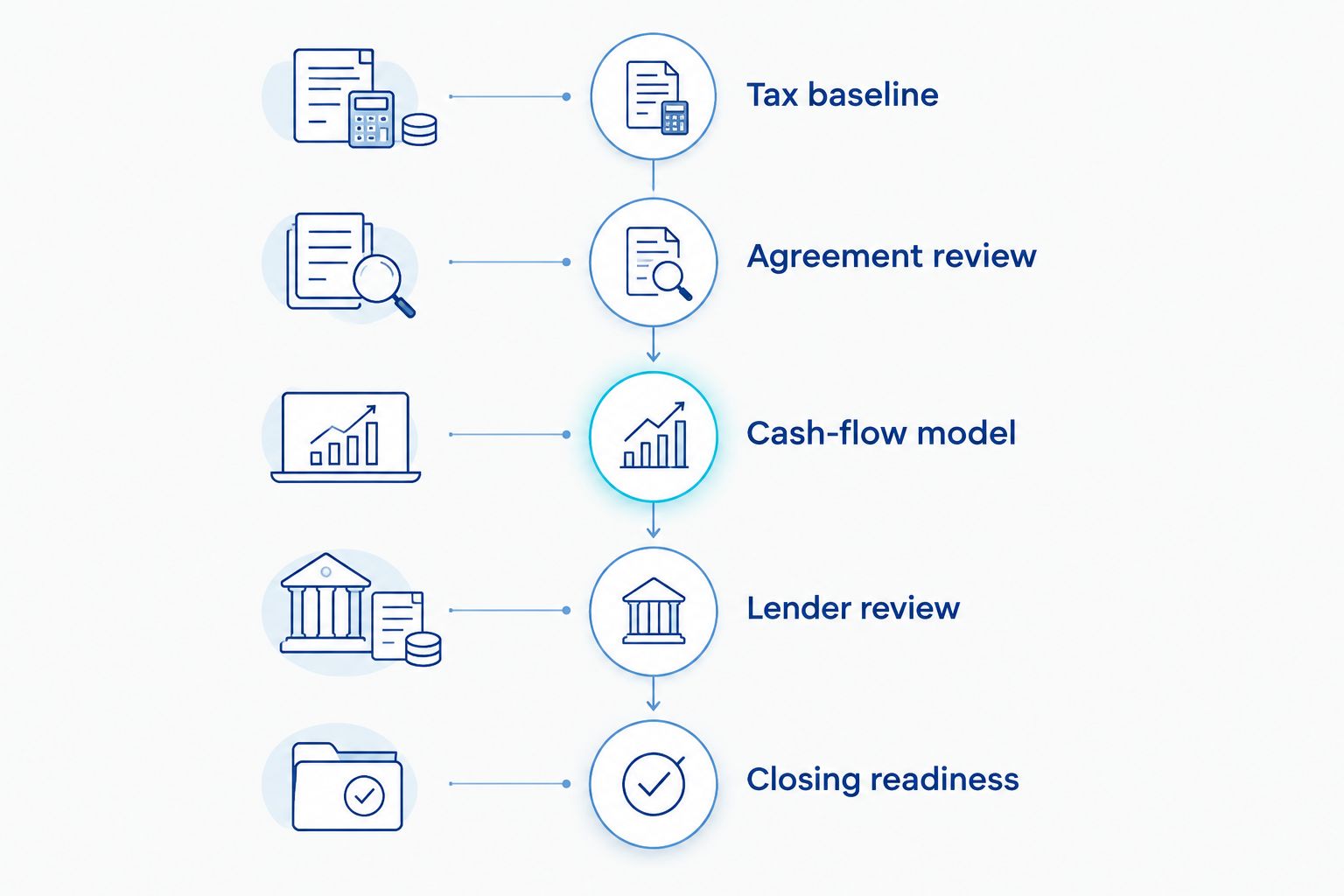
The sequence is procedural, not an approval guarantee. A favorable financial model does not establish eligibility, municipal support, or satisfaction of the agreement's conditions.
Nieves Development Consulting LLC is best suited to New Jersey developers, property owners, and investors seeking development strategy and municipal-process coordination. Its New Jersey real estate development consulting is distinct from the licensed professional work needed to establish legal, design, and technical conclusions.
Why PILOT savings vary
PILOT savings vary because the comparison depends on the completed property and the actual agreement. These drivers belong in a 2026 underwriting model, not just in a summary of the initial payment.
- Completed-project assessment. The conventional-tax baseline depends on the valuation assumptions for the finished development.
- Service-charge method. The agreement's calculation method determines how project revenue or other applicable inputs affect the payment.
- Land-tax treatment. Retained taxes and credits change the total obligation; omitting either distorts the comparison.
- Payment schedule. Adjustments, minimums, and phase-in provisions change the relationship between the initial and later payments.
- Agreement term. The duration of the exemption determines how long the payment arrangement applies.
- Compliance and transaction requirements. Reporting, professional work, and agreement-specific conditions affect the net benefit and execution readiness.
Test each driver independently. If the model only shows one favorable operating case, it does not reveal which assumption is carrying the projected savings.
Examine the term, not just the opening payment
For long-term exemptions, N.J.S.A. 40A:20-12 provides statutory maximum periods of 30 years from project completion and 35 years from execution of the original financial agreement, subject to the statute's applicable limits. These are legal limits, not a promise that a municipality will grant either duration.
In your 2026 review, identify the actual commencement provisions, expiration date, and payment phases in the proposed agreement. Do not assume that the execution date, construction completion, and stabilized operations occur together.
A term limit also does not mean the annual benefit stays constant. Compare each modeled period with the conventional-tax alternative and show the transition after the exemption ends.
For a shorter ownership horizon, review the agreement's assignment and transfer provisions with counsel. Do not assume that a purchaser can inherit the arrangement without satisfying its conditions.
Separate gross savings from investment benefit
Gross annual savings measure the difference between the conventional-tax estimate and the PILOT-related payment obligations for a particular period. Net investment benefit asks a broader question: what remains after relevant implementation costs, compliance obligations, and timing effects?
Keep those measures separate in your investment memorandum. A tax-payment comparison is useful, but it is not a complete measure of development profitability.
Use clear labels in the financial model:
- Annual payment difference: the conventional-tax estimate less the complete PILOT payment obligation.
- Cumulative payment difference: the annual differences added across the selected analysis period.
- Present-value benefit: future differences discounted using the financial team's stated assumptions.
- Project-level effect: the resulting change in cash flow after other relevant costs and obligations.
Present value means expressing future cash flows in today's terms using a stated discount rate. Do not substitute an undisclosed rate or treat a cumulative total as though every payment occurs immediately.
The benefit of this separation is transparency. The limitation is equally clear: every result remains dependent on the tax baseline, agreement terms, and financial assumptions supporting it.
Does a PILOT automatically improve financing?
A PILOT does not automatically improve financing. A lender needs to evaluate the payment schedule, agreement status, operating assumptions, and obligations affecting the property.
Give the lender both the conventional-tax case and the proposed PILOT case. Identify unresolved terms rather than embedding them inside the preferred scenario.
Can a developer use another project's savings estimate?
Another project's savings estimate is not a substitute for your property's calculation. Different assessments, operating assumptions, service-charge terms, and agreement conditions produce different outcomes.
Use another agreement to identify questions for review, not to establish your payment obligation. The underwriting figure must come from your project's supported assumptions.
What should be confirmed before relying on the savings?
Confirm the conventional-tax baseline, the complete payment schedule, and the agreement's legal and municipal status before relying on PILOT savings. Then align the lender's requirements with the transaction's closing conditions.
For a 2026 closing, maintain a written list of unresolved items with an owner and milestone for each. This separates a promising financial scenario from a transaction that is ready to proceed.
FAQ
How much can a PILOT tax abatement save a developer in New Jersey?
PILOT savings are project-specific: subtract the complete PILOT payment obligations from the conventional property-tax estimate for the same completed development. Include retained taxes, administrative charges, payment adjustments, and applicable credits.
Is a PILOT the same as paying no property taxes?
A PILOT is not the same as eliminating all property-related payments. A New Jersey long-term exemption involves an annual service charge, and the agreement review must identify retained taxes and other obligations.
Should I use the property’s current tax bill to estimate savings?
Use a completed-project tax estimate, not only the property’s current bill. The current bill does not establish the conventional-tax burden for the proposed redevelopment.
How long can a New Jersey long-term tax exemption last?
New Jersey law provides statutory maximum periods of 30 years from project completion and 35 years from execution of the original financial agreement, subject to the applicable statutory limits. The actual agreement can provide a shorter term.
Are there administrative charges beyond the annual service charge?
New Jersey law permits an annual administrative fee of up to 2% of the annual service charge. Confirm whether the municipality imposes that fee and include the actual obligation in the payment comparison.
Does municipal approval of a PILOT replace site-plan approval?
PILOT approval does not replace required land-use or construction approvals. Coordinate the financial agreement and development approvals as distinct parts of the project roadmap.
Who should review a developer’s PILOT savings calculation?
Use qualified legal, tax, valuation, and financial advisers for the conclusions within their respective disciplines. Development consulting supports strategy and municipal-process coordination but does not replace licensed professional services.
One last thing
Model the first conventional-tax period after the PILOT expires. That transition belongs in the investment decision even when it falls beyond your anticipated ownership period.
An initial payment difference answers only the opening question. A documented schedule, an expiration scenario, and a coordinated closing roadmap give you a more useful answer: whether the arrangement supports this development under its actual conditions.
Nieves Development Consulting LLC provides development strategy and municipal-process coordination, not licensed legal, engineering, architectural, planning, or surveying services. This article is general information; obtain project-specific professional advice and verify current law and municipal requirements before acting.
Related guides
- Connect feasibility studies to lender underwriting
- Connect redevelopment projects to NJEDA incentives
- Review Paterson zoning before property acquisition
YOUR NEXT STEP
Planning a project in New Jersey?
Discuss your property, project goals and municipal-process questions with Nieves Development Consulting.
Explore our consulting services · See a Paterson project example