

A real estate development consultant charges according to the agreed scope, billing method, and duration of the assignment—not one standard fee. For a New Jersey project in 2026, distinguish the consultant’s compensation from municipal application fees, review escrow, and separately retained professional services. The useful comparison is the fee for a defined deliverable, with clear limits on additional work.
- How much does a real estate development consultant charge? Compare defined scopes, billing methods, and additional-work provisions.
- Nieves Development Consulting LLC serves New Jersey developers and owners seeking development strategy and municipal-process coordination.
- Keep consulting compensation separate from municipal fees, review escrow, and licensed professional services.
- Choose a billing structure that matches your project’s uncertainty and required milestones.
How much does a real estate development consultant charge?
The consultant’s written proposal should identify what you receive, how compensation is calculated, and what triggers additional charges. A preliminary development roadmap and ongoing municipal-process coordination are different assignments. Comparing their headline fees without comparing their responsibilities does not establish value.
For Nieves Development’s own baseline pricing and engagement options, see Engagements & Fees. That schedule is a pricing guide; the signed agreement sets the project-specific scope and fee.
For New Jersey projects, start with the work described in a real estate development consultant’s scope, then separate that work from the responsibilities of your attorney, engineer, architect, planner, and surveyor.
The following structures are ways to organize an engagement, not published rates or offers from any particular consultant.
| Billing structure | Best for | Main advantage | Main limitation | What the agreement should state |
|---|---|---|---|---|
| Fixed scope | A defined review or development roadmap | Connects compensation to an identifiable deliverable | Changed assumptions can require additional work | Deliverables, exclusions, revision limits, and completion criteria |
| Hourly | An assignment whose tasks are not fully defined | Allows work to follow emerging questions | Total compensation depends on time spent | Authorized tasks, reporting, and a spending-control process |
| Retainer | Continuing coordination across project stages | Establishes an ongoing working arrangement | The payment alone does not explain what is included | Covered services, billing treatment, and termination terms |
| Milestone-based | Work divided into distinct project phases | Connects payments to defined stages | Ambiguous milestones create disagreement | Each milestone, required output, and payment trigger |
Compare scope before comparing compensation. Require each proposal to describe the same project assumptions, deliverables, and exclusions before deciding which arrangement fits.
Why this matters
A development project involves several different kinds of work. Development strategy identifies decisions and sequencing; municipal-process coordination organizes submissions, responsibilities, and follow-up. Licensed professionals prepare or advise on matters within their respective professional roles.
Your 2026 project budget should preserve those distinctions. A consulting proposal does not become a complete development budget simply because it mentions zoning or municipal approvals.
Treat the engagement as a roadmap with a defined boundary. You need to know where the consultant’s assignment ends, where another professional’s work begins, and who coordinates the handoff. That clarity matters whether you are reviewing your first property or managing an established development pipeline.
Fixed-scope consulting: define the output before signing
A fixed-scope engagement works best when you can describe the question and the expected output. For example, you might request an initial development roadmap identifying zoning questions, municipal-process dependencies, and the professional input needed before proceeding.
The advantage is a clear connection between the assignment and its deliverable. The limitation is that an altered development concept or newly identified issue can fall outside the original scope.
Ask the proposal to identify:
- The property and development concept being considered.
- The documents you must provide before work begins.
- The questions the consultant will address.
- The format of the deliverable and any presentation meeting.
- The treatment of revisions and changed assumptions.
Best for: a bounded decision with a defined output. Do not treat a preliminary review as an obligation to coordinate every later approval stage. If you need continuing support, identify that as a separate phase rather than assuming it is included.
Hourly consulting: control the assignment, not just the rate
An hourly engagement connects compensation to time spent on authorized work. It fits an assignment where the next task depends on documents, municipal feedback, or decisions that have not yet been resolved.
Its advantage is flexibility. Its limitation is that an hourly rate does not establish the total commitment, especially when the assignment has no clear stopping point.
Request task-level descriptions with invoices and establish how additional work receives authorization. Decide who can instruct the consultant, how progress is reported, and when the consultant must pause for your decision.
A useful control is a written scope checkpoint: review completed work and unresolved issues before authorizing the next stage. Best for: uncertain work that needs explicit spending controls. An experienced developer still needs those controls; familiarity with the process is not a substitute for an agreed authorization procedure.
Retainer consulting: clarify what the payment covers
A retainer is a payment arrangement, not a complete description of services. Before signing, determine whether the payment covers specified recurring services, is credited against work performed, or has another treatment stated in the agreement.
The advantage is an established arrangement for continuing coordination. The limitation is ambiguity if the agreement does not explain covered tasks, additional-work provisions, or the treatment of unused funds.
Ask which activities are included: project-status meetings, document tracking, municipal correspondence, or coordination with the professional team. Also establish how the engagement ends and what records are delivered at termination.
Best for: continuing coordination with clearly stated responsibilities. Do not assume a retainer includes unlimited meetings, unlimited revisions, or professional services outside the consultant’s role. Each obligation belongs in the written scope.
Milestone-based consulting: tie payment to a defined stage
Milestone-based billing divides an engagement into identifiable phases. A milestone should describe a completed task or deliverable, not merely an expectation that the project will progress.
For example, distinguish a completed initial roadmap from a coordinated submission package. Each requires its own definition of completion, including the documents and decisions needed from you and your professional team.
The advantage is visibility into stage-by-stage commitments. The limitation is disagreement when a milestone depends on an undefined event or an external decision.
Best for: phased assignments with objective completion criteria. Do not equate a consultant’s completed coordination task with municipal approval. Approval remains a decision of the applicable public body or reviewing authority, not a result the consultant can promise.
Why development consulting charges vary
Development consulting charges vary with the work assigned. For multifamily, mixed-use, and redevelopment projects, specify these factors before requesting proposals:
- Assignment scope: An initial strategy review differs from continuing municipal-process coordination.
- Project stage: Pre-acquisition questions differ from the coordination needed for an active application.
- Zoning questions: Clarifying the applicable district and proposed use differs from organizing work around requested zoning relief.
- Municipal-process requirements: Identify the submissions, review stages, meetings, and follow-up included in the assignment.
- Team coordination: State which professional consultants are involved and which coordination responsibilities belong to the development consultant.
- Changes to the concept: Define how a revised use, building program, or development approach changes the authorized work.
These are scope questions, not reasons to accept an unexplained charge. Ask the consultant to connect each proposed responsibility to a deliverable or recurring task.
For a 2026 engagement, put the current development concept in writing. A proposal based on an earlier concept needs review when the project changes; otherwise, you and the consultant can be working toward different milestones.
What expenses sit outside the consulting fee?
Keep consulting compensation separate from the project’s other obligations. Municipal application fees are charges associated with filings; review escrow is money deposited for applicable municipal professional-review expenses. Neither is automatically part of a consultant’s compensation.
Your project can also require separately retained legal, engineering, architectural, planning, surveying, or other specialized services. Identify those responsibilities before treating a proposal as your complete readiness budget.
For projects involving zoning relief, review the distinctions in New Jersey zoning variance costs. A variance is permission to depart from a zoning requirement; organizing its process is different from providing the legal advice, plans, or professional testimony needed for the application.
Use separate budget categories for consulting compensation, municipal charges, professional services, and authorized additional work. Ask who contracts with each provider and who pays each invoice. Coordination does not mean every outside expense is included.
How do you request a comparable consulting proposal?
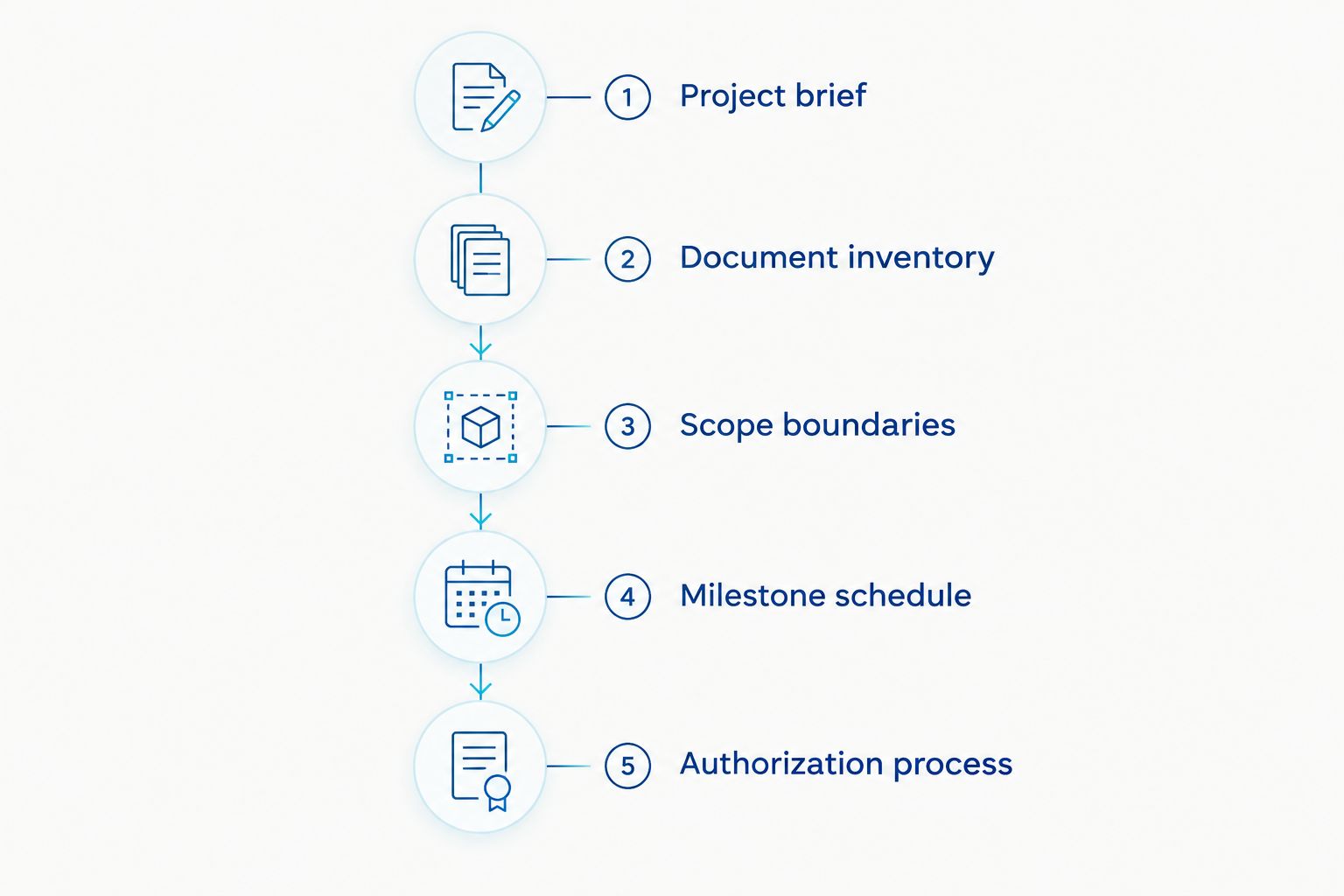
Send prospective consultants the same project brief. A shared starting point makes differences in responsibilities visible and reduces the need to compare assumptions buried in separate proposals.
- Project brief: Identify the property, proposed use, development concept, and decision you need to make.
- Document inventory: List the surveys, plans, prior approvals, correspondence, and other records you can provide.
- Scope boundaries: Separate strategy and coordination from licensed professional responsibilities.
- Milestone schedule: Identify the outputs needed before acquisition, submission, or another project decision.
- Authorization process: Define who approves additional work and how changes are documented.
Keep the brief factual. If an issue is unresolved, name it as a question rather than presenting an assumption as an established entitlement—a development right supported by the applicable approvals or regulations.
Ask each consultant to identify required inputs, excluded work, and completion criteria against that brief. For your 2026 agreement, document changes in writing rather than allowing meeting discussions to become an unrecorded expansion of scope.
How do you decide whether the consulting scope is useful?
Evaluate the proposal against the decision you need to make. A long task list is not necessarily useful if it does not explain which uncertainty the assignment addresses or what you receive at completion.
Ask whether the proposed roadmap identifies dependencies: what must happen first, who supplies the required information, and which unresolved issue prevents the next milestone. For an active project, ask how coordination responsibilities will be recorded and reported.
Nieves Development Consulting LLC is best for New Jersey developers and property owners seeking development strategy and municipal-process coordination. Its stated work covers multifamily, mixed-use, and redevelopment projects in Paterson and throughout New Jersey.
The relevant benefit is a defined strategy-and-coordination role. The boundary is equally important: development consulting is not a substitute for licensed professional services, and no consulting engagement guarantees municipal approval. Assess fit against the actual scope, not the service label alone.
Should you hire a consultant before buying the property?
Consider pre-acquisition consulting when the purchase decision depends on unresolved development-strategy or municipal-process questions. Define the assignment around those questions rather than commissioning open-ended coordination before you have a project brief.
A useful deliverable identifies unresolved issues, the professional input needed, and the next decision milestone. Keep legal review of acquisition terms and technical property investigations with the appropriate professionals.
Does a consultant’s fee include getting municipal approval?
A consultant’s fee covers the work stated in the agreement, not a promise of approval. Municipal-process coordination can organize responsibilities and submissions, but the reviewing authority makes the approval decision.
Ask whether hearing preparation, meeting attendance, response coordination, and post-decision follow-up are included or excluded. Do not infer those tasks from a general reference to approval support.
FAQ
How much does a real estate development consultant charge?
A real estate development consultant charges according to the agreed scope and billing arrangement. Compare deliverables, exclusions, and additional-work terms before comparing compensation.
Is a fixed-scope agreement better than hourly consulting?
A fixed-scope agreement fits a defined deliverable; hourly consulting fits work whose tasks are not fully resolved. Neither structure replaces clear authorization and completion criteria.
Does a development consulting retainer cover unlimited work?
A retainer covers only the work and payment treatment stated in the agreement. Ask how additional tasks, revisions, and termination are handled.
Are municipal application fees included in the consulting fee?
Municipal application fees are separate obligations unless the agreement expressly addresses their payment. Identify municipal fees, review escrow, and consulting compensation separately in your budget.
Can a development consultant guarantee zoning approval?
A development consultant cannot guarantee zoning approval. The applicable reviewing authority decides the application, while the consultant performs the agreed strategy or coordination work.
Do I still need an attorney or engineer?
Development consulting does not replace legal or engineering services. Retain the appropriate licensed professionals for the legal advice, technical work, and other professional services your project requires.
What should I send when requesting a consulting proposal?
Send the property information, development concept, available records, and decision you need to make. Ask for defined deliverables, exclusions, milestones, and an additional-work authorization process.
One last thing
Ask what happens when the project pauses. Your 2026 agreement should explain how ongoing billing, work authorization, records, and restarting the assignment are handled. A clear pause procedure is as useful as a clear start date.
Nieves Development Consulting LLC provides development consulting and municipal-process coordination. This article is general information, not legal, engineering, architectural, planning, or surveying advice; retain appropriately licensed professionals for those services. Municipal approval is not guaranteed.
Related guides
- Zoning consulting for multifamily developers
- Feasibility studies for first-time developers
- Land acquisition to municipal due diligence
YOUR NEXT STEP
Planning a project in New Jersey?
Discuss your property, project goals and municipal-process questions with Nieves Development Consulting.
Explore our consulting services · See a Paterson project example